Friday, December 15, 2006

Scenes of Christmas in Sandusky

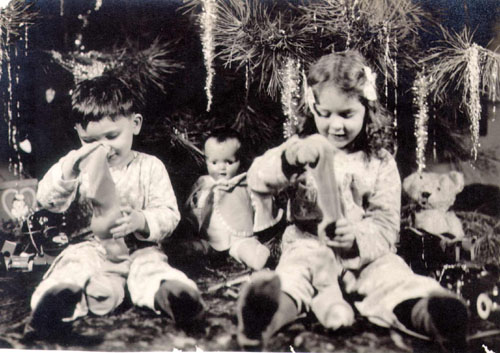
Some scenes from past Christmases in Sandusky. . . . The children above are opening their presents in 1938.


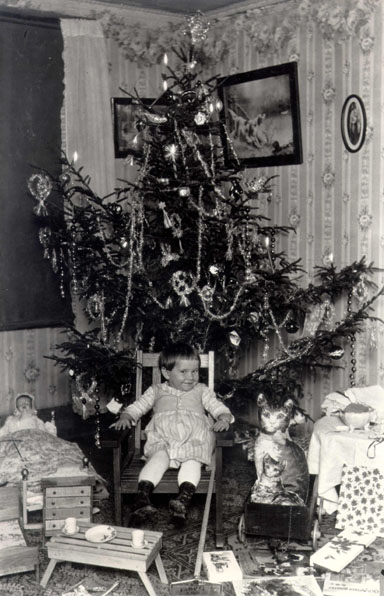
These Christmas trees were from around 1900. It looks like the child was enjoying her Christmas. (I think Santa Claus was, too.)


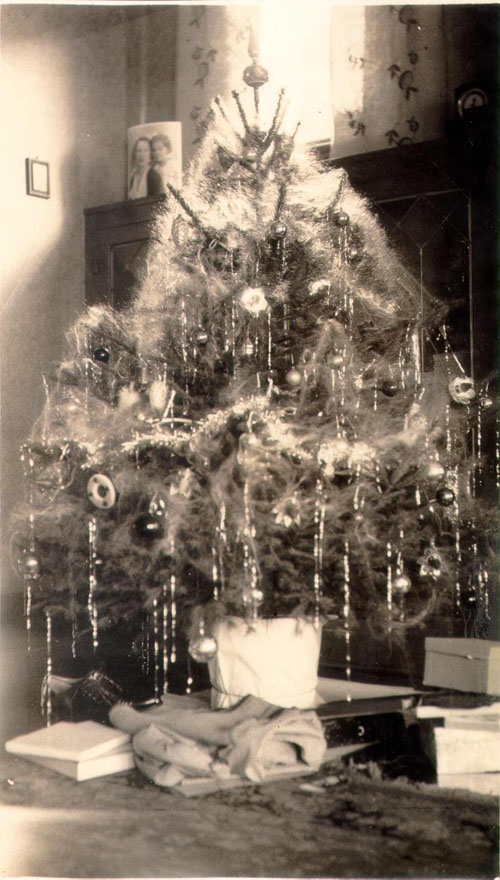
A Christmas tree from 1905, and another from 1938.


A view of Columbus Avenue in downtown Sandusky, circa 1935.

Wednesday, December 13, 2006

Christmas Traditions in Sandusky

Sandusky, like much of the United States, did very little to celebrate Christmas and the winter holidays in the early part of the 19th century.

Ohio became a state in 1803, and the City of Sandusky was platted in 1818. In 1818, and for many of the following years, Sandusky was still on the edge of the wilderness, gradually becoming an established city. Sandusky grew along with the nation, and as the nation grew, it established holiday traditions.

These traditions have certainly evolved over time. An 1818 resident of Sandusky wouldn’t recognize our holidays of today, and vice versa. Christmas in the early 19th century was usually just another day, perhaps marked by a visit to church, or reading a few passages from the bible. No holiday decorations were put out, or special meals prepared. However, as the 19th century progressed, so too did the celebration of Christmas.

A study of the Sandusky Register and ads and announcements related to the Christmas holidays (or the lack thereof) offer insight in to how Sanduskians marked the day. In 1822, 1824 and 1825, the papers on Christmas Eve Day and Christmas Day are like the papers preceding and following—no mention of Christmas whatsoever. No newspapers from the 1830s are extant, however no mention of Christmas appears in the 1840s until Christmas Day 1849, when an announcement in the Sandusky Clarion stated “We wish you all a Merry Christmas.” This is also the first time that advertisements for holiday gifts appear in the newspaper: suggested by the advertisers are feathers (from a milliner), books and toys. These ads are small and one must read through the entire paper to find them.

In 1851, a lengthy ad mentioned a variety of book titles that would make suitable gifts Another long ad proclaimed “We beg leave to call the attention of the Ladies of Sandusky City and vicinity to our stock of Fancy goods just received from New York.”
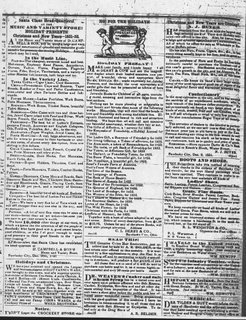

Also in 1851, we find a mention of Santa Claus—“Santa Claus Head-Quarters! At the Music and Variety Store!” A few years later, in 1853, the paper published a short story entitled “TOPPS FASHION’S Christmas Eve Adventures,” which was written expressly for the Sandusky Register. An ad later in that paper suggested several different items for Christmas including silver plate tea sets, coffee urns, cake baskets, sugar and butter dishes, fish knives and forks, candlesticks and more. Paper mache items such as work boxes, backgammon boards, glove boxes and ink trays were for sale, along with rosewood cases, Parian marble statues and figurines, terra cotta ware, porte monnaies in silver, gilt, pearl, velvet silk and more. A wide variety of games were advertised, many of them unknown to us, including Uncle Tom, Peter Abroad, Sham Fights, bell and Hammer, What do you Buy, Fox and geese, lots, domino’s mansion of happiness, reward of virtue, doct. Busby, Tivoli boards, puzzles, magic lanterns, flags of all nations, dissecting maps, ninepins, backgammon boards and more. In addition, ads mentioned tea trays and cutlery.

An 1852 ad from William Burnet announces the latest selection of French and German toys. While most of these are familiar to us today, it’s unlikely to find many of these items on a 21st century child’s Christmas list.
Magic Lanterns
Cosmoramas
Building blocks
Menageries
Butcher shops,
Bureaus
Stables
Houses
Kitchens
Noah’s Arks
Horse and Drays
Carts
Carriages
Wagons
Soldiers
Horsemen
Guns
Swords
Whips
Musicians
Bows and Arrows
Elephants
Camels
Rhinoceros
Monkeys
Horses
Dogs
Cats
Rabbits
Geese
Sheep
Squirrels
Children
Cradles

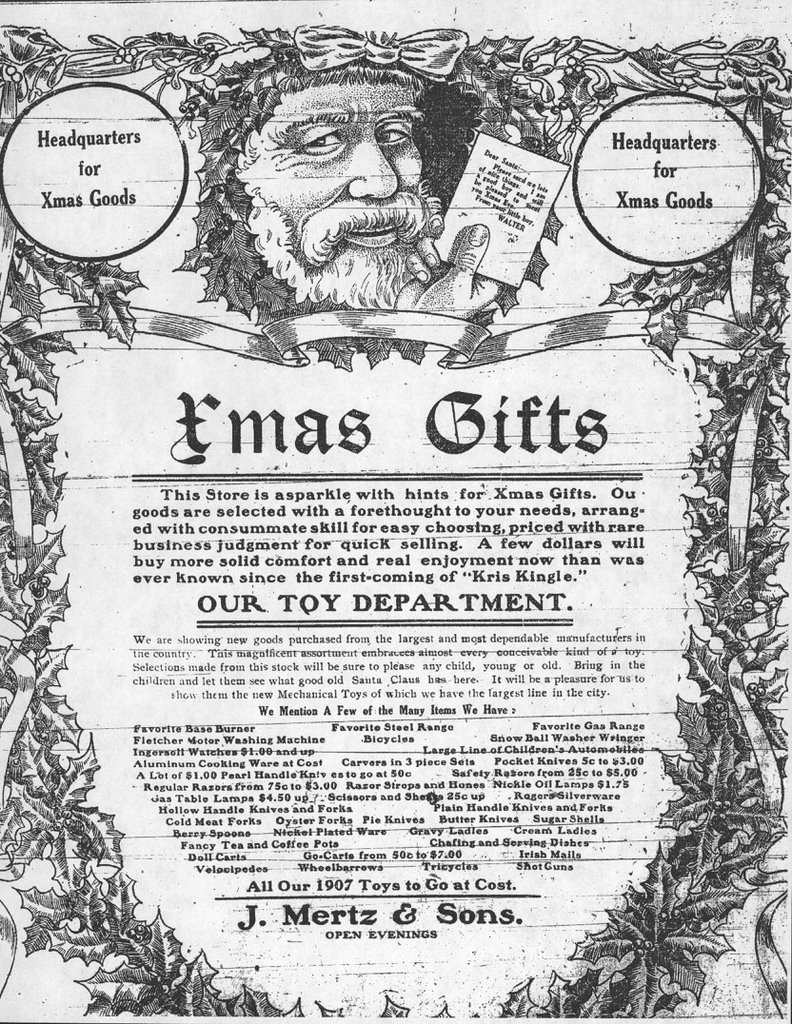
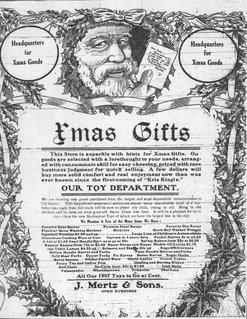
By 1908, holiday editions of the Sandusky Register of packed full of advertisements meant to catch shoppers’ attention. J. Mertz’s eye catching ad, surrounded by holly and topped off with St. Nick proclaims “This store is asparkle with hints for Xmas Gifts. Our goods are selected with a forethought to your needs, arranged with consummate skill for easy choosing, priced with rare business judgment for quick selling. A few dollars will buy more solid comfort and real enjoyment now than was ever known since the first coming of “Kris Kringle” Other ads shout out “Only 20 shopping days left between now and Xmas” just as they do in modern times!
Friday, December 01, 2006

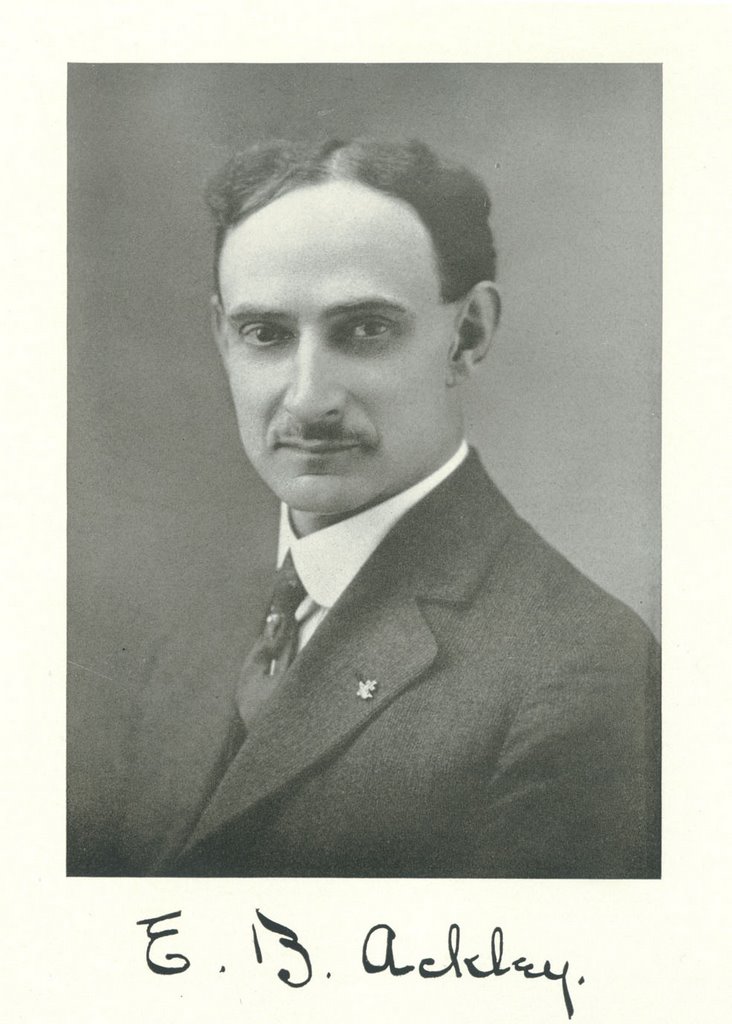
E.B. Ackley — Musician, Bandleader

In Sandusky, E.B. Ackley is fondly remembered as a band leader. He led a rich life that took him all over the country before finally settling in Sandusky. He was born November 1, 1871 in Illinois. Ackley came from a musical family, and took up the cornet at 12. He studied with Carl Kaltenborn of New York who had been the solo cornetist with Gilmore’s famous band for 12 years. At one time, Ackley enjoyed the reputation of being one of the best B flat cornetists in the country.

Before arriving in Sandusky, Ackley traveled the continent with different groups. He spent a season with the Hattie Bernard Chase Company and a season with the Great Eastern Show, a season with the Floyd Concert Company. He spent a season in Omaha, Nebraska with the Farnham Street Theater, as well as a season in Youngstown at the Grand opera House. When he came to Sandusky he spent several seasons at the Nielson Opera House.

As a young man, he worked for the Gorman Minstrel Show and traveled all over the country. Fred Baumann, of the Great Western Band, heard Ackley Perform and brought him to Sandusky. This was shortly before the Great Western Band dissolved. Ackley then created his own band. He arrived in Sandusky in 1893 and worked as the director of music at Cedar Point and as the instructor of the Sandusky Band and Orchestra. He wrote the Cedar Point March in 1902, the first piece of music dedicated to the resort.

In 1898, Eugene Ackley joined Professor Leon’s Military Band of Toledo and took part in the inaugural exercises in Columbus at the State Capital for the inaugural exercises of the second term governor Asa Bushnell.

E.B. Ackley married Ida Frohman in 1904. For many years, he ran a successful billiard parlor equipped with twelve tables. At the time of his death in 1957, he was the chairman of the board of the Western Security Bank. He is buried at Oakland Cemetery.

Tuesday, November 28, 2006

Announcement: New Local History Photograph Book


A new local history book, Erie County and the Erie Isles: A Pictorial History of the Early Years, has been published (just in time for the holidays) by Pediment Publishing. Presented by the Sandusky Register and the Sandusky Library, the book contains hundreds of images of scenes of life in Erie County before 1940, from photographs in the library's collections and from contributions of local residents.

A great coffee table book, Erie County and the Erie Isles is available for purchase ($39.95) at the Register or at the library's gift shop -- or you may order it online via the Register's website.

Join us in the Library Program Room on Sunday, December 10 at 1PM for a book release celebration, where you can purchase copies of the book, learn about how it came together, and see original copies of some of the images in the book (some more than 100 years old).

Thursday, November 16, 2006

Happy Thanksgiving!

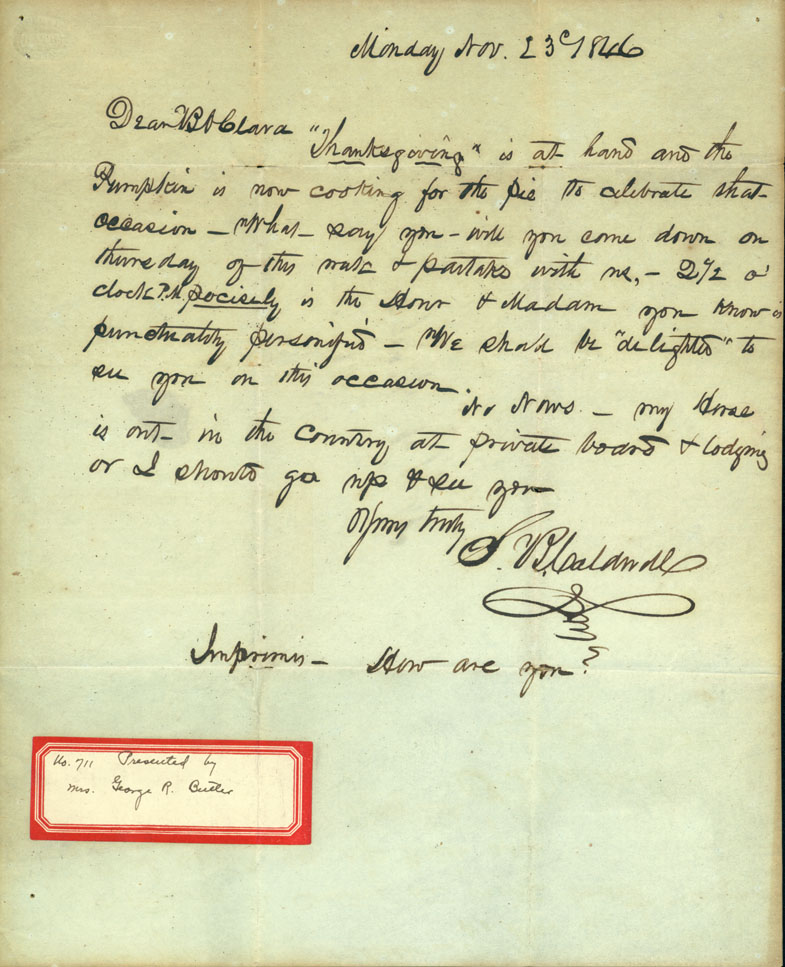
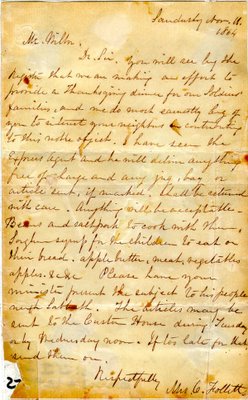
As many of you might remember learning in grade school, the first "official" Thanksgiving was proclaimed by President Abraham Lincoln during the height of the Civil War, in 1863, in honor of the first Thanksgiving held by the pilgrims in Plymouth during the 17th century. But even before President Lincoln made Thanksgiving a holiday, it was traditionally celebrated by many people. The first letter below is evidence of that:

In this letter, Judge Samuel Caldwell of Sandusky has invited Samuel Butler and his wife Clara to his home for Thanksgiving dinner. (We know pumpkin pie was on the menu!) The date of the letter is November 23, 1846, nearly twenty years before the national holiday was observed. (It is also interesting to note that even then Thanksgiving was celebrated on a Thursday in November -- nobody seems to know for sure why this day was chosen.)


The second letter is from Eliza Follett, the wife of Oran Follett, requesting contributions from local residents to provide Thanksgiving food to the wives and children of soldiers serving in the Civil War. Mrs. Follett was very active in community service and charitable work, as can be inferred from this letter.

Have a happy Thanksgiving. . .

Tuesday, November 14, 2006

Football Season!

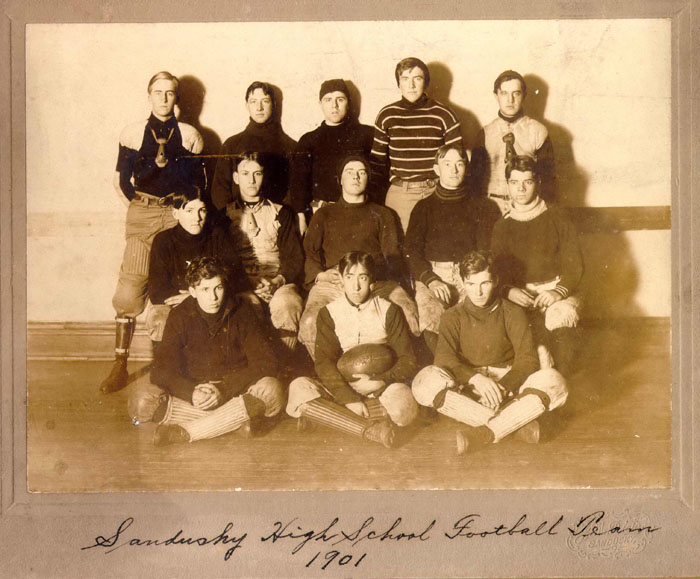
In commemoration of the big football game coming up this weekend (no, not Manchester United v. Chelsea -- that's later in the month; I mean the one between those schools on US 23) , I thought I'd show some scenes from early football in Sandusky.

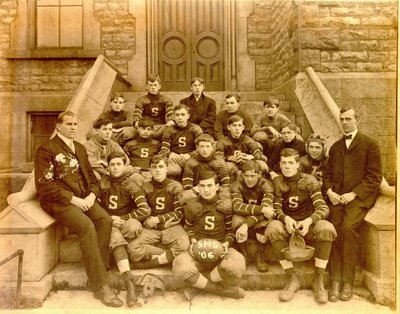
The image above is of the very first Sandusky High School football team in 1901. (Did you know that SHS had a basketball team before it had a football team?) The 1901 team went 2-1, defeating Cleveland West (16-5) and Norwalk (10-5), but losing to Toledo Scott, 34-0.

The 1906 SHS team (pictured here) was Sandusky's first undefeated team, winning all five of its games without allowing a single point. They defeated Fremont twice, Lorain Senior twice, and Norwalk.

Monday, November 13, 2006

Helen M. Hansen, 1902-2006


Helen Hansen, a former curator of the Follett House Museum, died Sunday morning, after a long and rich life. She was 104. The photo above shows Mrs. Hansen while at work in the museum, holding a copy of an original plat map of the city of Sandusky. She served at the museum beyond the age of 90.

As many know, Mrs. Hansen was a dedicated local historian; with Virginia Steinemann, she wrote a series of history-related articles for the Sandusky Register for several years. These articles were the foundation for a two-volume book series, From the Widow's Walk. Additionally, Mrs. Hansen was the author of At Home in Early Sandusky, a book about the histories of early homes in Sandusky and their occupants. In her many years of service at the Follett House Museum and as an independent historian, Mrs. Hansen was instrumental in preserving and promoting the history of Sandusky, through her curatorship of the historical collections and her extensive historical research. The collections of the museum and the Archives Research Center substantially reflect her contributions.

The community owes a deep debt of gratitude to Helen Hansen for her contributions to preserving its history.

Tuesday, November 07, 2006

Dr. McMeens Inducted into Ohio Veterans Hall of Fame

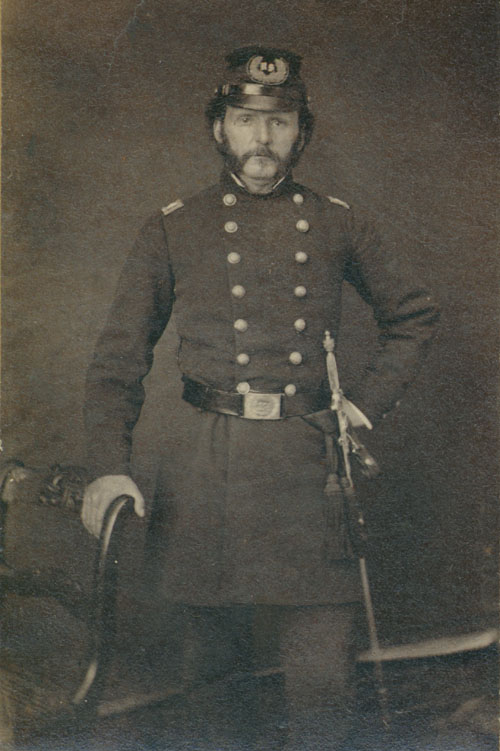
Dr. Robert R. McMeens, who served in both the Mexican War and the Civil War, was inducted into the Ohio Veterans Hall of Fame during a ceremony in Columbus on Thursday, November 2.

Born in Pennsylvania in 1820, Dr. McMeens received his M.D. from the University of Pennsylvania in 1841, and migrated to Tiffin, Ohio shortly thereafter. He settled in Sandusky in 1849. During his medical practice in Sandusky, he treated many of the victims of the several cholera outbreaks that struck the city (in 1849, 1852, and 1854). (A report he wrote on cholera for the Ohio State Medical Society in 1857 is excerpted in Peeke's book, A Standard History of Erie County, Ohio, available in the library.)

As a soldier, Dr. McMeens served as a surgeon in the Mexican War of 1846-48. Back in Sandusky, in 1851, he founded and commanded the Bay City Guards, a local militia. Upon the outbreak of the Civil War in April 1861, Dr. McMeens returned to active duty, again as a surgeon, in the Third Regiment of the Ohio Volunteer Infantry. He died while serving at the Battle of Perryville, Kentucky on October 30, 1862. The Firelands Pioneer of January 1888 quoted a letter written by a fellow surgeon on the day after Dr. McMeens' death: "He has fallen while nobly working at his post; although suffering greatly from disease, he refused to abandon his work, and performed several important surgical operations only a few hours before his death."

Sandusky resident Dr. Robert Bartholomew, who was instrumental in garnering this recognition for Dr. McMeens, accepted the award in Dr. McMeens' honor at the induction ceremony.

Thursday, November 02, 2006

Some Gave All . . .

As I hope you know, Veterans Day is commemorated on November 11 in recognition of the armistice that ended World War I, on the 11th hour of the 11th day of the 11th month of 1918. Millions of lives were lost in that war, including more than 125,000 American soldiers. Sandusky and Erie County suffered its share of losses, with around 40 men dying in service. The Sandusky Library Archives Research Center holds material relating to the lives and deaths of two men of Erie County who gave their lives in the First World War.

John A. Michel was born in Cleveland on November 24, 1892, the son of William and Caroline Michel. He lived with his parents in the family home on Huntington Avenue in Sandusky, and worked for the Hinde and Dauch Paper Company before entering the war. Drafted into the Army, he was inducted on May 26, 1918 and sent to the European battlefield for the final offensive at Meuse-Argonne. Private Michel was killed in battle on November 8, 1918 -- three days before the end of the war; one of the last Sandusky men to die in the war.

The first man from Sandusky to die in the First World War, was Corporal Elmer A. Reese of the U.S. Marine Corps. Born in Niles, Ohio on August 12, 1896, he volunteered for service on May 19, 1917, and was sent to Quantico for training on August 1, 1917. While in Quantico, he wrote a letter to the local chapter of the Daughters of the American Revolution, offering thanks for the gifts they sent and describing life at camp. (This letter is part of the archival collections at the Sandusky Library; you can read it online here.) He was shipped to France on February 12, 1918 with the American Expeditionary Forces. On June 18, 1918, Corporal Reese was killed in the battle of Belleau Wood. His body was returned to Sandusky in 1921, and he was buried in Oakland Cemetery.

To see a photo of Elmer Reese and most other men and women from Erie County who served in World War I, see the book, Honor Roll of Ohio, 1917-1918, Erie County Edition, which is available in the genealogy department of the Sandusky Library. (I had intended to post Corporal Reese's picture in this entry, but . . . let's not talk about Blogger again.)

Tuesday, October 31, 2006

Honoring Our Veterans


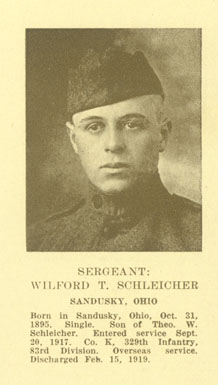
In honor of all veterans, in commemoration of Veterans Day on November 11, we offer a tribute to a World War I veteran from Sandusky. Wilford Schleicher was born in Sandusky on October 30 (or 31), 1895. A sales manager for the American Crayon Company, his life changed dramatically in 1917, when he was called to service when the United States entered the Great War that had been going on in Europe since 1914.

Wilford Schleicher was enlisted into the United States Army on September 20, 1917, and assigned to Company K of the 329th Infantry, 83rd Division. He was trained at Camp Sherman in Chillicothe, where most of Sandusky's recruits went for training. In June of 1918, he and his fellow soldiers departed the United States for the war zone of Europe. By October of that year Corporal Schleicher had been promoted to sergeant. After honorable service in the French war zone, he returned to his native land on January 31, 1919 and received his honorable discharge about two weeks later.

Like most other men who served (unfortunately not all), Wilford Schleicher returned to his normal life, back home in Sandusky. He went back to work at the American Crayon Company, and worked there for nearly fifty years; he was a member of the Trinity United Methodist Church, the American Legion, and the Veterans of Foreign Wars. He lived on Polk Street with his wife, Gladys, who died in 1974. Mr. Schleicher died in November 1982, at age 87.


The Sandusky Library Archives Research Center is privileged to have two scrapbooks compiled by Mr. Schleicher. One scrapbook (two pages of it are shown above) contains photographs of his military adventures, along with mementoes such as postcards, military passes and other official documents, and a wrapper for a candy bar from the Red Cross Canteen. The other scrapbook consists of newspaper clippings describing the war and local soldiers. Additionally, the archives holds many other items relating to the First World War, a war little understood by most Americans.