Continuing the series of lunchtime historical programs at the library, Follett House Museum curator Maggie Marconi will present a talk on the roles many Sanduskians played in helping fugitive slaves reach freedom. The presentation will be in the library program room at noon on Wednesday February 7.
Ohio was a major transit point for freedom-seekers as they fled from the slave lands of the south to the free territories in Canada and the northern United States. Of course, due to the nature of the activity, there is little documentary history of the Underground Railroad, but the memories of participants were frequently recorded -- most notably by Professor Wilbur H. Siebert of the Ohio State University, author of the classic book, The Underground Railroad From Slavery to Freedom (in the Sandusky Library at 326 SI).
Come to the program on Wednesday afternoon to learn more about Sandusky's contribution to freedom.

A blog dedicated to the discussion of topics relating to the history of Sandusky and Erie County, Ohio, the Lake Erie Islands, and nearby communities; inspired by the collections of the Sandusky Library Archives Research Center and the Sandusky History Museum at the Follett House. A service of the Sandusky Library.
Wednesday, January 31, 2007


Friday, January 19, 2007
Program Announcement -- Identifying and Preserving Your Family Documents
On Saturday, January 27, at 2:00 p.m. in the Library Program Room we will have a "hands-on" presentation on identifying and preserving your historical documents. Using examples from the Library's archival collections, we will show you how to identify your documents - what they are, what they are made of, and how old they might be - and offer tips on how to care for these items, so you can preserve your history for future generations. The program will include a brief overview of formats and preservation techniques, with tips on care for specific items, and where to go for supplies and more information.
You are welcome to bring in samples of your own family documents to discuss particular issues you might have with their care and handling. (Because of time constraints, we cannot guarantee detailed discussion of all items; please limit your materials to one or two items.)
To register for the program, call 419-625-3834 and press 0 to speak with a switchboard operator (9-5, Monday-Friday) or press Option 6 to leave a message.
You are welcome to bring in samples of your own family documents to discuss particular issues you might have with their care and handling. (Because of time constraints, we cannot guarantee detailed discussion of all items; please limit your materials to one or two items.)
To register for the program, call 419-625-3834 and press 0 to speak with a switchboard operator (9-5, Monday-Friday) or press Option 6 to leave a message.
Friday, January 12, 2007
Program Announcement - Sweet Water Lady: The Marblehead Lighthouse Story
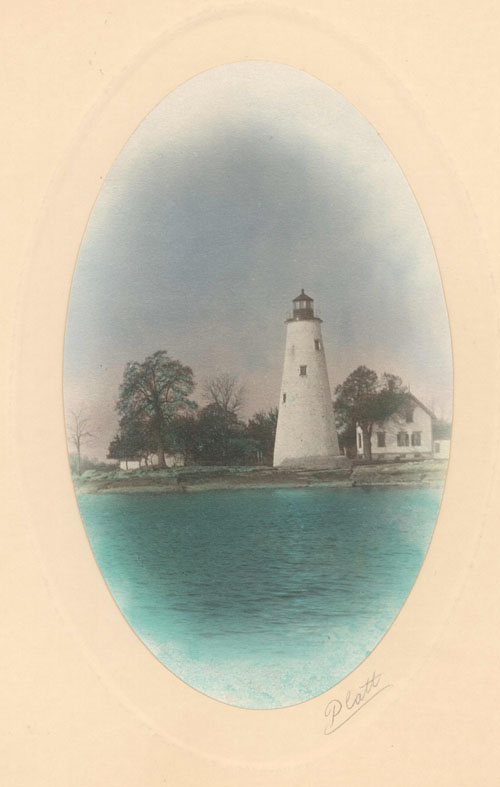 Join us for a brown-bag lunch program in the Library Program Room at noon on Wednesday, January 17, when Berlin Heights filmmaker Tom Koba will present a screening of his film, Sweet Water Lady, the Marblehead Lighthouse Story.
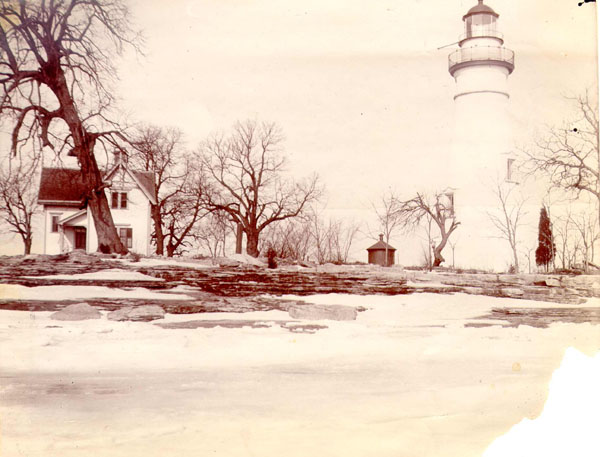
The Marblehead Lighthouse is the oldest continuously-operating lighthouse on the Great Lakes, illuminating the Lake Erie shoreline since 1822. The grounds of the lighthouse and the keeper's house (as seen in the photo below, circa 1890) are now the site of a state park, where tours are offered of the lighthouse interior.

Monday, January 08, 2007
Ralph Smalley Tebbutt—Artist
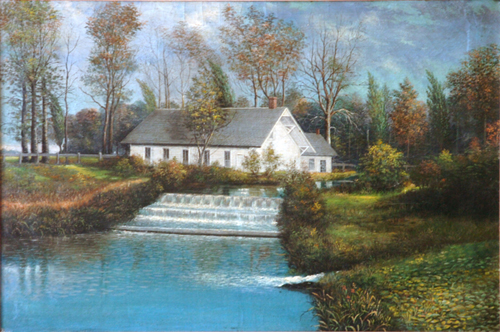 Ralph Smalley Tebbutt was a well known Sandusky area artist. Born in England on May 14, 1849, he immigrated to Sandusky with his parents when he was five years old.
For sixty years he ran a painting and decorating business. For a time, was in business with another local artist, John Holland, but they dissolved their partnership in January, 1895. We know that in 1870, Tebbutt kept a studio in the Reber Block in downtown Sandusky.
Ralph Tebbutt lent his talents to local efforts. During the first World War, painted signs and banners for the Red Cross. In 1920, he painted two scenes for a pageant that was put on by local school children. One was a scene of the Santa Maria, and the other was for a sketch about Francis Scott Key.
Tebbutt enjoyed painting religious scenes, and several were given to area churches. Tebbutt used many mediums, including oil, pastel, charcoal and watercolor. He painted portraits, landscapes, religious themes, marine paintings, manufacturing plants, ships and animals.
An article appeared in the Register after his death detailing a quartet of four drinking scenes painted for a forgotten local brewery. The article described the paintings as “remarkably free in execution, that is they are natural and look as if they just flowed from the painter’s brush. The lights and shades, shadows and expression are handled with all the skill of a master painter.” No one knows what became of these paintings.
He painted for the love of the work, apparently never attempting to sell his work, although if offered a price and it suited him, he would sell and did sell many of his paintings. According to his son, Tebbutt painted constantly until his death. At the time of his death, art critics were saying that Tebbutt had many earmarks of a genius.
Ralph Smalley Tebbutt died March 4, 1930 at the age of 81. He is buried in a family plot in Oakland Cemetery.

Wednesday, January 03, 2007
One of the Oldest Items in Our Collections
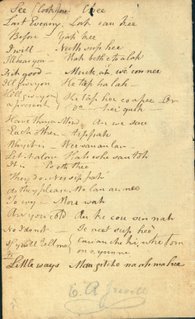
In the vault of the Sandusky Library Archives Research Center is a manuscript copy, dated 1787, of a phrase book, containing translations of words, phrases, and speeches, from English to a local Native American language, possibly the Wyandot/Huron language. This item was donated to the library in 1943, by Dr. Marjorie Anderson (1892-1954) -- a professor at Hunter College in New York, a poet, author, former employee at the Sandusky Library, and native Sanduskian. (She was the great-granddaughter of Dr. George Anderson, Sandusky's first physician -- he died in the cholera outbreak of 1834, after treating infected patients.)

The manuscript is attributed to E.R. Jewett, but the accuracy of this claim is far from certain -- the only signatures with the Jewett name are written in pencil along the margin of a page, and don't seem to match the rest of the handwriting. Who E.R. Jewett was is also unclear -- there was a businessman in Buffalo named Elam R. Jewett, who owned a publishing company and engraving business; this E.R. Jewett, however, appears to have been born around 1811, much later than the date of this manuscript. Could there have been an earlier E.R. Jewett, who travelled around the Sandusky Bay in 1787? Or was this phrase book written by someone else (whose name we do not know), but later owned by E.R. Jewett of Buffalo? Or is there another explanation? (Anybody out there looking for a research project?)
Also, some of you might be wondering, "How could this manuscript be marked 'Sandusky, 1787' when we know that the city of Sandusky was not founded until 1818?" In fact, in that era most of the region around Sandusky Bay and along the Sandusky River was identified simply as "Sandusky." It is possible (or even likely) that this phrase book was written in or around what is now known as the city of Fremont, which was called Lower Sandusky until 1849, and was the site of a Wyandot village in the 18th century. (The city named Upper Sandusky -- farther up the Sandusky River -- still exists, of course.)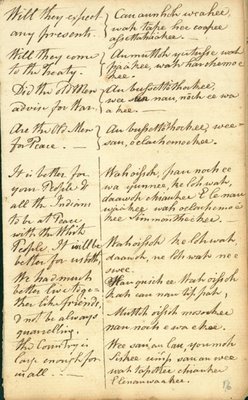 For those who study Native American languages and cultures, and the early interactions between those peoples and the European settlers, this document may prove an invaluable resource. Although access to the original item is restricted due to its age and fragility, the entire document (21 leaves on 32 digital images) is available in digital format at the library.
Update: Oops. . . . I forgot about the Reverend Edward R. Jewett, who was a founder of the Bethel Church on Water Street (between Decatur and Jackson) in Sandusky in 1852. The image below shows Reverend Jewett some thirty years later. So we might be able to assume that the phrase book was in the Reverend Jewett's possession at some point, but we still do not know the complete provenance of this document.
Update 2: Here is an enlarged view of a portion of a page from the phrase book:
The manuscript is attributed to E.R. Jewett, but the accuracy of this claim is far from certain -- the only signatures with the Jewett name are written in pencil along the margin of a page, and don't seem to match the rest of the handwriting. Who E.R. Jewett was is also unclear -- there was a businessman in Buffalo named Elam R. Jewett, who owned a publishing company and engraving business; this E.R. Jewett, however, appears to have been born around 1811, much later than the date of this manuscript. Could there have been an earlier E.R. Jewett, who travelled around the Sandusky Bay in 1787? Or was this phrase book written by someone else (whose name we do not know), but later owned by E.R. Jewett of Buffalo? Or is there another explanation? (Anybody out there looking for a research project?)
Also, some of you might be wondering, "How could this manuscript be marked 'Sandusky, 1787' when we know that the city of Sandusky was not founded until 1818?" In fact, in that era most of the region around Sandusky Bay and along the Sandusky River was identified simply as "Sandusky." It is possible (or even likely) that this phrase book was written in or around what is now known as the city of Fremont, which was called Lower Sandusky until 1849, and was the site of a Wyandot village in the 18th century. (The city named Upper Sandusky -- farther up the Sandusky River -- still exists, of course.)
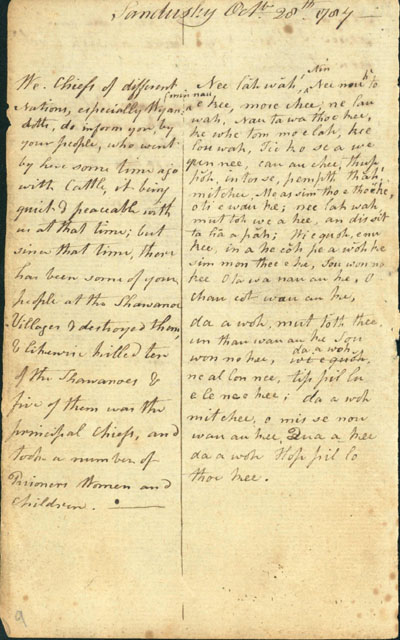
 For those who study Native American languages and cultures, and the early interactions between those peoples and the European settlers, this document may prove an invaluable resource. Although access to the original item is restricted due to its age and fragility, the entire document (21 leaves on 32 digital images) is available in digital format at the library.
Update: Oops. . . . I forgot about the Reverend Edward R. Jewett, who was a founder of the Bethel Church on Water Street (between Decatur and Jackson) in Sandusky in 1852. The image below shows Reverend Jewett some thirty years later. So we might be able to assume that the phrase book was in the Reverend Jewett's possession at some point, but we still do not know the complete provenance of this document.

Friday, December 15, 2006
Scenes of Christmas in Sandusky
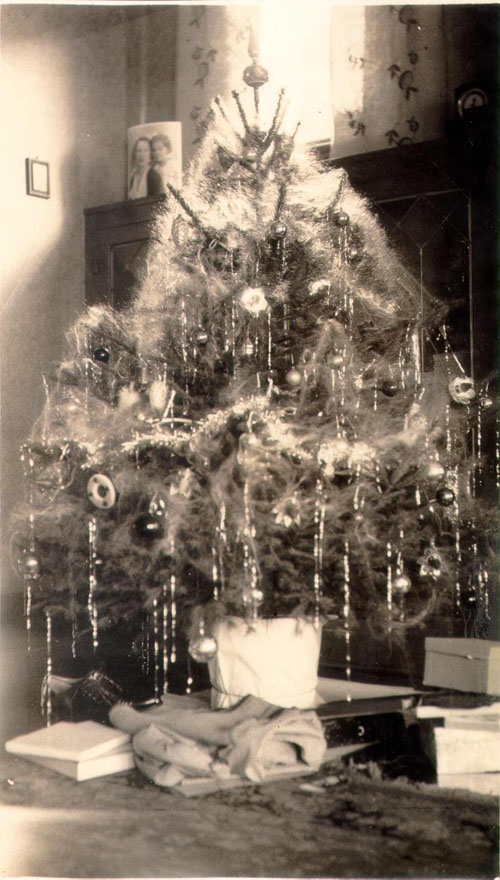
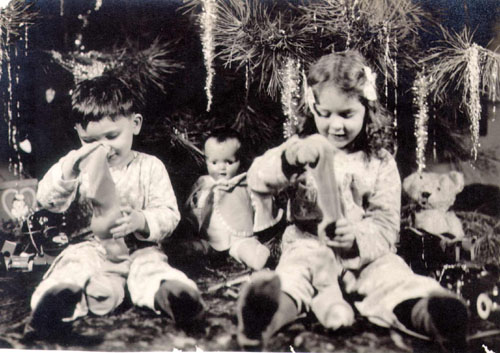 Some scenes from past Christmases in Sandusky. . . . The children above are opening their presents in 1938.
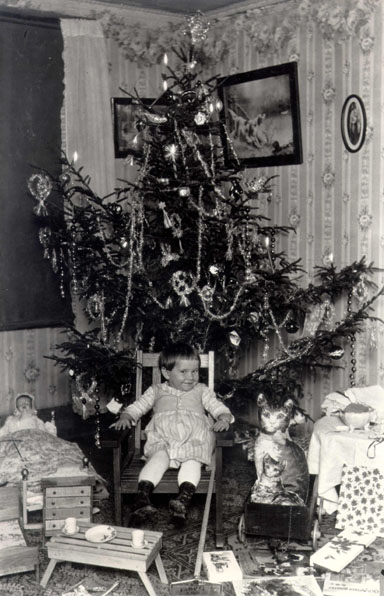
These Christmas trees were from around 1900. It looks like the child was enjoying her Christmas. (I think Santa Claus was, too.)

A Christmas tree from 1905, and another from 1938.
A view of Columbus Avenue in downtown Sandusky, circa 1935.
Wednesday, December 13, 2006
Christmas Traditions in Sandusky
Sandusky, like much of the United States, did very little to celebrate Christmas and the winter holidays in the early part of the 19th century.
Ohio became a state in 1803, and the City of Sandusky was platted in 1818. In 1818, and for many of the following years, Sandusky was still on the edge of the wilderness, gradually becoming an established city. Sandusky grew along with the nation, and as the nation grew, it established holiday traditions.
These traditions have certainly evolved over time. An 1818 resident of Sandusky wouldn’t recognize our holidays of today, and vice versa. Christmas in the early 19th century was usually just another day, perhaps marked by a visit to church, or reading a few passages from the bible. No holiday decorations were put out, or special meals prepared. However, as the 19th century progressed, so too did the celebration of Christmas.
A study of the Sandusky Register and ads and announcements related to the Christmas holidays (or the lack thereof) offer insight in to how Sanduskians marked the day. In 1822, 1824 and 1825, the papers on Christmas Eve Day and Christmas Day are like the papers preceding and following—no mention of Christmas whatsoever. No newspapers from the 1830s are extant, however no mention of Christmas appears in the 1840s until Christmas Day 1849, when an announcement in the Sandusky Clarion stated “We wish you all a Merry Christmas.” This is also the first time that advertisements for holiday gifts appear in the newspaper: suggested by the advertisers are feathers (from a milliner), books and toys. These ads are small and one must read through the entire paper to find them.
In 1851, a lengthy ad mentioned a variety of book titles that would make suitable gifts Another long ad proclaimed “We beg leave to call the attention of the Ladies of Sandusky City and vicinity to our stock of Fancy goods just received from New York.”
Ohio became a state in 1803, and the City of Sandusky was platted in 1818. In 1818, and for many of the following years, Sandusky was still on the edge of the wilderness, gradually becoming an established city. Sandusky grew along with the nation, and as the nation grew, it established holiday traditions.
These traditions have certainly evolved over time. An 1818 resident of Sandusky wouldn’t recognize our holidays of today, and vice versa. Christmas in the early 19th century was usually just another day, perhaps marked by a visit to church, or reading a few passages from the bible. No holiday decorations were put out, or special meals prepared. However, as the 19th century progressed, so too did the celebration of Christmas.
A study of the Sandusky Register and ads and announcements related to the Christmas holidays (or the lack thereof) offer insight in to how Sanduskians marked the day. In 1822, 1824 and 1825, the papers on Christmas Eve Day and Christmas Day are like the papers preceding and following—no mention of Christmas whatsoever. No newspapers from the 1830s are extant, however no mention of Christmas appears in the 1840s until Christmas Day 1849, when an announcement in the Sandusky Clarion stated “We wish you all a Merry Christmas.” This is also the first time that advertisements for holiday gifts appear in the newspaper: suggested by the advertisers are feathers (from a milliner), books and toys. These ads are small and one must read through the entire paper to find them.
In 1851, a lengthy ad mentioned a variety of book titles that would make suitable gifts Another long ad proclaimed “We beg leave to call the attention of the Ladies of Sandusky City and vicinity to our stock of Fancy goods just received from New York.”
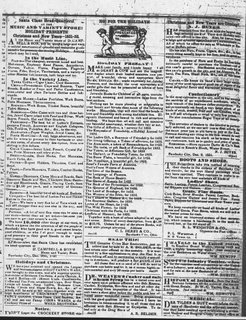
Also in 1851, we find a mention of Santa Claus—“Santa Claus Head-Quarters! At the Music and Variety Store!” A few years later, in 1853, the paper published a short story entitled “TOPPS FASHION’S Christmas Eve Adventures,” which was written expressly for the Sandusky Register. An ad later in that paper suggested several different items for Christmas including silver plate tea sets, coffee urns, cake baskets, sugar and butter dishes, fish knives and forks, candlesticks and more. Paper mache items such as work boxes, backgammon boards, glove boxes and ink trays were for sale, along with rosewood cases, Parian marble statues and figurines, terra cotta ware, porte monnaies in silver, gilt, pearl, velvet silk and more. A wide variety of games were advertised, many of them unknown to us, including Uncle Tom, Peter Abroad, Sham Fights, bell and Hammer, What do you Buy, Fox and geese, lots, domino’s mansion of happiness, reward of virtue, doct. Busby, Tivoli boards, puzzles, magic lanterns, flags of all nations, dissecting maps, ninepins, backgammon boards and more. In addition, ads mentioned tea trays and cutlery.
An 1852 ad from William Burnet announces the latest selection of French and German toys. While most of these are familiar to us today, it’s unlikely to find many of these items on a 21st century child’s Christmas list.
Magic Lanterns
Cosmoramas
Building blocks
Menageries
Butcher shops,
Bureaus
Stables
Houses
Kitchens
Noah’s Arks
Horse and Drays
Carts
Carriages
Wagons
Soldiers
Horsemen
Guns
Swords
Whips
Musicians
Bows and Arrows
Elephants
Camels
Rhinoceros
Monkeys
Horses
Dogs
Cats
Rabbits
Geese
Sheep
Squirrels
Children
Cradles
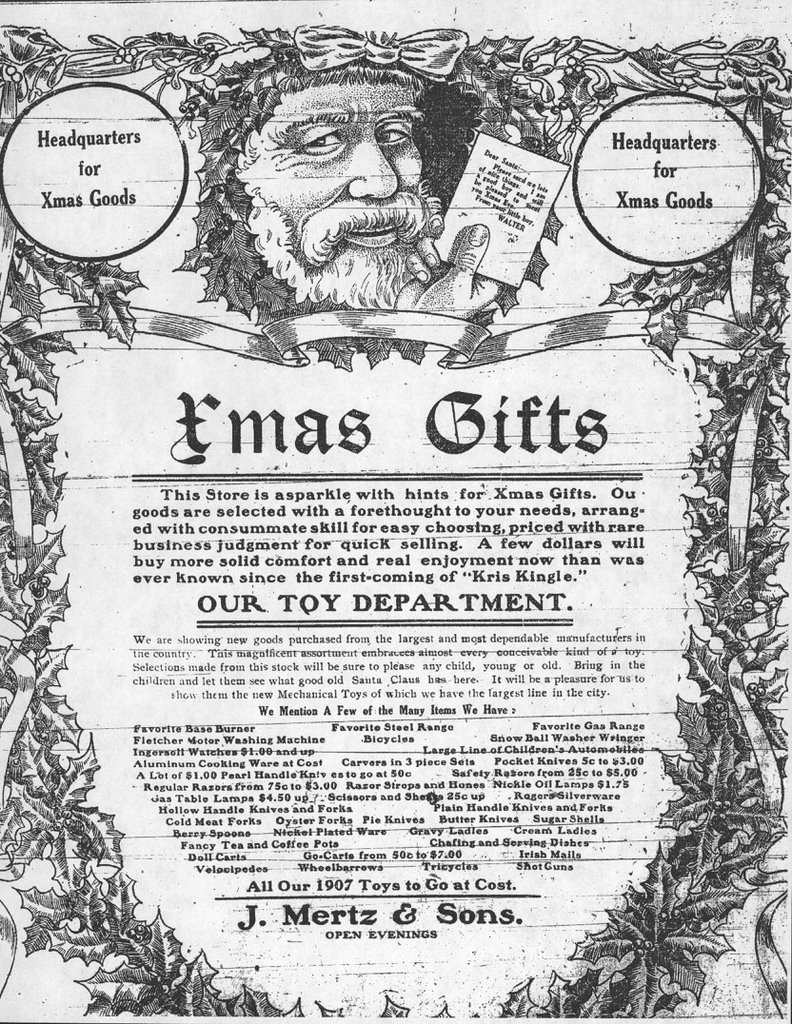
By 1908, holiday editions of the Sandusky Register of packed full of advertisements meant to catch shoppers’ attention. J. Mertz’s eye catching ad, surrounded by holly and topped off with St. Nick proclaims “This store is asparkle with hints for Xmas Gifts. Our goods are selected with a forethought to your needs, arranged with consummate skill for easy choosing, priced with rare business judgment for quick selling. A few dollars will buy more solid comfort and real enjoyment now than was ever known since the first coming of “Kris Kringle” Other ads shout out “Only 20 shopping days left between now and Xmas” just as they do in modern times!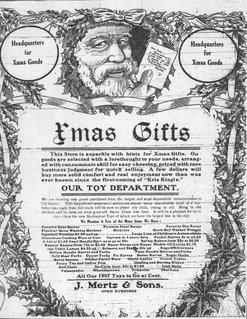
Friday, December 01, 2006
E.B. Ackley — Musician, Bandleader
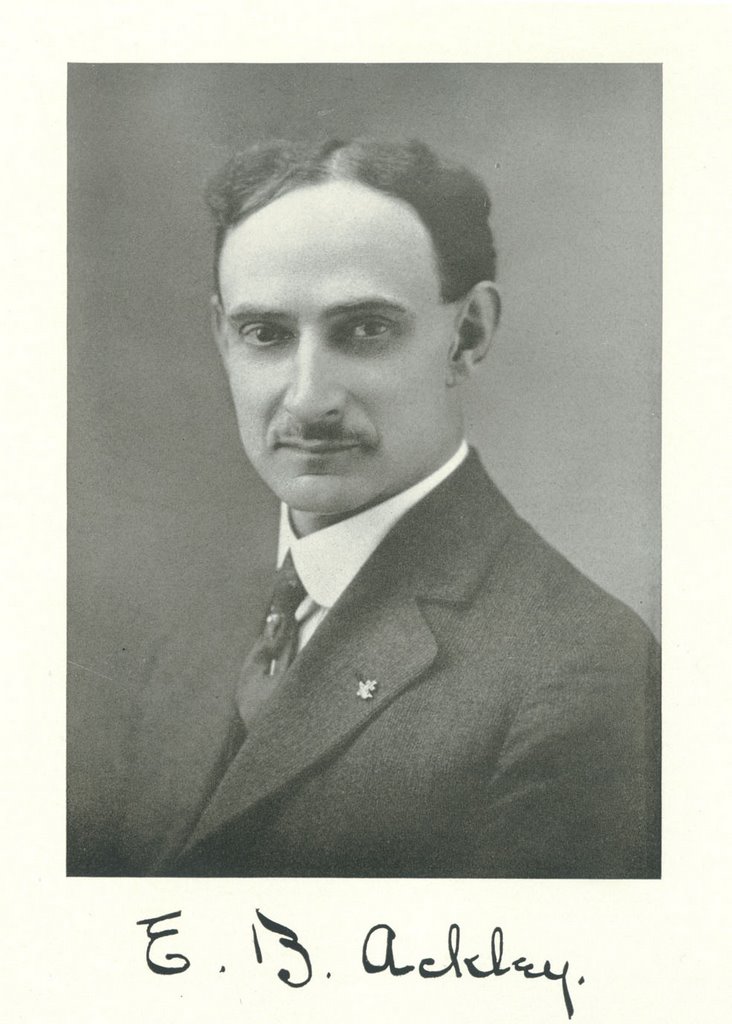 In Sandusky, E.B. Ackley is fondly remembered as a band leader. He led a rich life that took him all over the country before finally settling in Sandusky. He was born November 1, 1871 in Illinois. Ackley came from a musical family, and took up the cornet at 12. He studied with Carl Kaltenborn of New York who had been the solo cornetist with Gilmore’s famous band for 12 years. At one time, Ackley enjoyed the reputation of being one of the best B flat cornetists in the country.
Before arriving in Sandusky, Ackley traveled the continent with different groups. He spent a season with the Hattie Bernard Chase Company and a season with the Great Eastern Show, a season with the Floyd Concert Company. He spent a season in Omaha, Nebraska with the Farnham Street Theater, as well as a season in Youngstown at the Grand opera House. When he came to Sandusky he spent several seasons at the Nielson Opera House.
As a young man, he worked for the Gorman Minstrel Show and traveled all over the country. Fred Baumann, of the Great Western Band, heard Ackley Perform and brought him to Sandusky. This was shortly before the Great Western Band dissolved. Ackley then created his own band. He arrived in Sandusky in 1893 and worked as the director of music at Cedar Point and as the instructor of the Sandusky Band and Orchestra. He wrote the Cedar Point March in 1902, the first piece of music dedicated to the resort.

In 1898, Eugene Ackley joined Professor Leon’s Military Band of Toledo and took part in the inaugural exercises in Columbus at the State Capital for the inaugural exercises of the second term governor Asa Bushnell.
E.B. Ackley married Ida Frohman in 1904. For many years, he ran a successful billiard parlor equipped with twelve tables. At the time of his death in 1957, he was the chairman of the board of the Western Security Bank. He is buried at Oakland Cemetery.
Tuesday, November 28, 2006
Announcement: New Local History Photograph Book
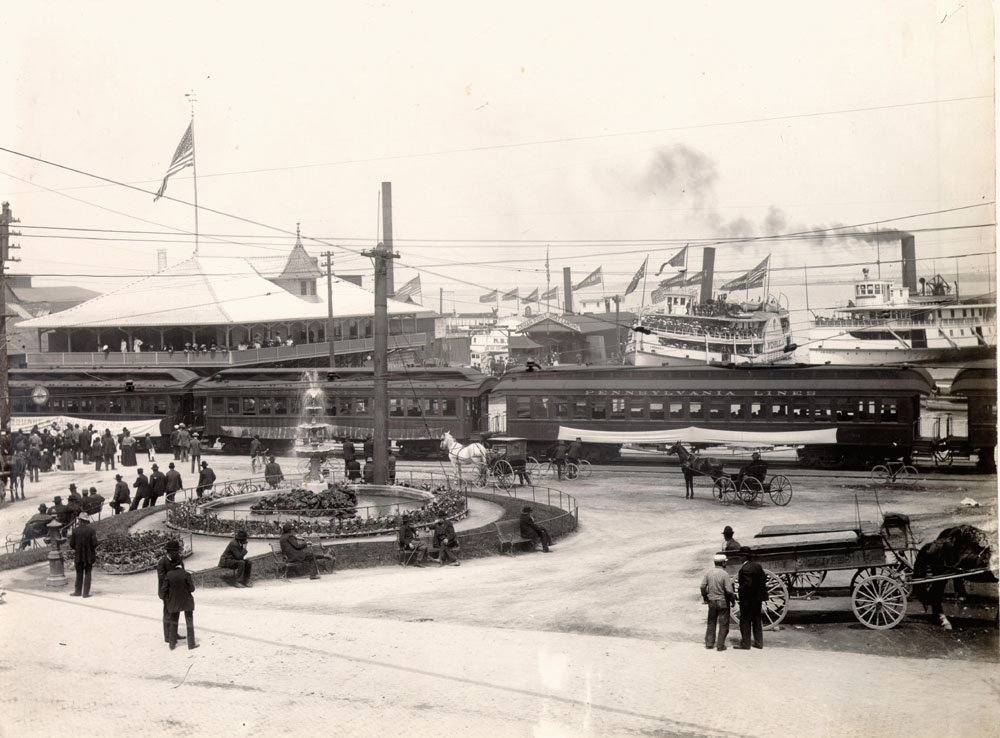
A new local history book, Erie County and the Erie Isles: A Pictorial History of the Early Years, has been published (just in time for the holidays) by Pediment Publishing. Presented by the Sandusky Register and the Sandusky Library, the book contains hundreds of images of scenes of life in Erie County before 1940, from photographs in the library's collections and from contributions of local residents.
A great coffee table book, Erie County and the Erie Isles is available for purchase ($39.95) at the Register or at the library's gift shop -- or you may order it online via the Register's website.
Join us in the Library Program Room on Sunday, December 10 at 1PM for a book release celebration, where you can purchase copies of the book, learn about how it came together, and see original copies of some of the images in the book (some more than 100 years old).
Thursday, November 16, 2006
Happy Thanksgiving!
As many of you might remember learning in grade school, the first "official" Thanksgiving was proclaimed by President Abraham Lincoln during the height of the Civil War, in 1863, in honor of the first Thanksgiving held by the pilgrims in Plymouth during the 17th century. But even before President Lincoln made Thanksgiving a holiday, it was traditionally celebrated by many people. The first letter below is evidence of that:
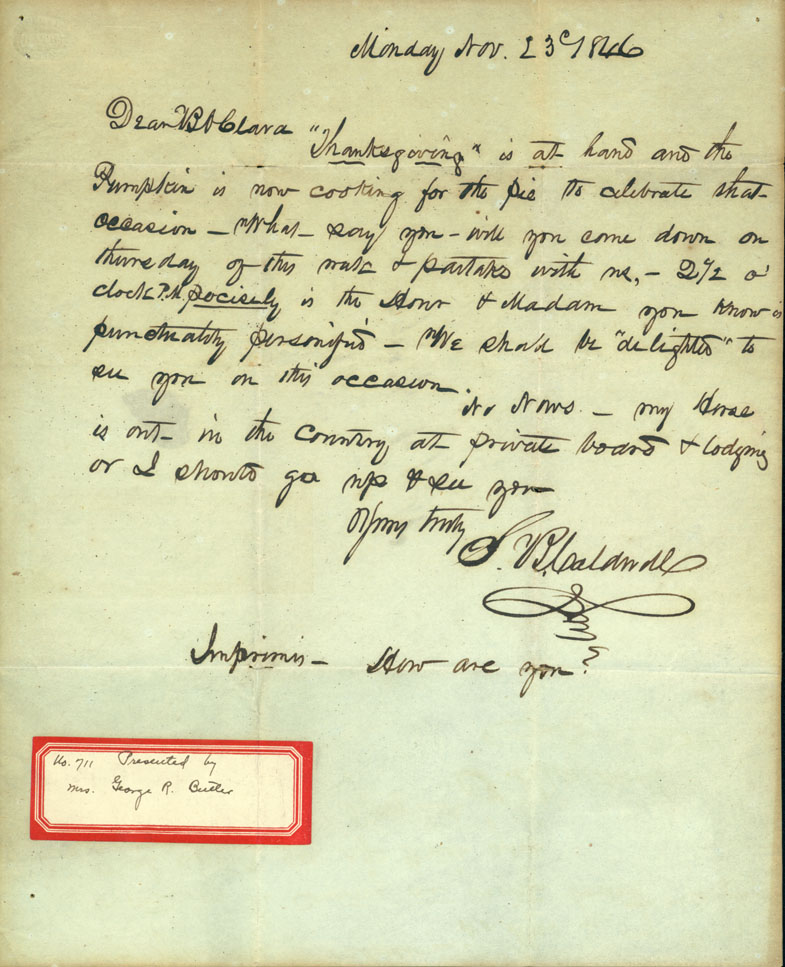 In this letter, Judge Samuel Caldwell of Sandusky has invited Samuel Butler and his wife Clara to his home for Thanksgiving dinner. (We know pumpkin pie was on the menu!) The date of the letter is November 23, 1846, nearly twenty years before the national holiday was observed. (It is also interesting to note that even then Thanksgiving was celebrated on a Thursday in November -- nobody seems to know for sure why this day was chosen.)
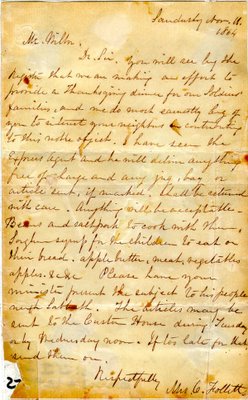 The second letter is from Eliza Follett, the wife of Oran Follett, requesting contributions from local residents to provide Thanksgiving food to the wives and children of soldiers serving in the Civil War. Mrs. Follett was very active in community service and charitable work, as can be inferred from this letter.
Have a happy Thanksgiving. . .
Subscribe to:
Posts (Atom)