Saturday, November 08, 2014

Gustave A. Hauser


Gustave Adolph Hauser was born in Sandusky, Ohio in 1874 to John and Margaret (Schmidt) Hauser, who were both natives of Germany. He was known fondly as Otto to his family and friends. He is pictured above next to a high wheeled bicycle when he was quite young.  Here is a picture of Gustave as an adult, again posing with a bicycle:


For most of his adult life, Mr. Hauser worked as a ship carpenter. He was interviewed in an article which appeared in the January 14, 1934 issue of the Sandusky Register, in a piece which featured an old ship named the Valley Mills. The ship was a stern wheeler, which turned out to be unprofitable for use on the lake. The hulk of the vessel remained in Sandusky Bay near the old B and O Railroad docks for many years. When Mr. Hauser had last seen the ship in 1897, he was employed at the Monk shipyard in Sandusky.


Sadly, Gustave A. Hauser died suddenly of a heart attack while riding his bicycle on Cleveland Road. He was survived by a sister, two nieces and two nephews, and was laid to rest in the family lot at Oakland Cemetery. Mr. Hauser was uncle to Norbert A. Lange, and Elmer Wirth, who were both college professors in scientific fields. 

Wednesday, November 05, 2014

Sebastian Schweinfurth Family


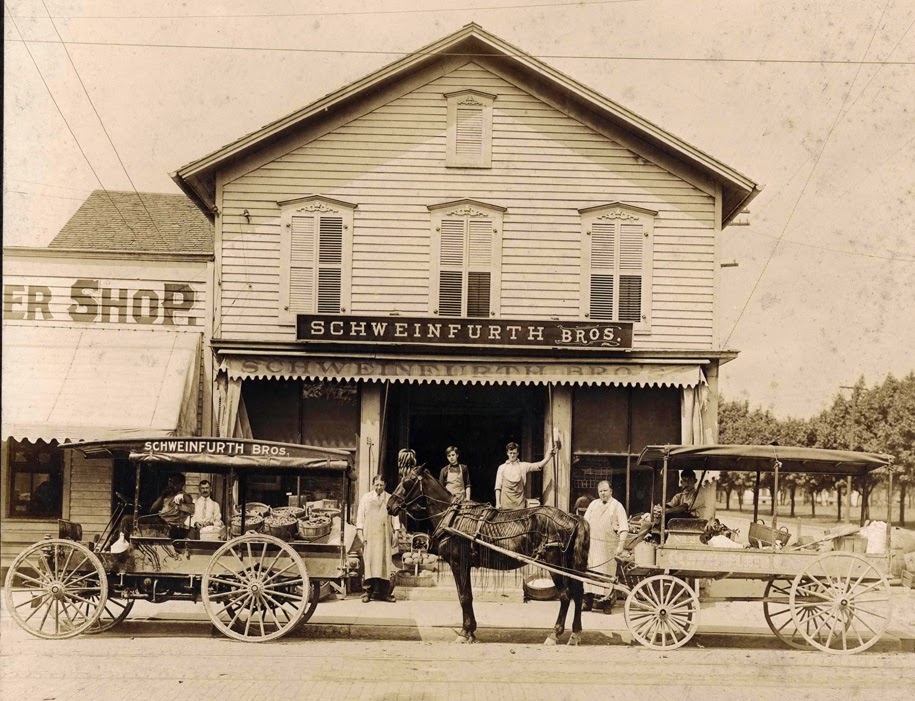
The Sebastian Schweinfurth family is pictured above in the late 1800s, in front of the Schweinfurth residence at the corner of McKelvey Street and Sycamore Line in Sandusky, Ohio. Sebastian had been born in Baden, Germany, and came to the United States in 1854. During the Civil War, Sebastian Schweinfurth served in Company D of the 128th Ohio Volunteer Infantry, a unit which stood guard at the prison camp at Johnson’s Island. In 1865, Sebastian married Anna Elizabeth Horn, who was also a native of Germany. Mr. and Mrs. Schweinfurth had a large family of seven children. After working in the Klotz and Kromer machine shop, Sebastian Schweinfurth ran a grocery store with his son Fred. All four of Sebastian’s sons were educated in the grocery business and went on to have businesses of their own. For many years, Fred and Simon operated the Schweinfurth Brothers grocery store at the southwest corner of Hayes Avenue and West Park Street.  Later, John was a partner with Simon at the Schweinfurth Brothers grocery store, and Fred had his own business.


You can still just barely read the name of Fred Schweinfurth on the building at 428 Decatur which was at one time a grocery and a bakery.


After Fred’s death, other members of the Schweinfurth family ran the business until the early 1950s. Henry and John Schweifurth operated saloons in Sandusky in the early 1900s, and later they too were in the grocery business. Consult the historical Sandusky city directories to learn the specific dates and locations of the many businesses which were operated by the Schweinfurth family in Sandusky. Sebastian and Anna’s grandson, Gerald Schweinfurth, served as the Erie County Auditor from 1947 to 1982. Members of several generations of the Schweinfurth family contributed to their community through their businesses, church, and social affiliations. 

Sunday, November 02, 2014

The Boy Scouts Have Been Active in Sandusky for Many Years


The Boy Scouts of America have been active in Sandusky since shortly after the organization was founded in 1910. Pictured above is a group of Boy Scouts in Washington Park in Sandusky about 1916, with a young lady dressed in a patriotic costume. After the flood of 1924, several troops of Boy Scouts met at Grace Church in Sandusky, to report for duty to aid in the clean up effort in Sandusky. In 1936, Sandusky Boy Scouts co-operated with the American Red Cross to collect clothing and food for flood victims in Southern Ohio. 

A Sandusky Boy Scout once made national news for his act of heroism. On January 30, 1926, Henry Sherman Potter, saved Omar E. Meyer, Jr. from drowning. Omar fell through the ice while skating on Sandusky Bay. Henry crawled on thin ice, and tossed his sweater to Omar, and pulled him to safety. For his heroic deed, Henry Sherman Potter was awarded the Carnegie Hero Medal for saving the boy's life. 

In the summer of 1937, area Boy Scouts marched in a parade before they departed for the first National Jamboree of the Boy Scouts of America, which was held June 30 to July 7, in Washington D.C.


Here is an undated photograph of Troop Number 4 from Sandusky:


Another undated picture shows a large group of Boy Scouts gathered in Sandusky.

If anyone knows the identity of the Scouts in the unidentified photos, please contact the Sandusky Library Archives Research Center, so that the names can be recorded for history.

Thursday, October 30, 2014

Happy Halloween!


Here is a group photo of the Business Women's Club Halloween Party at Reinke's Boat House on Meigs Street. The exact date is unknown, but it was probably around 1920-1925.

Many of the young women are identified. Visit the Sandusky Library Archives Research Center to learn their identities.

Monday, October 27, 2014

Beilstein Steam Laundry


From the late 1890s until about 1909, the Beilstein Steam Laundry did business at 630 Market Street. The proprietors in 1898 were Henry J. Beilstein and John Pfanner, but in 1900, they were Henry J. Beilstein and Philip J. Pfanner. In the picture above, you can see that some customers arrived at the Beilstein Laundry by horse driven vehicles, and others by bicycle. The inside of the laundry is pictured below. Both males and females were employed at the Beilstein Steam Laundry.


In an advertisement which appeared in the October 27, 1904 issue of the Sandusky Star, the proprietors of the Beilstein Steam Laundry stated that that they could get dress clothes in order for the weddings and parties of the for the fall and winter season.


The 1910 Sandusky City Directory listed the business as the Beilstein-Pfanner Laundry, still located at 630 Market Street. By 1915, the Beilstein Laundry and the Philip J. Pfanner’s Dry Cleaning and Dyeing businesses were at separate locations. The Beilstein Laundry had moved to the 200 block of Jackson Street, and Mr. Pfanner’s business was located at 318 Washington Street. In the twentieth century, the Beilstein and Pfanner families both operated dry cleaning businesses for many years.

Thursday, October 23, 2014

Postcards from the Echo Cafe


The Echo Cafe was established about 1901 by Julius Brengartner. It was located at 725 Market Street in its early years. After street numbers changed in Sandusky in 1915, the address became 201 West Market Street. An article in the October 4, 1921 issue of the Sandusky Star Journal stated the bar at the Echo was said to be one of the longest in Northern Ohio.

       
In the October 5, 1921 issue of the Sandusky Register, a brief article was entitled: “Echo Cafe a Thing of the Past After Today.” The article said that the son of Julius Brengartner, Ralph, had taken over the Echo after his father needed to give his full attention to his position with the Ulmer Mortgage Company in Pennsylvania. The Echo Cafe was purchased by Alex M. Wagner. The building where the Echo Cafe once stood is now a parking lot, but it was the site of a hardware store in the 1920s and 1930s, and later was home to B.F. Goodrich and City Loan. This vintage picture shows a portion of the Echo Cafe on West Market Street in the early twentieth century.


Another business called the Echo Tavern later operated on Columbus Avenue in Sandusky from about 1948 until the early 1980s.

Sunday, October 19, 2014

Lewis M. Lea, Jeweler and Optician


Lewis M. Lea was born in Sandusky in 1843 to James D. and Caroline (Mackey) Lea. James D. Lea was successfully engaged in the lumber yard business in Sandusky for many years. When Lewis M. Lea was twenty years of age, he enlisted in Co. B of the 145th Ohio Volunteer Infantry. After the end of the Civil War, he began a long career in the jewelry business, working as a jeweler and watchmaker in Sandusky in 1866.  He was first in partnership with other jewelers, including Joseph Bixby, Henry Dehnel, and a Mr. Greenfelder. In the 1888 Sandusky City Directory, Lewis M. Lea was listed as the sole proprietor of a jewelry business at 135 Columbus Avenue. He stayed at this location until 1917, when he moved the jewelry business to the Lea building at the southwest corner of East Market and Wayne Streets. 

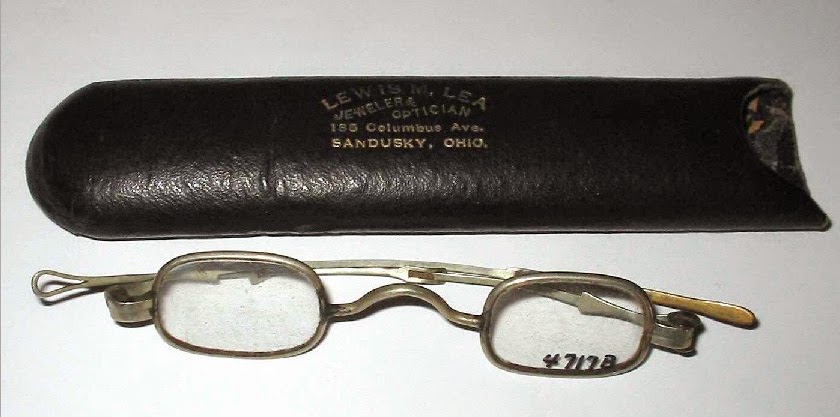
Besides selling watches, clocks, jewelry and silverware, Lewis M. Lea was also an optician. An advertisement in the May 1, 1891 issue of the Sandusky Register stated that residents could secure their spectacles from Lea, the “graduate optician.”


An article in the December 9, 1911 issue of the Sandusky Register stated that Lewis M. Lea’s life was “like an open book.”  Mr. Lea was said to have large and well-selected stock, featuring “novelties of every selection” and a complete line of optical goods. 

On August 18, 1918, Lewis M. Lea passed away after an illness of six months. His obituary, found in the 1918 Obituary Notebook, stated that Lewis M. Lea had been one of Sandusky’s best known business men. Funeral services were held at the Masonic Temple. Several Ohio leaders in the Masonic order attended Mr. Lea’s funeral, which was solemn and impressive, according to an article in the August 22, 1918 issue of the Sandusky Register. At the funeral, Grand Commander Barton Smith presented Lewis M. Lea’s 33rd degree Masonic ring to his son, Jay D. Lea.  Lewis M. Lea was survived by his wife, one son, seven grandchildren, and a sister and brother. A son, Lewis W. Lea, had predeceased him. Lewis M. Lea was buried in the family lot at Oakland Cemetery. At the Follett House Museum you can view eyeglasses and silverware which were purchased from Lewis M. Lea’s jewelry store.

Thursday, October 16, 2014

Group Photographs on the Steps of Sandusky High School


Sandusky photographer Ernst Niebergall took many images of people and places in and around Erie County during most of the first half of the twentieth century. He was a native of Germany, and during times of war, he had his cameras confiscated, as government officials considered him a potential threat to the country. (Read more about Mr. Niebergall at the April 2004 edition of Paper Trails, from the Rutherford B. Hayes Presidential Center.) 

A popular location for some of Niebergall’s group pictures was on the steps of the old Sandusky High School, later Adams Junior High School.  Below is a photograph of the War Bond Group of the Sandusky Chamber of Commerce, taken on May 27, 1918. A large American flag is hanging over the middle door on the western portion of the school building.


Two more group photos of members of the Sandusky Chamber of Commerce were taken by Mr. Niebergall on June 25, 1919. In the picture below, the men are all wearing hats.


It appears that Mr. Niebergall was a stickler for detail, or he had an unusual sense of humor, as another picture of the same group is nearly identical, except that the men have removed their hats.


Several years later, Niebergall took this picture of the Sandusky High School Band on the steps of Sandusky High School. Over sixty members of the band are pictured with their instruments in 1935.


The steps at the old Sandusky High School, facing the Erie County Courthouse look virtually the same today as they did when Mr. Niebergall took the group pictures many years ago.

Monday, October 13, 2014

Union Ticket for Ohio from October 1863 Election


During the Civil War, many Ohioans became members of the Union Party, which was made up of Republicans and Democrats who were in support of the Union cause. On October 13, 1863, John Brough was elected Governor of Ohio on the Union Party ticket. Brough soundly defeated Clement L. Vallandigham, who was against the Civil War, and had been forcibly exiled to the Confederacy. When President Abraham Lincoln heard that John Brough’s majority was over 100,000, he personally wired the Governor-elect. His message said “Glory to God in the highest. Ohio has saved the nation. A. Lincoln.”
John Brough, Ohio Governor 1864-1865(Image from http://en.wikipedia.org/wiki/File:JohnBrough.jpg )

Several articles that appeared in the October 16, 1863 issue of the Sandusky Register, reported that Sandusky area residents had a “grand era of good feeling” over the Union party majority during the recent election. The article stated that the hundreds of people from all around Sandusky and Erie County turned out at the Erie County Courthouse. The courthouse was illuminated from top to bottom, and bonfires were ablaze at the parks on Columbus Avenue. The Union Band played patriotic music, and at 8 p.m. Colonel J.C. Lee of Tiffin addressed the crowd. There was an announcement for the Brough Ball which was to be held at Norman Hall on October 16.


Proceeds from the Brough Ball were for the benefit of the families of Union soldiers.


Business owner C.C. Keech included the words Brough! Brough! in his advertisement for wool. The ad mentioned the 100,000 majority for Brough, along with an ad in which he offered to purchase 100,000 pounds of wool for 73 to 75 cents a pound.  Governor Brough died in 1865, before he completed his two year term as Governor of Ohio.


The names of several local candidates also appeared on the ballot in the fall of 1863, including W.D. Lindsley, who was elected to the Ohio Legislature; George Morton, elected Probate Judge; George O. Selkirk, elected as Clerk of Common Pleas Court; George W. Smith, elected Erie County Auditor; Calvin Caswell, elected Erie County Commissioner; and John Wines, elected Infirmary Director. 

Friday, October 10, 2014

Movie Posters from Schine's State Theater


In the late 1920s, the State Theatre in Sandusky was known as “Schine’s State Theatre.” It was then a part of the Schine circuit of independent theaters, which a major chain of theaters until it broke up in 1965. The post card pictured above was created by E.B. Ackley. On November 30 and December 1, 1929, the silent movie “Our Modern Maidens” played at the Schine’s State Theatre. It starred Joan Crawford, the second in a trilogy of movies put out by MGM. 

  
On December 9 through 11, 1929, the movie “The Mighty,” starring George Bancroft, was featured at the theatre. This film was about a ruthless gangster who gets drafted into military service.


On December 12, 13, and 14, “Halfway to Heaven” played at the State. This film featured Charles “Buddy” Rogers, who was once known as America’s Boy Friend.


Mr. J. Robert Hoffman donated these movie posters, which are now a part of the collection of the Follett House Museum.