Friday, November 09, 2018

Harlequins Production of Journey’s End


On February 27, 1939, the Harlequins performed the play Journey’s End. The play, written by R.C. Sherriff, took an honest look at the horrors of war. It was first performed in London, England in 1928, starring Laurence Olivier as Captain Stanhope, an officer in a British infantry unit during World War I. The play was an instant stage success, and went on to have several revivals on the stage and as a motion picture. 

In the Sandusky production of Journey’s End, Earle Seidner played the role of Captain Stanhope. On the cast picture, some of the performers autographed the bottom of the photograph, while the character they played is listed along the top of the picture. November 11, 2018 marks the one hundredth anniversary of the armistice that ended fighting on land, sea and air in World War I between the Allies and the Germans. Sandusky residents in 1939 must have reflected upon the events that took place during the Great War as they watched the play

To learn more about Sandusky’s participation during World War I, in the war as well as the home front, visit the Sandusky Library to see the reference book Honor Roll of Ohio, 1917-1918, Erie County Edition. This volume provides photographs, history, and biographical information about the many local residents who were involved in the war effort.


Tuesday, November 06, 2018

O.S. Alcott and the "First Presidential Voters’ Club" of 1888


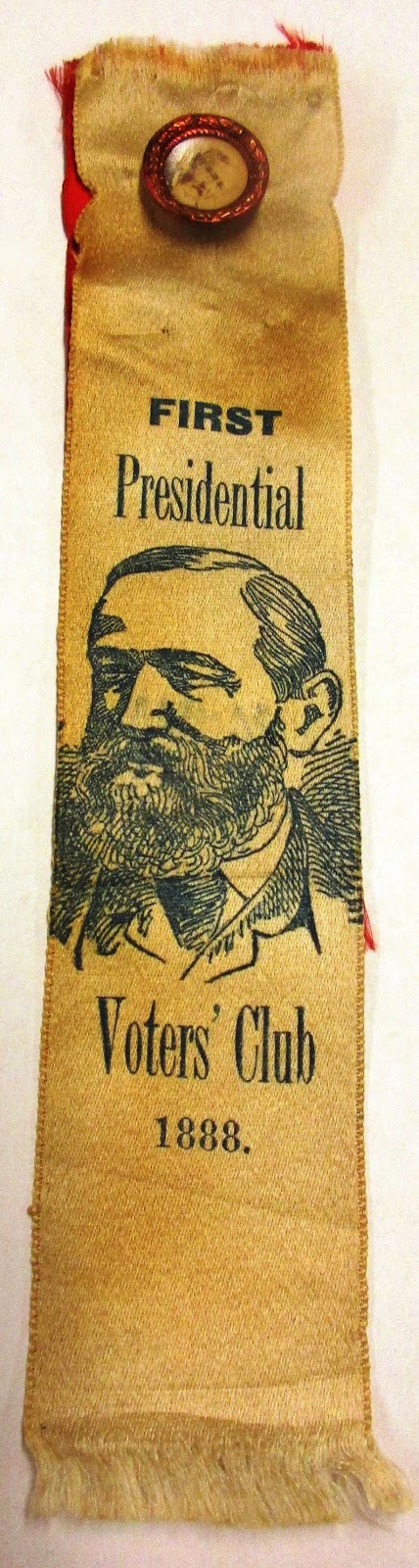
O.S. Alcott donated this 1888 ribbon from the First Presidential Voters’ Club of 1888. The members of this club supported the Republican Presidential candidate Benjamin Harrison, who defeated the incumbent Grover Cleveland on November 6. 

First voters’ clubs were popular in the late nineteenth and early twentieth centuries. At that time, only men could vote. The club members were anxious to exercise their duties as citizens to make their voting choice count. 

Mr. Alcott ran a men’s clothing shop in the Kingsbury Block from about 1900 to 1930. He took the business over from his father, L.D. Alcott.


O.S. Alcott was the topic of the “Who’s Who and Why” column in the December 14, 1911 issue of the Sandusky Register.


Saturday, November 03, 2018

Election of November 3, 1891


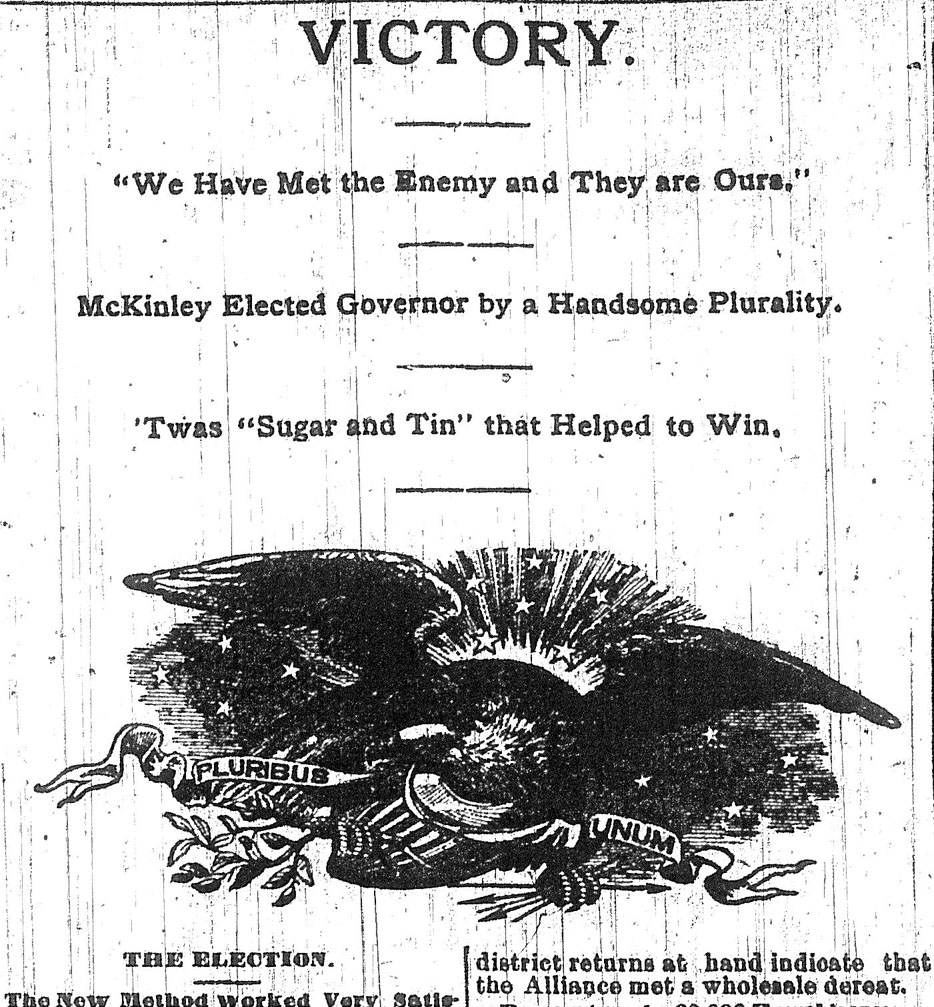
On October 12, 1891, Erie County Sheriff Christian Wiedel posted a proclamation which notified area residents that the November election of 1891 was to be held on November 3, 1891. The Sandusky Register of November 4, 1891 listed a tabulation of election results.


Governor McKinley won “by a handsome plurality.” Of course he would later win the Presidential election, and he served as U.S. President from March of 1897 until he was assassinated in 1901.


A local election winner was Dr. B.R. Hubbard, who was chosen to serve as the Erie County Coroner:


You can read much more about Erie County’s elected officials in the book Elected to Serve: Erie County, Ohio, 1838-2003, by Patty Dahm Pascoe, available in the library's Genealogy collections.

Wednesday, October 31, 2018

Buoys and Gulls around Sandusky Bay


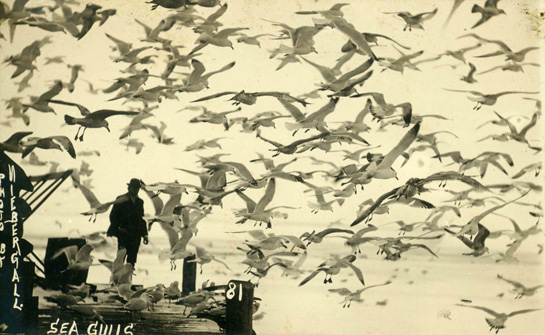
Since Sandusky is located on Sandusky Bay and Lake Erie, seagulls and buoys are sights that are quite familiar to local residents and visitors to the area. Gulls are found in location all locations of the globe, virtually always near a body of water. The photographic postcard above was created by local photographer Ernst Niebergall about 1912. In this view, the gulls are flying near a local pier.


Mr. Niebergall took a close up view of these seagulls:

        
Buoys, the anchored floats that serve as navigational aids, are a common site on the water during boating season. Several men are working on buoys near Sandusky Bay, probably for placing into winter storage, in this picture taken in the 1930s or 1940s.

   
This postcard, now in the collection of historical postcards at the Sandusky Library Archives Research Center, was originally sent in 1909:

Sunday, October 28, 2018

Commercial Building at the Southeast Corner of Market and Wayne Streets


This picture of the Bing’s Furniture Store at 202 East Market Street was taken by Helen Hansen in 1983. At that time the building recently had a face-lift which included the addition of shutters over the upper level windows, and sandblasting of the exterior brick. This commercial building was built by Sandusky contractor George W. Doerzbach in the Spring of 1894. It originally was a one hundred foot square brick structure. An article in the Sandusky Register of March 30, 1894 reported that the foundations of the building were blasted out of the stone bedrock. The stone that was blasted was then used in the basement and the first floor. Klotz and Kromer provided the engines that drove the elevator. A tin roof was put in by J. Mertz and Son, and the interior painting was done by Holland and Tebbutt. Total cost was $40,000 (about $1.2 million today). 

Here is an illustration from the Sandusky Register which depicts the building as it originally appeared:

 From the Sandusky Register, Mar. 30, 1894
The basement was leased to Engels and Krudwig, who pressed 400 tons of grapes in the fall of 1893, while the construction was still ongoing. In April of 1894, the J.L. Hudson Store opened at this location, after having previously done business in the Hubbard Block. The J.L. Hudson Company, which had its headquarters in Detroit, claimed that their store was the largest and finest in Erie County.


The April 9, 1894 issue of the Sandusky Register reported that at Hudson's grand opening, Professor Theodore Taubert’s orchestra provided musical entertainment, and potted plants and ferns decorated the store. Mr. J.L. Hudson himself arrived from Detroit to be present at the opening of his store’s newest location. The store sold men’s clothing and hats, women’s apparel and dry goods. J.P. Hicks was the manager. Mr. Hudson died on July 5, 1912, and soon after, in the summer of 1913, articles in the Sandusky Register announced that the Sandusky store would soon be closing. 

For a short time, John J. Healy operated a retail store at the site of the former J.L. Hudson store. Jacob H. Herman sold furniture and carpets here for many years, until the Bing Furniture moved in to this site in the 1940s. Since 1987, Value City Furniture has been in business at the southeast corner of Market and Wayne Streets in Sandusky. 

*In January 2025, Value City announced it was going out of business. The future of the building is presently unknown.

Thursday, October 25, 2018

Brown Clutch Company and Brown Industries


Though it is no longer in business, for many years the Brown Clutch Company, later Brown Industries, played an important role in several different lines of manufacturing. The Brown Clutch Company of Elyria, Ohio began doing business in Sandusky in 1907. It was located at the site of the former Dunbar Manufacturing facility at what is now 1737 Camp Street, where the Sandusky Automobile Company had been in business from 1902 to 1904. In the early years of the automobile industry, the Brown clutch was widely respected as a very reliable clutch, which allowed for the starting of a gasoline engine without moving all the machinery that was attached to the engine.


Later the company also manufactured gears for motorboats. 

T.T. Morgan was the general manager in 1908, and he became president of the company in 1913.


Under his leadership, the Brown Clutch Company grew from a small business to a manufacturing facility that was known all over the United States for its excellent workmanship. 

This is a view of the fly wheel with pulley, made by the Brown Clutch Company in the 1920s:
 

In the 1930s, the Brown Clutch Company became known as Brown Industries. After Oliver Rinderle, Sr. took over management, the company concentrated on foundry and pattern shop production. During World War II, over half of the production of  Brown Industries was devoted to heavy gasoline and diesel engine manifolds and cylinder heads, for use in tanks, trucks, cranes, shovels, marine unites, and many other motor-powered units which were valuable to the war effort. 

Brown Industries merged with the Sterling Foundry Company in 1972.  Today J & V Pallets is in operation at the site of the former Brown Industries. Visit the Sandusky Library Archives Research Center to view a 1922 catalog from the former Brown Clutch Company.

Monday, October 22, 2018

Anton Johanssen, Caretaker of Johnson’s Island Cemetery

   
From about 1911 to 1956, Sandusky resident Anton Johanssen worked as the caretaker of the Johnson’s Island Cemetery, on Johnson’s Island. The cemetery is the final resting place of over two hundred Confederate soldiers who died at the prison camp on Johnson’s Island during the Civil War. An article from the December 5, 1953 issue of the Sandusky Register reported that Mr. Johanssen made the trip from Sandusky to Johnson’s Island from early Spring until late Fall to mow the grass at the cemetery, and care for the “most peaceful place on earth.” He would drive to Marblehead, and then take a small motorboat out to the island. (At that time, the causeway to Johnson’s Island had not yet been constructed.) For many years he decorated each grave with both a Confederate and a United States flag. 


Anton Johanssen was born in 1879 on a Danish Island. He emigrated to the United States in 1895. When he first settled in Ohio, he resided on Johnson’s Island, where he raised cattle and farmed over 75 acres of land. Besides working as the caretaker of the Johnson’s Island Cemetery, Mr. Johanssen also worked for twenty-five years at the American Crayon Company. 
  
On October 27, 1967, Anton Johannsen passed away at the age of 88. He was survived by a son, daughter, and several grandchildren. He lived a full and busy life in his adopted country. Mr. Johanssen must have found this monument to the Confederate soldier (built in 1910) a familiar sight.


Friday, October 19, 2018

Eighty-First Annual Assembly of the Grand Lodge of Ohio

Nielsen Opera House

On October 15 and 16, 1890, the 81st Annual Assembly of the Grand Lodge of Free and Accepted Masons of Ohio convened in Sandusky, Ohio. The opening meeting was held at the Opera House, where Grand Master Leander Burdick gave the address. Masonic groups from all over the world sent greetings to the Ohio lodge members. Several committee reports were given, and officers were elected. During the evening hours, Lodge officers, members, and ladies were invited to a reception at the newly-built Sandusky Masonic Temple. Mr. W. G. Mellish gave a speech, and entertainment was provided by the Masonic Quartette and the Opera House Orchestra.

Sandusky Masonic Temple

Nearly 500 members attended the banquet on October 15, held at the Sloane House.


That same evening the Masonic Veterans Association of Ohio met at the Odd Fellows Hall in Sandusky. During their time in Sandusky, lodge members were invited to go fishing. Local lodge members arranged for boats and fishing tackle to be available to all visiting lodge members. 

You can read about the 81st Annual Assembly of the Grand Lodge of Ohio in the October 16, 1890 issue of the Sandusky Register, available on microfilm at the Sandusky Library Archives Research Center.


Tuesday, October 16, 2018

Ohio Structural Iron Company, Predecessor to Mack Iron Works


John D. Mack and A.C. Blinn founded the Ohio Structural Iron Company in 1901, after they purchased the Crandall Iron and Fence Company, located on Warren Street in Sandusky. These advertisements, the one below from an early issue of Park and Cemetery and Landscape Gardening, let us know exactly what types of products were made by the Ohio Structural Iron Company.


In 1903, the Ohio Structural Iron Company manufactured 200 lawn seats for the parks of the city of Toledo, and 100 lawn seats for the National Soldiers’ Home in Dayton, Ohio. The company built a fire escape that could fold up like an accordion for the Donahue building in Sandusky in 1905. 

After John D. Mack bought out Mr. Blinn’s interest in the company, he changed the name to Mack Iron and Wire Works. This company got a contract for building an iron fence around the Confederate Cemetery at Johnson’s Island, according to an article which appeared in the September 2, 1912 issue of the Sandusky Register. The fence was four feet in height and had ornamental posts and arched gates. 

A tornado seriously damaged the Mack Iron and Wire Works building in June of 1924.


In 1925, as the company was re-building, John D. Mack hired his son-in-law to manage the Iron Works, so he could devote more time to the Sandusky Register, where he served as Vice-President and Treasurer. Having weathered setbacks during the Great Depression, in the 1940s, Mack Iron made defense materials in support of the U.S. War Effort. So many of Mack’s regular employees went off to serve in World War II, that to keep up production the company brought in German prisoners of war from Camp Perry to work on the lines. After the war, Mack Iron moved from foundry work to metal fabrication. A lengthy article in the April 22, 2001 issue of the Sandusky Register reported that projects made by Mack Iron can be seen at Sandusky City Schools, the Erie County Jail, the County Parking Garage, a coaster at Cedar Point, and many other area buildings. 

You can read more about the history of Mack Iron Works in the Sandusky Register of April 22, 2001, now on microfilm at the Sandusky Library Archives Research Center. The company motto of the Mack Iron Works Company is:  “Quality people doing quality work.” 
 
An aerial view of Mack Iron, taken by photographer Thomas Root in the summer of 1965.


Saturday, October 13, 2018

Toys from Yesteryear at the Follett House


Now in the collections of the Follett House Museum, this Singer sewing machine was sold as “A Singer for the Girls” in the 1910s and 1920s.  This miniature sewing machine, which sold for $3.00 (about $75 in today's money), was fully functional, and was promoted as an item to help young ladies learn to sew clothing for their dolls. It was sold only at Singer stores or by Singer salesmen. 

Pictured below is a box containing a Sturdy Robot Catapault [sic]:

          
The catapult was made by the Sturdy Toy Company, which was owned by Bert Hall. The company made wooden and aluminum toys at their small factory in Castalia, Ohio in the 1940s. Mr. Hall was a member of the French Foreign Legion during World War I.

A local resident donated these roller skates to the Follett House Museum:


The donor wore these skates as a young adult in the 1950s. 

Moving on to the Space Age, this GI Joe Official Space Capsule and Space Suit is dated 1966, near the peak of American manned space exploration:

                                           
Visit the Follett House Museum to see many historic toys and artifacts from Sandusky and Erie County, Ohio.