Friday, February 24, 2023

Wyandotte Point


An article in the October 12, 1919 issue of the Sandusky Register reported that real estate development had begun in an area known as Wyandotte Point, under the impetus of James J. Hinde, manager of the Sandusky Development Company. The area contained 30 acres of land adjacent to West Monroe Street, running from Sandusky Bay to land close to New York Central railroad tracks.  The name Wyandotte Point was a nod to the Native Americans who once lived in this vicinity. The plot was laid out prior to World War I, but government regulations prohibited new construction during the wartime years.

Homes were to be constructed for a cost of between 3000 and 7000 dollars ($47,000-$110,000 in today's dollars), with only single family residences to be built here for fifty years. Mr. Hinde was quoted in the Register article, “The time is right for extensive real estate development here. This is evident owing to the incoming of many manufacturing plants and the need for housing. Employees and officials must have dwellings. Another thing, as I see it, all modern home development must be in the suburbs. The tendency of home seekers is to withdraw from city surroundings into the more open and healthy country.”

The close proximity to Sandusky Bay and Winnebago Park were key factors for prospective buyers of homes in Wyandotte Point. A street car line took residents from Winnebago Park to Sandusky.

Notes on the picture below indicate that J.J. Hinde had these homes built on Gartland Avenue, which was close to the G and C Foundry, and namesake of one of the foundry's owners.

An advertisement in the Sandusky Register of November 26, 1919, told prospective owners of homes in this development that they could double their money in five years.

Winnebago Park is now known as Lions Park. In “The Follett House Scrapbook,” a feature in the August 23, 1987 issue of the Sandusky Register, Helen Hansen and Virginia Steinemann gave a brief history of Winnebago Park and Lions Park. The park was once included in the Wyandotte Point development.

In the 1920s through the 1950s, many family reunions were held at Winnebago Park, later known as Lions Park. The Sprau family gathered at Winnebago Park in 1920.


Sandusky Register, Oct. 12, 1919

Monday, February 20, 2023

Three Sandusky City School Officials in 1970


In the picture above, three Sandusky City School officials are looking over a magazine article explaining the art program for the school district in 1970. From left to right are: Frank Smith, Wallace Glenwright, and Thomas C. Gallagher.

Frank Smith was well known in art circles in Sandusky. He was an art teacher for Sandusky Schools, and eventually became supervisor of art instruction for the entire school district. Mr. Smith was the founder of the Sandusky Cultural Center, and he was a long time member of the Art Study Club.


Wallace Glenwright was associated with Sandusky City Schools for over thirty years, having been a coach of football, basketball and golf. He also served as Athletic Director, Assistant Principal, and Principal of Sandusky High School, and eventually became the School Superintendent.


Well known Sandusky Register Charles Wagner once said of Mr. Glenwright, “He was a gentleman’s gentleman.”

Thomas Gallagher was in the field of education for thirty five years, and was the Principal of Osborne School for twenty eight years. When he retired, the Sandusky Register of March 25, 1986 featured an article chronicling his career.


Many former students of these local educational leaders will have fond memories of these Sandusky educators.

Wednesday, February 15, 2023

Embroidery from the Historical Collections of the Follett House Museum


Embroidery, as defined by the Encyclopedia Britannica, is "the art of decorating material, primarily textile fabric, by means of a needle and thread (and sometimes fine wire)." It dates back to ancient times, often used in garments, tomb paintings, and for religious items.  Shown above is an embroidered sampler created by nine-year-old Nancy Ward in 1810. She stitched two upper case alphabets, a lower case alphabet, and numerals 1 to 10.

Here is a hand embroidered motto that reads “Forget me not” with a floral design:

In 1834 Caroline Sprague monogrammed the letter “M” on a linen tablecloth. Since Caroline married Henry Frost Merry in 1837, it is likely that the tablecloth was made for a member of the Merry family.

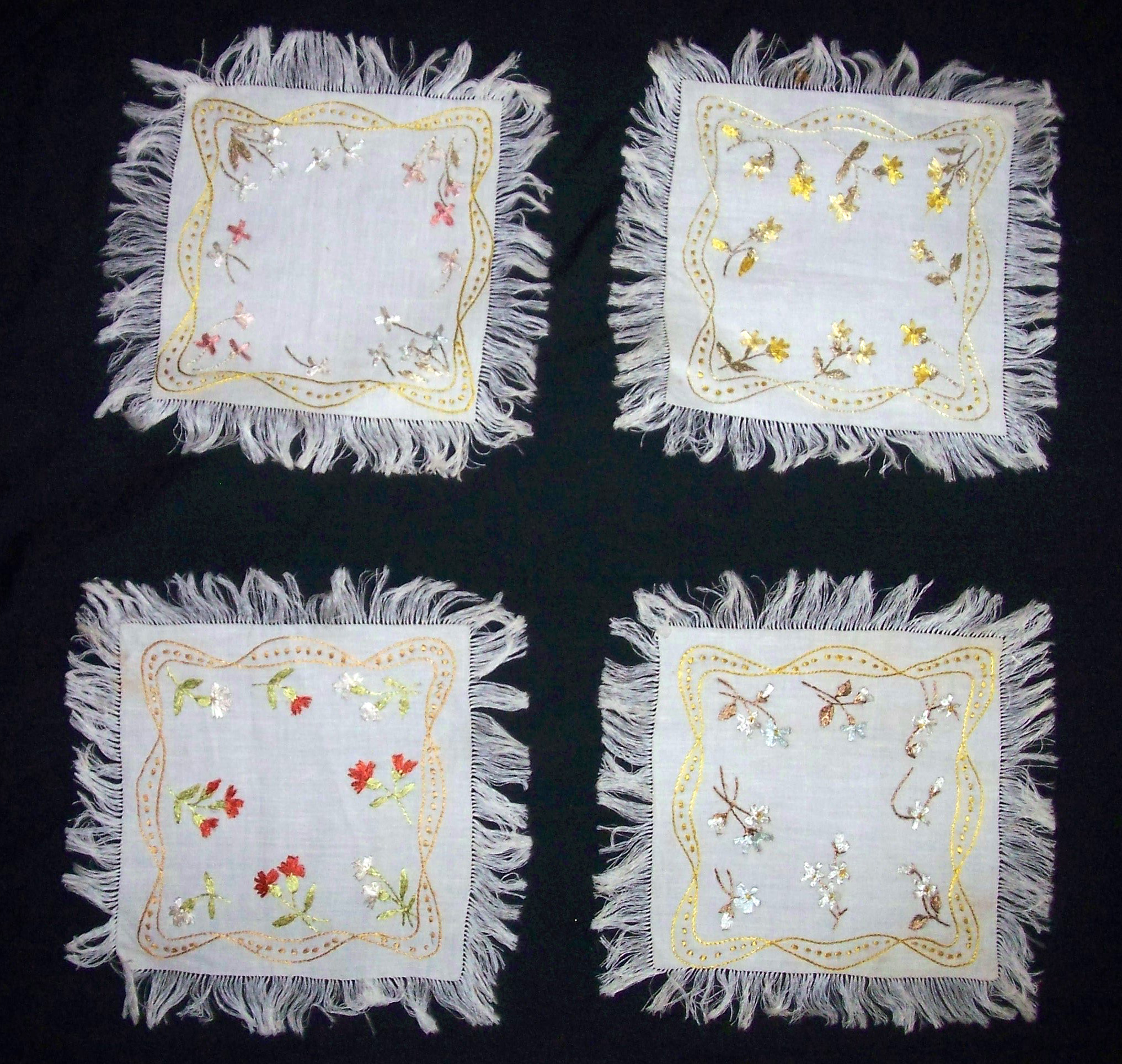
These four linen embroidered doilies belonged to pioneer Sandusky resident Mrs. William T. West, nee Lydia Mahala Todd:

Also in the historical collections of the Sandusky Library and Follett House Museum is a book published in 1888 entitled How to Shade Embroidered Flowers and Leaves, by Ellen Galusha Smith.

To read more about the history of embroidery in the United States, see the book The Development of Embroidery in America, by Candace Wheeler, available at Project Gutenberg.

Saturday, February 11, 2023

Was the Surname Melville or Milne?


According to Helen Hansen's At Home in Early Sandusky, William Gordon Melville-Milne was born in Aberdeen, Scotland in 1819. He emigrated to Canada, where he married Catherine Kennedy. The couple moved to Missouri, where Mr. Melville-Milne worked for E. F. Osborn, the owner of a large flour mill. In the 1840s, Mr. Osborn moved to Sandusky to serve as superintendent of the Mad River and Lake Erie Railroad. He sent for Mr. Melville-Milne in 1847, to assist in the operations of the railroad in Sandusky. 

In February, 1861 William Melville-Milne died at age 41. He left a widow and eight children, six of whom survived to adulthood. In her book, Mrs. Hansen explained that some branches of the family used the Scots double name of "Melville-Milne." Some family members used only "Milne" as their surname, but many dropped the "Milne" and went by the last name of "Melville." (This is just one example of how family history can be quite confusing.) There are streets in Sandusky named for both of the surnames Melville and Milne. Melville Street runs between Camp Street and Pearl Street, while Milne Street runs between West Adams and Harrison Streets.

Sons of William Melville-Milne, who were known as William and Charles Melville, ran a drug store in Sandusky which was in operation for fifty years. Another son, George W. Melville, was an engraver in Chicago. The former home of William G. Melville-Milne is at 319 Lawrence Street in Sandusky.

Photo taken in 1958

When looking through genealogical records, there are several variations of the surname. A descendant named Frank Rowland Melville Milne is listed as “Frank Rowland Melville” on his World War II draft registration card, but the name on his tombstone at Oakland Cemetery reads Frank Rowland Melville Milne.


When researching anyone in the Melville-Milne family, be sure to check for Melville, or Milne, or Melville-Milne! Do the same for any hyphenated name.

Monday, February 06, 2023

Elmer Grahl’s Painting and the Story of Sandusky's Puck


In 2003 longtime Sandusky barber Elmer Grahl painted a picture of the ice cream and sandwich shop operated by the Charles Hoffman family in the 1920s and 1930s. This shop is no longer standing, but it once stood at the southeast corner of Scott and Hancock Streets.


Puck, the figure on top of the stand, was in the front window of Dietz and Mischler’s cigar store on Columbus Avenue until about 1915. After the cigar store closed, this zinc statue landed in John and Henry Weier’s scrap yard, on Hancock Street, between Neil and Scott Streets. Charles Hoffman rescued Puck and placed him on top of the family sandwich shop, just down the street. The tip of Puck’s spear was electrified, and fitted with a light bulb, showing the way to Hoffman’s shop. Hoffman descendants donated Puck to the Follett House Museum in the 1970s.

Below is a photograph of Hoffman’s shop when it was in business in Sandusky. The Hoffman family was well known in Sandusky for its business ventures, including the Hoffman Coal and Milling Company and the Hoffman Manufacturing Company.

Wednesday, February 01, 2023

Grover Cleveland Enjoyed Fishing in Ohio


An often forgotten President, who is the subject of a recent book (available at the Sandusky Library), Grover Cleveland enjoyed fishing in several spots across the United States, during and after his terms as U.S. President. The Sandusky Star Journal of September 11, 1926 reported that during his administration, President Cleveland “sought refuge from the affairs of state by fishing in the streams fed by the cold waters from the mysterious ‘Blue Hole’ of Castalia,” as a member of the Castalia Trout Club.

A trout stream at the Blue Hole circa 1940

An article in the May 10, 1956 issue of the New York Times reported about a time that Ex-President Cleveland had arrived in Sandusky, Ohio to spend several days fishing at Middle Bass Island. Accompanying President Cleveland were Professor John Lloyd, Judson Harmon, and Charles Foster, former Secretary of the Treasury.

In 1906, the former President wrote a book called Fishing and Shooting Sketches; this book is available in full text at the Internet Archive.


One of the chapters in the book was “A Defense of Fishermen.”

To learn more about the history of Castalia, read Glenn Kuebeler’s book Castalia, Cold Creek, and the Blue Hole (Arcadia Publishing, 2007.)

Friday, January 27, 2023

A Home to Many Businesses on Market Street


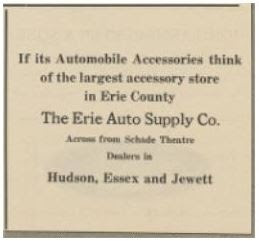
From the early 1920s through the mid 1930s, The Erie Auto Supply Co. was located at 208 West Market Street in Sandusky. The company sold wholesale and retail automobile parts, and serviced vehicles in the space behind the store. Hudson, Essex and Jewett were some of the brands carried by Erie Auto Supply.


In 1936, Erie Auto Supply moved to 212 Hancock Street. From 1942 until the mid 1960s, Weber’s Men’s Wear was in business at 208 West Market Street.

Weber’s was one door away from City Hall. Other stores visible on Market Street in this 1950s era picture above were Gray’s Drugstore, Herman’s Jewelry, and Third National Bank.

Through the years, several different businesses operated at 208 West Market Street, including Sears, Spiegel Inc., Sonrise Ceramics, Revelations, and Bloomquist TV.


Today the Crowbar is now in business where Erie Auto Supply Company was once located.

Monday, January 23, 2023

Getting to Know Rev. Edward R. Jewitt


Rev. Edward Rogers Jewitt (sometimes spelled Jewett) was born in Connecticut in 1811. He married Elizabeth Camp in 1834. In 1835 the young couple settled in Elyria, Ohio. By 1840 E.R. Jewitt was admitted to the North Ohio Conference of the Methodist Episcopal Church. Rev. Jewitt ministered in the Methodist Episcopal Church for over twenty years. Rev. Jewitt addressed the crowd that gathered on July 4th in Milan, Ohio for a Celebration and “PicNic.” He was the pastor of the Sandusky Methodist Episcopal Church from 1845 to 1847. In the 1850s, he was the minister of the Bethel Church, which was an outreach of the Methodist Episcopal Church to improve the moral and religious condition of seamen in waters west of New York State.

Rev. Jewitt preached a sermon on July 4, 1852 at Put in Bay, when five companies of the Volunteer Militia of Ohio met at Put in Bay to celebrate Independence Day, as well as to discuss the erection of a monument to commemorate Perry’s victory at the Battle of Lake Erie.

In 1860 and 1861, Rev. Jewitt was the Presiding Elder of the Methodist Episcopal Society of Sandusky. On January 13, 1860, under his leadership, the following anti-slavery resolution was passed at the Quarterly Meeting of the Methodist Episcopal Church of Sandusky:


 According to the obituary of Mrs. Elizabeth Jewitt, in 1863 Rev. Jewitt was injured and had to retire from active ministry. However, Rev. Jewitt remained involved in the community and in Methodist religious circles in Erie County, Ohio.

This advertisement from the Sandusky Register of May 11, 1864, states that Rev. Jewitt had opened a bookstore on Columbus Avenue. He sold Bibles and hymn books, as well as stationery, toys, and writing supplies.

When the Convention of the Erie County Sunday School Union met on May 11, 1872, the president of the organization was absent, so Rev. E.R. Jewitt stepped in to run the convention. Several in attendance felt that there was a significant correlation between children who attended Sunday School and secular school. There was a feeling that learning at Sunday School could reinforce the skills of school children who also attended public school. 

Rev. Jewitt attended the 42nd Annual Session of the North Ohio Conference of the Methodist Episcopal Church held in Ashland in September of 1888, and reported on the events which took place.

By 1880, Rev. and Mrs. Jewitt retired to a farm in Margaretta Township. Rev. Jewitt died on August 22, 1892, and he was buried at Oakland Cemetery. Mrs. Jewitt survived until 1904.

This obituary appeared in the Sandusky Register of August 23, 1892:

Wednesday, January 18, 2023

"Under Construction"


The Sandusky Library Archives Research Center has several photographs of businesses under construction in its collections. The image above shows the Sandusky Masonic Temple under contruction. The view is from the cornerstone-laying ceremony on June 24, 1889.

Below is a picture of St. Mary’s Catholic Church under construction in the 1870s. A worker is visible at the top of the building, while two adults and several young people are seen at the front of the church.

In the 1890s, this house was being built on Columbus Avenue for Sandusky businessman R.M. Wilcox. 

In the picture below, two men appear to be attaching slats to the frame of a Lyman boat at the Lyman Boat Works in 1938.

Helen Hansen took this photograph of the Citizens Banking Company, now Civista Bank, under construction in 1985 at the southwest corner of Water and Wayne Streets in Sandusky.

If you are interested in the historic buildings in Sandusky, Ohio, see Ellie Damm’s book Treasure by the Bay (Bucknell University Press, 1998) at the Sandusky Library. In this book Mrs. Damm points out that many of Sandusky’s early commercial buildings were built from native limestone, demonstrating the thrift and practicality of the early residents of Sandusky.

Friday, January 13, 2023

Zeiher and Millar, Building Contractors


Peter J. Zeiher and Thomas C. Millar formed a partnership in 1914. In the early years, Zeiher & Millar focused on brick and stone work, but as time went by, they broadened their scope and they became general building contractors. Mr. Zeiher and Millar are in the group photo below, taken outside the Erie County Courthouse, when the 11th Annual Conference of the Bricklayers, Masons, Plasterers and Marble Masons met in Sandusky in May of 1916.


Zeiher & Millar are remembered for several important building projects in Sandusky, Ohio and throughout northern Ohio. In 1924, they were the contractors for the new Sandusky Butter and Egg Company, located on West Water Street, where Feddersen’s Bakery later was in business from the mid-1960s to the mid-1990s. This advertisement appeared in the Sandusky Star Journal on February 25, 1928, when the new Junior High School was dedicated in Sandusky.


In the fall of 1928, Schine’s State Theater opened, which was yet another building constructed by Zeiher & Millar.

The Star Journal of October 12, 1928 featured an article about the firm:

Zeiher & Millar went out of business in the early 1930s. Peter J. Zeiher continued to work as a masonry contractor, and Thomas C. Millar went to serve as superintendent of maintenance for Sandusky City Schools for over twenty years. Mr. Zeiher passed away in 1964, and Mr. Millar died in 1966. The final resting place of both men is in Oakland Cemetery in Sandusky, Ohio.