Wednesday, November 27, 2013

Thanksgiving Dinner at the Opera House Cafe in 1900


According to the November 29, 1900 issue of the Sandusky Daily Star, on Thanksgiving Day in 1900, George A. Boeckling invited one hundred youngsters to have dinner at the Opera House Cafe. Mr. Boeckling asked Truant Officer Ulrich Zuercher to pass out the dinner invitations to needy children in Sandusky.


 The Opera House Cafe was located on Water Street, next to the Nielsen Opera House, seen at the far right in the picture above. G.A. Boeckling and Ulrich Zuercher met the crowd of hungry youngsters at the cafe at 11:00 on November 29, 1900. Waiters and waitresses served the children a traditional turkey dinner with all the trimmings. The Star article reported that the children had their appetites with them and they gave “an exhibition of knife and fork play that has never been rivaled in the cafe.” Mr. Boeckling was making plans to have Santa Claus make an appearance at the lobby of the Nielsen Opera House on Christmas Eve, at which time he planned to pass out one thousand complimentary tickets. 

Saturday, November 23, 2013

Adam J. Stoll, Inventor


Adam J. Stoll was born in Bucyrus, Ohio in 1844.  He moved to Sandusky in 1868. That same year, he married Sophia Burgdorf, the adopted daughter of Ferdinand Geiersdorf. He was part owner of the Cedar Point resort in its very early years. When Mr. Stoll first moved to Sandusky, he worked in the commercial fishery business with his father in law. Later he partnered with Lewis Adolph in the fish business. For a time he worked independently in the fish business, until he sold the business to Booth Fisheries.  In 1883, Adam J. Stoll was issued Patent Number 285,521 for an apparatus which mixed ice and salt for freezing fish.


The former home of the Adam J. Stoll family, at 531 Wayne Street, is listed on the National Register of Historic Places. Mrs. Sophia Stoll died in January, 1921. Adam J. Stoll passed away on July 17, 1930. He was survived by two daughters. His funeral services were held at the Stoll residence, and burial was at Sandusky’s Oakland Cemetery. To read more about Adam J. Stoll and other former residents of Sandusky and Erie County, visit the Sandusky Library Archives Research Center.

Wednesday, November 20, 2013

The Kuebeler and Stang Breweries

The production of beer was a major industry in nineteenth century Sandusky, with the Kuebeler and Stang families among the most successful brewers. In 1880 the Stang Brewery was founded from an earlier brewery that had first been operated by Phillip Dauch and Andrew Fischer. The Stang Brewing Company was located at the corner of Madison and King Streets. (Shown here in 1940, long after the plant was closed.)

Frank Stang started the Stang Brewing Company. His younger brother John Stang took over as president in 1890. Pictures of John Stang and Jacob Kuebeler appear in the 1895 publication, Men of Sandusky.


Jacob and August Kuebeler founded the Kuebeler Brewing Company in 1867. About 1885 the Kuebeler brothers both built virtually identical large brick homes on Tiffin Avenue. Mr. and Mrs. Jacob Kuebeler lived at 1318 Tiffin Avenue. (This home no longer stands.) The August Kuebeler residence was built at 1319 Tiffin Avenue, and is still standing today.


The Kuebeler Brewing Company was on Tiffin Avenue.

 The Kuebeler & Stang Breweries merged in 1896.  Two years later the Kuebeler-Stang Breweries merged with Cleveland breweries to form the Cleveland and Sandusky Brewing Company. Many breweries closed during Prohibition, but the Stang plant continued doing business as Crystal Rock Products Company, selling soft drinks. The picture below shows a float sponsored by the Kuebeler Stang Brewing Company in the late 1800s.


To read more about the Kuebeler and Stang Brewing Companies and other brewing companies, see the book, Brewing Beer in the Buckeye State, by Dr. Robert A. Musson, available for loan through the ClevNet system.

Sunday, November 17, 2013

Ferdinand V. Seibert, Painter and Interior Decorator


Above is a tintype portrait of Ferdinand V. Seibert as a young man. Mr. Seibert was born in Sandusky, Ohio on February 20, 1861, to Valentine and Margaret (Ulrich) Seibert. This cabinet card of Ferdinand V. Seibert was created by photographer W.A. Bishop in the 1880s.


Ferdinand was well known as a sign painter and interior decorator. In the 1890s and early 1900s, Ferdinand V. Seibert was in business with a Mr. Hasselbach. Hasselbach & Seibert were awarded the contract for painting rooms at Sycamore School in 1894. When Hasselbach & Seibert did the decorating work for attorneys King & Guerin in 1901, the January 11, 1901 issue of the Sandusky Star reported that the work done by them was “as fine as any ever done in Sandusky.” Later, Ferdinand V. Seibert worked alone. In 1912 he created fifty-six life size oil paintings of bathing beauties for a local resort. Mr. Seibert did art work on the face of Frank Steinle’s Wonder Clock,” now on display at Cedar Point’s Town Hall Museum. Ferdinand V. Seibert died on November 17, 1930, after a lengthy illness. His obituary, which appeared in the Sandusky Register of November 18, 1930, stated that he had been an expert sign painter, and a lifelong resident of the city. Mr. Seibert was survived by three sons. He was buried next to his wife, the former Mary Schumacher, at Oakland Cemetery.  The bracelet pictured below was crafted by Ferdinand V. Seibert from walnut shells. It can be seen at the Follett House Museum.


Thursday, November 14, 2013

Vintage Views of the Sloane House Hotel


According to volume one of From the Widow's Walk, by Helen Hansen & Virginia Steinemann, the Sloane House hotel opened November 17, 1881 and was razed in the early 1950s to make way for the Lasalle’s store. The four story brick building was located at the northwest corner of Columbus Avenue and Washington Row, now the location of Erie County offices.  It was named for its owner, Rush Sloane, a well-known lawyer and abolitionist who served as Sandusky’s Mayor in the 1880s. When it opened, the Sloane House furnished accommodations for one hundred fifty guests.


 The Sloane House was a popular gathering place for business meetings, wedding receptions, and family gatherings. Several businesses were in operation at the street level. A drugstore was the anchor store at the Sloane House for several years. Below, you can see a portion of the H.K. Henkelman and J.H. Bechberger drugstore in a picture from a wintry day in 1909.


 An article in the October 25, 1915 issue of the Sandusky Register reported that a play entitled “Emma McChesney and Company” used an exact replica of the lobby of the Sloane House as part of its scenery.  A traveler told Sloane House Manager Charles T. Gauvey that when he saw the play, he was tempted to go on stage to go through the swinging door into the bar room, because it looked so much like the Sloane House lobby.


This postcard from the Alexander Manufacturing Company shows a view of side of the Sloane House that faced Washington Park.


 By the time this postcard was created by E.B. Ackley, visitors to the Sloane House could reach the hotel by automobile instead of horse-drawn vehicles.


 Several items from the Sloane House hotel can be viewed at the Follett House Museum, including this china water pitcher.


Sunday, November 10, 2013

Veterans Day November 11 -- Errol "Zip" Zistel, Military Aviator


Errol Henry Zistel was born in Sandusky, Ohio on July 16, 1895, to Ottomar and Amelia Zistel. He earned the nickname “Zip” from his days of “zipping” in an iceboat on Sandusky Bay when he was a teenager. He once went from Sandusky to Kelleys Island in eight and a half minutes in his iceboat, at a speed of ninety miles per hour. 

Errol Zistel began his military career as fighter pilot in Britain’s Royal Flying Corps and later transferred to General Pershing’s American Air Service during World War I.  During the war, he was seriously injured, but after his recovery he remained active in the Reserves. In 1927 he was one of the organizers of Ohio’s first Air National Guard Unit, the 112th Observation Squadron. During World War II, he commanded the fourth Air Support Command at Hamilton Field, California, achieving the rank of Major General. General Zistel actively flew aircraft until his retirement from active service in 1957. 

Errol H. Zistel died on January 25, 1968, and was buried with full military honors at Lake View Cemetery in Cleveland, Ohio. Members of the Air Force served as Honor Guards. General Zistel had been a member of the Early Birds, the American Fighter Aces Association, the Order of Daedalus, the Quiet Birdmen, and the Air Force Association. He was a past president of the Cleveland Aviation Club. A lengthy obituary for Errol “Zip” Zistel appeared in the February 3, 1968 issue of the Sandusky Register.

Thursday, November 07, 2013

Dr. Norbert A. Lange’s Life is Well Documented in Pictures


Dr. Norbert Adolph Lange, was a chemistry professor who is known for writing the classic text Handbook of Chemistry. In 1959 Dr. Norbert A. Lange and his wife, Marion Cleaveland Lange, translated Dr. Von Schulenburg’s book Sandusky Einst und Jetzt into English. The title in English is SanduskyThen and Now. The Langes were also the generous benefactors of the Lange Trust, which provides for “The promotion of cultural and educational enterprises in the City of Sandusky, Ohio, and the adjacent area within Erie County, Ohio.”  

Through the generosity of the Langes, the Sandusky Library Archives Research Center became the recipients of several Lange family photos and documents. As a result, we can see what Dr. Norbert A. Lange looked like at several different stages of his life. Here is a very early picture of Norbert Adolph Lange.


A few years later, we see Norbert Lange, the older child at the right, with his cousin Elmer Wirth, and their parents. Elmer Wirth's and Norbert Lange’s mothers were sisters. Their maiden name was Hauser.


By 1906, Norbert had a summer job at the Cedar Point Bathhouse. He is number 12 in the picture below.


He graduated from Sandusky High School in 1910. (He is number 40, in the back row.)


In 1918, Norbert A. Lange earned his PhD from the University of Michigan.


In most of the Lange photographs, people have been identified and dates provided. In your own family photographs, remember to identify the people, so that future generations can be informed about their family heritage.

Monday, November 04, 2013

Isaac Grasgreen Boots and Shoes


From 1882 through 1890, Isaac Grasgreen operated a business that sold boots and shoes at 115 Columbus Avenue in downtown Sandusky. An advertisement for Isaac Grasgreen’s store, which appeared in the October 16, 1889 issue of the Sandusky Register, stated that Mr. Grasgreen could save customers from twenty-five cents to forty cents on each pair of school shoes purchased. The shoes ranged in prices from $1.00 to $1.75.


A listing by Mr. Grasgreen in the 1886 Sandusky City Directory stated that “fine custom work” was a specialty at the Isaac Grasgreen boot and shoe store. This promotional booklet was given to customers of the Grasgreen boot and shoe store.


By 1891 the Isaac Grasgreen family had moved to Toledo, Ohio, where he operated a saloon. 

Thursday, October 31, 2013

Who Are the Men in the Under the Baton Banner?

The Sandusky Library is pleased to announce the documentary film Under the Baton: Music at Old Cedar Point. The premiere screening will take place on Friday, November 1 at 7:15 p.m., with additional presentations on Thursday, November 7 at 6:30 p.m., Thursday, November 14 at 10:30 a.m., and Friday, November 15 at 1:30 p.m., all at the Sandusky Library’s Program Room. The television premiere will be on November 14 at 8:00 p.m. on WGTE, Toledo.

You may be wondering about the names of the men featured in the picture of Ackley’s Band, which appears on the promotional flyers related to the documentary:


This photograph of Ackley’s Band was taken in the early 1900s. From left to right in the back row are: Ed Senne, John Bauman, M. McAdams, A. Becker, William Hauser, J. Thomas, F. Ortman, and F.W. Bauer. In the front row are: N. Bergmoser, Elmer Center, W. Scott, J. Samsel, F. Bauman, George Godfrey, C. Schaufelberger, and E.B. Ackley.  We know more details about some of the band members than others. Ed Senne played in several local musical groups, including the Great Western Band, Dials Concert Orchestra, and in the orchestra of the Lakeside Association, besides playing in Ackley’s Band. William Hauser, an uncle of Dr. Norbert Lange, also played in several bands through the years, and survived the tornado of 1924; he was inside his home, which was seriously damaged, but he was not injured. There were three members of the Bauman family in Ackley’s Band. Elmer Center was in the plumbing business for over thirty years, and he also operated the Center Hotel. F.W. Bauer went on to serve as Erie County Auditor, and he was instrumental in the founding of Winnebago Park, now known as Lions Park.

George Godfrey conducted a series of free concerts at the Big Store in the spring of 1902.  Mr. Godfrey’s musical composition entitled Sandusky’s Big Store March and Two-Step was published by the C.L. Engels Company in Sandusky, Ohio.


 E.B. Ackley was well known as a band leader and musician.


He also published postcards, operated a billiards parlor, was director of music at Cedar Point and served as the instructor of the Sandusky Band and Orchestra. He wrote the Cedar Point March in 1902, the first piece of music dedicated to the resort. Ackley’s Band contributed greatly to the cultural heritage of Cedar Point and Sandusky. Many of our grandparents and great grandparents had the pleasure of hearing them play, when live music was a significant form of entertainment, before radio and television brought music to the masses.

Monday, October 28, 2013

Merrill L. Starr, Erie County Sheriff, 1876 to 1880


Merrill Leroy Starr was born in the state of New York in 1842 to Daniel and Bathsheba (Chadwick) Starr. The Starr family moved to Perkins Township, Erie County, Ohio in the 1850s. During the Civil War, Merrill L. Starr enlisted in Company E, Ohio 8th Infantry Regiment. Military records indicate that he was honorably discharged in 1863, after he was wounded at Antietam. According to Erie County Probate Court records, he married Kate Cooper on December 5, 1867. From 1876 to 1880, he served as Erie County Sheriff. Mr. Starr also was Superintendent of the Erie County infirmary in 1870 and in 1884-1885. In the 1880s, he was a partner in a shoe and boot business with E. W. Dewitt.


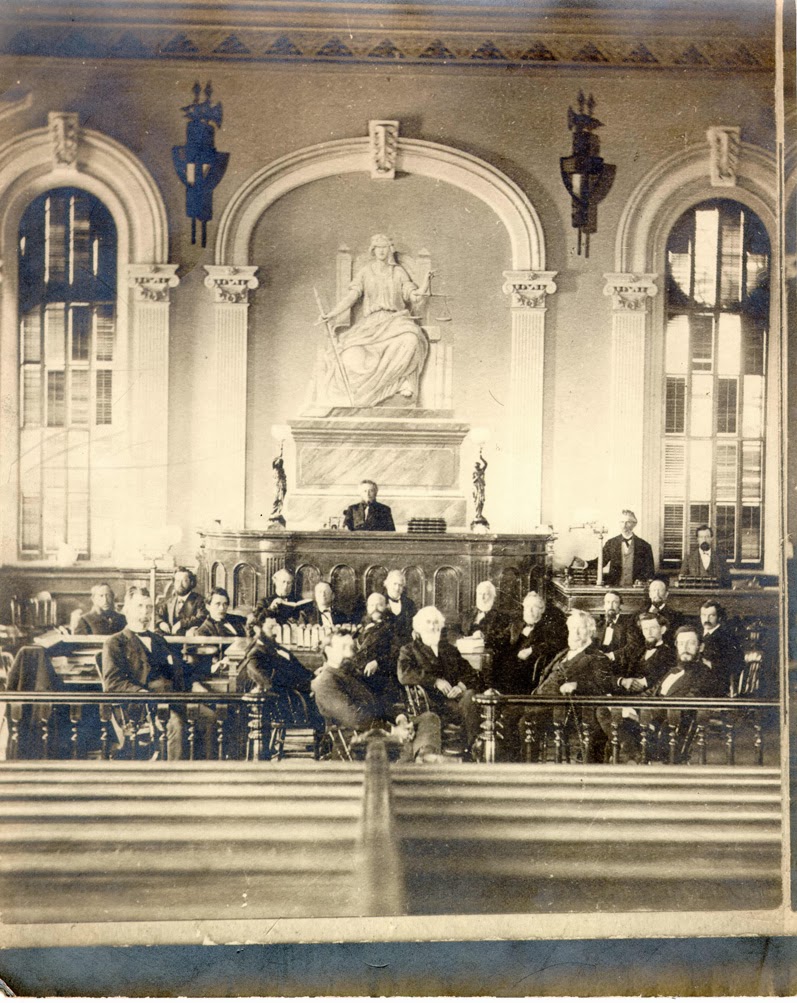
Merrill L. Starr died January 6, 1914 at the home of his daughter, Mrs. Alfred Huntley on Adams Street.  Mr. Starr was survived by his widow, four daughters, a son, a brother and a sister. He was buried in the Sand Hill Cemetery. Mr. Starr is sitting in front of the bench in the courtroom at the Erie County Courthouse in this picture taken in 1875.


To learn more about Merrill L. Starr and many other former Erie County officials, see Elected to Serve, by Patty Pascoe, in the Sandusky Library genealogy collection.