Tuesday, November 17, 2015

The “Elderlies” Column by Karl Kurtz


Karl Kurtz can be seen at the right in the picture above at WLEC Radio. From 1974 to 1979, Mr. Kurtz wrote a column for the Sandusky Register entitled “The Elderlies.”  The articles usually featured photographs, and included topics of interest to senior citizens. Karl interviewed area residents and asked them their memories about businesses, school days, sporting events, and customs from Sandusky in years gone by. Here is a column from 1975 talking about the days when local residents used an ice box instead of a refrigerator.


Copies of “The Elderies” columns have been clipped and were bound into three large notebooks. If you would like to read more of these articles, stop by the Reference Services desk at Sandusky Library. The three bound volumes kept in the Sandusky Library Archives Research Center. 

Karl Kurz worked in advertising and radio for many years. He passed away on May 15, 1980. His tombstone at Oakland Cemetery includes the inscription “Oddity Man,” named for his popular WLEC radio program based on unusual facts and stories.


Saturday, November 14, 2015

The Wagner Palace, at the Junction of Columbus and Hayes Avenues


The road once known as the Columbus and Sandusky Pike, now Route 4, began at the intersection of Columbus and Hayes Avenues in Sandusky, Ohio.  Michael Wagner built a structure at the junction of these two key streets in Sandusky about 1882. He and his family lived on the upper floor, and at the street level was a saloon known as the Wagner Palace. In the book Treasure by the Bay, Ellie Damm describes the architecture of the building, designed in the Second Empire style, with a front tower and arched windows.  

In 1893, Michael Wagner founded the Wagner Quarries, now a part of Lehigh Hanson. This listing for Michael Wagner from the 1902 Sandusky City Directory indicates both of his business ventures.


The Wagner Palace was considered a fine saloon. This picture shows the interior of the business. Note the large fan, ornate ceiling, and mirrored bar.
   
     
This postcard image, which was published in the Sandusky Register on February 23, 1909, shows the downed wires in front of the saloon after a severe sleet storm hit the city on February 14, 1909.


By 1910, Anthony Uhl and John Oswald were the proprietors of the business. From about 1912 to 1919, Mr. Uhl was the sole proprietor. After Prohibition, Mr. Uhl served soft drinks at the former saloon.  In the late 1930s, Edward Brindley operated a sandwich shop at the site. For several decades, the building was home to a beauty salon, first as the Vogue Beauty Salon from 1941 to 1961.  For many years in the 1960s and 1970s, the Marge Marie Beauty Salon operated here. Since the mid 1990s, an insurance company has been in business at this location. 

Through the years, many different businesses have been in operation at this prime site, including a bookstore, thrift shop, meat market, and an appliance store. The historical Sandusky City Directories provide the exact years of operation for these businesses. As you drive down Columbus Avenue or Hayes Avenue in Sandusky,  take a few moments to look at this historic building. Many of the fine architectural details remain from its early days, especially the designs above the arched windows and the tower on the northern most point of the building.


Wednesday, November 11, 2015

Sandusky Chapter of the American Red Cross was very Active during the Great War

Prior to the entry of the United States into World War I, and throughout the war years, hundreds of volunteers in Sandusky and Erie County worked tirelessly for the local chapters of the American Red Cross. Here are some of the volunteers of the Sandusky Chapter:


In 1916 a sewing room on the third floor of the Parish House of Grace Episcopal Church was used by local volunteers to sew night shirts for the office of the American Fund for French Wounded. Later work done at this location was for the American Red Cross. During World War I, the Sandusky Chapter of the American Red Cross made 59,043 surgical dressings; 13,775 knitted articles; and over 20,000 other articles. The members participated in five parades and raised money for Red Cross Nurses. Red Cross members participated in collecting items for the Tin and Lead Foil Drive and provided financial support to the emergency hospital for victims of influenza in Erie County. Mrs. Elizabeth D.G. Moss Marsh served as chairman of the surgical dressing committee of the Red Cross during the Great War years.


This 1917 American Red Cross display helped to promote the services of the local chapters of the American Red Cross during the War. It depicts a Red Cross nurse giving medical aid to a wounded soldier.


The participation of members of Sandusky and other Erie County chapters of the American Red Cross have been chronicled in detail in the Honor Roll, Erie County Edition, from pages 179 to 213. Many pictures are included on these pages, as well as the names of key individuals and their length of service with the Red Cross. Inquire at the Reference Services Desk to view this valuable local history resource. Military records of servicemen, including family details and brief service records are provided for hundreds of local men who served their country during World War I. Also included are details about the hundreds of local residents who lent aid to the war effort on the home front.


Monday, November 09, 2015

Jessica Follett Foster


Jessica Follett Foster was born in 1869 in Sandusky, Ohio to Frank E. Foster and his wife, the former Eliza Ward Follett. Jessica’s father and her maternal grandfather, Oran Follett, were the publishers of the Lincoln-Douglas Debates. While living in DeKalb, Illinois, Jessica taught at the Northern Illinois State Teachers College for seventeen years. She was a member of the Martha Pitkin Chapter of the Daughters of the American Revolution, tracing her ancestry back to Revolutionary soldier Frederick Follett. Jessica’s lineage is found in volume 35 of the Daughters of the American Revolution Lineage Book.


From about 1923 to 1934, Miss Foster resided on Wayne Street in Sandusky, and during that time worked as an agent for the New York Life Insurance Company. This advertisement appeared in the January 19, 1924 issue of the Sandusky Star Journal.


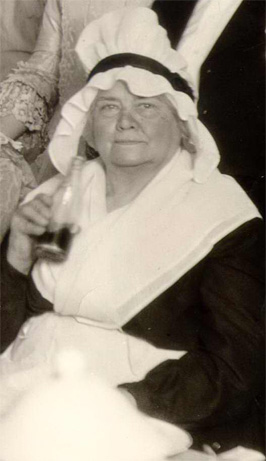
In Sandusky, Jessica was a member of the Art Study Club, pictured below at an event in which all the members dressed in historic costume.


In the Centennial issue of the Sandusky Register, on December 22, 1922, she shared excerpts from her grandfather Oran Follett’s meeting with President Abraham Lincoln in October of 1862 (available on microfilm at the Sandusky Archives Research Center).  

In the 1930s, Jessica Follett Foster moved to Los Angeles. She resided there until her death on April 30, 1960. Miss Foster was buried in the family lot at Sandusky’s Oakland Cemetery. 

In the collections of the Follett House Museum is a chair which once belonged to her grandparents, Oran and Eliza Follett, and was a favorite of her mother when she was a child.


Friday, November 06, 2015

The Bustling Waterfront in Sandusky in the 1910s


This photograph of a busy day in downtown Sandusky’s waterfront district was taken in the 1910s. The steamer “R.B. Hayes” was docked at the Cedar Point pier, while the “Arrow” was out in Sandusky Bay, most likely heading towards Cedar Point.  A third vessel, the “Ottawa,”  is on the western side of the Cedar Point pier. Several people are located near the train, including some local policemen. In this closer view, you can see a Penny Arcade located near the pier, as vacationers head towards the boarding area. 


On the very right side of the full picture, you can see the steps on the side of the Post, Lewis & Radcliffe building, now 101 East Water Street. In the view below, you can read the words New York Central Lines on the U.S. mail car number 105.


In the close-up view below, the abbreviation CCC & STL appears on the locomotive. The Cleveland, Cincinnati, Chicago and St. Louis Railway, also known as the “BigFour was an affiliate of the New York Central System for much of the first half of the twentieth century.


The foot of Columbus Avenue in Sandusky has long been the  hub of activity and transportation center, especially during the warm weather months. Visit the Sandusky Library Archives Research Center. to learn much more about the history of Sandusky and Erie County. 

Tuesday, November 03, 2015

Interior Views of an Unidentified Sandusky Store


In the Business Collection of the Sandusky Library Archives Research Center are some interior views of an unidentified business, taken in the 1950s or 1960s.  A male employee can be seen on the right side of the picture. He is surrounded by a wide array of merchandise for sale. “Approved Comics” were sold, one of which was Walt Disney’s Uncle Donald and His Nephews Dude Ranch. The store had a display of Sheaffer Scrip ink cartridges, and a wide variety of Dr. Scholl’s foot comfort remedies. Other health and beauty products sold here were Q-tips, hair nets, and “Pic a Puff” tissues. Band-aids had recently introduced their “stars and strips” bandages. Color prints could be developed from Kodacolor film for 25 cents. The picture was likely taken in the Fall, as Halloween masks can be seen next to the display of Ballreich’s chips, and a sign from Esmond’s advertised their “Fall Festival” sale. The store had recently opened a dairy delicatessen department which sold many Esmond Dairy products, including milk which cost 75 cents for two half gallon cartons. Other Esmond products sold at this unidentified store included ice cream, cottage cheese, coffee cream, sour cream and “snak dip.” In the picture below, many more Halloween masks can be seen. Decorative candy boxes line the counter at the bottom of the picture.


Here is a different view of the dairy delicatessen section of the store, which includes a wide range of grocery items in a relatively small space.


Seeing these pictures is like going back in time, when residents could buy their groceries in neighborhood stores. If you think you can identify this business, please leave a message in the Comments field of this post.

Friday, October 30, 2015

Lawrence Cable, Originally Known as Lorenz Kobul


Lawrence Cable, also known as Lorenz Kobul, was born in 1824 in Siegen, Alsace-Lorraine, which was then a part of France, but later was incorporated into the German Empire. Laurence emigrated to the United States in 1843, and he first settled in Indiana, where his brother was living. After attending college classes at the University of Notre Dame in Indiana, he moved to Sandusky. 

In the spring of 1848, he married Miss Josephine Zuercher. She died of cholera in 1849, leaving behind a young daughter named Josephine. That year he began working for the Mad River Railroad. For a time in the 1850s he worked with Ben Icsman, to furnish timber for the railroad bridge across Sandusky Bay. He worked in the shoe business from about 1856 to 1867. In 1872, Mr. Cable was named president of the newly formed Third National Bank, and he stayed in this position until his death in 1904. Ernst Von Schulenburg wrote in Sandusky Then and Now, that Cable and the bank’s treasurer, F.P. Zollinger, protected the Third National Bank “with the eyes of an Argus.” In 1904 he purchased the site of the old fairgrounds at the end of Wayne Street with the intent of building an upper middle class neighborhood. After he died, his sons Edward and Frank Cable continued the development of Cable Park, located at 1103-1234 Wayne Street.

Mr. Cable had married Victoria Stoll in 1852, and they had five children. Mrs. Victoria Cable died in 1874. Laurence married for a third time in 1880, to Miss Mena Walter. In 1880 he built a two story home at 910 West Monroe Street, which still stands today. After his death, his wife stayed at this home until she died in 1930.

       
Lawrence Cable was known for his generosity. He, along with two other parishioners, donated three bells to the St. Mary’s Catholic Church, when the current church building was in its early days. In 1902 Mr. Cable donated money to buy the former residence of C.C. Keech on Hayes Avenue for use as a hospital under the direction of the Sisters of Charity of St. Augustine. This home eventually became Providence Hospital, which later became a part of Firelands Regional Medical Center.


Lawrence Cable died on October 16, 1904; he was buried at St. Mary’s Cemetery in Sandusky. In a long life, beginning in Europe and ending in Sandusky, he became one of the community’s most respected residents. You can read much more about him in the book, History of the Western Reserve.  The Cable Family Collection is housed in the Sandusky Library Archives Research Center.  This collection documents some of the business activities of Cable and his sons Edward and Frank in the late 1800s and early 1900s.

Tuesday, October 27, 2015

Glimpse of Sandusky


An image titled Glimpse of Sandusky, From St. Paul’s Church is housed in the Sandusky Library Archives Research Center.   The engraving was done by John Douglas Woodward for the book Picturesque America, or the Land We Live In, which was edited by William Cullen Bryant in 1872, and published by D. Appleton and Company, New York. Most likely the view was actually from Saints Peter and Paul Catholic Church, looking northward toward Sandusky Bay. In the view you can see the two steeples of the First Congregational Church, which was then in Washington Park. Further north, you can see the West House hotel, which once stood where the State Theater now stands. On the right half of the illustration you can see SanduskyHigh School, and the old Academy building, which had once served as an early courthouse in Erie County.  

Picturesque America was a two volume set that described and illustrated scenes all across the United States. It was first published as a series in Appletons’ Journal, and then was published as a serialized subscription book.


Here are two pages from Picturesque America from the Internet Archive, one of which features the illustration of Sandusky in black and white.


If you would like to learn more about Picturesque America and how it was created, the book Creating Picturesque America is available for loan through the CLEVNET system.

Saturday, October 24, 2015

Sandusky Men in Libby Prison During the Civil War


This print of Libby Prison, as it appeared on August 23, 1863, was donated to the Sandusky Library by Mrs. I.F. Mack. Sandusky’s well known newspaper editor, Isaac F. Mack, was imprisoned in Libby Prison and two other Southern prison camps during the Civil War. Fortunately he survived the war and had a very successful newspaper career with the Sandusky Register


Many other area men spent time at Libby Prison, including Fred Frey, Jr., Delos Ransom, Foster Neill, Frank Colver, William B. Rice, Wilbur F. Cowles, and John M. Butler, the son in law of Jay Cooke. In December of 1863, the Ladies Aid Society from Sandusky sent packages of food which were distributed to local men who were imprisoned at the prison in Richmond, Virginia. Captains C.H. Riggs and O.H. Rosenbaum, with the 123rd Ohio Volunteer Infantry, sent a letter of thanks to the Ladies Aid Society, to the attention of Mrs. T.D. West, the Society’s secretary-treasurer. The men were thrilled to have such a package from their hometown in the midst of a dismal prison setting.  The letter appeared in the January 30, 1864 issue of the Sandusky Register, and read in part:

“To the ladies, first, (God bless them) we tender our most grateful thanks; secondly, to all others who in any way contributed thereto. Such form the bright spots in our life in Libby. Though irksome our stay in prison, we are of good cheer. Having been blessed with good health, we have no fault to find; full of confidence in the integrity of our Government, well assured that our interest are not forgotten there, and that, as soon as an exchange can be effected compatible with best interest of all, we will be released, we cheerfully submit. In conclusion, allow us to again thank the ladies and them our best wishes for their perfect success in the human work in which they are engaged, alleviating the sufferings of the sick, the sorrowful, &c. Colonel Wilson wishes to be especially remembered, and, with the other members of “Mess 32” will ever cherish in his heart of hearts the memory of the Ladies of Sandusky.”


To learn more about area men who served during the Civil War, visit the Sandusky Library Archives Research Center. Many sources, both online and in print, can aid in searching for information about Civil War soldiers.

Wednesday, October 21, 2015

Palmison's Bicycle Shop on Central Avenue


Palmison’s Bicycle Shop was in business in Sandusky, at several different locations, for over eighty years. The business was begun by Salvatore “Tutie” Palmison, who came to this county from Italy in 1888. From 1915 through the 1930s, the Palmison family resided at 411 Central Avenue, which was also the address of the bicycle shop. 

This advertisement appeared in the December 6, 1915 issue of the Sandusky Register:


In the early years, the store also carried groceries. A small article about the business was featured in the January 14, 1922 issue of the Sandusky Star Journal:


During the 1923 holiday season, the Palmison Bicycle Store sold bicycles, wagons, “kiddie cars,” as well as Christmas trees:


The Palmison family also repaired bicycles, usually in the evenings after the retail store was closed. By 1946 the store had moved to 279 East Market Street. The shop moved to 1030 Hayes Avenue in the early 1950s, when Tutie’s son John Palmison, Sr. began working in the store; after Tutie Palmison's death in 1952, his son took over the bicycle business. The store moved from its Hayes Avenue location in 1974 to 2525 South Columbus Avenue, and was known as Palmison’s Cycle City. 

An article in the July 30, 1980 issue of the Sandusky Register, stated that John Palmison, Jr. took over the business in 1978, after having worked with his father in the bicycle shop for several years. According to John Palmison, Jr., the bicycle store was busiest during the summer months as well as the holiday season. The final location of Palmison’s bicycle shop was at 1022 West Monroe Street. The store was in business through the late 1980s. The 1991 Sandusky City Directory listed Scoop’s Ice Cream shop at 1022 West Monroe Street. 

Though Palmison’s is no longer in business, the three generations of family members who worked in the bicycle store for several decades played an important role in the lives of many local residents who used bicycles for transportation and recreation along the streets of Sandusky. The address that was once known as 411 Central Avenue is now home to the Good Shepherd Center of St. Mary’s Parish.