In honor of St. Patrick's Day we are reposting this article from 2014.
A blog dedicated to the discussion of topics relating to the history of Sandusky and Erie County, Ohio, the Lake Erie Islands, and nearby communities; inspired by the collections of the Sandusky Library Archives Research Center and the Sandusky History Museum at the Follett House. A service of the Sandusky Library.
Thursday, March 17, 2022
A St. Patrick's Day Celebration
Monday, December 14, 2020
Columbian Session of the Ohio State Grange
On December
12, 13, and 14, 1893, the 21st Annual Session of the Ohio State
Grange, Patrons of Husbandry met in Sandusky. It was called the “Columbian
Session” in reference to the World’s Columbian Exposition, which was held in Chicago in 1893 to celebrate the
400th anniversary of Christopher Columbus’s arrival in the New
World.
Sessions for
the Grange members were held at Biemiller’s Opera House in downtown Sandusky. Chairman
of the evening session on December 12 was James D. Parker. According to the
December 13, 1893 issue of the Sandusky
Register, the Opera House was decorated with palms and sheaves of wheat. Mr.
Parker told the audience that he had drafted some of the children of Erie
County Grange members to participate in the entertainment portion of the
evening’s events. His son and daughter, Eva and Jay Parker performed a vocal
solo. Another daughter, Jessie Parker, played instrumental duets with Nellie
Taylor and Will Gurley. Several other solos and recitations were performed. Joseph H. Brigham, Master of the National Grange, gave the main address. Other
speakers of the evening were Rev. Mr. Hart, J.F. Greene, F.A. Derthick, and
S.H. Ellis, Past Master Ohio State Grange. Miss Hattie White recited “The First
Settler’s Story” and Mrs. Emma Rood Tuttle recited “Mother and Poet” by
Elizabeth Barrett Browning.
The Columbian Session of the Ohio State Grange was the topic of a lengthy front page article in the December 13, 1893 issue of the Sandusky Register. The Register extended hospitality to all the visiting Grange members, and the headline stated that “brilliant oratory” had graced the opening session. Pictured below is the Nielsen Opera House, which had originally opened as the Biemiller Opera House in 1877. The Opera House was the site of many of the sessions held by Ohio State Grange’s annual meeting in 1893.
Tuesday, December 22, 2015
Illustrated Lecture on the Battle of Gettysburg
Saturday, December 19, 2015
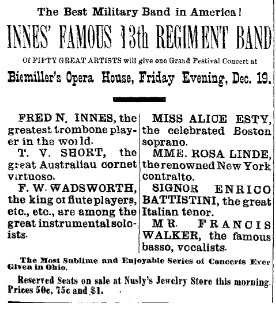
Thirteenth Regiment Band of New York Performed in Sandusky
Monday, March 17, 2014
St. Patrick’s Day Entertainment at Biemiller’s Opera House
Sunday, October 21, 2012
The Sandusky Theatre
In the picture above, three individuals can be seen painting a sign and the building of the Sandusky Theatre, about 1930. The Sandusky Theatre had a long, rich history according to an article by John Himmelein in the Twin Anniversary Edition of the Sandusky Register-Star-News from November 24, 1947. The theater was built in 1877 by Andrew Biemiller. It was first known as the Biemiller Opera House, located at southwest corner of Water & Jackson Streets on property that had originally been owned by William T. Townsend.
Biemiller’s Opera House accommodated 1,500 persons, and featured cushioned seats and excellent acoustics. The cost of the original building was $48,000. The spacious stage was sixty-six feet wide and thirty-three feet deep. The first opera to play at Biemiller’s Opera House was Wagner’s “Lohengrin.” In May of 1895, the building was purchased by Carl Neilsen. Mr. Nielsen remodeled the Opera House and changed its name to the Neilsen Opera House.
John A. Himmelein acquired the building in 1902. Again, the theater was remodeled. Mr. Himmelein stated that several types of amusements were performed here, including opera, dramatic, musical, minstrel, vaudeville, and plays by stock companies. The first attraction after the remodeling project was the play “York State Folks,” which opened on September 7, 1905. Between 1905 and 1907, the building was known as the Grand Opera House. By 1908, the name was changed to the Sandusky Theatre, after the building was leased to O.S. Hathaway. The Seitz Amusement Company leased the building in 1936 to show motion pictures, bought it in 1950, and sold it four years later. The building was razed in 1955.
Visit the Sandusky Library Archives Research Center to see a variety of programs from performances at this former Sandusky landmark.