Showing posts with label Photographers. Show all posts

Friday, April 21, 2023

Stereograph Cards of the Lake Erie Islands, by A.C. Platt


A.C. Platt was a popular photographer in Sandusky, Ohio in the 1870s and 1880s. The stereograph image above shows the A.C. Platt photographic art gallery and party room at Put in Bay. Platt produced a series of stereographic views of scenes on the Lake Erie Islands.

Here is a stereograph card of the well-known Round House at Put in Bay:

While we do not know whose house is pictured, here is a view of the inside of a home at Put in Bay:

In Coewell’s (or possibly Crowell’s) Billiard hall, several gentlemen appear to be enjoying beverages, before they play pool:

The Atlantic Billiard Hall is featured in this stereograph card:

An article from the July 9, 1873 issue of the Sandusky Register reported on the opening of the Atlantic Billiard Hall. A transcription of the article reads:

On Put in Bay

Among the new attractions this year on Put-in-Bay is the new Atlantic Billiard Hall in Doller's new building. Mr. Fred Gill, the proprietor, has fitted up the room in an elegant and tasty manner. The main room is 50x100 feet, and contains six of Brunswick, Balke and Co.'s splendid billiard tables, finished in superb style, and provided with Phelan's patent cushions, than which there are no better made. There is a pocket table for ball pool, and also one for pin pool. Mr. Gill has taken great pains to make his establishment au attractive place, one which ladies can visit with propriety and never have occasion to regret it. We are of the opinion and earnestly trust that Mr. Gill will have a successful season, for he is of a very obliging disposition, and exerts himself to the utmost to please his patrons. In addition to his billiard room, he has fitted up a ladies parlor, where ladies can go and enjoy themselves sipping lemonades or cobblers to their heart's content, without fear of molestation. In a few days Mr. Gill will have another entrance to his place, on the south side, for the especial accommodation of ladies and their escorts. He has stocked his bar with the choicest of wines, liquors and cigars, and what is better does not charge exorbitant prices for anything. A visit to the Atlantic Billiard Hall will convince any one that what we have said is strictly true, and we can assure them that Mr. Gill, who is a courteous gentleman, will strive to make them feel at home. Give him a call when you are on Put-in-Bay.

Thursday, July 29, 2021

"Mystery Photos" Taken by H.J. Epler

The photographs below were taken by photographer H.J. Epler in Sandusky, Ohio. Unfortunately we are not sure of the identity of these two individuals. All we know is that H. J. Epler took photographs of the men in Sandusky sometime between 1869 and 1873.


In the 1869 Sandusky City Directory, Harry J. Epler was listed as a photographer. He worked for A.C. Platt. In 1873 H.J. Epler was working on his own as a photographer. His studio was located at the northeast corner of Columbus Avenue and Water Streets in downtown Sandusky.

Erie County Probate Court records show that H.J. Epler married H. L. Agard on June 25, 1872. Helen L. Agard’s  father, Dr. Aurelius Homer Agard, was a well known physician in Sandusky, Ohio from 1856 to 1875, when he moved to California.


According to the book Artists in Ohio, 1787-1900, from 1876 to 1880, Harry J. Epler worked with Edwin J. Howard in the Akron area. By 1900, H. J. Epler was living with his wife Helen and their two children Charlotte and Don in Saratoga Springs, New York. City directories there, published in 1888 and 1892, list Harrison J. Epler as a photographer with Thomas J. Arnold in Saratoga Springs. Census, vital records, and directories have listed  H. J. Epler’s first name as Henry, Harry, or Harrison. Records from Greenridge Cemetery in Saratoga Springs indicate that Harrison J. Epler died in 1909, and his wife, Helen Agard Epler died in 1931. They are both buried in the East Hillside section of Greenridge Cemetery.

Thursday, July 08, 2021

Jay Hoehlein, Great War Veteran and Photographer


Jay Lawrence Hoehlein, who served as a Sergeant during World War I, was born in Sandusky, Ohio on April 16, 1889 to Lawrence and Jessie Hoehlein. (The Social Security Death Index reported his birth year as 1888.)  During his military service, he worked in the photo laboratory for the Signal Corps in Washington D.C.

Here is a picture of Jay’s fourth grade class of the Ninth Ward School (later known as Monroe School) in 1897:

He is seated directly behind the young ladies who are labeled numbers 6 and 7:

After living in Kentucky for several years, Jay and his wife Katherine moved back to Sandusky, Ohio. From 1935 until his retirement in 1979, he operated a photographic studio in Sandusky, starting out at 234 West Market Street, and later moving to Central Avenue. In the 1960’s and 1970’s, his photography studio was at 502 West Monroe Street.

On June 11, 1935, he took this picture for the Third National Exchange Bank on West Market Street in downtown Sandusky.

In the summer of 1935, he took pictures of Miss Helen Koppenhafer and Paul Mayberry, both of Norwalk, as they got married aboard the steamer Chippewa. The beautiful bride pictured below, Lucille Holtz Moosbrugger, was photographed in 1938.

An article in the July 8, 1935 issue of the Sandusky Star Journal stated that Mr. Hoehlein had the largest and most modern studio in Sandusky, and was equipped to handle all kinds of photography. The article ended with: “Hoehlein’s ideal is to render the greatest possible service at a price which will be entirely satisfactory.”   

On September 18, 1984, Jay L. Hoehlein passed away at the age of 96. He had been a member of Grace Episcopal Church and the American Legion Post 83. He was buried next to his wife, the former Katherine Horne, at Sandusky’s Oakland Cemetery.

Thursday, January 30, 2020

Harry G. Olds, Photographer in Sandusky and Argentina


In the novelty picture above, taken in Sandusky at the Bishop & Barker Photographic Studio in the late 1880’s are Harry Olds, Charlie Olds, John Irvine, and another male friend. The initials H.O. can be seen on the fan that Harry holds, on the left side of the image. 

Harry Grant Olds was born in Sandusky on November 3, 1868, to Mr. and Mrs. Henry H. Olds. Harry’s brother Charlie was born in 1871. On a passport application issued to Harry G. Olds in 1921 indicated that his father had died by 1921, and his mother Georgia Olds was residing in Detroit, Michigan. After working in Sandusky, Ohio as a photographer, around the turn of the twentieth century, Harry G. Olds moved to Argentina, where he had a successful career as a commercial photographer. In 1998, a book of his photographs was published in Argentina, entitled: Fotografías, 1900-1943 (Buenos Aires : Fundación Antorchas, 1998.) While this book is not found in the ClevNet library consortium, several copies of Fotografías, 1900-1943 are found in academic libraries in the United States and other countries.


Book Description:
Buenos Aires,: Ediciones Fundación Antorchas,, 1998,. 108p. b/w plates (1 color), ports., ind., pict. wrps. 9.5x10  in. The work of Harry Grant Olds,  Ohio-born photographer who relocated to Argentina in 1899 and lived there until his death in 1943. Much of this relatively unknown, commercial photographer's work was marketed in postcard form. His original negatives show that he concentrated on institutional, documentary and journalistic photography, publicity and landscapes in and around Buenos Aires. 

Saturday, October 26, 2019

Photographs by John G. Brittingham


According to the 1886 Sandusky City Directory, John G. Brittingham was a photographer whose work was “unexcelled and guaranteed.” His studio was at 707 Market Street (between Columbus Ave. and Jackson St.), and he resided at 1059 Columbus Avenue.


We do not know the name of the young lady in the cabinet photograph below, but Mr. Brittingham took this picture at his Market Street studio. This studio was later occupied by J.M. Lloyd, who was a photographer in Sandusky from about 1888 to 1893; it appears that Lloyd may have acquired the studio when Brittingham moved to Springfield Illinois. (According to A Directory of Early Illinois Photographers, published in 1977, John G. Brittingham was in business in SpringfieldIllinois in the late 1880s.)


Another picture taken by Mr. Brittingham features the names of the cities of both Springfield, Illinois and Sandusky, Ohio at the bottom of the portrait. Perhaps Mr. Brittingham traveled between Ohio and Illinois for a time.


Saturday, September 12, 2015

E.H. Schlessman, Commercial Photographer


During the first quarter of the twentieth century, Edward H. Schlessman was a commercial photographer in Sandusky. On his World War I Draft Registration card, Mr. Schlessman stated that he was self-employed as both a photographer and a taxi driver.


Though he made his living by taking pictures, no known picture of him is in the historic photographic collections of the Sandusky Library Archives Research Center. 

Mr. Schlessman’s photos and postcards chronicled the everyday life of area residents. Ice workers and friends were captured on Sandusky Bay in this postcard from December, 1909.

     
In 1912  Schlessman took a picture of the Shamrocks, who were the champions of their baseball league that season.


Sandusky newsboys who were promoting the Saturday Evening Post were captured in this 1916 Schlessman postcard, near the stand of Norman Holzaepfel.


A young lady feeding two horses is the subject of this undated photograph.

          
When a tornado struck Sandusky in 1924, Schlessman took a series of photographs that showed how much damage the tornado had caused to the Sandusky area. You can see that many buildings were reduced to rubble.

       
The National Guard can be seen near their supply area in this photo taken on June 28, 1924.


By 1934 Edward H. Schlessman had left Sandusky. A legal notice which appeared in the September 22, 1934 issue of the Sandusky Star Journal stated that his last known address had been in Detroit, Michigan, and his wife, Mrs. Josephine Schlessman, had filed for divorce. Though Edward Schlessman moved away from Sandusky, he left us with a better understanding of local life in our community. Visit the Sandusky Library Archives Research Center to view over one hundred photographs taken by E. H. Schlessman.

Tuesday, August 18, 2015

Willard A. Bishop, A Popular Sandusky Photographer


Willard A. Bishop was born in Shelby County, Indiana in 1856. In 1880, he moved to Sandusky, Ohio, where he opened a photographic studio. The 1882 Sandusky City Directory listed his studio at the northeast corner of Water Street and Columbus Avenue, with his residence at the West House hotel. By 1884, Mr. Bishop had a partnership with James H. Veitch in a photography studio in Stone’s block, on the corner of Columbus Avenue and Market Street. Besides taking photographs, Bishop and Veitch also created crayon drawings and ink portraits for their customers. Frank S. Barker was a partner with W.A. Bishop in 1886, and by then the studio had moved to 725 Washington Row, which is now in the 200 block of West Washington Row.  By 1888, W.A. Bishop was the sole proprietor of the studio, which can be seen in the picture below, taken in the first decade of the 1900s. Mr. Bishop remained in this location until 1941.


On the back of a cabinet card, Bishop advertised as a “photographic artist,” whose studio was all on the ground floor.


Bishop took pictures of individuals, families, businesses, and local government offices. This 1908 picture shows Sandusky’s downtown after a sleet storm.


Here is a composite picture of the Sandusky High School graduates of 1911:


In 1908 Mr. Bishop gave the history room at the Sandusky Library three frames containing 149 pictures of business and professional men of Sandusky whose portraits he had taken prior to this time. These portraits are now in the collections of the Sandusky Library Archives Research Center. 

More than just a photographer, Mr. Bishop was active in many local community activities. In 1903, he was in the cast of “The New Dominion”, a play which was performed at the Nielsen Theater. He can be seen here with fellow cast member Annette Fitch Brewer.


In 1917 Willard A. Bishop was the chairman of the building committee of the Good Samaritan Hospital. He is the second individual on the left in the picture of the ground breaking for the new hospital building on Van Buren Street which was built in 1918-1919.


Late in 1941, Willard A. Bishop’s health began to fail. He passed away on January 31, 1942. A lengthy obituary for Mr. Bishop is found in the 1942 Obituary Notebook at the Sandusky Library. It read in part, “Few men were better known or highly respected in Sandusky than Mr. Bishop…his camera recorded the history of Sandusky in pictures in the thousands of negatives on file in his studio here.”  The article pointed out that Bishop’s pictures told the story of the surrender of the horse to the automobile, and portrayed the transformation of the hoop-circled American girl to the modern athletic person of the 1940s. Funeral services for Willard A. Bishop were held at the Keller Funeral Home, and graveside services at Oakland Cemetery were held under the auspices of Erie Commandery, Knights Templar. Mrs. Bishop, the former Mary Mathews, had predeceased her husband in 1925.

Tuesday, June 30, 2015

Gainsborough Photographers

From 1931 until 1982, Gainsborough Photographers did business at 223 West Washington Street, on the street level of the Odd Fellows Temple in downtown Sandusky.


Though this close up view is not very clear, you can see that at Gainsborough’s you could have portraits taken, or purchase a camera.


Samuel Barkan opened the Gainsborough photographic studio in Sandusky in October of 1931. There was a studio in Lorain as well. An opening day special included twelve 4 x 6 inch pictures in a folder, and a 7 x 9 inch color picture in an easel frame, all for $7.50.


In the 1940s, Sam Barkan resided on Fifth Street in Sandusky with his wife Ann, and their two daughters. During World War II, there was a patriotic display at the Gainsborough Studio during Sandusky’s fifth war loan drive. Every customer who purchased a $25 war bond received a picture of one of the panels of the Honor Board that was on display in Washington Park.


This undated advertisement shows the services available at Gainsborough’s, which included family and commercial photography, sales of photographic equipment and supplies, camera repair, and one day film finishing, as well as reprints and enlargements.


When customers picked up their developed film, the prints were inside a paper album that stated “Send a snapshot with every letter.”


In the 1950s, Sam Barkan wrote a newspaper column entitled “The Camera Column.” This column appeared in the May 12, 1954 issue of the Sandusky Register Star News.


This artistic picture of a championship bowling team was created by Gainsborough Photographers.


Sam Barkan’s name was associated with the Gainsborough Photography studio through the 1960s. In the 1969 Sandusky City Directory, he was listed as the president of Gainsborough, Inc. and Mrs. Ann Barkan was the secretary-treasurer. From 1970 through 1977, George A. Hassenplug was the proprietor of Gainsborough Photographers. Rick Abbott operated Gainsborough Photographers from 1978 until the studio closed in October of 1982. By 1970 Sam and Ann Barkan had moved to Columbus, Ohio. Mr. Sam Barkan passed away at the age of 67 on September 6, 1972. Ann Barkan died in 2006. Both Mr. and Mrs. Barkan were buried at Green Lawn Cemetery in Columbus. During their years in Sandusky, Mr. and Mrs. Barkan were active members of the Oheb Shalom Temple.

Friday, November 14, 2014

Stereograph Cards by A.C. Platt


Stereographs are a pair of nearly identical images that give a three dimensional effect when viewed through a device called a stereoscope. Several stereographic cards are found in the collections of the Sandusky Library and the Follett House Museum. Above is a stereograph card of the Erie County Courthouse created by Sandusky photographer A.C. Platt, probably around 1876. A group of stereographs created by Mr. Platt were donated to the Sandusky Library by Mrs. John H. Jacques. The cards originally belonged to her father, Willis Merry. Mrs. Jacques was a direct descendant of Ebenezer Merry, a pioneer settler of the Firelands. A view of Sandusky High School and the old academy building can be seen in the stereograph card below. The academy building was used as a courthouse prior to the construction of the Erie County Courthouse in 1875. It was torn down in 1884.


This view of downtown Sandusky was taken from the upper level of the Erie County Courthouse. The steeples of the Congregational Church, then in Washington Park, are visible. This church was demolished in 1896, and a new church was built at the northwest corner of Columbus Avenue and Jefferson Street. In the background, you can see a portion of the Cedar Point peninsula


     In 1875, the first city water works was under construction, at Meigs and Washington Streets. Here you see construction scaffolding around the standpipe. If you look closely, you can see men at the top of the scaffolding.


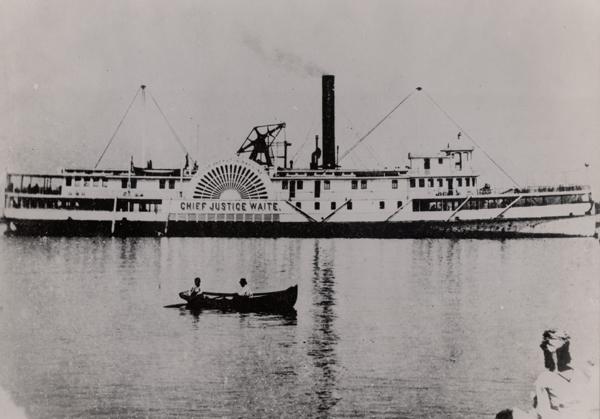
Below is a view of the Sandusky’s waterfront in the early 1880s. The vessel Chief Justice Waite is partially obscured by an unidentified ship in Sandusky Bay.


Thanks to A.C. Platt’s stereograph cards, we can get a sense of what life was like in Sandusky in a bygone era.

Monday, May 19, 2014

N.J. Abele and Charles A. Bogert


From about 1915 through the 1930s, Nicholas J. Abele and Charles A. Bogert shared a building at 205 West Market Street in downtown Sandusky. Nicholas J. Abele was a photographer and photo finisher. Nicholas J. Abele continued in the photography business in Sandusky until 1949.  An advertisement in the July 1, 1916 issue of the Sandusky Star Journal stated that customers would be delighted when Nick Abele was finished with their pictures.


These postcards of Sandusky area basketball teams were created by Nicholas J. Abele during the winter of 1912-1913. The first postcard features the Holzaepfels basketball team.


This postcard shows the basketball team from the Sandusky Business College in 1912-1913.
Although the handwritten note on the postcard reads 1922-23, a closer look at the markings on the basketball reveals that the image is from 1912-13.)

 Charles A. Bogert operated a jewelry store at 205 West Market Street. Later, Mr. Bogert was the proprietor of the Sandusky Recreation Center. He was a nationally known trapshooter. For a time he managed the Camp Perry National Rifle matches during the summer months. Mr. Bogert died in 1945, and Nicholas J. Abele passed away in 1953. Both men were well known and respected in Sandusky’s business circles.

Monday, August 13, 2012

J. M. Frisbie, Daguerreotype Artist

In the 1850 U.S. Census, John M. Frisbee was residing in the household of Sandusky lawyer F.D. Parish in Portland Township, now known as the city of Sandusky. His occupation was listed as Daguerreian artist. The advertisement below appeared in the January 16, 1851 issue of the Daily Sanduskian:


A biographical sketch from Artists in Ohio, 1787-1900: A Biographical Dictionary states that J. M. Frisbie was born in Guilford, Connecticut in 1802. He came to Ohio in 1842, and was active as a daguerreotype and ambrotype artist from the mid-1850s until at least 1874.

This page from the 1855 Sandusky City Directory places J.M. Frisbie’s Daguerreotype Rooms at 155 ½ Water Street. Mr. Frisbie kept up with the latest technological advances and business practices in his long career as a photographer in Sandusky. He used sky and side lights in his studio, to give every possible advantage of light. He used Voigtlander cameras and processed his photographs using superior chemicals. And as was common among photographers of the time, Mr. Frisbie took pictures of sick or deceased persons, even going to the person’s home if necessary.

By the time the 1860-1861 Sandusky City Directory was published, Frisbie’s ad stated that he had a Photographic and Ambrotype Gallery at 135 Water Street, and that his was the oldest such establishment in the city of Sandusky. The ad read, “Likenesses taken in every style and in all weather, at prices with the read of all.”


During the Civil War, Frisbie produced this carte de visite in Sandusky:


J.M. Frisbie died in February of 1880. He was buried in Sandusky’s Oakland Cemetery. A large monument with the name of Mr. and Mrs. Frisbie, along with four of their children is found in Block 32 of the Cemetery. 

To see photographs taken by J.M. Frisbie and other early Sandusky photographers, visit the Sandusky Library Archives Research Center.