Miss Rose Ball was born May 4, 1877 in Reed Township, Seneca
County, Ohio. An article in the February 20, 1926 issue of the Sandusky Star Journal stated that Rose Ball was
a well-known nurse, having graduated from Providence Hospital School of
Nursing. U.S. Census Records list Rose’s occupation as a nurse in 1910, 1920
and 1930. She resided in Sandusky, Ohio during these years. In October of 1933,
Rose Ball was on the featured speakers at the banquet of the Nurses’ Alumnae
Association of Providence Hospital, which was held at the Hotel Rieger. After
having been in poor health for several years, Miss Rose Ball died on September
6, 1956 in Tiffin, Ohio. Though we do not know the exact year of Rose’s
graduation from nursing school, this is how Providence Hospital looked in 1910.
The facility formerly known as Providence Hospital is now the South Campus of
Firelands Regional Medical Center.
A blog dedicated to the discussion of topics relating to the history of Sandusky and Erie County, Ohio, the Lake Erie Islands, and nearby communities; inspired by the collections of the Sandusky Library Archives Research Center and the Sandusky History Museum at the Follett House. A service of the Sandusky Library.
Showing posts with label Nursing. Show all posts
Saturday, May 04, 2013
Sunday, August 19, 2012
Medicine in the Civil War: Part Two - Nurses
Nursing during the Civil War started out as a duty done by less sick soldiers in hospitals. Eventually women who were inspired by Florence Nightingale in the Crimean War came to hospitals to cheer up troops, and became nurses. This allowed soldiers to go back to the front faster, and concentrate on healing. On top of caring for soldiers nurses also helped entertain, assist in surgery, administer medicine, write letters home for those who could not, and search for supplies.
Before female nurses were allowed in hospitals, young women who lived near the hospitals would visit to help care for and entertain the wounded. They would bring food, alcohol, and flowers. They would also play the piano, sing, and read poetry. This was frequently done on Sunday. After the war had been going on for a while female nurses were more accepted, and recruited so male nurses could return to fight in the war. The nursing service had women from all parts of society.
Dorothea Dix was working as a copy clerk for the U.S. government in Washington D.C. in1862, when she noticed how bad the military hospitals were. She took it upon herself to walk into the office of Acting Surgeon General R. C. Wood and tell him that the War Department did not have adequate resources to treat its soldiers. There were only a few surgeons, not enough nurses -- which meant that soldiers were filling the nursing role -- and no permanent hospitals. She asked to put together a female nursing corps of volunteers under the War Department. She sought the help of Dr. Elizabeth Blackwell to do this. She hoped to keep romance out of the army, so her requirements for nurses were very strict. Her requirements, which were published as an article in the Sandusky Register, included: only plain looking women over the age of thirty could apply, married ladies preferred; dresses must be brown or black; women’s clothing could not have any jewelry, and their hair could not have bows or curls; women could not wear hoop skirts. This was because hoops were cumbersome, and made movement in narrow wards difficult. The ban on hoop skirts was even published in the Sandusky Register as an order from the government.
Nursing was not yet a profession and most who took the role learned as they worked. Convalescent soldiers usually filled the role, before women were allowed to work as nurses. Ill soldiers were expected to take care of each other. Only wounded had special treatment from medical staff at the beginning of the war. Many women followed their male family members into service, and then by accident became nurses. Nuns were also nurses. Some doctors liked them the best because they did not question the doctor’s authority. Women nurses were also sought out when it was discovered that a soldier was a woman and she needed treatment.
Female nurses were new in the military. The position was open to any women no matter their class, although upper class women were looked down on if they became nurses. Nursing duties included administering medicine, distributing special diets ordered by the doctor, writing letters, and attending to visitors. In cases where a soldier was dying and he was alone, they would sometimes pretend to be the dying soldier’s relative to make him feel better. Another thing nurses did to make things easier was to fill out a card with the patient’s information and attached it to the head of the patient’s bed for staff to read.
Opponents to female nurses said that they were too weak to help. The strongest of these critics were male doctors. Nurses had to care for wounded not just in hospitals, but in tents, caves, under trees, in fields and in barns. Nurses would go out while the battle was still occurring to take care of the men. After battles the wounded would lie close together for miles. Clara Barton said, “The wounded laid so close it was impossible to move about in the dark. The slightest misstep brought a torrent of groans from some poor mangled fellow in your path.” This was her experience, and men thought that at the sight of such things women would faint. They were wrong.
Female nurses received twelve dollars a month while their male counterparts received twenty. Female nurses were well aware of the difference. Pay was not just an issue for nurses. Doctors had problems receiving their pay also. It would sometimes take months. In June of 1861, Dr. McMeens wrote a letter to the Register. In the letter, he stated that he had been in the Army for two months and had not been paid yet. He then went on to ask his patients who owed him money to pay his wife. They could pay the entire bill or only part of it.
Nurses, because they were so close to patients, could often discover things about the patient that the doctor had missed. This occurred to one local soldier who had received a scalp wound in battle. He said, “She (the nurse) had been engaged in washing the blood from my head and face when she discovered that what had seemed on a superficial view to be the most desperate wound of the head, including the skull was but a mere scalp wound which bled profusely and doubtless made a most unpromising case for surgery at first view.” Cases like this were common. Sometimes because of the circumstances of the war and the way medicine was practiced at the time, things were overlooked and people were not treated properly.
Nurses also served an important function in letter writing. They would write for soldiers who could not. They would also write letters trying to find information about soldiers. One such letter appeared in the Sandusky Register in June of 1863. Sarah L. Porter wrote a letter about a soldier named Joseph Cramer who was in her care at a hospital in Washington D.C. She could not get much information from him before he died, except that he was from Sandusky. After his death, she wrote a letter to the Postmaster of Sandusky, and it was published in the paper. She asked that his friends and family contact her. Medical professionals did this so that personal belongings of soldiers could be sent home, and so people could get closure.
The author Louisa May Alcott was a nurse during the Civil War. Not only did she recount her experiences in a book, she also wrote for newspapers. One article that appeared in the Boston Commonwealth was reprinted in the Sandusky paper. It recounted the story of a soldier who was sick and dying. He had her write a letter to his mother for him, and the article also talked about how his comrades who were in the hospital could not stand to see him die. This article also gave an impression about how female nurses were treated.
As stated before, a lot of soldiers in the hospital were sick, not wounded. Alcott noted in her book Hospital Sketches, “I spent my shining hours washing faces, serving rations, giving medicine and sitting in a very hard chair with pneumonia on one side, diphtheria on the other, two typhoid’s opposite.” Typhoid was one of the more prominent illnesses. Treatment for it was quinine, whiskey, and turpentine. Sometimes all nurses could do was comfort the patient.
By the end of the war, women had helped heal the sick and inspired soldiers to fight. They applied for pensions, and some received medals. Many published their memoirs. Some even went on to start the campaign for women’s rights and the right to vote. The Civil War was a starting point for women to move towards equality.
Before female nurses were allowed in hospitals, young women who lived near the hospitals would visit to help care for and entertain the wounded. They would bring food, alcohol, and flowers. They would also play the piano, sing, and read poetry. This was frequently done on Sunday. After the war had been going on for a while female nurses were more accepted, and recruited so male nurses could return to fight in the war. The nursing service had women from all parts of society.
Dorothea Dix was working as a copy clerk for the U.S. government in Washington D.C. in1862, when she noticed how bad the military hospitals were. She took it upon herself to walk into the office of Acting Surgeon General R. C. Wood and tell him that the War Department did not have adequate resources to treat its soldiers. There were only a few surgeons, not enough nurses -- which meant that soldiers were filling the nursing role -- and no permanent hospitals. She asked to put together a female nursing corps of volunteers under the War Department. She sought the help of Dr. Elizabeth Blackwell to do this. She hoped to keep romance out of the army, so her requirements for nurses were very strict. Her requirements, which were published as an article in the Sandusky Register, included: only plain looking women over the age of thirty could apply, married ladies preferred; dresses must be brown or black; women’s clothing could not have any jewelry, and their hair could not have bows or curls; women could not wear hoop skirts. This was because hoops were cumbersome, and made movement in narrow wards difficult. The ban on hoop skirts was even published in the Sandusky Register as an order from the government.
Nursing was not yet a profession and most who took the role learned as they worked. Convalescent soldiers usually filled the role, before women were allowed to work as nurses. Ill soldiers were expected to take care of each other. Only wounded had special treatment from medical staff at the beginning of the war. Many women followed their male family members into service, and then by accident became nurses. Nuns were also nurses. Some doctors liked them the best because they did not question the doctor’s authority. Women nurses were also sought out when it was discovered that a soldier was a woman and she needed treatment.
Female nurses were new in the military. The position was open to any women no matter their class, although upper class women were looked down on if they became nurses. Nursing duties included administering medicine, distributing special diets ordered by the doctor, writing letters, and attending to visitors. In cases where a soldier was dying and he was alone, they would sometimes pretend to be the dying soldier’s relative to make him feel better. Another thing nurses did to make things easier was to fill out a card with the patient’s information and attached it to the head of the patient’s bed for staff to read.
Opponents to female nurses said that they were too weak to help. The strongest of these critics were male doctors. Nurses had to care for wounded not just in hospitals, but in tents, caves, under trees, in fields and in barns. Nurses would go out while the battle was still occurring to take care of the men. After battles the wounded would lie close together for miles. Clara Barton said, “The wounded laid so close it was impossible to move about in the dark. The slightest misstep brought a torrent of groans from some poor mangled fellow in your path.” This was her experience, and men thought that at the sight of such things women would faint. They were wrong.
Female nurses received twelve dollars a month while their male counterparts received twenty. Female nurses were well aware of the difference. Pay was not just an issue for nurses. Doctors had problems receiving their pay also. It would sometimes take months. In June of 1861, Dr. McMeens wrote a letter to the Register. In the letter, he stated that he had been in the Army for two months and had not been paid yet. He then went on to ask his patients who owed him money to pay his wife. They could pay the entire bill or only part of it.
Nurses, because they were so close to patients, could often discover things about the patient that the doctor had missed. This occurred to one local soldier who had received a scalp wound in battle. He said, “She (the nurse) had been engaged in washing the blood from my head and face when she discovered that what had seemed on a superficial view to be the most desperate wound of the head, including the skull was but a mere scalp wound which bled profusely and doubtless made a most unpromising case for surgery at first view.” Cases like this were common. Sometimes because of the circumstances of the war and the way medicine was practiced at the time, things were overlooked and people were not treated properly.
Nurses also served an important function in letter writing. They would write for soldiers who could not. They would also write letters trying to find information about soldiers. One such letter appeared in the Sandusky Register in June of 1863. Sarah L. Porter wrote a letter about a soldier named Joseph Cramer who was in her care at a hospital in Washington D.C. She could not get much information from him before he died, except that he was from Sandusky. After his death, she wrote a letter to the Postmaster of Sandusky, and it was published in the paper. She asked that his friends and family contact her. Medical professionals did this so that personal belongings of soldiers could be sent home, and so people could get closure.
The author Louisa May Alcott was a nurse during the Civil War. Not only did she recount her experiences in a book, she also wrote for newspapers. One article that appeared in the Boston Commonwealth was reprinted in the Sandusky paper. It recounted the story of a soldier who was sick and dying. He had her write a letter to his mother for him, and the article also talked about how his comrades who were in the hospital could not stand to see him die. This article also gave an impression about how female nurses were treated.
As stated before, a lot of soldiers in the hospital were sick, not wounded. Alcott noted in her book Hospital Sketches, “I spent my shining hours washing faces, serving rations, giving medicine and sitting in a very hard chair with pneumonia on one side, diphtheria on the other, two typhoid’s opposite.” Typhoid was one of the more prominent illnesses. Treatment for it was quinine, whiskey, and turpentine. Sometimes all nurses could do was comfort the patient.
By the end of the war, women had helped heal the sick and inspired soldiers to fight. They applied for pensions, and some received medals. Many published their memoirs. Some even went on to start the campaign for women’s rights and the right to vote. The Civil War was a starting point for women to move towards equality.
Monday, March 07, 2011
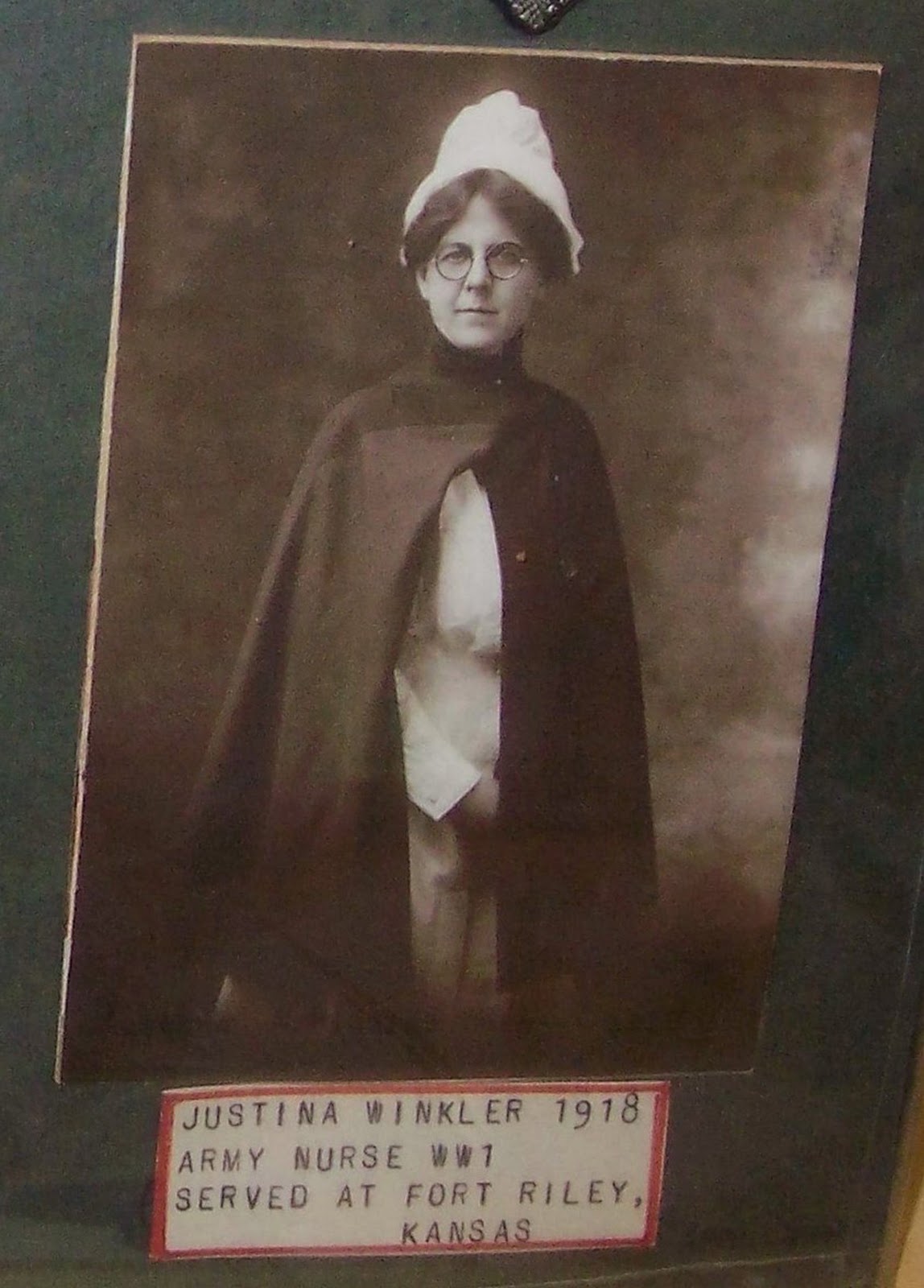
Justina Winkler, World War I Nurse
Miss Justina M. Winkler was born in Sandusky on March 4, 1872 to Leonard and Theresa Winkler. She earned her diploma as a graduate nurse from St. Vincent’s Hospital in Toledo in 1908. During World War I, Justina worked as a nurse at the hospital located on base at Fort Riley, Kansas.
After the war, Justina worked as a nurse at Providence Hospital and for the Metropolitan Life Insurance Company. She was a member of the Commodore Denig Post of the American Legion, the Erie County Chapter of the American Red Cross, and she was a charter member and past president of the Santa Clara Auxiliary, United States Spanish War Veterans. Miss Winkler also served as secretary of the Erie County Soldiers’ Relief Commission. On August 24, 1939, Justina Winkler passed away after a lengthy illness. She was buried at Oakland Cemetery with a full military service. Funeral services were held at the home of her sister, Mrs. Norman Jesson, as well as at St. Mary’s Church. The 1939 Obituary Notebook at the Sandusky Library features several obituaries for Justina Winkler. One read, in part: “Miss Winkler was known for her faithful and energetic work as officer and member of several patriotic, church and civic organizations. Nearly every patriotic holiday in the last twenty hears found Miss Winkler aiding in some capacity in the observance.”
Sunday, September 26, 2010
Training Nurses in Sandusky
September 26, 1907 was the date of the first official graduating class from the Providence School of Nursing. Providence Hospital opened its doors at 1912 Hayes Avenue on April 5, 1904, under the direction of the Sisters of Charity of St. Augustine of the Cleveland Diocese. In 1923, the diocesan boundaries were re-drawn, placing Sandusky in the Toledo diocese, so the Sisters of Charity of St. Augustine transferred ownership to the Sisters of St. Francis, Sylvania, Ohio.
From 1910 to 1937, Good Samaritan Hospital also trained nurses. A listing in the 1923 Sandusky City Directory shows Good Samaritan Hospital at 624 Van Buren Street, and the Good Samaritan Hospital nurses’ home at 612 Van Buren Street.
Here is a scene from the Good Samaritan nurses’ residence in 1923; the young ladies may actually be Good Samaritan nursing students:
If male callers came to visit the nursing students, they had to stay in the “beau’s room” at the end of the hall, and they were never to enter the upstairs rooms of the young ladies.
Names of individual nurses who resided in Sandusky were listed on pages 501 and 502 of the 1923 Sandusky City Directory.
Today individuals who wish to enter into a career in nursing can enroll at Firelands Regional Medical Center School of Nursing. The history of the school has its origins in Sandusky, dating back to 1905. Today's Firelands Regional Medical Center is the combination of three former hospitals in Sandusky, Good Samaritan Hospital, Sandusky Memorial Hospital, and Providence Hospital.
Visit the Sandusky Library Archives Research Center to learn more about the history of health care in the Sandusky area. Books, historical newspaper articles, city directories, and other archival resources provide details about the former hospitals, nurses and doctors who served Sandusky residents.
Subscribe to:
Posts (Atom)