Showing posts with label Margaretta. Show all posts

Saturday, September 28, 2024

The Dorastus Snow Family and a Wartime Raid in Margaretta Township


 According to the September 1860 Firelands Pioneer, Dorastus P. Snow was the first white settler in Margaretta Township. He built a log house and also constructed a grist mill on Cold Creek. In 1813, there were three families living in the area of Cold Creek, those of Dorastus P. Snow, and the families of Mr. Butler and Mr. Putnam.

A copy of the map of Dorastus Snow's property along Cold Creek in 1823

In June of 1813, while the men were in the fields, the women and children of the families were attacked by sixteen Odawa (Ottawa) men allied with the British who controlled Fort Detroit during the War of 1812. The women were told they would be taken to Detroit. Mrs. Hannah Snow, however, was physically unable to travel due to an illness (or pregnancy), so she and three of the children were killed, while the rest of the group was taken to Detroit and given over to the British agent named Ironside. All the survivors were eventually returned to safety by the Fall of the same year, when United States forces established contact with the British in Detroit.

After life returned to normal at the end of the war, Dorastus Snow married Anna Faulk in 1818, and they had a son named Charles Snow. (After Mr. Snow’s death in 1824, Anna married Philip Cowell, and they had several children.) The Firelands Pioneer lists the children of Dorastus Snow from his first marriage as: Henry, Alanson, Willard, Electa, and Laura. 

Charles and Willard Snow are both buried in the Castalia Cemetery of Margaretta Township.  The inscription on Willard Snow's tombstone (pictured below) is in memory of his mother and brother who were murdered in 1813. (Though the stone reads 1812, all other sources indicate that the killings took place in 1813.) Willard Snow died on January 22, 1875. He was a Veteran of the Civil War, having served in the 40th Illinois Volunteer Infantry.


There are several accounts of the Snow Massacre. You can read about it in Lewis Cass Aldrich’s A Standard History of Erie County, Ohio, as well as The History of the Firelands, by W. W. Williams, both available at the Archives Research Center of the Sandusky Library.

Wednesday, July 19, 2023

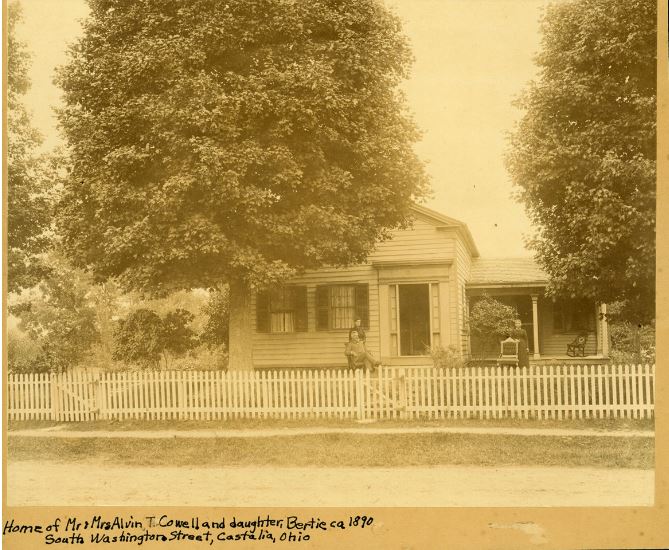
The Cowell Family of Castalia


For many years Mr. and Mrs. Alvin T. Cowell resided in a home on South Washington Street in Castalia, approximately where the Castalia Branch of Civista Bank is now located. Mr. and Mrs. Cowell are in front of the house, and their daughter Frances Alberta Cowell, known as “Bertie” or “Fannie” is standing by a chair.

The book A Standard History of Erie County, Ohio, by Hewson L. Peeke provides biographical information about Alvin Cowell and his family:

Alvin T. Cowell was reared in Castalia, attended the public schools there, and was about seventeen years of age when the country was thrown into the confusion resulting from the outbreak of the Civil war. A few years later he responded to the call of his patriotism and enlisted on May 2, 1864, in Company I of the One Hundred and Forty-fifth Volunteer Infantry of Ohio. He was out about four months, and spent most of the time with his regiment in guard duty at Arlington Heights, just across the Potomac River from Washington. On receiving his honorable discharge he returned to Erie County, and subsequently .had the advantage of a brief attendance at the Notre Dame University in South Bend, Indiana. With this preparation for practical life he became a farmer, and for many years conducted a large farm of more. than 200 acres in the vicinity of Castalia. While a man who has been known for his strict attention to his business, he has at different times consented to serve in the public interest and for six years was a trustee of Margaretta Township. At the present time he is living in Castalia, and has all the conveniences and comforts he needs for the evening of life.

On February 28, 1910, Mr. Cowell was called upon to mourn tine loss of his faithful companion who had shared with him in the joys and sorrows of existence for nearly forty years. On December 26, 1871, he married Catherine Cooper, who was born in Mount Vernon,. Ohio, a daughter of Cyrus and Sarah (Mitchell) Cooper. Her father was for many years a resident of Knox County, Ohio, and came from there to Margaretta Township where he was a prosperous farmer, but finally sold his land and spent his declining years at Clyde, Ohio, but his body now rests in the cemetery at Castalia. Mr. and Mrs. Cowell became the parents of two children. Fannie A. is the wife of Rev. Charles J. Dole, who is pastor of the Congregational Church at Chelsea, Michigan. The only son, Philip C., is now deceased. Rev. Mr. Dole and wife have five children named Marie L. Catherine Irene, Alberta A., Edward C. and Charles R.

Frances Alberta Dole married a Congregational minister, Rev. Charles Joel Dole in 1891. In the late 1800s, Rev. Dole served as the minister of the Castalia Congregational Church. Two of the Dole daughters had long careers with the Sandusky Library. Miss Irene Dole was the librarian for the Castalia Branch Library from 1942 to 1968. During her time as librarian, the library was housed in the former Town Hall on Main Street in Castalia. The former town hall in Castalia is pictured at the left, in the post card below, about 1905.

Mrs. Alberta Dole Smith was the children’s librarian at Sandusky Library during the 1950s and early 1960s. Mrs. Smith’s picture appeared in the Sandusky Register during National Library Week, on March 19, 1958. The article stated in part: “Children’s librarians feel that none of their patrons will turn out to be a Johnny or Joan who “can’t read” as they are accustomed to having books around the home, and visiting a store house of wonderful and exciting book friends.”

Friday, June 04, 2021

Distiller’s Bond Issued to Fredrick Hofner


On December 20, 1867, Fredrick Hofner was issued a Distiller’s Bond from the United States Internal Revenue Service. Mr. Hofner lived in Margaretta, in Erie County. He was listed as the principal, with Isodore Metterer and John Charles Boloker, of Sandusky, Ohio serving as sureties. Fredrick Hofner was in the business of distilling grapes, and by signing this bond he agreed to see that all taxes, including any penalties owed, were paid to the United States government. Five five-cent tax stamps were attached to the Distiller’s Bond, and were properly cancelled. 

In the 1880 U.S. Census, Frederick Hoffner still resided in Margaretta Township, Erie County, Ohio, with his wife, four children, and three grandchildren. Mr. Hoffner died on March 27, 1890, and was buried at the St. Mary’s Cemetery in Sandusky, Ohio.

Wednesday, January 10, 2018

An Area Known as Mustcash


According to The History of the Fire Lands by W. W. Williams (Leader Printing Co., 1879), the area known as Mustcash or Muscash was located in the northwest section of Margaretta Township in Erie County, Ohio. Some of the families who lived in this area included the Prentice, Wadsworth and Neill families. A description of Mustcash is found on page 37 of History of the Descendants of the Families of Ira Barnes, Hiram Barnes, Richard Wadsworth and Levi Prentice of Mustcash, Ohio : From 1817 to 1913, by N.E. Prentice,  (Payne, Ohio, 1913). the author describes the area as “the point of land that extends into Sandusky Bay on the south shore.”  It was first called Mustcash Point, and then the word “Point” was dropped. 

The area considered Mustcash eventually included the land of the families living further back from the water, along what is now Wahl Road. (Note: People have argued about the exact location of Mustcash for over one hundred years.) This brief article from the September 13, 1876 issue of the Sandusky Register tells us that the Margaretta Hayes Wheeler and Foster Club was to meet at Neill’s school house in Mustcash to discuss the election of 1876.  Rutherford B. Hayes did indeed win the presidential election, with William A. Wheeler serving as his Vice President. Republican Charles Foster served four terms in the House of Representatives, and later he was Ohio’s Governor, in office from 1880 to 1884.


In the late 1800s, there was a small Lutheran church in Mustcash served by Rev. Jacob Dornbirer, who later was the pastor of Zion Lutheran Church in Sandusky. This picture from History of Zion Lutheran Church shows the interior of St. Paul’s Lutheran Church at Mustcash:


The Mustcash congregation was later combined with the Lutheran church in Castalia, now Grace Lutheran Church. 

The (possibly apocryphal) origin of the name Mustcash/Muscash is explained briefly in Hewson Peeke’s Standard History of Erie County (Lewis Publishing Co., 1916):  “The name Muscash is said to be of Indian derivation, and arose from the fact that the tribes brought their skins here for barter, and not being able to speak English, and wanting money instead of produce, insisted on "Muscash" or must cash.”

In this map of Castalia from the 1896 Erie County Atlas, you can see Mustcash Road leading in the northwest direction, away from the village of Castalia:


Sunday, July 17, 2016

Weyers Station and Matthias Weyer


The small unincorporated community known as Weyers or Weyers Station was located at the junction of Skadden and Bardshar Roads in Section One of Margaretta Township, Erie County, Ohio. It was named for an early resident of the area, Matthias Weyer. An article found in the historical files of the Sandusky Library Sandusky Research Center states that Matthias Weyer, a native of Germany, settled in Margaretta Township in 1852. His son, also named Matthias Weyer was named Postmaster of Weyers in 1895. By 1902, the Post Office at Weyers closed, and the mail that had been delivered there was sent to Parkertown, where Portland Road crosses the railroad. Below is a page from the U.S. Appointment of U.S. Postmasters, 1832-1971, a database from Ancestry Library Edition.


The old Mad River and Lake Erie Railroad, and railroads that superseded it, passed through the community of Weyers, most likely picking up and dropping the U.S. mail as it traveled through. It is said that there was an old quarry south of the railroad crossing, which was used to furnish gravel for the road bed of the first railroad. There was once a grain elevator at Weyers, and a store and lunch counter were in business there for a time. 

Matthias Weyer, the son, died in 1902. His will is on file at Erie Probate Court, as well as at Ancestry Library Edition. Below is a portion of his will.


Matthias Weyer, the former Postmaster, was buried in Sandusky’s St. Mary’s Cemetery.  Many of his descendants still reside in Erie County, Ohio today.

Tuesday, November 08, 2011

T.C. Adams, Civil War Veteran and Merchant


Thomas C. Adams was born in England about 1839 to Thomas and Catherine (Cooley) Adams. When quite young, Thomas C. Adams came to the United States with his parents, and they settled in Edmeston, New York. During the Civil War Thomas C. Adams enlisted with the 121st New York Infantry. He rose to the rank of Lieutenant, but was seriously wounded in battle. Notes in the 1890 Veterans Schedules, accessible at Ancestry Library Edition, indicate that he lost his left arm during the war. In the early 1860s Thomas C. Adams married Emily Bower. Their first two children, Nelson and Robert, were born in New York State. Mr. and Mrs. Adams had several more children after they moved to Erie County, Ohio. The Combination Atlas Map of Erie County, published by Stewart & Page in 1874, shows that the Adams family resided close to Cold Creek, just west of Depot Street in 1874.


According to the publication Margaretta Township, Castalia Village, Past and Present, put out by the Cold Creek Girl Scouts in 1976, Mr. T.C. Adams, along with several other businessmen, formed Castalia Milling Company in 1875. The mill could produce 125 barrels of flour a day. Eventually T.C. Adams and his son ran a wholesale flour, fruit and produce business in downtown Sandusky. For most of his life, T.C. Adams resided in Margaretta Township, but he did move to Sandusky for a few years, and then returned to the Castalia Area. T.C. Adams and Son provided supplied flour to the Ohio Soldiers and Sailors Home for the year 1896. T.C. Adams retired from active business about 1901, and his son took over the business. On November 13, 1903, T. C. Adams passed away while visiting with the Quinn family in Sandusky County. Thomas C. Adams left behind a widow, five daughters, and two sons. Rev. C. L. Johnson of Trinity Methodist Church conducted services at the Adams home, and burial was at Castalia Cemetery.

Thursday, May 27, 2010

Log House on the old Castalia Road

The image below is a graphical depiction of one of earliest log houses in Erie County. Notes which accompanied this item stated: It stood on the Venice Road just off the Castalia Road and was occupied by the family of Isaac Mills. In 1847 it was bought by Orlando Ransom. The latter's daughter, Mrs. William Marshall was born there in 1848. Mrs. William Marshall, the oldest daughter of Orlando Ransom, donated this item to the Sandusky Library Archives Research Center.

The book FOUR OHIO RANSOM LINES, by Mervin and Alberta Ransom, provides historical background information about Orlando Ransom and his family. Orlando Ransom was born in 1814 at Colchester, Connecticut. He taught school in Colchester, Connecticut for a year. In 1836 he traveled to Ohio by horseback. He stopped at Clarksfield in Huron County, where he taught school for one year. After he moved to Sandusky, Ohio in 1837, he taught school there until 1841.

In 1841 Orlando Ransom and his wife, the former Louise Newton, moved to Margaretta Township, where they rented a log cabin which was owned by Isaac Mills, a pioneer settler of Erie County. The Mills farm was located at the northwest corner of Homegardner Road and State Route 101. (State Route 101 was known as the Castalia Road in the 1800’s.) The first three Ransom children were born in the log cabin, Emma, William, and Clara Ransom. Shortly after Clara was born, Louise Newton Ransom passed away. This same year, Orlando and the children moved to the farmhouse on the Mills property, after Mr. Mills moved to Sandusky. Orlando married Ellen Osborne in 1852, and they had several children.

Orlando Ransom died in 1902, having outlived both his wives. He was survived by five sons and four daughters. Mr. Ransom was buried at Oakland Cemetery. Visit the Sandusky Library to learn more about the Ransom and Mills families. Ask for assistance at the Reference Services desk.

Saturday, February 07, 2009

Calvin Caswell, Erie County Commissioner

Having settled in Margaretta Township in 1838, Calvin Caswell was one of the largest wheat producers in Erie County. Mr. Caswell was an Erie County Commissioner from 1863 to 1868. He served as president of the Erie County Agricultural Society for a number of years. Caswell was also a member of the Margaretta Grange, and had served as a fifer for the Bay City Guards. An engraving of Mr. Caswell’s farm from the 1874 Erie County Atlas is pictured below. Calvin Caswell was married twice, first to Louisa Ellison, and then to Serena Jackson Caswell. (After Calvin’s first wife died, he married his brother Daniel’s wife, who had become a widow in 1855.)

On February 7, 1879, Mr. and Mrs. Calvin Caswell hosted a dinner for the members of the Erie County Agricultural Society. A napkin, which was a gift to the Follett House Museum, reads: “Welcome All, Grand Circuit of Feasting and Not Fasting.”
Calvin Caswell died in May of 1907. The Sandusky Register featured a lengthy obituary, which stated in part: “In the presence of hundreds of kindred and friends, farmers and citizens from the varied walks of business and professional life, the funeral of the late Calvin Caswell was held at the family home in Margaretta Saturday afternoon. The body of the deceased reposed in a magnificent casket of the McKinley pattern, surrounded by the rarest of flowers, and rising back and above a large floral crown, a Gates Ajar several feet in height, while at the head rested a pillow of carnations.” Calvin Caswell was buried in the family plot at Castalia Cemetery. A large sculpture was erected by Mr. Caswell several years before his death. A biographical sketch of Calvin Caswell is found in Patty Pascoe’s book, Elected to Serve Erie County, Ohio, available at Sandusky Library.

Monday, August 06, 2007

"The Margaretta"

Margaretta High School, first called “Castalia High School,” was established in 1867. Mr. Tiffany of Oberlin was the first teacher. The second teacher was Wells W. Miller, former president of the Ohio State Board of Agriculture and a personal friend of President McKinley. The first high school in Castalia held classes in a small stone building, while the second school, built in 1874, was located on Lucas Street near the intersection of Lucas Street, Bardwell Road, and Bogart Road. In 1914 the 1874 school was torn down and a new building was constructed at the same location, at a cost of $50,000. It was “commodious, light, fireproof, furnished with all the modern improvements.” Middle school classes are still held in the 1914 school building.


Genevieve McGookey was the editor-in-chief of the 1916 yearbook entitled “The Margaretta.” The publication provides readers with a history of the school, an alumni directory, and several photographs of the students and faculty. For the yearbook, Genevieve composed a poem honoring the members of the Senior Class. Below are several stanzas:

A stands for Adams,
It’s Thomas I mean –
Who sure was the star
Of our Basket Ball Team.

B stands for Borchardt,
She’s next on the string,
Oh! yes it was Lucia
Who taught us to sing.

C stands for Cowie
Who never comes last,
‘Cause he can make
Wooden engines, that run very fast.

D stands for Dobrunz
Daisies, Drane and all the rest,
But of all these
Our Emma D’s the best.

E stands for Eggert,
And elocution, by gum,
But to truly describe her
It ought to be the first letter in “fun.”

F stands for Fischer
Tho’ she is quiet as a rule,
She works hard at lessons
And does good work in school.

G stands for Geneva
Who mustn’t think she’s slighted
Because we did this to place her
Near the boy whose life she blighted.

H stands for Havice
Basketball manager, I’ll have you know,
And also I’d like to add
He’s now Mabel’s beau.

To learn more about the Margaretta High School class of 1916, visit the Archives Research Center of the Sandusky Library. The 1916 edition of “The Margaretta” is Box-H-10 in the “Neighboring Communities” collection.