Showing posts with label Sandusky Star Journal. Show all posts

Wednesday, January 04, 2023

George William Doerzbach, General Contractor


G. William Doerzbach is pictured above with a youngster and dog in an undated picture. Mr. Doerzbach was born in Sandusky in 1852 to Christopher and Louisa Doerzbach, both natives of Germany. Hewson Peeke wrote in A Standard History of Erie County (Lewis Publishing, 1916), that “G. William Doerzbach is a man who has largely been the architect of his own fortune.” As a youngster, he worked for the Western Union Telegraph Company. His first trade was cabinet maker, and then he became a carpenter. Eventually he studied in Philadelphia under a leading architect. When he returned to Sandusky, he worked as a general contractor. 

In 1894, G.W. Doerzbach built a bridge crossing Mills Creek. An article in the December 24, 1894 issue of the Sandusky Register reported about the new bridge.

After working independently for several years, he formed a partnership with his brother Fred C. Doerzbach in 1900. Together G.W. Doerzbach and Brother built many important buildings in Sandusky and beyond. The Sandusky Register of December 31, 1922 describes several of their projects:

The Hotel Rieger was built by the Doerzbach brothers in 1911.

Right across the street from Hotel Rieger, G.W. Doerzbach and Brother built the Sandusky Star Journal building (now occupied by the Sandusky Register) from 1920 to 1921:

Now home to Bailey Legal Group, this Market Street building was originally built by the Doerzbachs as Third National Exchange Bank:

Mr. Doerzbach never married. His office and home were located at the corner of Monroe and Camps Streets.

Image courtesy Google Maps

George William Doerzbach died in 1932, and his brother and business partner, Fred C. Doerzbach died in 1934. Both were buried in Sandusky’s Oakland Cemetery. Though the Doerzbach brothers have been gone for decades, many buildings in Sandusky still stand as a testament to their excellent workmanship as general contractors.

Friday, January 28, 2022

Petition from Sandusky Residents Requesting Purchase of Library Materials


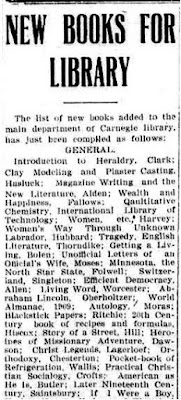
Sometime in the first decade of the twentieth century, local residents gave a petition to the Carnegie Library Committee (Sandusky Library) requesting that the library purchase the title International Library of Technology.

The first name listed on the petition was that of E.B. Krieger, a reporter with the Sandusky Star Journal. Most of the individuals who signed the petition were men in technical fields who worked in transportation or manufacturing businesses in the area.


The International Library of Technology was a series of textbooks for persons in the trades or the field of engineering, published in Scranton, Pennsylvania, by the International Textbook Company, in conjunction with the International Correspondence Schools. The textbooks were published on a wide variety of topics, and came in several editions. An article in the February 14, 1909 issue of the Sandusky Register indicated that the Sandusky Library indeed did purchase a copy of the International Library of Technology.


Wednesday, August 25, 2021

Printers in Sandusky in 1900

An unidentified print shop, probably early 20th century

 Listed in the 1900-1901 Sandusky City Directory are eight businesses under the heading “Printers, Book and Job.” They are:

Alvord –Peters Company, at the northwest corner of Water Street and Columbus Avenue

C. C. Bittner at 622 Market Street

C.E. Chaney at 513 Market Street

I.F. Mack and Brother at 626 Water Street

Sandusky Printing Company, at 618 Water Street

W. & W.F. Senn at 742 Water Street

Star Publishing Company at 602 Market Street

Several of these print shops published newspaper as their primary business.

A.J. Peters and F.E. Alvord would go on to own and publish the Sandusky-Star Journal, which was a merger of three newspapers: the Sandusky Journal, the Sandusky Local, and the Sandusky Star. When A. J. Peters died in 1929, employees of the Star-Journal served as active pallbearers at his funeral.

In 1900, C. C. Bittner was the publisher and proprietor of the Sandusky Daily and Weekly Journal and Local. C.E. Chaney and the Sandusky Printing Company were primarily job printers. The Sandusky Star was published by the Star Publishing Co. in 1900, whose officers were Charles Bang, President, and E. C. Tierney, Secretary.


I.F. and John T. Mack were the proprietors of the Sandusky Register, but the company also did printing jobs, binding, and sold stationery. I.F. Mack was associated with the Register from 1869 until 1909, when his brother John T. Mack took over as the editor and publisher. 


(In 1972 Charles E. Frohman chronicled I.F. Mack’s years as editor in the book, Sandusky's Editor: Isaac Foster Mack's Blazing Forty Years as Editor of the Sandusky Register.)

Philip Buerkle and William F. Senn published the Sandusky Demokrat, the last German language newspaper in Sandusky.

To read more about newspapers in Sandusky, see the chapter about Erie County Newspapers in Hewson L. Peeke’s book A Standard History of Erie County.  Also available at the Sandusky Library Archives Research Center is a bound copy of the Twin Anniversary Celebration edition of the Sandusky Register-Star News, from November 24, 1947, which features an article about the history of newspapers in Sandusky, beginning from David Campbell and the Sandusky Clarion and continuing through 1947. Ask at the Reference Services desk to view this item.

Monday, June 29, 2020

“Along the Wharves” in Sandusky

“Along the Wharves” was the title of a popular column that appeared in the Sandusky Star and the Sandusky Morning Star newspapers in 1898 and 1899; it reported on the activities of commercial vessels in the port of Sandusky.

The sinking of the sandsucker Mary H. was discussed in the October 18, 1898 issue of the Morning Star, along with news of vessels that loaded and unloaded coal and lumber in Sandusky.


The steamers Ogontz, American Eagle, and Cumberland were mentioned in the December 13, 1899 issue of the Sandusky Star.


Pictured below is the Ogontz in the late 1890s.


Sandusky, Ohio has long been known as one of the finest and most well-protected harbors on the Great Lakes. At the Sandusky Dock, owned by Norfolk & Southern, and operated by the Sandusky Dock Corporation, millions of tons of materials are shipped out each year, with coal being the major commodity. Pictured below is the Edward Smith at the coal docks in Sandusky in the 1890s.


During the warm weather months, commercial ferries come to Sandusky to transport visitors to and from the Lake Erie Islands, sharing the waters of Sandusky Bay and Lake Erie along with many privately owned boats and yachts. Visit the Sandusky Library Archives Research Center to learn more about the history of Sandusky through historical photographs, newspapers on microfilm, and a wide variety of local history books and online resources.

Sunday, January 07, 2018

Henry C. Millott, Architect


Henry C. Millott was born in Erie County, Ohio in 1878 to Martin and Julia (Tracy) Millott, who were both of Irish descent. Mr. Millott worked as an architect in Sandusky for over fifty years, in partnership with Harold Parker for much of that time. He was the architect for St. Mary’s Catholic School, which was dedicated in 1909.


In 1915 Mr. Millott designed an addition to the Hotel Rieger. He was also the architect for the Sandusky Star-Journal building built between 1920 and 1921 at the southeast corner of Market and Jackson Streets, now home to the Sandusky Register.


Two financial buildings were constructed in Sandusky in 1923. Mr. Millott was the architect of the Third National Exchange Bank on Market Street, which was built in the Neoclassic style.


Both Henry C. Millott and Harold Parker were listed as architects of the Commercial Banking and Trust Company, built at the corner of Columbus Avenue and East Washington Row. Ellie Damm wrote in her book Treasure by the Bay that the Commercial Banking and Trust Company is the only Beaux-Arts style building in the city of Sandusky.


Note the carved cornucopias above the front door of the former Commercial Banking and Trust Company, which is a symbol of abundance.


In 1938, Mr. Millott designed the Erie County Children’s Home, which was a federal Public Works Administration project. The August 10, 1939 issue of the Sandusky Star Journal reported that Henry Millott had been the “brain child” of renovation of the Erie County Courthouse project which took place in the 1930s.  The courthouse renovation was completed without interrupting the normal activities of the courts.


When Mr. Millott filled out his World War II registration card in 1942, he stated that his employer was the Trojan Powder company, for whom he worked as an architect. In 1946, the Bellevue Housing Company announced that he was the architect for twelve new homes to be constructed for U.S. veterans on lots purchased on Ellis Avenue, Sheffield, Walnut and Kern Streets in that city. 

Henry C. Millott died on June 20, 1957. He was survived by his wife, the former Eleanor Hinde, two daughters, three sons, and several grandchildren. Through his architectural designs, Mr. Millott quite literally left his mark on Sandusky and Erie County.


Saturday, September 30, 2017

Eunice Downing’s School Friendship Book


Eunice Downing was the daughter of Roy and Bertha (Haller) Downing. Her father Roy M. Downing was the U.S. Deputy Collector of Customs in Sandusky for 48 years. Eunice kept a friendship book during her high school years. She was a 1929 graduate of Sandusky High School.


The School Friendship Book was designed and illustrated by Clara Powers Wilson and was published by the Reilly & Lee Company of Chicago in 1910. (The 1916 edition of this title sold for $1.00.) The book provided pages for autographs and photographs. 

Juanita Gilbert wrote this verse for Eunice on June 1, 1925:

When your (sic) in love it’s hearts
When your (sic) engaged it’s diamonds
When your (sic) married it’s clubs
And when your (sic) dead it’s spades.

Dorothy Lorcher wrote:

Nothing more
Nothing less
Just a friend
From S.H.S.

A certificate of proficiency from the Remington Typewriter Company appears on page 44.  Eunice could type at a net speed of 29 words per minute for fifteen consecutive minutes. Also included in the friendship book were programs from art shows, concerts, and tally cards from many bridge games. Napkins, decorations, favors, and invitations found in the book have retained their original bright colors. Eunice’s book includes birthday cards, Christmas cards, Valentines, and graduation cards from the late 1920’s.

Newspaper clippings from Sandusky High School sporting events, honor roll announcements, and Sandusky social and church events allow us to learn what was important to Eunice in her teenage years. Eunice was the winner of a limerick contest sponsored by the Sandusky Star Journal, and she kept her letter of congratulations from the Star Journal.


The “Kodak Snap Shots” section of the friendship book features several photographs of Eunice and her family and friends. In the picture below are: Ila Chaffin, Dolores Neir and Eunice Downing.


Below are snapshots from a family trip to Niagara Falls in 1925.


After graduating from Sandusky High, Eunice Downing was a teller at the Western Security Bank. She married Myron G. Kryeski, and they were married for 35 years. Eunice died on May 17, 1987. Eunice and Myron Kryeski donated many items to the historical collections of the Sandusky Library Archives Research Center. The Roy Downing Maritime Collection, in memory of Eunice’s father, contains many photographs of Great Lakes ships from 1902 through 1950, the years that Mr. Downing was with the Sandusky Customs Office. By looking through Eunice’s School Friendship Book, one can get a vivid view of the life of a young lady from a former generation in Sandusky. The friendship books of both Eunice and her sister Evelyn Downing can be seen at the Archives Research Center of the Sandusky Library.

Tuesday, June 14, 2016

The Alvord & Peters Company


The Alvord & Peters Company was formed in 1898 to engage in job printing. The map of Sandusky pictured above was published by Alvord & Peters in 1898. In 1904 this company was incorporated by A.J. Peters, F.E. Alvord, and Cornelius Nielsen. Prior to incorporating, Alvord and Peters had acquired the Sandusky newspaper known as the Star. In 1904, the company also acquired the Journal, and the two newspapers were merged, to form the Sandusky Star Journal.

While the Sandusky Register was known as a newspaper with Republican views, the Sandusky Star Journal promoted Democratic  politics. 
In 1914, Alvord & Peters published Sandusky High School’s Victory Song, which was written by Lloyd Weninger.


A new building was built for the Star Journal in the early 1920s.


Albert James Peters  died in 1929, at the age of 59. 


After the death of A. J. Peters, Mr. F. E. Alvord severed ties with the Alvord & Peters Company. Records on file at the Ohio Secretary of State indicate that the Alvord & Peters Company went out of existence in November of 1929. The Sandusky Register is now housed in the building that had originally been built for the Sandusky Star Journal. 

Friday, April 24, 2015

Small Bits of History on Sandusky’s Historic Buildings

The symbols, initials, and acronyms that can be seen on Sandusky’s older buildings provide us with clues to the historic past of our community.


The Sandusky Register building was originally built for the Star Journal, as evidenced by the initials SJ seen on the top corner of the building.


A series of Rs border the upper level of the Rieger Lofts help us remember the Rieger family.


When John Rieger opened the Hotel Rieger at the southeast corner of Jackson and Market Streets in Sandusky in 1912, it was Sandusky’s first “fireproof” hotel.


The letters I.O.O.F. and globe that are seen on the corners of the Odd Fellows Temple on Washington Row remind us that the building was first built for the fraternal organization known as the Independent Order of Odd Fellows.


Sandusky’s Odd Fellows building was dedicated on March 18, 1890. Several attorneys and businesses are now located in the I.O.O. F. building on Washington Row in downtown Sandusky. Through the years, several other businesses have been in operation at the street level of the Odd Fellows Temple on Washington Row.


The building now home to Calvary Temple was constructed in the 1920s for the Commercial Banking and Trust Company.


The group of layered letters above the door on the west side of Calvary Temple feature the beginning letters of the words Commercial Banking and Trust Company.  The bank did not survive the Great Depression.


On the north side of Adams Junior High School, which opened in 1869 as Sandusky High School, is a trefoil and an equilateral triangle, which is a traditional Christian symbol that represents the Trinity.


Take note of the interesting architectural details found on the historic buildings in Sandusky and Erie County. Lots of history can be learned by observing closely the fine details in the buildings you may walk by every day.

Monday, January 05, 2015

Views of Market Street Looking East from Jackson

                 
This postcard of Market Street, looking east from Jackson Street, was created in the 1920s. E.B. Ackley’s billiard parlor is on the north side of West Market Street, adjacent to Jackson. You can see the marquee of the Schade Theatre, which later became the Ohio Theatre. In the distance, the Cooke building is visible at the northeast corner of Columbus Avenue and Market Street. The Hotel Rieger building (which recently opened as an apartment building, the Rieger Lofts) is on the south side of West Market Street, just opposite the Star Journal building, which now is home to the Sandusky Register. Going east down Market Street, the Third National Bank is next to the Hotel Rieger. A sign advertising an auto supply store is visible, just west of the old city building, with its two towers. In the distance you can see the Feick building, a tall structure on the south side of East Market Street. A variety of offices and small businesses are found all along Market Street, on the street level as well as on upper floors. The Hotel Rieger featured some businesses which were below street level. Below is a view of Market Street in a picture that was taken between 1890 and 1910.


The Manhattan clothing store is located where Mr. Ackley later had his billiards parlor. Dr. Nicholson had his dental office above the Manhattan store. The Hotel Rieger and Star Journal buildings had not yet been constructed, but the Cooke building and former city hall can still be seen. Street cars and horse drawn vehicles were the mode of transportation at this time, instead of the autmobiles seen in the postcard above. You can see several other images of Market Street at the Sandusky History blog by clicking on this link.

Wednesday, October 05, 2011

Carl H. Stubig, Local Politician and Newspaper Man

Carl H. Stubig was born on October 5, 1886 in Sandusky, Ohio, to Christian and Catherine (Lanz) Stubig, who were both natives of Germany. After working for several years in newspapers in New York and Canada, Carl returned to Sandusky and worked briefly for the Sandusky Star Journal. Carl H. Stubig published a weekly newspaper in Sandusky entitled Stubig’s Weekly between 1915 and 1918. Stubig's editorials and his approach when describing political foes caused a great deal of controversy and agitation throughout the city's political circles.


In 1914 Carl Stubig lost the Republican nomination for mayor to Charles F. Mischler. Stubig's defeat and his support against a campaign to change the city's charter put him as a leading figure in Sandusky politics. Following the adoption of a new city charter, Stubig was one of twenty-seven candidates running to fill the five positions on the first City Commission, established by the new city charter. Despite the number of candidates and the ferocious nature of the campaign, Stubig won a seat and took office as a City Commissioner on January 1, 1916.

His service on the commission was often controversial. At one point during his term, the local Congregational minister assailed Stubig from the pulpit, referring to him as a demagogue and a reactionary. And on March 20, 1916, Stubig took it upon himself to have a “test run” of the city’s fire department. He pulled the fire alarm at city hall during a blinding snow storm. City streets were dangerously slippery, and Henry Rudolph, a veteran Sandusky fireman, fell from the No. 3 hook and ladder truck while answering the false alarm. Mr. Rudolph survived the accident for several months, but he died on February 23, 1917 as a result of the injuries he sustained.

An article in the December 22, 1917 issue of the Sandusky Star Journal reported that Carl H. Stubig was tired of the town of Sandusky. Stubig moved to Akron, where he was the courthouse reporter for the Akron Times. Then he worked at the Goodyear Tire and Rubber Company as a member of the publicity department. Later, Carl H. Stubig was secretary to C.L. Knight of the Akron Beacon Journal. On May 2, 1930, Carl H. Stubig died suddenly of heart disease at his home in Akron, Ohio, at the age of 48. An obituary found in the 1930 Obituary Notebook stated that Mr. Stubig was to be buried at Sandusky’s Oakland Cemetery. However, the Oakland Cemetery interment card for Carl H. Stubig has a note indicating that in July on 1930, the remains of Carl H. Stubig had been transferred to Marion, Ohio.

Carl H. Stubig was a dynamic individual, and he was passionate in his beliefs and goals. Though his life was brief, he made an impact on many people in several different communities. The picture of Carl H. Stubig below was taken in Albany, New York on April 14, 1912, when Mr. Stubig was with the Knickerbocker Press.