Showing posts sorted by relevance for query market street. Sort by date Show all posts

Monday, January 05, 2015

Views of Market Street Looking East from Jackson

                 
This postcard of Market Street, looking east from Jackson Street, was created in the 1920s. E.B. Ackley’s billiard parlor is on the north side of West Market Street, adjacent to Jackson. You can see the marquee of the Schade Theatre, which later became the Ohio Theatre. In the distance, the Cooke building is visible at the northeast corner of Columbus Avenue and Market Street. The Hotel Rieger building (which recently opened as an apartment building, the Rieger Lofts) is on the south side of West Market Street, just opposite the Star Journal building, which now is home to the Sandusky Register. Going east down Market Street, the Third National Bank is next to the Hotel Rieger. A sign advertising an auto supply store is visible, just west of the old city building, with its two towers. In the distance you can see the Feick building, a tall structure on the south side of East Market Street. A variety of offices and small businesses are found all along Market Street, on the street level as well as on upper floors. The Hotel Rieger featured some businesses which were below street level. Below is a view of Market Street in a picture that was taken between 1890 and 1910.


The Manhattan clothing store is located where Mr. Ackley later had his billiards parlor. Dr. Nicholson had his dental office above the Manhattan store. The Hotel Rieger and Star Journal buildings had not yet been constructed, but the Cooke building and former city hall can still be seen. Street cars and horse drawn vehicles were the mode of transportation at this time, instead of the autmobiles seen in the postcard above. You can see several other images of Market Street at the Sandusky History blog by clicking on this link.

Monday, June 18, 2012

A View of the North Side of East Market Street in 1956


In the Sandusky Pictures Collection of the Sandusky Library Archives Research Center is a photograph of the north side of East Market Street in Sandusky which was taken in September of 1956. At the northeast corner of Columbus Avenue and East Market Street, Donald A. Smith operated the Smith Drug Company, which was affiliated with the Walgreen Agency. Prescriptions and health and beauty aids were sold here, along with light meals served at the luncheon counter. Baked goods were sold at Cassidy’s Fine Foods at 121 East Market Street. Moving east down East Market Street we find Jean Frock’s, the Neisner Brothers five and ten cent store, and the William S. Frankel store, which sold women’s apparel. Walter’s Shoe Store was located at 151 East Market Street, and the large Sears and Roebuck department store was at 161 East Market. Not pictured in this picture is the Joseph’s Store which was at the end of the block. Joseph’s sold women’s and children’s ready to wear clothing in the mid-1950s.  On the left side of the picture you can see the clock from the Citizens Banking Company which was in the Feick Building at that time, on the south side of East Market Street.  Visit the Sandusky Library to browse through decades of historical Sandusky City Directories. The earliest Sandusky City Directory in our collection dates back to 1855.

Friday, January 27, 2023

A Home to Many Businesses on Market Street


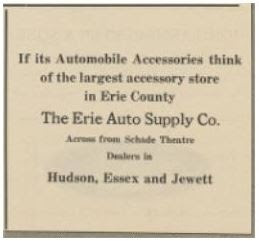
From the early 1920s through the mid 1930s, The Erie Auto Supply Co. was located at 208 West Market Street in Sandusky. The company sold wholesale and retail automobile parts, and serviced vehicles in the space behind the store. Hudson, Essex and Jewett were some of the brands carried by Erie Auto Supply.


In 1936, Erie Auto Supply moved to 212 Hancock Street. From 1942 until the mid 1960s, Weber’s Men’s Wear was in business at 208 West Market Street.

Weber’s was one door away from City Hall. Other stores visible on Market Street in this 1950s era picture above were Gray’s Drugstore, Herman’s Jewelry, and Third National Bank.

Through the years, several different businesses operated at 208 West Market Street, including Sears, Spiegel Inc., Sonrise Ceramics, Revelations, and Bloomquist TV.


Today the Crowbar is now in business where Erie Auto Supply Company was once located.

Sunday, June 29, 2008

Grand Opening of the A&P store on West Market Street

On June 28, 1937, the A & P opened a new “super-service food market” on West Market Street, opposite the Hotel Rieger. The Sandusky Star Journal reported that “the new store will operate as a self-service unit with every item on display on tables plainly price tagged and easily accessible to the customer. Customers entering the store will be provided with either a hand basket or a push-basket on wheels in which to gather their purchases.”

The 1937-1938 Sandusky City Directory listed a total of six A & P stores, located at 232 Columbus Avenue, 901 Columbus Avenue, 600 Hancock Street, 182 East Market Street, 231 West Market Street, and 933 West Washington Street. There were still over fifty small neighborhood grocery stores in Sandusky at this time, as well as a total of seven stores operated by the Kroger Grocery and Baking Company.
In the right corner of the photograph above, a portion of the theater marquis is visible. The Ohio Theater was playing “I Met Him in Paris” with Claudette Colbert and Robert Young. Area Boy Scouts were marching in a parade preceding their trip to the National Jamboree of 1937 (as reported in the previous blog entry).

Wednesday, August 25, 2021

Printers in Sandusky in 1900

An unidentified print shop, probably early 20th century

 Listed in the 1900-1901 Sandusky City Directory are eight businesses under the heading “Printers, Book and Job.” They are:

Alvord –Peters Company, at the northwest corner of Water Street and Columbus Avenue

C. C. Bittner at 622 Market Street

C.E. Chaney at 513 Market Street

I.F. Mack and Brother at 626 Water Street

Sandusky Printing Company, at 618 Water Street

W. & W.F. Senn at 742 Water Street

Star Publishing Company at 602 Market Street

Several of these print shops published newspaper as their primary business.

A.J. Peters and F.E. Alvord would go on to own and publish the Sandusky-Star Journal, which was a merger of three newspapers: the Sandusky Journal, the Sandusky Local, and the Sandusky Star. When A. J. Peters died in 1929, employees of the Star-Journal served as active pallbearers at his funeral.

In 1900, C. C. Bittner was the publisher and proprietor of the Sandusky Daily and Weekly Journal and Local. C.E. Chaney and the Sandusky Printing Company were primarily job printers. The Sandusky Star was published by the Star Publishing Co. in 1900, whose officers were Charles Bang, President, and E. C. Tierney, Secretary.


I.F. and John T. Mack were the proprietors of the Sandusky Register, but the company also did printing jobs, binding, and sold stationery. I.F. Mack was associated with the Register from 1869 until 1909, when his brother John T. Mack took over as the editor and publisher. 


(In 1972 Charles E. Frohman chronicled I.F. Mack’s years as editor in the book, Sandusky's Editor: Isaac Foster Mack's Blazing Forty Years as Editor of the Sandusky Register.)

Philip Buerkle and William F. Senn published the Sandusky Demokrat, the last German language newspaper in Sandusky.

To read more about newspapers in Sandusky, see the chapter about Erie County Newspapers in Hewson L. Peeke’s book A Standard History of Erie County.  Also available at the Sandusky Library Archives Research Center is a bound copy of the Twin Anniversary Celebration edition of the Sandusky Register-Star News, from November 24, 1947, which features an article about the history of newspapers in Sandusky, beginning from David Campbell and the Sandusky Clarion and continuing through 1947. Ask at the Reference Services desk to view this item.

Monday, March 31, 2014

The Market Street Fire of 1939


On this date seventy-five years ago the most devastating fire Sandusky has known struck downtown, turning nearly an entire block into ruins. Commonly known as the Herb & Myers fire (or the Market Street fire) because it was believed to have started in the M.R. Herb department store on East Market Street, the fire quickly destroyed many business on the 100 block of East Market Street, and continued to smolder for days afterward. The cause of the fire was never determined, probably due to the intensity of the flames, which left little evidence to discover in the rubble.


Among the other businesses destroyed in the fire were the Sears & Roebuck store, the W.S. Frankel store, the McLellan Dollar store, all in the Graefe Building,  and E.B. Ackley's cigar store and office on Water Street.


The fire and the subsequent demolition and removal of the remaining rubble soon became a major tourist event, as can be seen in some of the photographic images. Reports claimed that as many as 10,000 spectators went downtown to see the fire and its aftereffects, although that might be an exaggeration.


The estimated financial cost of the fire was $2 million (about $33 million in today's dollars), with about 200 people put out of work.


Monday, July 10, 2023

Enrico and Olimpia Ambrusini, Victims of the 1918 Influenza Epidemic


Enrico and Olimpia Ambrusini both died from influenza in October of 1918, when the disease spread across the United States and many other parts of the world. Their young son Tulio had died in 1916, in a tragic drowning incident. In 1918, four Ambrusini children were left as orphans: Theresa, Erma, Eda and Louis.

In 1907 Olimpia Filipinni and Enrico Ambrusini, both natives of Italy, were married at Sts. Peter and Paul Church in Sandusky, on the very same day that Olimpia’s sister Filomena Filipinni married Lazzaro Uguccoini. Olimpia and Filomena were the daughters of Enrico Filippini and his wife Maria.

By the time of the 1910 United States Census, three related families were all living on Market Street. Enrico Flippini and his family were at 426 Market Street. Filomena Uguccioni and her husband Lazzaro Uguccioni, and their daughter Rosa lived at 430 Market Street. Enrico (here listed as Federico) and his wife Olimpia resided at 432 Market Street. (These house numbers changed in 1915, when the city of Sandusky re-numbered the city streets.)

Sadly, Enrico Ambrusini died at the emergency hospital on Adams Street on October 19, 1918. Olimpia Ambrusini died on October 20, 1918, leaving behind four young children.

An article on the front page of the Sandusky Register of October 21, 1918 told of the rapidly rising numbers of cases of influenza in Sandusky at that time:


Theresa Ambrusini was adopted by the Battisti family in Sandusky. She lived a long life and died in Louisville, Kentucky at the age of 91. Her married name was Theresa Moremen. Erma Ambrusini marred Zeno Adante. She lived most of her life in Michigan, but passed away in California in 1997, at the age of 87. Louis Ambrusini, later known as Louis Ambrosine, lived in the Dearborn, Michigan area. He repaired and sold juke boxes, and he retired in Florida. A reasonable search did not find information about Eda/Ida Ambrusini.

The 1918 influenza epidemic brought tragedy to many. The Ambrusini family hoped to find a better life in the United States. They were active in the local Catholic Church, and had close relationships with members of their large extended family. Enrico and Olimpia Ambrusini were buried at St. Joseph’s Cemetery in Sandusky, Ohio.

Note: The spellings of both first and last names of members of the Filippini and Ambrusini families vary widely, depending on the record.

Friday, December 09, 2011

Cooke Block

Sandusky’s Cooke Block, at the northeast corner of Columbus Avenue and Market Street, has been in existence since the 1850s. Ellie Damm wrote in Treasure by the Bay that the north section, known as the Union Building, was built first, along Columbus Avenue. Wildman Mills erected a large building at the corner of Columbus Avenue & Market Street, and he sold the building to Charles E. and George A. Cooke in 1866. In about 1876 the Cooke Block and the former Union Building were consolidated. Sandusky city officials met in the Union Building and the Cooke Block in the early days of the city’s history. From 1882 until 1899, the Melville Brothers ran a wholesale and retail drug business in the main corner building of the Cooke Block. Josh B. Davis and J. H. Wagenet were insurance agents in the upper levels of the building. When the men of Company B returned home from the Spanish American War, a huge parade in downtown Sandusky welcomed them home.


By 1908 the Commercial National Bank was the main business in the corner building of the Cooke Block. A variety of other businesses were located in the Cooke Block, including insurance and real estate agents, lawyers, doctors, restaurants, and retail stores.

From about 1923 and into the 1930s, Fred A. Martin operated a wholesale and retail confectionery business in the Cooke Block. In the picture below, you can just barely read the name Martin’s under the Dining Room sign. By the time Martin’s Confectionery was in the Cooke Block, streetcars and automobiles had replaced horse drawn vehicles.

At the time of the Northwest Territory Celebration Parade in 1938, Walgreen’s Drugstore was located at 172 Columbus Avenue, where Martin’s had formerly been in business.

Holzaepfel Brothers Sporting Goods was at the northeast corner of Columbus Avenue and Market Street from the 1960s to the 1980s. More recently, antique shops have been located at this address. The street numbers have varied slightly through the years on Columbus Avenue and Market Street, and businesses have changed hands numerous times. Check the historical Sandusky City directories for the names and addresses of specific businesses that have been located in the Cooke Block through the years. Article 51 of From the Widow's Walk, Volume II, by Helen Hansen and Virginia Steinemann provides a concise history of the east side of the first block of Sandusky’s Columbus Avenue.

Friday, January 14, 2022

Buildings on the 100 Block of West Market Street in the 1990s


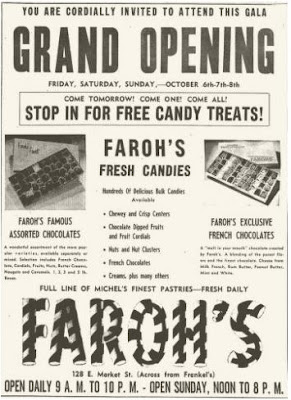
The photograph above was taken in the 1990s by a member of the Erie County Chapter of the Ohio Genealogical Society. The Thrift Shop of Grace Church was then located at 136 East Market Street in a building known as the Kugel Building. According to the Ohio Historic Inventory for Erie County, the Kugel Building was built around 1910. Through the years, there have been businesses on the street level, and apartments and offices on the upper floor. The Kugel Building was constructed from brick, with a stone foundation. The name “Kugel” is cut into the cement above the third floor windows. Herman and Benjamin Kugel emigrated to the United States from Hungary in the 1860s. They were successors to their brother Joseph’s dry goods store which opened in Sandusky in 1859. The Kugel brothers had stores in three different locations in Sandusky, the last one being located in the Kugel Building. Next to the Thrift Shop in the picture is Faroh’s Candies, at 128 East Market Street. Faroh’s Finest Candies first opened in Lorain, and then the company branched out to Amherst, Sandusky and Elyria. Faroh’s was located at 128 East Market Street in Sandusky from 1961 through the early 2000s. 

Here is an advertisement from the opening gala of Faroh’s in Sandusky, from the October 5, 1961 issue of the Sandusky Register:

Saturday, September 27, 2014

Postcards of the Third National Exchange Bank


The postcard above is from the historical postcard collection of the Sandusky Library Archives Research Center. Founded in 1872 as the Third National Bank, the Third National Exchange Bank was at 220 West Market Street from 1914 until the mid-1960s. Henry Millott was the architect, and G. William Doerzbach and Brother were the contractors for this building. According to the book, Treasure by the Bay, by Ellie Damm, the Third National Exchange Bank building was built in the Neoclassic style. The portico features Ionic style shafts, and double cornucopias are located above the entrance. The post card below, which pictures the interior of the Third National Exchange Bank, was created by the Alexander Manufacturing Company.


Local photographer Jay Hoehlein took this photograph at the bank in the summer of 1936:


In 1961 the bank’s name was listed as the Third National Bank of Sandusky, Ohio. By 1965 the Third National Bank of Sandusky, Ohio had its downtown office at 220 West Market Street, and a Perkins office at the corner of Columbus and Perkins Avenues. In 1969, there were three locations of the Third National Bank, but the bank was no longer in operation at 220 West Market Street. In 1993, the Third National Bank of Sandusky began operating under the "National City" name when it was consolidated with National City Bank in Cleveland. National City was acquired by PNC in 2008. The building at 220 West Market Street in downtown Sandusky is now home to the Bailey Legal Group.

Wednesday, December 02, 2015

The Lea Block, on Market Street


Located at the southwest corner of Market and Wayne Streets in Sandusky, Ohio, the Lea Block was built in 1895, at what is now 174 to 186 East Market Street.  It was named for its first owner, James D. Lea, a prominent Sandusky business man. The three story brick structure was built in the Second Romanesque Revival style of architecture, and features rounded windows and corbeled brick trim.


There is ornamentation both above and below the fire escape on the side of the building that faces Wayne Street.


The first floor of the Lea Block has been home to number of different businesses through the years. In the early 1900s, the top floor was used as an Armory. Mr. F.X. Rinderle operated his tailoring shop in the ground floor in 1900. (Note: Before the street numbers changed in 1915, the Lea Block was in the 600 block of Market Street.)


From about 1917 to 1919, the Wendt Economy Grocery was in business in the Lea Block.


Wrestling matches were held on the upper level of the building in the early 1920s. In 1928 the Lea Block was purchased by the Knight of Pythias, for use by the lodge for meetings, dances and parties. In 1936 the Knights of Pythias occupied the third floor; the second floor was home to the Oheb Shalom Jewish congregation and the Progressive Spiritual Church; and on the first floor were a music teacher, dental office, insurance agent, and two dress makers. In more recent years, the ground level of the building has been occupied by jewelry and floral shops, a finance company, a novelty business, home decorating store, and even a metaphysical shop. 

Read Ellie Damm’s book, Treasure by the Bay, available at Sandusky Library, to learn more about the historic architecture of Sandusky, Ohio.

Monday, January 09, 2023

Do You Remember Bazley Meats?


In the picture above, Bazley Meats can be seen in the 200 block of Columbus Avenue during a Grape Festival Parade held in 1940. The Bazley family had a chain of meat markets throughout states in the Midwest for several years.  From 1928 to 1930, Bazley Meats was in Sandusky at 148 Columbus Avenue.  By November of 1930, the business had moved to 216 Columbus Avenue, where later Woolworth’s had a store in the 1950s and 1960s. An advertisement in the Sandusky Star Journal of November 21, 1930, stated that the Bazley Cash Market was modern and sanitary, and pledged to “give you better quality meats at lower prices.”

In today's dollars, pork loin was $2.49/lb and ground beef $1.62

In 1936, an article in the December 23 issue of the Sandusky Star Journal, reported on a pig named Oscar that was given free run of the market for a day. The manager of Bazley’s Meats, Leo Hall, reported that Oscar “would go the way of all porkers” and was soon to be at the table of an employee.

In February, 1949, a newspaper article reported that soon Bazley Meats would be moving to a new location at 182 East Market Street.

By April 26, 1972, Family Meats had taken over the location at 182 E. Market Street, where Bazley Meats had been in operation since 1949.  You can see Bazley Meats at its East Market Street location in the picture below, taken by Helen Hansen in 1963.

Locations of specific businesses and homes in Sandusky throughout several decades can be found in the historical city directories housed in the Reference Services area of the Sandusky Library. Consult the street directory, where addresses can be looked up by house number in an alphabetical listing of streets in Sandusky, Ohio.

Friday, October 07, 2016

Samuel Facer, Original Owner of the Building at 279 East Market Street


The building at 279 East Market Street, now home to Mabel and Ethel’s Quilt Shop, was built by Samuel Facer in 1883-1884. Facer had several business ventures in Sandusky, including a blacksmith shop and a hack and omnibus business. After he sold his hack business to the Goosman family, Mr. Facer carried mail for the U.S. Post Office, before the Post Office owned their own vehicles. In the 1880s, he leased the space on the street level of the building at the northwest corner of Market and Hancock Streets for a store, and he and his wife lived upstairs. 

Ellie Damm wrote in her book Treasure by the Bay that the building was built in the Italianate style, with an intricate system of cast iron columns and sandstone beams. On the east side of the building is a cast iron balcony.


Facer’s former store building has been named to the National Register of Historic Places.


A wide variety of businesses and organizations have been in operation at 279 East Market Street through the years, including grocery stores, a bicycle shop, a pool hall, dry cleaners, and an antique store. In the 1980s, Grace Church had their thrift shop at this location, and for a time the Maritime Museum was here. 


In 1892 Samuel Facer worked to protect land along the waterfront, and Facer Park was created.  In 2007 the “Path to Freedom” sculpture was dedicated in Facer Park.

A portrait of Samuel Facer is on display at the Follett House Museum.


Monday, October 12, 2009

East Market Street Primary School

Charles E. Frohman wrote in his book, A History of Sandusky and Erie County, that following a public meeting on October 14, 1843, a committee consisting of Moors Farwell, Alexander Porter, and Zenas Barker met to prepare a plan for the erection of one or more school houses for the education of the young people of Sandusky. Two stone school houses were built at the end of West Market Square and the south side of East Market Square. Another school was erected on the west side of Camp Street at Adams, and the high school was located on the West Public Square.

Pictured below is the building that was formerly used as the East Market Primary School located on East Market Street. The school was in operation from the mid 1840’s through the 1870’s. The view is from Franklin Street, and the Variety Village Drive-Through can be seen adjacent to the former school building.
The Archives Research Center of the Sandusky Library has in its local schools collection an attendance register from the East Market Primary School, covering the years 1848 through 1853.

On the register page dated August 18, 1851, are the names of Melissa and Minerva Bell. These twin girls lost their parents, Horace and Sarah Bell, during the cholera epidemic in Sandusky in 1849. Mary and Rosa, daughters of well known lawyer and abolitionist F. D. Parish, are also seen on this page. (Rosa was also known as Damask Rose. See the book, Stories of Sandusky, for a touching, possibly fictionalized story about Damask Rose Parish.)

Many familiar names of the children of early Sandusky residents can be seen throughout the attendance register. A student named Theodore Hosmer would become the first Mayor of Tacoma, Washington.

An interesting report form was found from August 19, 1853. Besides recording attendance, absence and tardiness, the following items were also recorded by the teacher: number of communications for the week, number of pupils engaged in quarreling, and the number of cases of falsehood, uses of profane language and cases of obscene language. The final item to be tallied was the number of corporal punishments inflicted in the classroom for the week.
Visit the Sandusky Library to find a variety of historical items relating to Sandusky and Erie, including historical yearbooks and city directories and county histories of several counties in Ohio.