Showing posts with label Lockwood. Show all posts

Sunday, March 20, 2022

Prominent Sanduskians

The image below is of a group of prominent Sandusky men, taken sometime between 1910 and 1920. The picture was anonymously mailed to the Sandusky Register and then was forwarded to Wilbert Ohlemacher, who wrote The Elderlies column for the Register for several years.

Back row: Fred Emmons, Mr. H. Squire, C. Webb Sadler, Dr. J.T. Haynes, F. P. Zollinger, Dr. J.F. Douglas, Mr. Feick, William Seitz, Dr. C. B. Bliss, Sidney Frohman, unknown, and Mr. Bruce

Front row: Mr. Feick, C.B. Lockwood, William Sumser, Lawrence Morton, T. T. Morton


Fred Emmons was the secretary and assistant treasurer of the Hinde and Dauch Paper Company; Mr. H. Squire owned Squire Electric Company; C. Webb Sadler was the father of city manager Webb Sadler; Dr. J. T. Haynes was the physician at the Ohio Soldiers’ and Sailors’ Home; F. P. Zollinger was the president of the Third National Bank; Dr. J.F. Douglas had a dental office on Columbus Avenue for many years; Mr. Feick was a local builder; William Seitz was a merchant tailor, Dr. C.B. Bliss was an ophthalmologist; and Sidney Frohman was the president and general manger of the Hinde and Dauch Paper Company. In the front row was another member of the Feick family of builders. C. B. Lockwood and William Sumser were associated with the Standard Box Company; Lawrence Morton was the sales manager of the Threading Machine Company; and T. T. Morgan was the treasurer and general manager of the Brown Clutch Company.


We do not know the occasion for this gathering, but you can read Mr. Ohlemacher’s newspaper article about this picture in the March 27, 1983 issue of the Sandusky Register, available on microfilm at the Sandusky Archives Research Center, or online via the Sandusky Library's website.

Thursday, July 23, 2020

Schwehr Box Company


Established in 1878, this cigar box manufacturing company was first operated by the Fox Brothers. In 1884, Albert Schwehr became a partner in the Fox & Schwehr Box Company at the northeast corner of Water and McDonough Streets. By 1886, Albert Schwehr was the sole proprietor of the Schwehr Box Company, by then at the southeast corner of Water and McDonough Streets. That same year, the Eureka Lumber Company was in business at the northeast corner. Both the Schwehr Box Company and the Eureka Lumber Company were manufacturers of cigar boxes.

In the late nineteenth and early twentieth centuries cigar making in Sandusky was a major industry. Locally produced cigar boxes were made of cedar, held together with nails. Karl Kurtz wrote in the Sandusky Register of January 14, 1978 that in the early years, the Schwehr Box Company made 350,000 cigar boxes and 5000 fish boxes a year. The factory employed about 25 people, and had a printing press to make their own labels for the boxes. By 1900, C. B. Lockwood was the proprietor of the business. In the 1912 Sandusky city directory, the company’s name had been changed to the Standard Box Company, and around 1920, William Sumser became the proprietor. In 1930, the Standard Box and Screen Company was manufacturing window and door screens as well as cigar boxes. An advertisement in the May 17, 1941 issue of the Sandusky Star Journal recommended the bronze screens made at the Standard Box Company for their endurance.


From 1946 to 1952, the Weske Cutlery Company, which primarily made fixed blades, was in business at the site of the former Standard Box and Screen Company. You can see the layout of the Weske Cutlery Company on the Sanborn Fire Insurance map, below.


In the 1960s and 1970s, Bob’s Furniture had a warehouse at 932 West Water Street, where the box factory once stood. Now, the southeast corner of Water and McDonough Streets is an empty lot, but that location was once an important spot for local businesses.

Thursday, April 23, 2020

Frances Lockwood Davis, Civic Leader and Suffragist


Frances Lockwood was born in Elyria,Ohio in 1849, the oldest daughter of Judge and Mrs. William F. Lockwood. She married Thomas H. B. Davis, a successful businessman, in 1872. They had two children, Thomas H. B. Davis, Jr., and Edith Davis, who later married Clifford M. King.


In 1900, T.H.B. Davis died, at the age of 57. Mr. Davis’s obituary stated that “a son and daughter, together with the wife now left to tread life’s winepress alone, survive him.”

Mrs. Frances Lockwood Davis lived a very full life following her husband’s death. Her obituary, which appears in the 1933 Obituary Notebook, listed her many accomplishments: “Mrs. Davis was active in civic affairs, was the first president of the local Women’s Suffrage association and a member of the Library Building Fund association and of the board of the Sandusky Library association. She was one of the organizers of the Children’s Day Nursery, which later led to the founding of the Erie-co. Children’s Home.” Mrs. Davis passed away on January 22, 1933. She is buried in the North Ridge section of Oakland Cemetery in the family plot.


Mrs. Edith Davis King, daughter of Frances Lockwood Davis, is pictured below. Edith was also the daughter in law of Judge and Mrs. E. B King. Edith was the Assistant Librarian of the Sandusky Library in 1930, according the U.S. Census records for Erie County.


Sunday, November 19, 2017

The “All Nation’s Pageant” in 1932


Several ladies from the Sandusky and Erie County Federation of Women’s Clubs participated in the Cleveland Plain Dealer’s “All Nation’s Pageant”, held at Cleveland’s Public Hall. This event was part of the International Exposition presented in Cleveland from November 19 to 28, 1932. While thirty-eight women participated, only sixteen were present for the photograph above. 

Pictured are: Back Row: Ada Parker, Leona Love, Carrie Beatty, Nettie Beatty, Ms. Drummond, Emma Phillips, Dorothy Drummond, Adeline Rosekelly, Florence Wright. Front Row: Mary Louise Blanckey, Annette Lockwood, Lois Miller, Attie Hawley, Harriet Ruggles, Virginia Caswell, and Marie Harris. 

Several scrapbooks, membership lists, secretary’s record book and photographs from both the Erie County and Sandusky Federation of Women’s Clubs are housed in the Sandusky Library Archives Research Center.

Tuesday, October 06, 2009

The Young Men’s Debating Association of Sandusky

The secretary’s book containing the minutes of the Young Men’s Debating Association is housed in the Archives Research Center of the Sandusky Library. The group was organized in 1840 and was later called the Philomathesian Society (a precursor of the Sandusky Library). The back of the book contains a listing of the questions which were debated as well as the bylaws, constitution, treasurers’ accounts, and a record of fines that were collected. The book was donated by Thomas B. Hoxsey. According to notes found with the secretary’s book, the group’s motto was “Knowledge is power.”

In the beginning, only the surnames of the members were given. Early members were: Mr. Lockwood, Mr. Campbell, Mr. Camp, Mr. Vrooman, Mr. McGee, Mr. Cooke, Mr. Mills, and Mr. Davidson. H. D. Cooke, brother of Jay Cooke, served as the Secretary-Treasurer in August 1840. A different member served as president of each meeting.

On October 7, 1840, the Young Men’s Debating Association met in Sandusky. Mr. J. Vrooman served as president, as the person who was designated to serve as president was absent. Attending the meeting were: Jacob A. Camp, William S. Mills, J. H .Lockwood, J. Steiner, E. B. Goodrich, J. S. Vrooman, and James McGee. The members debated the question: “Which is more desirable knowledge or fame?” The minutes read that “after a long and extremely animating debate” the president awarded the honor to both parties. The question for the next meeting was “Should fiction ever be considered as a vehicle for truth?”

Other questions debated were:

“Which affords the greatest field for eloquence, the pulpit or the bar?”
“Which has been the most benefit to mankind, invention or discovery?”
“Was Columbus the first discoverer of America?”
“Is conscience an innate principle?”

The final entry in the minutes book of the Young Men’s Debating Society is dated April 13, 1841. Jacob A. Camp was serving as the Secretary-Treasurer at this time, and Mr. Vrooman chaired the meeting.

Long before radio, television, cell phones, and the Internet, debating served as an enjoyable pastime for Sandusky’s young men. Visit the Sandusky Library’s Archives Research Center to view the minutes of the Young Men’s Debating Association.

Sunday, August 16, 2009

Carnegie Hall at the Sandusky Library

The Sandusky Daily Star, in its February 20, 1901 issue, reported that when Andrew Carnegie gave his “handsome gift” to Sandusky to be used for the purpose of building a public library, one of his stipulations was that the library should have a music hall and an organ, and efforts were to be made to have free musical recitals for the community on a regular basis. The Carnegie Library had its grand opening on July 3, 1901. The musical hall held 338 people, and was known as “Carnegie Hall.”
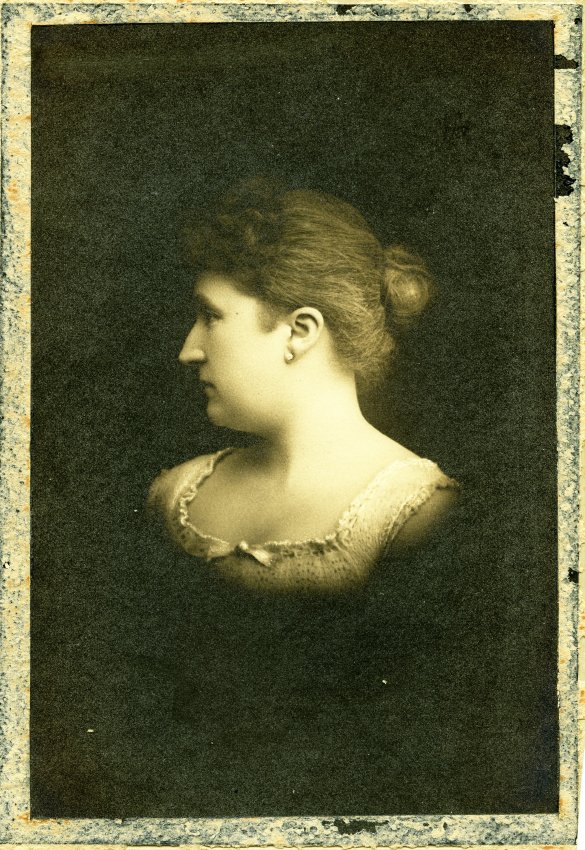
One of the earliest groups to sponsor concerts at Sandusky’s Carnegie Hall was the Tuesday Musical Club. The composer Beethoven was featured on the January 21, 1902 concert. It appears that the entertainment was provided by local musicians. The string quartet was composed of Miss Heiter, Mr. Dempsey, Mr. Schnaitter, and Mr. Anderson. Mary Lockwood and Mr. Anderson had solo numbers, and the final number was “Symphony, C. Minor” which was performed by Mrs. Williams, Mrs. Feick, Miss Stoll, and Mrs. Sloane. Anna G. Lockwood was the President of the Tuesday Musical Club during the 1901-1902 season. Miss Lockwood (Shown below in her 1888 Sandusky High School graduation photo) would go on to teach piano at the Institute of Musical Art, later known as The Juilliard School in New York City.
Besides musical events, Carnegie Hall was used for political, social, and other cultural activities. In December, 1903, Professor Edwin Earle Sparks gave a lecture about Alexander Hamilton, and also presented a short study of the U.S. Constitution at Carnegie Hall. In January 1905, Hewson Peeke and F. G Strickland participated in a lively debate at Carnegie Hall. Hewson Peeke’s premise was: “Resolved that the Prohibition party presents a better solution of the labor problem than the Socialist party.” Mr. Strickland was a member of the Socialist Party. The January 21, 1905 Sandusky Star Journal wrote that about two-thirds of the crowd in attendance were in support of Mr. Strickland.

Area clubs and organizations often met at Carnegie Hall. In January of 1905, the Knights of St. John and its Ladies Auxiliary had their joint installation of officers at Carnegie Hall. In January, 1908, a new club called the “Children of the Republic” held a preliminary meeting at Carnegie Hall. Several ladies from the Martha Pitkin Chapter of the Daughters of the American Revolution wanted to help young people in Sandusky to learn how to become good citizens. Speakers for the evening were Mrs. Thomas M. Sloane, Mrs. James Melville, Mrs. Roy Williams, and Dr. Carrie Chase Davis. The annual meeting of the Erie County Farm Bureau held one of its sessions at Carnegie Hall in February, 1920. The Firelands Historical Society held an all day session at Carnegie Hall on November 10, 1920.

By 1929, the space in the auditorium on the first floor of the Library would become an adult reading room with additional space for books and shelves. Though the library no longer features a music hall, you can read about the early days of the Sandusky Library in the historical newspapers, housed on microfilm in the Archives Research Center of the Sandusky Library. The music hall of the original Carnegie library building in Sandusky is now a portion of the Children’s Services Area of the Sandusky Library.