Showing posts with label Grace Episcopal Church. Show all posts

Tuesday, December 10, 2024

John Dean's Pew at Grace Church


 This is the deed to pew number 67 in Grace Episcopal Church, issued by the parish to John Dean on August 27, 1866, granting him and his heirs the right to exclusive use of the pew in perpetuity, for a payment of fifty dollars (equivalent to a little more than $1000 today). It was common through the nineteenth century for churches to sell access to specific pews, to raise funds for the church and to recognize the prominence of certain parishioners. 

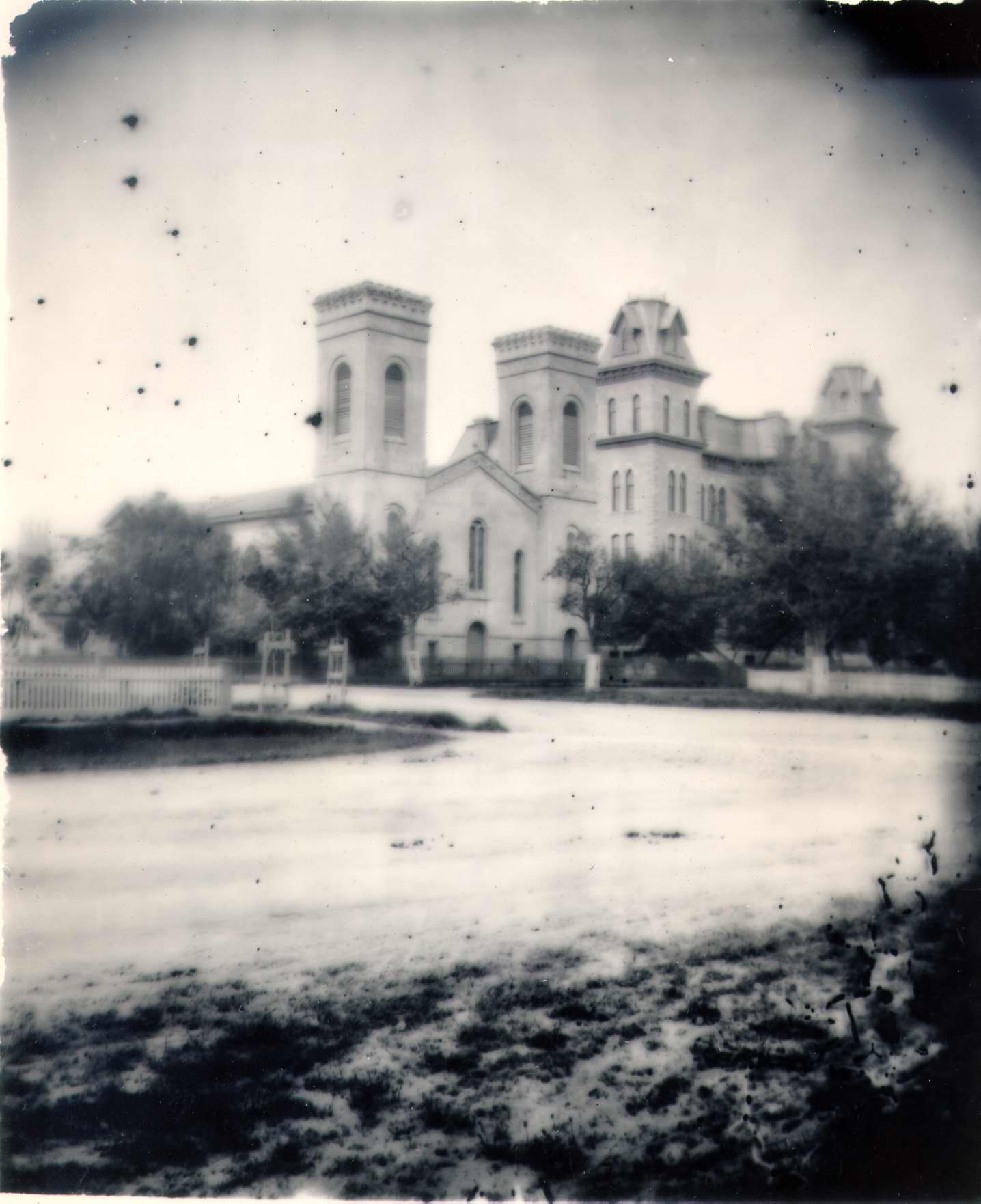
Grace Episcopal Church was founded in Sandusky in 1835, and has the oldest church building in the city. The original version of the building was completed in 1843; The towers, as seen in the photo above (circa 1870), were constructed in 1858. Other modifications have been made to the church over the years, and can be recognized by the difference in colors of stone.

John Dean, the owner of pew #67, had a productive life in Sandusky. He was born in 1835 in Tydd St. Mary, Lincolnshire, England, and came to Sandusky as a boy with his parents, William and Susannah Dean. He married Susan Belton in Sandusky on New Year's Day 1859, and together they had four sons and three daughters. He served two years in the United States Army during the Civil War years. He was a fisherman by profession. He died in 1892 and is buried with his wife in Oakland Cemetery.

Monday, February 28, 2022

William Ayres Simpson and Mary Denman Simpson


William Ayres Simpson was born in New Hampshire in 1812. After working in Boston and Detroit, he moved to Sandusky in 1834. In Sandusky, William Simpson was a partner of Horace Aplin in the grocery business. Later he was engaged in business ventures with Leonard Johnson and David Everett. Mr. Simpson was a stockholder and director in the Sandusky Gas Company, and served as  its president for many years. He was also a stockholder and director in the Second National Bank. 

Mr. Simpson was a member of Grace Episcopal Church for over forty years, serving on the church vestry for thirty-six years. Following his death on December 20, 1887, his former pastor, Rev. Dr. S. A. Bronson wrote in a letter, “Mr. Simpson was a man with as many virtues, and as few faults, as almost any one who can be found in this crooked world. As a vestry man in my church during the sixteen years I was rector of Grace Church, Sandusky, I can safely say I found no fault in him. As a business man, he was honest and honorable; as a Christian, and as an Officer of the church, he was faithful is the discharge of all his duties; benevolent, judicious and wise. If help was needed, he was always ready to do his part. He was always a pillar in Grace Church," and he adds, "a thousand more words in all departments of life may be said of him."  Rev. R. L. Howell, another former Grace rector, stated in the book History of Erie County, Ohio, that “William A. Simpson was one of those rare instances of the happy commingling of solid worth and simplicity of character which it is positively refreshing to behold.”  

On January 5, 1841, William A. Simpson married Mary A. Denman.


Mary’s parents, David and Mary Wright Denman died when she was only age two. She was adopted by Major John G. Camp, who was a friend of Mary’s father. Mr. and Mrs. Simpson did not have children of their own, but they raised two adopted daughters. One adopted daughter was Eliza D. Bartlett, who was the daughter of Mary Simpson’s sister; the other child was born Jane Eliza Marsh, to Cornelius and Rebecca Marsh. After her parents died in the cholera epidemic of 1849, Mr. and Mrs. Simpson raised her, calling her Jennie E. Simpson. 

Mary A. Simpson died on March 8, 1911. In her obituary, which appeared in the March 9, 1911 issue of the Sandusky Register, she was referred to as “a woman of generous impulses. Mrs. Simpson found great pleasure in giving for almost every good work.” Among the gifts that Mrs. Simpson presented to Grace Episcopal Church were the parish house, at the corner of Adams and Hancock Streets, and the east transept window of the church, which features “The Feast of the Epiphany.” Mrs. Simpson also left monetary gifts to Calvary Church, the Women’s Guild of Grace Episcopal Church, Kenyon College, Providence Hospital, and several others.

Mr. and Mrs. William A. Simpson were very generous to the community of Sandusky. To read more about this couple, there are several sources available, including History of the Western Reserve, At Home in Early Sandusky, and History of Erie County, Ohio. Mr. and Mrs. William A. Simpson are buried in the North Ridge section of Oakland Cemetery.

Friday, January 14, 2022

Buildings on the 100 Block of West Market Street in the 1990s


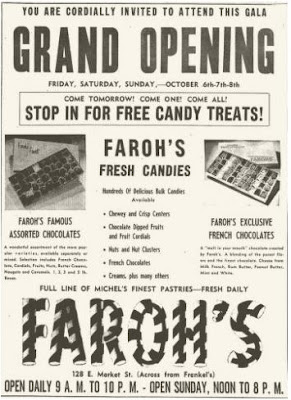
The photograph above was taken in the 1990s by a member of the Erie County Chapter of the Ohio Genealogical Society. The Thrift Shop of Grace Church was then located at 136 East Market Street in a building known as the Kugel Building. According to the Ohio Historic Inventory for Erie County, the Kugel Building was built around 1910. Through the years, there have been businesses on the street level, and apartments and offices on the upper floor. The Kugel Building was constructed from brick, with a stone foundation. The name “Kugel” is cut into the cement above the third floor windows. Herman and Benjamin Kugel emigrated to the United States from Hungary in the 1860s. They were successors to their brother Joseph’s dry goods store which opened in Sandusky in 1859. The Kugel brothers had stores in three different locations in Sandusky, the last one being located in the Kugel Building. Next to the Thrift Shop in the picture is Faroh’s Candies, at 128 East Market Street. Faroh’s Finest Candies first opened in Lorain, and then the company branched out to Amherst, Sandusky and Elyria. Faroh’s was located at 128 East Market Street in Sandusky from 1961 through the early 2000s. 

Here is an advertisement from the opening gala of Faroh’s in Sandusky, from the October 5, 1961 issue of the Sandusky Register:

Monday, December 20, 2021

Emma Matern Weaver, Artist


On January 1, 1897, Emma Matern, daughter of Henry and Lena Matern, was baptized at Grace Church in Sandusky, Ohio. Most baptisms in the Episcopal Church at that time were for infants, but she was in her thirties at the time of her baptism. Her baptismal sponsors were her sister Augusta Harrison  and Elizabeth Hudson, an artist and art teacher in Sandusky, and an early mentor to Emma Matern. Emma later studied at Adelphi College, the Art Students League, the Cincinnati Art Academy, and in Europe. She was known for painting flowers and portraits in oils and watercolor. In 1895, Emma Matern began teaching Art at DePauw University in Indiana, and in 1897, she married James Riley Weaver, a political science professor and a retired colonel in the U.S. Army.

In 1920, Colonel Weaver, who fought in the Battle of Gettysburg and was a prisoner of war during the Civil War, died in Indiana. He was a frequent visitor to Sandusky, Ohio, especially during the summer months, and he was buried at Sandusky’s Oakland Cemetery. Mrs. Emma Matern Weaver died at her sister Augusta’s home in Detroit, Michigan on March 29, 1932. She was buried beside her husband, Col. James Riley at Oakland Cemetery.

An example of Emma Matern's work from AskArt.com

Sunday, August 01, 2021

Rollin B. Hubbard, Pioneer Citizen of Sandusky


Rollin B. Hubbard was a pioneer in the lumber industry in both Ohio and Michigan. He was born in Connecticut in 1817 to John Mills Hubbard, and his wife, the former Mabel Barnard. As a young man, Rollin made his way from Connecticut to Ohio, and he settled in Sandusky. 

In the 1840s, he purchased timber land in what is now Sanilac County, Michigan. He operated saw mills in Michigan. Later he went into business with his cousins Langdon Hubbard and Watson Hubbard. They operated R.B. Hubbard and Company, a large lumber business on the waterfront in Sandusky, Ohio. By 1886, the company had become known as R.B. Hubbard and Son. The 1886 Sanborn Map shows the lumber yard south of Water Street, between Lawrence and Fulton Streets, and the planing mill was located on the north side of Water Street.


R.B. Hubbard once served as president of the Second National Bank, and he served for several years on the Board of Education. Mr. Hubbard was very active in Grace Episcopal Church, where he served as a vestryman. Mr. Hubbard’s first wife was Anne Massey, who died in 1871; he married Dorothea Hoffman in 1881. 

Rollin B. Hubbard died on May 18, 1904, after a lengthy illness. An obituary for R.B. Hubbard, which appeared in the May 19, 1904 issue of the Sandusky Register, read in part, “A man of fine presence and bearing; a gentleman of the old school in all that means in high character and intelligence; wise in counsel, charitable in judgment; closely identified through a long and successful career with the commercial and educational interests of Sandusky, Rollin B. Hubbard has left his impress on this community and it is an impress for good.” You can read much more about the history of the Hubbard family in the book One Thousand Years of Hubbard History, compiled by Edward Warren Day (Harlan Page Hubbard, 1895) available at the Internet Archive.


R.B. Hubbard was buried next to his first wife in the Hubbard family lot at Oakland Cemetery.

Friday, March 03, 2017

Dr. Dewey Duane Smith, DDS


Dewey Duane Smith was born in Gratiot County, Michigan in 1878. He was educated at Albion College, the University of Michigan, and Ohio State University’s College of Dentistry. He is pictured above with his wife Alma Smith and daughters Elizabeth and Marjorie. Sadly, Alma died shortly after the birth of her third child, Dewey Duane Smith, Jr.,  in 1925. He later married Etta Detleftsen.

In 1904 Dr. D.D. Smith moved to Sandusky, where he opened a dental office in the Kingsbury Block.


Dr. Smith took advantage of the fact that his initials were the same as the acronym for Doctor of Dental Surgery, as seen in the advertisement below from the August 31, 1905 issue of the Sandusky Star Journal.


Dr. Smith specialized in orthodontia. In the 1920s, he moved his dental practice to 130 East Market Street

Besides having a very busy dental practice in Sandusky for over fifty years, Dr. D. D. Smith, Sr. was also very involved in the community. He was a member of Grace Episcopal Church and the Masons. He served on the Council of the Boy Scouts of America for the local district, and he was instrumental in organizing Sandusky’s “Flicker Club,” a group of individuals interested in the promotion of amateur home movies.  Dr. Smith once served as secretary of the Northern Ohio Dental Association and was a member of the Erie County Medical Advisory Board. For eight years he served on the Ad Interim Committee, House of Delegates of the Ohio State Dental Society. 

Dr. D.D. Smith, Sr. died on May 1, 1959. He was survived by his wife Etta; daughter, Mrs. Walter Kerber; and son Dr. Dewey Duane Smith, Jr, who was also a dentist. Dr. Smith’s daughter Marjorie Kahn had died in 1956. Dr. Smith, Sr. was buried in Sandusky’s Oakland Cemetery.

Monday, October 17, 2016

The Barker Family Left Its Mark on Sandusky


If you have ever seen Barker School (now a Day Care Center) or driven down Barker Street on Sandusky’s west side, then you are familiar with the surname of a family whose many members  have made contributions to the development of the city of Sandusky. Zenas Ward Barker, who served in the War of 1812, moved his family from Buffalo, New York to Sandusky, Ohio in 1834. He was one of several individuals who helped organize Grace Episcopal Church in Sandusky in 1835. He was Erie County Clerk in 1838-1839. In the early 1840s, he was one of the directors of Sandusky’s public schools, and was Sandusky’s Mayor in 1846. This Zenas W. Barker died in Sandusky in 1879. His father, also named Zenas Ward Barker (1765-1834) was a pioneer settler of Buffalo, New York. One of the sons of Zenas W. Barker (1818-1879) also named Zenas W. Barker (1834-1861), became a First Sergeant in Company E of the Ohio 8th Volunteer Infantry. He lost his life during military service on August 28, 1861. 

Another son of Zenas Ward Barker, the former Sandusky Mayor, was Jacob A. Barker.


Jacob A. Barker began working at the Mad River and Lake Erie Railroad in 1846. He eventually became the freight agent for the railroad. From the early 1860s until he retired in 1891, he was the local agent for the United States Express Company. He was a member of the Sandusky City Council, the Board of Education of Sandusky City Schools, and he was a senior warden of Calvary Episcopal Church for several years. An article in volume 14 of the Firelands Pioneer said of him: “He was possessed of a generous, kind disposition and many instances of his generosity will be gratefully remembered by the recipients.” Jacob A. Barker died on December 22, 1898, and he was buried in the family lot at Oakland Cemetery. He was survived by his wife, the former Mary E. Paterson, and four sons. 

The son of Jacob A. and Mary Paterson Barker was George P. Barker:


He was born in Sandusky in May of 1852, and was associated with the United States Express Company in Sandusky for over forty years. From 1915 to 1929 Mr. Barker was storekeeper at the Ohio Soldiers’ and Sailors’ Home. During the Spanish American War, he rose to the rank of Major. He began with Company B of the Sixteenth Infantry, and mustered out with the Sixth Infantry. For four months Major Barker held the position of military governor of the district of Santa Clara in Cuba. On January 24, 1930 George P. Barker died as a result of heart disease. Funeral services for Major Barker were held on January 27 at Grace Episcopal Church, and burial was at Oakland Cemetery following a military salute at the gravesite. Many other members of the Barker family are also buried in the family lot in the North Ridge section of Oakland Cemetery.

Sunday, June 26, 2016

William P. Chapman, Pioneer Settler of Sandusky


William Pendleton Chapman was born in 1808, the son of Timothy Chapman and Nancy Pendleton, who were natives of Rhode Island. In 1834, William P. Chapman married Eliza Cross Pendleton in New London, Connecticut. Shortly after they were married, Mr. and Mrs. Chapman moved to Sandusky, where Mr. Chapman was the proprietor of a forwarding and shipping business. By 1862, he was the treasurer of the Sandusky, Mansfield and Newark Railroad. His name was listed in a Railway Directory in 1862.


While serving as treasurer of the Sandusky, Mansfield and Newark Railroad, Mr. Chapman and his family were given several railroad passes from several different railroads.

       
Besides being a busy business man, Mr. Chapman was active in the Grace Episcopal Church, where he had served on the very first church vestry. When church records began being kept for Grace Episcopal Church, it was William P. Chapman who painstakingly wrote them by hand.


When the church celebrated its fiftieth anniversary in 1885, Chapman, along with Rice Harper, wrote a history of the congregation, which was partially reprinted in Hewson Peeke’s A Standard History of Erie County, Ohio (Lewis Publishing Company, 1916.) 

By 1869 William P. Chapman had entered into the wholesale fish business with John Strickland. Mrs. Eliza Chapman died in 1891, and Mr. Chapman died in 1893. Both were buried in the family lot at Sandusky’s Oakland Cemetery. 

To learn more about William P. Chapman and his extended family, visit the Sandusky Library Archives Research Center, which holds letters from the Chapman and Pendleton families dating from 1843 to 1870. 

Thursday, December 04, 2014

St. John’s Chapel of Grace Episcopal Church


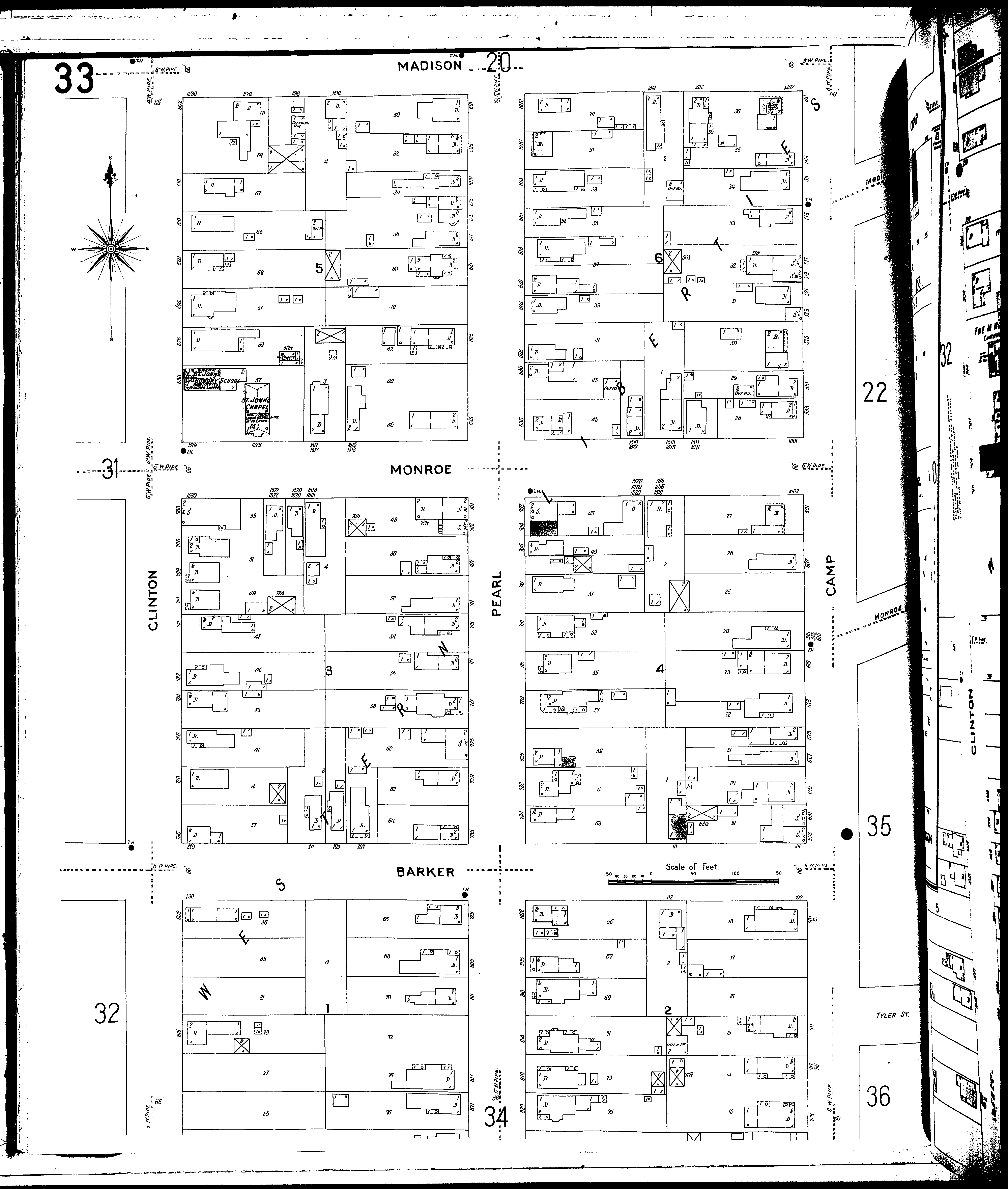
Pictured above is a Sunday School group at St. John’s Chapel, an outreach site of Grace Episcopal Church. The photograph was taken between 1900 and 1910. All the children are dressed in their Sunday best, and the pastor and several other adults are standing behind the Sunday School students. The 1905 Sanborn Map actually shows two buildings associated with the St. John’s Chapel. One was located on Clinton Street, and designated as the St. John’s Sunday School, while the St. John’s Chapel itself was located on West Monroe Street.


Grace Episcopal Church’s original church building was begun in 1835. This post card shows the church before the towers were altered.


At the back of a history of Grace Church by Gordon Wendt, is a list of several outreach programs undertaken by Grace Episcopal Church. Under the leadership of Rev. S.A. Bronson, St. Ann’s Chapel was built in the area known as Camptown, on the east side of Sandusky. St. Mary’s Chapel was built in the 1850s on the west side of Sandusky and later became the Sunday School building for St. John’s Chapel. St. John’s Chapel was built in 1876 on West Monroe Street, and was in operation through the 1920s. St. Luke’s Chapel was built in 1881 on Hayes Avenue, between Tyler and Polk Street. It was sold in 1915 to the First Christian Church, and was home to that church for many years. Mr. Wendt wrote that Calvary Episcopal Church started out as a chapel, built in 1870-71 at First Street and Erie Street. In 1899-1900, Calvary’s building at Meigs and First Street was constructed.  Old Calvary Church now serves as a wedding venue. Visit the Sandusky Library to read more about the history of Grace Episcopal Church, and many other local churches. The Sandusky Library Archives Research Center holds many reels of microfilmed church records.

Monday, February 10, 2014

Stereographic Cards from the American Views Series

Nicholas H. Hammond was the proprietor of the Great Bazar, a large dry goods store in business in downtown Sandusky from the 1880s through the early 1900s. As a side business, Mr. Hammond also created stereographic views of downtown Sandusky. These stereographic cards are all from the American Views series. 

Now known as St. Mary’s Catholic Church, this church was known as the German Catholic Church in the 1880s. Note the cigar stand next door.


Here is a view of Sandusky’s bustling waterfront in the nineteenth century:


You can see the steeple of Emmanuel Church in this stereographic image of the Erie County Courthouse.


Sandusky High School was constructed in 1867, and about ninety years later became Adams Junior High School. Grace Church is at the left of the image.


Visit the Sandusky Library Archives Research Center to learn more about the history of Sandusky and Erie County, Ohio.


Saturday, July 28, 2012

Entertainment by the Ladies of Grace Church, 1866

On Monday evening, July 30, 1866, the ladies of Grace Church directed an entertainment at Norman Hall. Funds from the evening’s events were to be given to the church. Several tableaux vivants were exhibited, which represented various scenes and characters. Both vocal and instrumental entertainments were provided during the concert portion of the program. Refreshments of ice cream and cake were to be served after the evening’s entertainment concluded. Fifty cents was the price of admission, which would be about $7.00 in today’s economy.

Many years later, in an example of Tableau Vivant, Mrs. James Douglas posed as Whistler’s Mother at a meeting of the Art Study Club in Sandusky.

Saturday, April 23, 2011

Services Held in Honor of President William Henry Harrison

Grace Episcopal Church held a special service in honor of recently-deceased President William Henry Harrison on Friday, April 23, 1841. The Order of Exercises included two Odes by the choir, as well as a choral anthem. Prayers were led by the Rev. I.A. Hart and Rev. A.W. Curtis, and the eulogy for President Harrison was give by the Rev. B.H. Hickox. William Henry Harrison was the ninth United States President, serving from March 4, 1841 to April 4, 1841, the shortest term of any American president. He died after he caught a cold that developed into pneumonia.

Before he became President, William Henry Harrison was a frontier leader who fought in several battles during the early Indian wars. He was known his victory over Shawnee chief Tecumseh at the Battle of Tippecanoe on November 7, 1811. During the War of 1812, he commanded the Army of the Northwest as Brigadier General. He became a national hero after the defeat of the combined British and Indian forces at the Battle of the Thames.

In September of 1835, Harrison was in Sandusky to officiate at the groundbreaking of the Mad River and Lake Erie Railroad.

During his presidential campaign in 1840, William Henry Harrison visited Sandusky. The ladies of Sandusky presented him with this embroidered banner in honor of the campaign.
The banner is still on display at the Follett House Museum. The story behind this banner is related on page 13 of the October 1896 issue of the Firelands Pioneer, available in the Genealogy section of the Sandusky Library.

Today few would agree with William Henry Harrison’s views on slavery and Native Americans, but in his day he was heralded as a military hero by the residents of Sandusky, Ohio.
Saturday, March 26, 2011

An Early Kindergarten in Sandusky

The young students of a Kindergarten class which was held at Grace Episcopal Church are posed for a picture in front of the church. While we do not know the exact date of the photograph, it is likely that it was taken sometime between 1900 and 1920. The Sandusky Star Journal reported that a private Kindergarten conducted by the Misses Grace Devine and Viola Link was to open at the parish house of Grace Church on September 10, 1916. In 1925, Miss Geraldine Wagar taught Kindergarten at the Grace Parish House, for children aged three to five years. Songs, games and other educational activities were featured for the youngsters between the morning hours of 9 and 11 a.m. during weekdays.

The word Kindergarten means “Children’s Garden” in German, and refers to the education of a child before the beginning of education in a more formal setting. To read more about Kindergartens in Sandusky, see Article 43 in Volume II of From the Widow's Walk, by Helen Hansen and Virginia Steinemann.