Showing posts with label Emrich. Show all posts

Monday, April 18, 2022

Nineteenth Century Children's Photographs

Elma and Frank Geib were the children of Frank Geib and Minnie Emrich Geib. Minnie may have been related to the Emrich family from Sandusky, but to date we have not determined a solid connection. Elma Geib married Frederick Schniewind, who was a pioneer in the introduction of by-product coke ovens for use in the manufacturing of illuminating gas. Elma Geib Schniewind’s son, Carl O. Schniewind, was a well known art historian who was head of the Prints Department of the Art Institute of Chicago. Elma Geib Schniewind died in New York City in 1964, and she is buried with her husband at Cleveland’s Lake View Cemetery. After her death, she donated works of art to the Cleveland Museum of Art and the Brooklyn Museum.

Elma Geib, born in Ohio in 1875 is pictured below in a photograph taken about 1881 by Henry Biddle, a Cleveland photographer.


Elma’s brother, Franz Geib, was born in Ohio in 1873. He later went by the name of Frank Geib. He became a physician in Cleveland, and passed away in June of 1956.


It is not known who donated these photographs to the Sandusky Library Archives Research Center, but they show us the style of clothing of two youngsters from Ohio, born to a father who was a native of Germany. Both Elma and Frank grew up to have full lives, and it is interesting to see how they appeared before they started on their journey to adulthood.

Saturday, March 02, 2019

“A Woman’s Club”


A poem titled “A Woman’s Club” appeared in the Sandusky Register on August 13, 1899. Written by Sarah Palmer, and originally appearing in the periodical Club Woman, the poem was said then to have been the best club poem ever written. The first twelve lines are:

What is a woman’s club? A meeting ground
For those of purpose great and broad and strong.
Whose aim is toward the stars: who ever long
To make the patient, listening world resound
With sweeter music, purer, nobler tones.
A place where kindly, helpful words are said
And kindlier deeds are done; where hearts are fed:
Where wealth of brain and poverty atones
And hand grasps hand, and souls find touch with soul.
Where victors in the race for fame power
Look backward even in their triumph hour,
To beckon others toward the shining goal.

Women in Sandusky and Erie County have met together informally as well as in clubs and organizations for many years. Hewson Peeke wrote about local women’s clubs in Chapter 23 of his book, A Standard History of Erie County, Ohio. During the Civil War, the Ladies Aid Society of Grace Church sent food to soldiers in need. The Ladies’ Library Association of Sandusky worked diligently to raise funds for the building of a public library in Sandusky.

Members of the Benevolent Society of the First Congregational Church of Sandusky are participating in a quilting bee in the late nineteenth century in the image below.


Here is a photograph of Mrs. Charles Emrich’s Reading Club:


The Pythian Sisters decorated a car with a patriotic theme in an unidentified parade:


Five Red Cross volunteers are pictured at the corner of Wayne and Jefferson Streets during World War One.


Visit the Sandusky Library Archives Research Center to view historic photographs and documents relating to women’s organizations in Sandusky and Erie County. Included in the Sandusky Library Archives Research Center are records from the Erie County Federation of Women’s Clubs, the Martha Pitkin Chapter, Daughters of the American Revolution, Art Study Club, the Nineteenth Century Club, Business Women’s Club, United Ladies Sewing Circle, College Women’s Club, and the Catholic Women’s Study Club, and others.

Wednesday, February 22, 2017

Historical Items from Sandusky Pharmacies

                       
This cabinet file once used for storing medicine labels is now housed in the attic level of the Follett House Museum. It had been used at the Sloane House Pharmacy, which was on the street level of the Sloane House hotel in Sandusky, beginning about 1890. Several different pharmacists worked in the Sloane House over the years, including H.K. Henkelman, Henkelman & Bechberger; Bechberger & Brown; Bechberger & Kubach, and Kubach and Buderer. Some of remedies on the labels are for Epsom salts, cod liver oil, boric acid and liniment. The label below from a container of pine tar capsules was purchased when Bechberger & Brown were partners in the Sloane House Pharmacy.


This apothecary bottle came from the pharmacy of Charles A. Lehrer, who had his business at the corner of Central Avenue and Decatur Street for several years in the first quarter of the twentieth century. He was the son of former Zion Lutheran Church pastor Rev. J. George Lehrer.
  
    
The compound of licorice powder is from the pharmacy of J.H. Emrich, an early Sandusky pharmacist.

    
This bottle of medicinal oil came from the E. J. Windisch Quality Pharmacy, which was in business in the 800 block of Hayes Avenue from about 1908 to 1925.

  
From 1898 until about 1930 Daniel Schaffer manufactured liniment. Advertisements claimed it to be the “greatest pain killer on earth.”  This advertisement for Schaffer’s Wonderful Liniment appeared in the Sandusky Star Journal on November 17, 1920:


Mihalovitch’s Hungarian Blackberry Juice was manufactured by a liquor dealer in Cincinnati, but was sold locally by nine different pharmacies in Sandusky in 1887. The juice was said to be a remedy for diarrhea, dysentery, cholera morbus (gastroenteritis), and all disorders of the bowels.


Sunday, June 14, 2015

David S. Curr, Practical Sail and Awning Maker

Two receipts from David S. Curr are housed in the business collections of the Sandusky Library Archives Research Center. In the spring of 1908, James Emrich paid 75 cents for putting up an awning (about $20 in today's money).


In December of 1908, John A. Feick paid $28.35 to Mr. Curr for a winter covering for his yacht named the Elizabeth.


David S. Curr was born in Dundee, Scotland in 1858. He came to the United States from Scotland in 1881. On the passenger list of the Devonia, accessed at FamilySearch.org,  he listed his occupation as sailmaker. His name is the twelfth name on the list below.


From about 1902 to 1910+, David S. Curr made and repaired sails and awnings for area residents. His sail loft was in the 500 block of Water Street, above a feed and grain store. Mr. Curr passed away on September 6, 1910, at the age of 52. He was survived by his wife Rosetta, and sons Charles and Frederick. Rev. H.V. Givler officiated at his funeral services, and burial was at Oakland Cemetery.

Tuesday, January 20, 2015

Early Veterinarians' Bills


In 1878 and 1879, Jay Bogert, who ran a livery service in Sandusky for many years, paid Dr. William B.H. Hunt for his services as a Veterinary Surgeon. Dr. Hunt attended to horses owned by Mr. Bogert on three occasions. The bill for three house calls totaled $5.75. Twice Dr. Hunt administered an antispasmodic drench to Bogert's animals. According to a reference from The Modern Horse Doctor, published in 1856, an antispasmodic drench was used for spasms of either the nervous system or muscular system. Dr. Hunt was listed in the Sandusky City Directories of 1878 and 1880 as a Veterinary Surgeon at 1220 Washington Street; later he was elected as Mayor of Sandusky, serving from 1881 to 1882, and then re-elected in 1887 and 1889.


Another veterinary bill from long ago was paid to Dr. E. R. Hinkley by a Mr. Emrich on July 1, 1904.


The veterinarian called at the Emrich residence to treat a horse. His bill was $2.50. Dr. Hinkley was born in Huron County, but he spent most of his adult life as a Veterinary Surgeon in Sandusky, Ohio. His office was located on the south side of West Market Street for many years; the office is visible at the extreme right of this image of Market Street, with the Columbus Avenue intersection in the background.

Tuesday, June 27, 2006

Featured Site


Our featured site in history is the Emrich Brothers Apothecaries, later known as the Emrich Drug Store. It was located at 118 Columbus Ave., on the west side, between Market and Water Streets, and operated from the 1850s until the first decade of the twentieth century. Born in Bavaria, James Emrich opened his store in Sandusky probably around 1853; his brother Phillip came to Sandusky and joined him in the business in 1863. However, Phillip died in 1876, of "hemorrhage of the lungs," at the age of only 38.
Here is a portrait of James Emrich, taken probably when he was in his sixties or early seventies (in the 1890s):


(Photo taken from the W.A. Bishop Portrait Photograph Collection.)

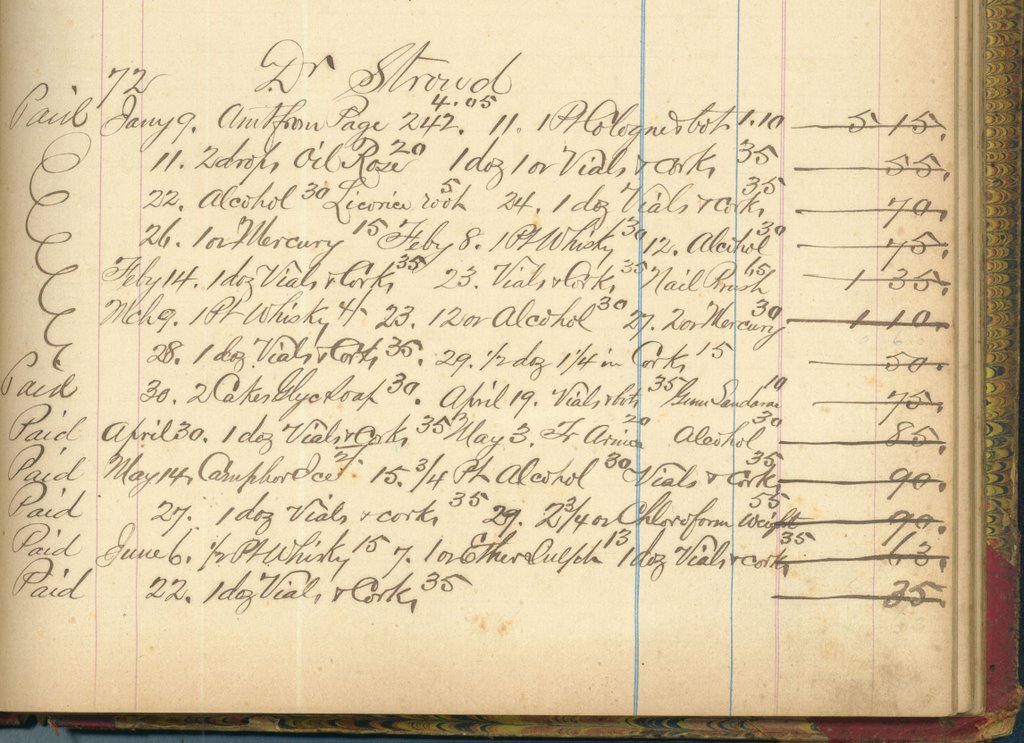
James Emrich ran his pharmacy for over fifty years, closing down the store only a few weeks before his death at age 80 in 1909. The Sandusky Library Archives Research Center possesses documents from the business, including ledgers from the 1860s and 1870s, and a folio book containing handwritten formulas for medicines and other products. Here is a sample of a page from one of the ledgers (notice the orders for whiskey for medicinal purposes):


You can find other life stories in the historical collections at the library.