Showing posts with label Elections. Show all posts

Monday, November 02, 2020

"Vote for Jackson!"


While the exact date is not known, the letter above was written from William H. Hunter to Dr. George Anderson during Andrew Jackson’s 1828 campaign for the U.S. Presidency. William H. Hunter was a Democratic member of the 25th U.S. Congress. In his letter to Dr. Anderson, he is hoping to gain support for Jackson in northern Ohio. An article in the American Heritage magazine points out that in 1828, when Jackson ran against John Quincy Adams, Ohio was considered a swing state.

A transcription of Mr. Hunter’s letter appears below:

Dear Sir,

The friends of Genl. Jackson in this place and some of the adjoining townships have thought it advisable to call a meeting of his friends for the purpose of sending delegates to Columbus on the 21st instant. I hope that you will join us and urge the necessity of all attending who are friendly to the cause and can conveniently leave home. The administration is straining every nerve to carry its points. But it must fail. It only requires moderation, union and firmness to carry the old Genl. in. And as it is necessary that Ohio should go along with the other western states let us use some little exertion to carry her along with them. So far as my information extends the friends of the Genl. are rapidly increasing. In this village where at the last election he had not above 6 notes we can calculate upon at least 40 at the next. In other parts of the county I hear almost every day of an accession to our strength.

Fail not if you please to have a notice put in the Clarion of contemplated meeting.

Yours respectfully,

W. H. Hunter

An article in the July 19, 1828 issue of the Sandusky Clarion reported about a Jackson meeting which had been held in Tiffin on July 4, 1828. However in the October 11, 1828 issue of the Sandusky Clarion was an editorial penned by a writer who called himself “Common Sense.” The writer stated, “We are called upon to bow down and worship the military idol of the south, under the seductive appellation of the Tennessee farmer, the hero of New Orleans, the compeer of Washington, the spotless patriot, … and we are denounced as knaves, aristocrats, and the enemies of our country, if we do not.”

While Andrew Jackson was not liked by everyone in the Sandusky area, he did win the election of 1828. Read more about Andrew Jackson at Ohio History Central.

Tuesday, November 06, 2018

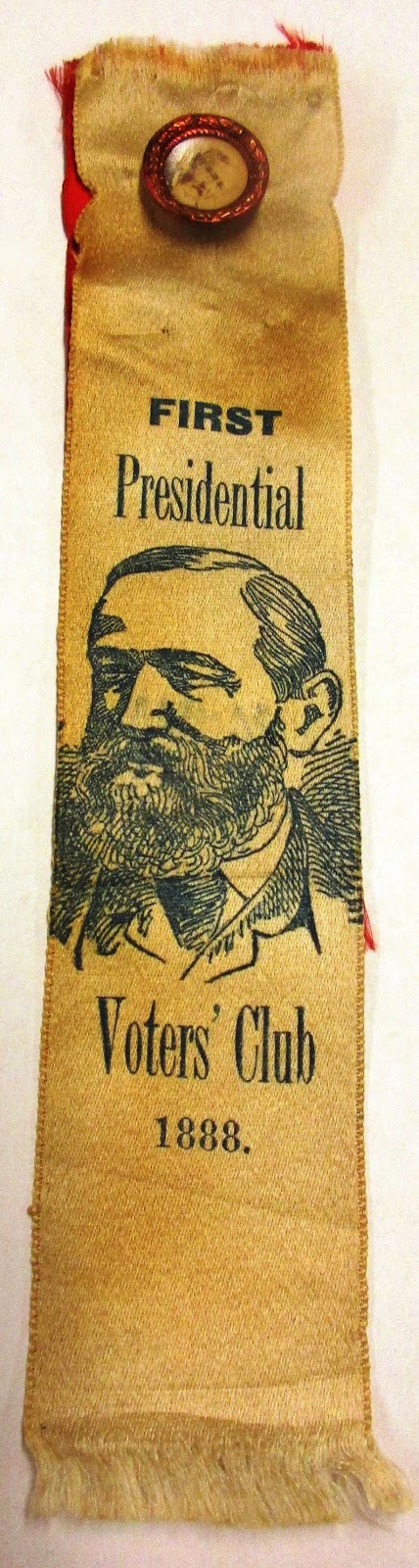
O.S. Alcott and the "First Presidential Voters’ Club" of 1888


O.S. Alcott donated this 1888 ribbon from the First Presidential Voters’ Club of 1888. The members of this club supported the Republican Presidential candidate Benjamin Harrison, who defeated the incumbent Grover Cleveland on November 6. 

First voters’ clubs were popular in the late nineteenth and early twentieth centuries. At that time, only men could vote. The club members were anxious to exercise their duties as citizens to make their voting choice count. 

Mr. Alcott ran a men’s clothing shop in the Kingsbury Block from about 1900 to 1930. He took the business over from his father, L.D. Alcott.


O.S. Alcott was the topic of the “Who’s Who and Why” column in the December 14, 1911 issue of the Sandusky Register.


Saturday, November 03, 2018

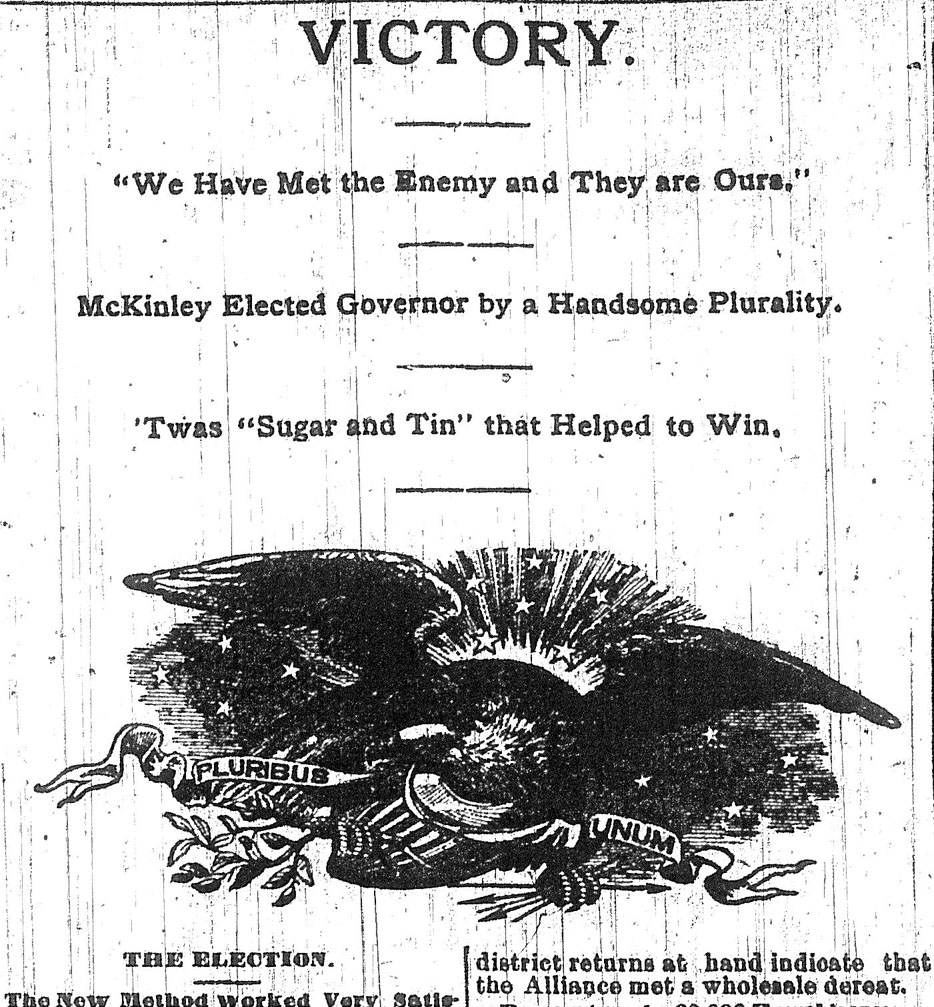
Election of November 3, 1891


On October 12, 1891, Erie County Sheriff Christian Wiedel posted a proclamation which notified area residents that the November election of 1891 was to be held on November 3, 1891. The Sandusky Register of November 4, 1891 listed a tabulation of election results.


Governor McKinley won “by a handsome plurality.” Of course he would later win the Presidential election, and he served as U.S. President from March of 1897 until he was assassinated in 1901.


A local election winner was Dr. B.R. Hubbard, who was chosen to serve as the Erie County Coroner:


You can read much more about Erie County’s elected officials in the book Elected to Serve: Erie County, Ohio, 1838-2003, by Patty Dahm Pascoe, available in the library's Genealogy collections.

Thursday, November 03, 2016

The Liberty Party in Erie County

According to the Firelands Pioneer, attorney F.D. Parish was the unsuccessful candidate for the Liberty Party in the 1844 Election. He had hoped to be elected to the 28th U.S. Congress. Hewson L. Peeke wrote in his book Standard History of Erie County, I (Lewis Pub. Co., 1916) that Parish helped to organize the Liberty Party in Erie County. This announcement appeared in the Sandusky Clarion on September 26, 1845. “Liberty men” were instructed to assemble at Berlin Center on October 10, 1845, for the purpose of renewing and increasing the efforts to redeem the country from “the disgrace of the system of American slavery, and to extend the blessings of liberty to all the people of the land.”


The names of the members of the Liberty Party in Erie County were listed in the May 28, 1849 issue of the Sandusky Clarion. They were:

M.  Farwell                 F.D. Parish
W.S. Mills                  G,.Osborne
Charles Cochrane       H. Curtis
L.S. Beecher               John Hughes
P.M. Ring                    H.J. Childs
F.T. Barney                  John Everitt
O. McKnight               Wm. Dildine
H.P. Radcliffe              G. Hughes
Wm.A. Bill                  Thomas Porter
S.E. Hitchcock             J. Neal
Wm. P. Chapman         J.B. Hughes
Wm. St. John               Samuel Hughes
Thos. Hughes              Thomas McFall
Edwin Forman             Jacob M. Colver
W.A. Simpson             S. DeWitt
John Wheeler              J.N. Davidson
C. Hadley                    John Irvine
S.M. Barber                Alexander Boyd
H. Johnson                  John Barr
A.H. Barber                Henry B. Green
Jas. D. Whitney          John Carson
Horatio Osborn           J.M. Goodman
D.C. Henderson          W.H. Clark
E.G. Ross                    John McEldowney
L.P. Clark                    H.H. Jennings
S. Ross                        W.C. Pettibone
Samuel Cochrane        Johan D. Whitney
J.H. Graham                P.B. Berry
E.P. Jones                    J.C. Mitchell
George Morris             G.W. Prichard
H.F. Merry                  Josiah Fowler

Several of the individuals whose names were listed as members of the Liberty Party in Erie County were also active participants in the Underground Railroad, the loosely knit network of people who assisted fugitive slaves to reach freedom in Canada

Monday, October 31, 2016

Political Campaign Buttons

The Sandusky Library owns a collection of political campaign buttons, which are housed in the Archives Research Center and the Follett House Museum. Here is a sample of some of them.


William Jennings Bryan ran unsuccessfully for U.S. President three times. Pictured above is a campaign button from his 1900 run against President William McKinley. 

Amos H. Jackson was elected as Representative to the 58th U.S. Congress, from March 4, 1903 to March 3, 1905. A.H. Jackson is also known for being the founder of the A.H. Jackson Manufacturing Company, which began in Fremont, Ohio, and had a division in Sandusky in the early 1900s.
     

Jay J. Perry served as Erie County Sheriff from 1898-1902 and from 1917-1920. The campaign button featuring an image of Jay J. Perry is most likely from his first campaign.


   Republican Warren G.  Harding, a former newspaper man from Marion, Ohio, defeated Democratic candidate James M. Cox for U.S. President in 1920.
 

This classic red, white, and blue pin promoted Dwight D. Eisenhower and his vice presidential candidate Richard Nixon. This team ran in both the 1950 and 1956 presidential campaigns. Eisenhower defeated Adlai Stevenson in both elections.   
  

Monday, September 26, 2016

Charles Evans Hughes Made Campaign Stop in Sandusky


On September 26, 1916, Charles Evans Hughes campaigned for the U.S. presidency in SanduskyOhio. He had resigned from the Supreme Court to run for President. He is pictured above, speaking in front of the American Crayon Company, near the Hayes Avenue subway.  The factory was decorated with patriotic bunting and flags, and a large crowd came out to hear what the Republican candidate had to say.


Because the train was an hour late, Ackley’s band entertained the crowds that had come out to hear the candidate speak. Once he arrived, Justice Hughes spoke for fifteen minutes, speaking about the power of progress, social justice, and the conditions of the American worker. Governor Myron T. Herrick and Erie County Auditor Hayes Adams also gave remarks.  In the November 1916 election, incumbent President Woodrow Wilson, the Democratic candidate, defeated Hughes.

During his 1908 presidential campaign, William Howard Taft spoke at the Ohio Soldiers' and Sailors' Home (now the Ohio Veterans Home), and Theodore Roosevelt gave a whistle-stop speech at the foot of Columbus Avenue to a large crowd of Sanduskians in May of 1912. Read an earlier blog post to learn more about other political campaigns in Sandusky

Monday, October 13, 2014

Union Ticket for Ohio from October 1863 Election


During the Civil War, many Ohioans became members of the Union Party, which was made up of Republicans and Democrats who were in support of the Union cause. On October 13, 1863, John Brough was elected Governor of Ohio on the Union Party ticket. Brough soundly defeated Clement L. Vallandigham, who was against the Civil War, and had been forcibly exiled to the Confederacy. When President Abraham Lincoln heard that John Brough’s majority was over 100,000, he personally wired the Governor-elect. His message said “Glory to God in the highest. Ohio has saved the nation. A. Lincoln.”
John Brough, Ohio Governor 1864-1865(Image from http://en.wikipedia.org/wiki/File:JohnBrough.jpg )

Several articles that appeared in the October 16, 1863 issue of the Sandusky Register, reported that Sandusky area residents had a “grand era of good feeling” over the Union party majority during the recent election. The article stated that the hundreds of people from all around Sandusky and Erie County turned out at the Erie County Courthouse. The courthouse was illuminated from top to bottom, and bonfires were ablaze at the parks on Columbus Avenue. The Union Band played patriotic music, and at 8 p.m. Colonel J.C. Lee of Tiffin addressed the crowd. There was an announcement for the Brough Ball which was to be held at Norman Hall on October 16.


Proceeds from the Brough Ball were for the benefit of the families of Union soldiers.


Business owner C.C. Keech included the words Brough! Brough! in his advertisement for wool. The ad mentioned the 100,000 majority for Brough, along with an ad in which he offered to purchase 100,000 pounds of wool for 73 to 75 cents a pound.  Governor Brough died in 1865, before he completed his two year term as Governor of Ohio.


The names of several local candidates also appeared on the ballot in the fall of 1863, including W.D. Lindsley, who was elected to the Ohio Legislature; George Morton, elected Probate Judge; George O. Selkirk, elected as Clerk of Common Pleas Court; George W. Smith, elected Erie County Auditor; Calvin Caswell, elected Erie County Commissioner; and John Wines, elected Infirmary Director. 

Saturday, March 03, 2012

1884 Congressional Map of Ohio


Erie County, along with Sandusky, Ottawa, and Lucas Counties, was a part of Congressional District 10 in 1884. A breakdown of the popular vote in the United States, as well as in Ohio, for the Presidential election of 1884 was provided on the map. The 1884 Congressional Map of Ohio was distributed in the fall of 1888 when President Grover Cleveland was running for reelection against Benjamin Harrison. Cleveland lost reelection in the Electoral College, even though he won the popular vote by a narrow margin.

The map was a promotional item distributed by the Aultman, Miller & Company from Akron, Ohio, the manufacturer of several Buckeye mowers, binders, and other agricultural implements.

You can read about the history of Ohio Congressional redistricting during the nineteenth century in an online article.

Friday, July 29, 2011

The Sandusky Telegram

On July 29, 1872, J.C. Loveland began publishing a weekly newspaper called the Sandusky Telegram. Loveland’s office was at 195 Water Street, opposite Barney & Ferris. According to Roswell’s American Newspaper Directory, the Sandusky Telegram was Sandusky’s only Democratic newspaper in 1872. Circulation was 700, and the annual subscription rate was $2.00. In the October 19, 1872 issue of the Sandusky Telegram, Loveland strongly endorsed Horace Greeley as the presidential candidate. (President Grant was re-elected in 1872.) The front page of the October 19 Sandusky Telegram carried several articles that were critical of Rush Sloane, who had just lost the election as a candidate for U.S. Congress.


A brief Telegram article was critical of I. F. Mack’s coverage of recent candidates in the Sandusky Register. Loveland stated about the Register’s editor, “the editor has stepped beyond the limits of journalism.” Interestingly, in Charles E. Frohman’s book about I.F. Mack, entitled Sandusky's Editor, there is no mention of J.C. Loveland or the Sandusky Telegram.

To view the 1872 issue of the Sandusky Telegram, or read the book Sandusky's Editor, visit the Sandusky Library, and ask for assistance at the Reference Services desk.

Saturday, July 09, 2011

Election Handbill in German


The handbill above was donated to the Sandusky Library Archives Research Center by Dr. Norbert Lange, who also provided the English translation:

German Fellow Citizens!
Do not neglect to vote for the
school candidates on the Volks-Ticket:

For members of the Board of Education:

Jacob A. Barker
Cornelius Schnaitter

The election will be held in the court house on
Tuesday the 9. of  July 1872.
Polls open until 5 o’clock in the evening.

In 1872 there were many German social groups which met in Sandusky, and it is most likely that when they met, this handbill was distributed just prior to the July 1872 election. According to the 1893 Annual Report of the Board of Education of City of Sandusky, Cornelius Schnaitter served on the Board of Education for the Sandusky City Schools from 1872 through 1876, while Jacob A. Barker was on the Board of Education from 1872 through 1878.

Saturday, April 23, 2011

Services Held in Honor of President William Henry Harrison

Grace Episcopal Church held a special service in honor of recently-deceased President William Henry Harrison on Friday, April 23, 1841. The Order of Exercises included two Odes by the choir, as well as a choral anthem. Prayers were led by the Rev. I.A. Hart and Rev. A.W. Curtis, and the eulogy for President Harrison was give by the Rev. B.H. Hickox. William Henry Harrison was the ninth United States President, serving from March 4, 1841 to April 4, 1841, the shortest term of any American president. He died after he caught a cold that developed into pneumonia.

Before he became President, William Henry Harrison was a frontier leader who fought in several battles during the early Indian wars. He was known his victory over Shawnee chief Tecumseh at the Battle of Tippecanoe on November 7, 1811. During the War of 1812, he commanded the Army of the Northwest as Brigadier General. He became a national hero after the defeat of the combined British and Indian forces at the Battle of the Thames.

In September of 1835, Harrison was in Sandusky to officiate at the groundbreaking of the Mad River and Lake Erie Railroad.

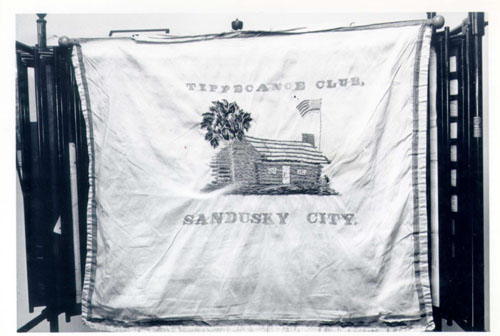
During his presidential campaign in 1840, William Henry Harrison visited Sandusky. The ladies of Sandusky presented him with this embroidered banner in honor of the campaign.
The banner is still on display at the Follett House Museum. The story behind this banner is related on page 13 of the October 1896 issue of the Firelands Pioneer, available in the Genealogy section of the Sandusky Library.

Today few would agree with William Henry Harrison’s views on slavery and Native Americans, but in his day he was heralded as a military hero by the residents of Sandusky, Ohio.

Saturday, November 06, 2010

Bella Lehman, Woman Candidate for Board of Education

Even though women did not legally get the right to vote until August 26, 1920, on occasion women ran for an elected position. On Tuesday, November 2, 1909, Bella Lehman’s name appeared on the ballot as an independent candidate for the Board of Education of Sandusky City Schools.
Bella Lehman pledged to local parents that she had no partisan principles, and that her interests were in the “welfare of our children and the cause of proper education, under normal, healthful and moral conditions.”
The Sandusky Register of November 3, 1909 listed the winners of the race for School Board as Paul H. Sprow, H. H. Lockwood, Chris J. Strobel, and Lee B. Kellar.

Bella Lehman died in Hollywood, California. An obituary for Mrs. Lehman appeared in the September 22, 1938 issue of the Sandusky Star Journal. Mrs. Lehman had been active in charitable work during the years she spent in Sandusky, giving freely of her time to aid stranded Americans in Germany. She worked towards establishing the Women’s Building and Rest Room Association in Sandusky, and was a member of the Business Women’s Club and the Community Chest. After the death of her husband Henry L. Lehman, Bella moved to Europe and was connected with the U.S. Embassy in Germany. She moved to California in 1929, and lived there until the time of her death in September, 1938. Bella Lehman was survived by three children, Mrs. Jack Zinkand, Mrs. Ralph Freeman, and Henry L. Lehman, Jr., all of California.
See an earlier blog post to read more about Women’s Suffrage in Sandusky.

Sunday, September 28, 2008

October is Archives Month

Once again, October is Archives Month, and the Sandusky Library will be offering several local history events in commemoration.

This year's theme is "Elections in the Archives." Therefore we'll start the month with a program on Saturday, October 4, at 2PM in the library program room, where we will have a sort of "show and tell" from the library's archival collections, describing elections and the electoral process in Sandusky, from the very first local election in 1824 to more recent times. There will be plenty of artifacts and historical documents to view, and we might even talk a little about Archives Month and the importance of archives in our lives.

Monday, October 23, 2006

Political Campaigns in Sandusky

As election day is approaching, it's a good time to talk about political campaigns that passed through Sandusky. I know it's not a presidential election year, but let's talk about some candidates for President of the United States who made campaign visits to Sandusky.


Possibly the earliest campaign visit to Sandusky by a presidential candidate was in 1840, when William Henry Harrison, the Whig Party candidate, came to town. To commemorate his visit, several women of Sandusky (including Mrs. Eleutheros Cooke) created an embroidered banner in honor of the campaign (shown above in a b&w photo). The banner, showing a log cabin on one side and an eagle on the other, is on display at the Follett House Museum. This story behind this banner is related on page 13 of the October 1896 issue of the Firelands Pioneer, available in the Genealogy section of the Sandusky Library.

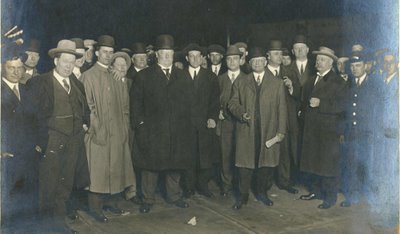
During his successful 1908 presidential campaign, William Howard Taft spoke at the Ohio Soldiers' and Sailors' Home (now the Ohio Veterans Home). The photo below shows the soon-to-be President-Elect with a group of local dignitaries outside of the Soldiers Home. Taft was a close friend of Sandusky resident Edward Marsh, and apparently visited the area several times for social occasions.


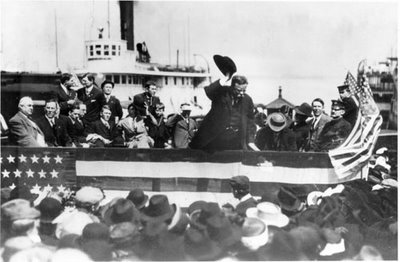
Taft's former political ally, Theodore Roosevelt, became his political opponent during the 1912 presidential campaign. Believing that Taft betrayed the progressive principles that formed the core of Roosevelt's beliefs, "TR" ran for president that year as the candidate of the Progressive Party (often called the "Bull Moose" party, in honor of a popular nickname for Roosevelt). In May of that year, Roosevelt gave a whistle-stop speech at the foot of Columbus Avenue to a large crowd of Sanduskians. Here is one of several images of that event from the library's photo collections:

In the 1916 election, Charles Evans Hughes was the Republican candidate for president, seeking to unseat President Woodrow Wilson from his position. In September 1916, Hughes gave a speech in front of the American Crayon factory on Hayes Avenue. (Unfortunately, that photo will not post properly on Blogger.)

Another interesting local story of presidential campaigns can be found in the November 11, 1940 issue of Life magazine. In an article titled "The People's Choice," the publishers used Erie County, Ohio as a microcosm for the nation, with images of local residents and descriptions of why they chose to vote the way they did. You can read the article, and see photographs of local residents of the time (as well as a picture of candidate Wendell Willkie in Sandusky), in the Sandusky Library. Ask a reference librarian for that issue of Life magazine from closed storage.