Showing posts with label photography. Show all posts

Friday, November 14, 2014

Stereograph Cards by A.C. Platt


Stereographs are a pair of nearly identical images that give a three dimensional effect when viewed through a device called a stereoscope. Several stereographic cards are found in the collections of the Sandusky Library and the Follett House Museum. Above is a stereograph card of the Erie County Courthouse created by Sandusky photographer A.C. Platt, probably around 1876. A group of stereographs created by Mr. Platt were donated to the Sandusky Library by Mrs. John H. Jacques. The cards originally belonged to her father, Willis Merry. Mrs. Jacques was a direct descendant of Ebenezer Merry, a pioneer settler of the Firelands. A view of Sandusky High School and the old academy building can be seen in the stereograph card below. The academy building was used as a courthouse prior to the construction of the Erie County Courthouse in 1875. It was torn down in 1884.


This view of downtown Sandusky was taken from the upper level of the Erie County Courthouse. The steeples of the Congregational Church, then in Washington Park, are visible. This church was demolished in 1896, and a new church was built at the northwest corner of Columbus Avenue and Jefferson Street. In the background, you can see a portion of the Cedar Point peninsula


     In 1875, the first city water works was under construction, at Meigs and Washington Streets. Here you see construction scaffolding around the standpipe. If you look closely, you can see men at the top of the scaffolding.


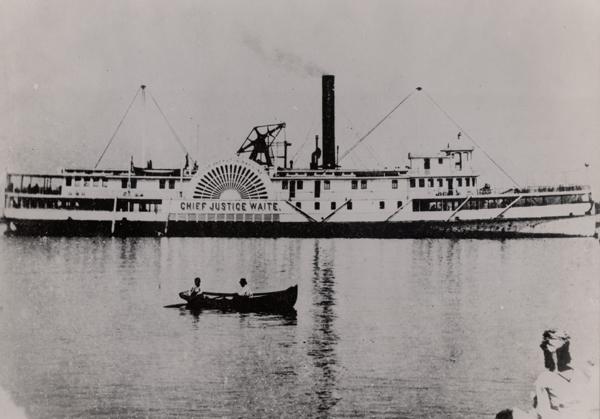
Below is a view of the Sandusky’s waterfront in the early 1880s. The vessel Chief Justice Waite is partially obscured by an unidentified ship in Sandusky Bay.


Thanks to A.C. Platt’s stereograph cards, we can get a sense of what life was like in Sandusky in a bygone era.

Friday, January 14, 2011

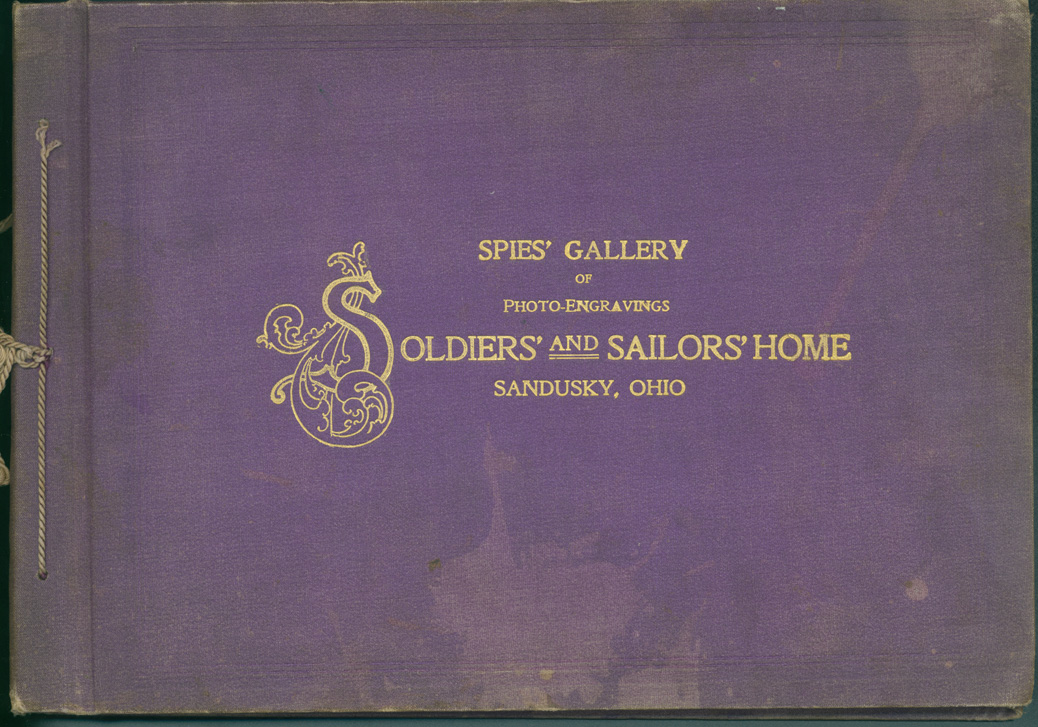
Spies’ Gallery of Photo Engravings: Soldiers’ and Sailors’ Home


First published in 1896, August Spies copyrighted and published a second edition of Spies’ Gallery of Photo Engravings: Soldiers’ and Sailors’ Home in 1902. On pages 2-3 of the 1902 edition is a brief history of the Ohio Soldiers’ and Sailors’ Home, which stated that the facility in Sandusky was “the most beautiful Soldiers’ home in the United States.”

The Administration Building, which is now home to the Ohio Veterans Home Military Museum, is pictured on page 14.

General Manning F. Force was the first Commandant of the Ohio Soldiers’ and Sailors’ Home. His picture appears on page 4 of the 1896 edition of Spies’ Gallery. General Force was appointed Commandant of the Ohio Soldiers’ and Sailors’ Home by Ohio Governor Joseph Foraker in October 1888 and he served in his official capacity until his death on May 8, 1899.

In 1902 General Thomas M. Anderson was Commandant of the Home.

The Ohio Soldiers’ and Sailors’ Home was arranged on the Cottage Plan. Residents had sleeping quarters and a sitting room.

Residents could read newspapers and books in the library.

In 1902 the Home used about 750 tons of ice each year, which was harvested from the lake on the grounds. Enough ice was harvested at the Ohio Soldiers’ and Sailors’ Home in the early 1900’s to fill two ice houses, as well as have a three month supply of ice which was stored just outside the ice houses.

The hospital at the Ohio Soldiers’ and Sailors’ Home employed both male and female nurses.

Many photographs can be seen in the Spies’ Gallery, including pictures of the fire department, work shop, cemetery, post office, railway station, and several view of the residents’ cottages and officials of the Home. The Ohio Soldiers’ and Sailors’ Home is now known as the Ohio Veterans Home.

From about 1900 until 1923, August Spies had his photographic studio at 123 West Market Street in Sandusky, above the offices of Buerkle and Lermann’s General Insurance business.

Wednesday, November 17, 2010

Hand Tinted Prints by C.W. Platt

Clayton Winfield Platt was the son of prominent Sandusky photographer A.C. Platt. Upon the death of his father in 1883, C.W. Platt took over his photographic gallery at the northeast corner of Columbus Avenue and Water Street. A.C. Platt had a fondness for the natural beauty of the Lake Erie Islands area, according to an article by Merlin D. Wolcott in volume 34 of the Inland Seas. It seems that C.W. Platt also enjoyed capturing scenes of the Lake Erie Islands area.


Several hand tinted matted prints of scenes from the Lake Erie Islands area were donated to the Sandusky Library Archives Research Center by Allene Schnaitter, granddaughter of C. W. Platt.

The print below features the shoreline of Kelleys Island.

The steamer Lakeside is seen out on Lake Erie.

The Marblehead Lighthouse is a favorite destination for visitors and local residents.
A news article in the August 18, 1903 issue of the Sandusky Evening Star reported that C.W. Platt had sold his business to his former employee, C.G. Wildenthaler, due to declining health. C. W. Platt passed away in Cleveland, Ohio on January 4, 1914. He was buried in Oberlin, Ohio.

Monday, August 09, 2010

Late Nineteenth Century Stereograph Images

In 1976, Irma Schoeneman donated eleven stereographic images to the Sandusky Library’s historical room, now the Sandusky Library Archives Research Center. Stereographs were popular in the latter part of the nineteenth century and early twentieth century. Stereographs are similar to a child’s ViewMaster toy. Two images placed side by side appear to be three dimensional, when viewed through a special viewer.

Below is an image of the Erie County Jail, now a part of the Sandusky Library, about 1885. The building to the left of the jail served as the medical office of Dr. J. D. Parker for many years. This image was created by N. H. Hammond for the American Views series.
Another stereograph by N. H. Hammond shows the north side of East Market Street about 1890. The Melville brothers operated a drugstore in the Cooke Block at the northeast corner of Columbus Avenue and Market Street. John H. Wagenet and Josh B. Davis had an insurance company in the upper floor of the Cooke Building. Jay Cooke was born near the site of the Cooke Block, though the building was named for an unrelated Cooke family, according to Article 51 of From the Widow's Walk, volume 2. The Bazar can be seen at 615 and 617 East Market Street. This business called itself “Sandusky’s Great Bargain Store.”
A.C. Platt was the photographer for this stereograph of an unidentified home in Sandusky, Ohio. Relaxing on the porch seems to be an enjoyable pastime that has remained throughout the years.
The date for the stereograph below, also taken by A. C. Platt, was March 3, 1887. A very large group of people, mostly children, can be seen on the porch. Notes on the back of the original stereograph card read, “Compliments of Sakie and Georgie.” While do not have enough clues to be absolutely sure, the names Sakie and Georgie may refer to the children of Mr. and Mrs. Andrew W. Prout. Andrew W. Prout was a well known banker and real estate agent in Sandusky. His daughter Sakie Prout Merz was a longtime member of the Board of Trustees of the Sandusky Library.

Tuesday, March 23, 2010

Early Photography

In the 21st century, a professional photographer’s studio contains no windows. Light is a carefully manipulated element of each image, altered using a host of modern tools. Before electricity and the electronic flash, a 19th century photographer relied on the power of the sun to light his subject. In Sandusky and across the nation, photographers’ studios were often located on the top floors of buildings, the better to take advantage of natural sunlight. 
This unusual view of C.J. Pascoe’s Sandusky photography studio gives a modern viewer insight on the tricks of the photography trade in the late 1800s. The rooftop skylight is filtered using a gauzy white cloth. Large white boards mounted on movable stands were used to bounce light on the subject. A decorative backdrop is at the rear of the studio. Several different chairs are located around the studio, along with an ornate footstool and a plush rug on the floor. A decorative pedestal is stowed in the left rear corner of the studio. If you look carefully on the left side of the studio, you will see three floor mounted stands. Early film required a long exposure, and these stands helped a subject keep still while holding a pose. You’ll notice that two of the chairs have padded armrests, which also helped the subject remain still during the exposure. On the right side of the studio, there is a large wood burning stove, used in the days before central heating. Near the center of the image is the tool of the trade—the camera. This appears to be a larger format glass plate camera which is mounted on a wooden tripod. Glass plates produced remarkably clear and detailed images.
C.J. Pascoe’s photography studio was located in downtown Sandusky, on Columbus Avenue. Charles James Pascoe was born December 23, 1854 in Ontario, Canada. He married Mary Jane Gilbert in Detroit in 1872. He died May 12, 1933. He worked as a photographer in Fremont, Sandusky, and Toledo.
Here is an interesting example of a portrait subject in the studio. You can see the hand-painted backdrop with a military scene behind this soldier. Photographers often had a variety of backdrops with different scenes to match the mood sought in the photograph. The large tree stump serves not only as a decorative prop, but also as a stabilizing device to to help a person steady himself for long exposures (at least several seconds; sometimes as long as a minute or more). At his feet, you can see a trace of the stand used to attach a stabilizing brace to the back of his head, to help keep his features from blurring in the image.

Wednesday, May 02, 2007

Reading Photographs

Photographs are my favorite sources of history. A photograph can tell you much about the world that existed at the time the picture was taken -- and, by extension, much about the world you live in today. (You'll notice that each entry on this blog has at least one photograph or an image of some sort.) Often, the most interesting parts of a photograph are things beyond the original "subject" of the picture. In some ways, the best photographs are ones that allow you to discover something new whenever you look at them. The photo below is a good example of that:
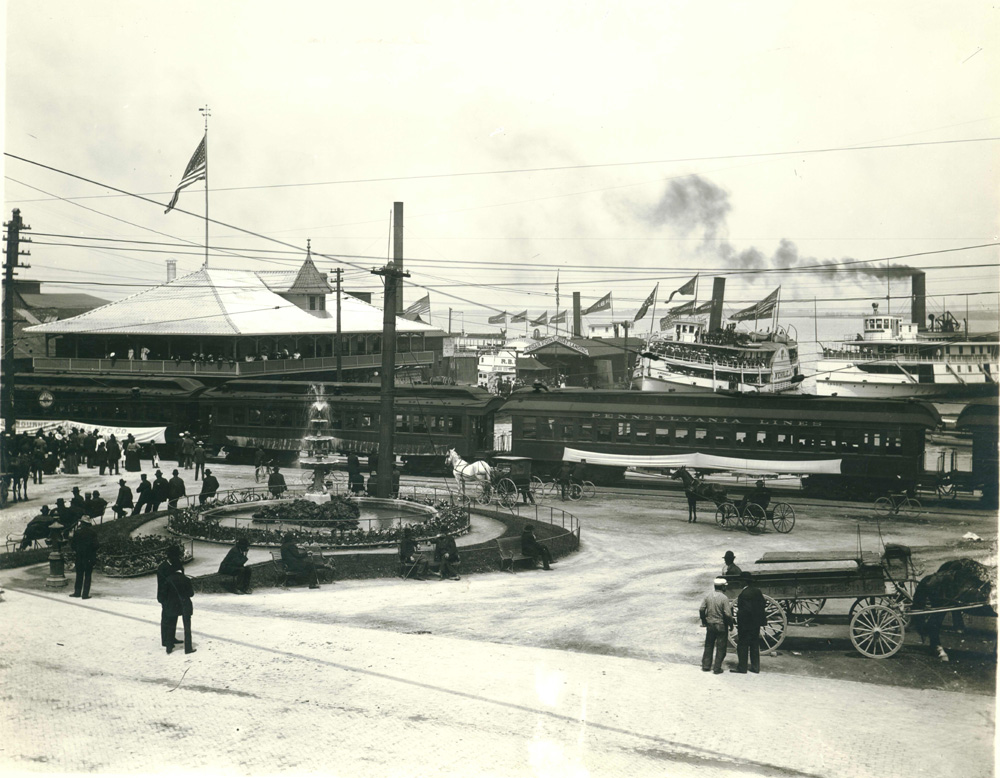
This is a scene at the foot of Columbus Avenue, probably in 1903 or 1904. The area in this picture was a major transit point for people and goods travelling through Sandusky at that time. Can you count how many different forms of transportation are visible within this image? What can this scene suggest to you about why Sandusky was founded and how it developed the way it did? (For answers relating to this question, see the article, "Sandusky, Pioneer link Between Sail and Rail," in the Ohio History journal.) What can the people in this scene tell you about life in Sandusky over one hundred years ago? Do you think you can create a reasonable story about the life of a person in the picture? Why do you think this picture was taken? How do you explain why a scene like this does not happen there today?

Here is another scene, on the waterfront (near the foot of Meigs Street) in the late 1870s. What inferences can you draw from this image? Why do you think this picture was taken? Does it say anything to you about the ideas of "progress" and "technology" and how people perceived those ideas at the time of the photograph?
Finally, compare and contrast the two photos below. You might not know who either of these men were (in fact, the man on the right is unidentified in our collections), but you can probably make some rather accurate assumptions just by looking at their photos. Note their appearance -- both in their clothing and pose. Even the type of photograph might give hints as to the background of the subject. (The image on the right is a carte-de-visite, an early pocket-sized photo.) Do you think you could create a realistic story for each man?


In many ways, photographs are as valuable as the written word for studying history. We tend to have a different kind of "intellectual filter" (perception) with a photograph than with a written text, and what is not found in the text may sometimes be revealed through your observation of the image. (But beware -- as with made-up stories, photographs can often be distorted to give an inaccurate presentation of the event pictured. It does not have to be "doctoring" of an image; the distortion could be as simple as selectively framing a scene to influence one's perception of events.)

For brief lessons on reading photographs, see here, here, and here. And, of course, the library has many interesting books on the history of photography and its role in culture and society. A good place to start is with Beaumont Newhall's book, The History of Photography (770.9 NE).

As always, if you have your own thoughts about this topic, or about any other postings on this blog, feel free to leave a message in the comments section.