Showing posts with label Wunderley. Show all posts

Tuesday, July 30, 2013

Cholera Victims of 1849: in Sandusky, Erie County, Ohio


In the fall of 1986, Mrs. Katharyn L. Wunderley completed a project which resulted in a compilation of information about hundreds of individuals who lost their lives in Sandusky’s cholera epidemic of 1849. Mrs. Wunderley used these ten sources in her research.


Names are listed alphabetically, with the sources used indicated for each name.


Some entries provide very brief details, while others are lengthy, such as this listing for William Townsend:


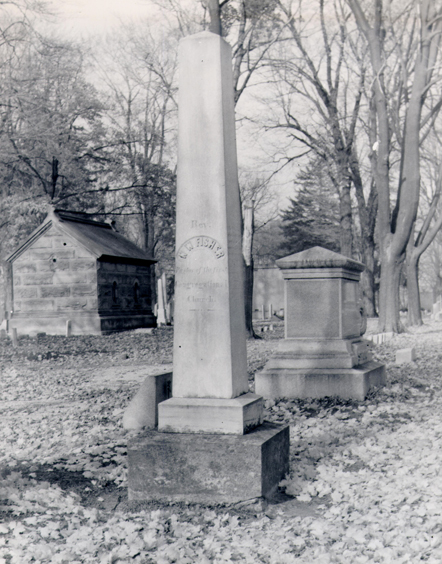
About two hundred fifty victims of cholera were buried in the Harrison Street Cemetery, now known as the Cholera Cemetery.  A single column honors the memory of those who died. About one hundred twenty persons were buried in the St. Joseph Catholic Cemetery. After Oakland Cemetery was opened in 1850, at least thirty tombstones were put in place in memory of cholera victims who lost their lives in 1849.  Three ministers who died of cholera are buried side by side at Oakland Cemetery.


A marble monument bears the name of Rev. N.W. Fisher, former pastor of the Congregational Church; Rev. H.P. Ward, a Methodist minister; and Rev. T.C. Cooper of the Bethel Church. To learn more about the many individuals who died of cholera in Sandusky in 1849, see Katharyn Wunderley’s book Cholera Victims of 1849: in Sandusky, Erie County, Ohio, shelved with the genealogy and local history books in the Lower Level of the Sandusky Library. This resource is invaluable, as it covers a time in history prior to the publication of Sandusky City Directories. 

Saturday, September 10, 2011

Dedication of Historical Marker at the Cholera Cemetery


On September 10, 1966, the Ohio Historical Society’s marker at the Cholera Cemetery was dedicated. Charles E. Frohman composed the wording on the text of the marker. The arch, which had been designed by Artist Frank W. Smith, was donated by the grandchildren of John Lay, Sr. Serving as Master of Ceremonies at the marked dedication was Charles E. Frohman. Dr. C. F. Lavender, President of the Erie County Medical Society spoke, along with Daniel R. Porter, executive director of the Ohio Historical Society. Music was provided by the Sandusky High School Band. The invocation was given by Rev. Msgr. William Armitage, and Dr. Theodore Stellhorn, Jr. gave the benediction. Also participating in the day’s events were the Boy Scouts, Girl Scouts, and Camp Fire Girls.


Over 300 persons lost their lives in the Cholera Epidemic of 1849, which took place between July 1, 1849 and September 7, 1849. Cholera struck Sandusky again in 1852 and in 1854, but not as severely as the 1849 epidemic.

Two sources which include historical details about the cholera epidemics in Sandusky are chapter XIV of Hewson Peeke’s A Standard History of Erie County, Ohio, published in 1916, and chapter 9 of Sandusky Then and Now.

Another outstanding resource relating to the cholera epidemic of 1849 is Cholera Victims of 1849 in Sandusky, Erie County, Ohio, by Katharyn L. (Huss) Wunderley. Mrs. Wunderley, who was an avid genealogist, spent hundreds of hours researching the names of the individuals who perished from cholera in 1849. She consulted the above two books, along with History of Erie County, Ohio, edited by Lewis Cass Aldrich, local newspapers, church records, and cemetery records. Two other resources used in Mrs. Wunderley’s research were the Cholera Hospital Register and the Cholera of 1849 and the Opinions of Medical and Other Professional Gentlemen in Regard to Its Origin and Proper Treatment, both accessible at the Ohio Memory Online Scrapbook.

Friday, January 07, 2011

Erie County Infirmary

 
The historic limestone Erie County building at 2900 South Columbus Avenue served as the Erie County Infirmary from 1886 until 1976, when the residents were transferred to the Erie County Care Facility at 3916 East Perkins Avenue in Huron Township. A history of the Erie County Care Facility and its predecessors is found on the Erie County web site.  The Infirmary housed individuals who were poor, unfortunate, disabled, or who were unable to care for themselves. Sixty acres of land were farmed on the Infirmary grounds. Residents capable of farming the land pursued this occupation as they were able. A hospital was located on the grounds to care for the sick. Over a seven year span, Katharyn Huss Wunderley produced a book which compiles information about residents who died at the Infirmary. She included obituary citations, references to local newspaper articles, and often indicated how long the person had made their home at the Infirmary. The book, entitled Erie County Ohio Infirmary, provides history of the facility, regulations from 1856, and a listing of the directors and superintendents.

The April 17, 1896 issue of the Sandusky Register ran a story about Jean Lafitte Johnson, who was buried at the Infirmary Cemetery, located just north of the Jewish Cemetery, on Columbus Avenue. Jean Johnson was said to have been the adopted son of Dan Rice, who had a traveling show. The “Great Quadruple Exhibition” featured circus acts and trained animals. Jean Johnson was a bareback horse rider who performed “unequaled feats of horsemanship.” Jean Johnson died July 12, 1895. A Mr. J. Killer died at the 1910, and was buried in the Infirmary Cemetery. He was afflicted with tuberculosis, and thought that if he lived in his covered wagon out in the open air, he would recover. He did not recover, and died in the wagon near Castalia. Robert W. Tavener (sometimes spelled Tavenor), known as the “Prince of Story Tellers,” became a resident of the Erie County Infirmary in 1918. He had been a colorful figure in Sandusky for many years. From 1900 – 1902, he operated a large bath parlor at the corner of Washington and Warren Streets. Mr. Tavener’s obituary in the February 21, 1919 Sandusky Register states that R. W. Tavener was a “globe trotter, medicine man, bath house proprietor, and finally porter in downtown cafes…” 

Read Mrs. Wunderley’s book, Erie County Ohio Infirmary, to learn more about the lives and deaths of many of the facility’s residents.