Edit: If you look closely particularly at the second image you could see portraits of men, draped in bunting, suggesting that this might be a political rally of some sort. William McKinley ran for Governor in 1891 and President in 1896, but the visible portraits do not show his face. Could he be the blurred-faced man speaking? We don't know, but have some doubts.
A blog dedicated to the discussion of topics relating to the history of Sandusky and Erie County, Ohio, the Lake Erie Islands, and nearby communities; inspired by the collections of the Sandusky Library Archives Research Center and the Sandusky History Museum at the Follett House. A service of the Sandusky Library.
Monday, January 27, 2020
A Crowd Gathered in Milan in the 1890s (Mystery Photo)
Edit: If you look closely particularly at the second image you could see portraits of men, draped in bunting, suggesting that this might be a political rally of some sort. William McKinley ran for Governor in 1891 and President in 1896, but the visible portraits do not show his face. Could he be the blurred-faced man speaking? We don't know, but have some doubts.
Friday, September 20, 2019
Bouncing Owl Club on a Boat in the Bay
Monday, December 07, 2009
Solution to Mystery Photos
Saturday, December 05, 2009
Mystery Photos: What's Wrong With This Picture?
Friday, October 02, 2009
Mystery Photos: Identify the Scene
Can you describe where this scene is? From where was it taken? How many landmarks can you identify?
Here is a crop of a single frame, which might make it a little easier to see things. (The original is not of great quality).
Sunday, September 13, 2009
Mystery Photo: An Early Gas Station
(The answer is posted in the comments.)
Thursday, August 20, 2009
Mystery Photos: Shoe Stores in Sandusky (or Elsewhere?)
We can try to guess some things about the images by looking closely at the details in the picture. It is probably safe to say that the picture above was taken in the late 19th or early 20th century, judging from the design of the store and the clothes of the men. The original image is not sharp enough for us to read the signs in the background, but sometimes reading the signs might help you identify an unidentified image.
The next image is certainly from a later period than the first, judging from the more "modern" appearance of the store and the salesman. We can read some of the signs (the one in the center says: "Our terms are cash. These prices positively do not warrant any extension of credit."), but they don't really help us to locate this store. But as for the date, do you think, around 1920?
This is probably the most recent of the images, but perhaps not too far in time from the previous one. 1930s, perhaps? Clothing and shoe styles help to date this photo. (Look at the really short tie of the man on the right, for example.) Again, we don't have much else in the photo to help us determine the location of the store. We do see the prices for the shoes, which makes the scene even more interesting, and might be helpful for any shoe historians who view the image.If you have any observations of your own -- especially if you recognize any of these stores or people -- feel free to add your comments.
Friday, July 17, 2009
Mystery Photos (Back by Popular Demand)
Where was this photo taken? What is the significance of this scene?You can post your answers in the comments. If no one guesses, we'll post the correct answer in a few days.
Update: Here is a related photo that might give you a little hint (or it might not).


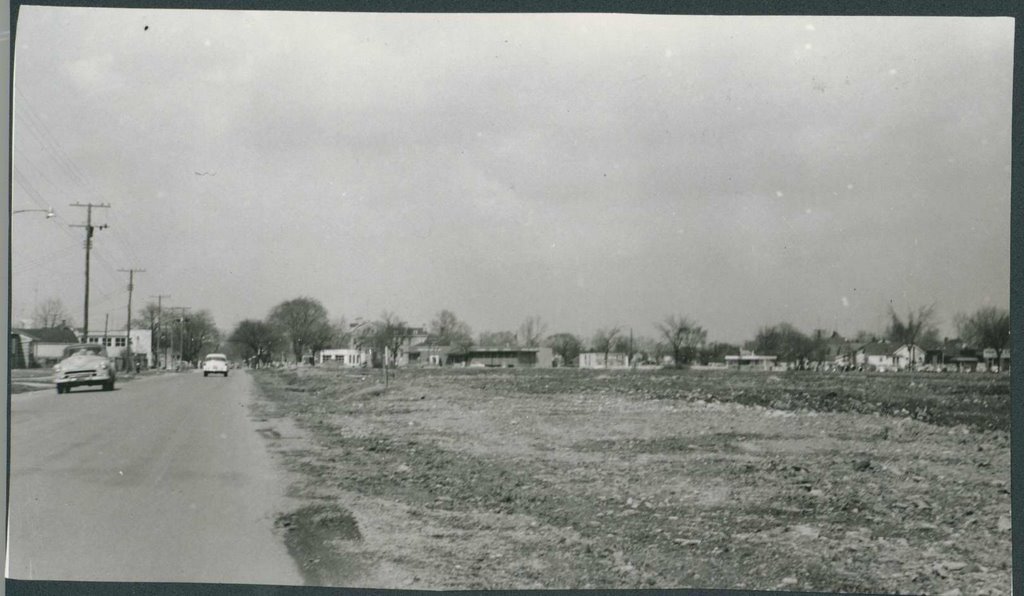
Answer: These scenes show what it looked like before and during the construction of the Cedar Point Causeway in 1956. The first image shows the view from First Street looking into the clearing being cut in the woods for the road. The second image is at Venetian Drive and First Street, with the bay in the background. The third image shows the roadway being built, circa April 1956. (The Library owns a set of more than 200 photographs showing various stages of the construction of the causeway.)
This image showed how it looked in 1953, before construction began. Prior to the completion of the causeway, the only access to Cedar Point was via the chaussee or by boat.
Tuesday, October 21, 2008
Mystery Photo: An Easy One

Monday, June 23, 2008
Mystery Photos: Guess the Location

As always, feel free to give your opinions in the comments link. I'll post the answer within a week or so, unless someone beats me to it.
Friday, April 18, 2008
Mystery Photos: Guess the Location
Here are a couple of other scenes, in the same area. (I covered over the street signs in one picture, so you can't cheat!)
Feel free to take your guess in the comments section. I will post the answer in the comments within a few days.The answer is in the comments section.
Thursday, February 21, 2008
Mystery Image: Washington Park as it Never Was
We recently received a donation of a drawing of Washington Park from an out-of-town collector who has never been in Sandusky. She thought it would be an interesting item for our collections, showing a view of the city from 1921. It certainly is an interesting view -- but it is a scene that never existed in reality.The image shows a slightly elevated view of Washington Park, from Wayne Street, down Washington Street. We can see several landmarks that were familiar to residents in 1921: on the left is Sandusky High School, with its top floor still there; beyond that we see the Erie County Courthouse as it looked before its remodeling in the 1930s; on the right is the Kingsbury Block, the Sloane House Hotel, Odd Fellows Hall, and the Presbyterian Church.
The strange part of this drawing is in the center of the picture: We see Washington Street as a boulevard, with landscaped medians and a monument at the center of the intersection with Jackson Street. Of course, this plan was never built, but what is the story behind its creation? What we do know about this drawing is that the donor found it in a photo album that was originally owned by Jessie A. Spieker-Fritz, who lived on Camp Street in Sandusky. The 1923 city directory says that she was a secretary for the Brown Clutch Company. This would help to explain how she came to have a copy of this drawing: In the lower right corner of the image, we see that the drawing was designed by T.T. Morgan and drawn by Charles Hottmann; Morgan was the president of the Brown Clutch Company and Hottmann was a superintendent there.
As to why the picture was drawn and why the plan was not implemented, those questions are still mysteries. Was Morgan part of a planning committee for the city, or were he and Hottmann simply interested citizens with an idea? Was this plan ever formally considered by the city? Further research is needed to find the answers.
Viewing this image raises another question for me: You notice in the background the monument in the intersection, most likely intended as a civic monument or war memorial. Have you noticed that in nearly every city or town in Ohio (and, it seems, in most American communities settled in the 19th century), there is a major civic monument in a prominent public square, sometimes several, usually built in the 19th century or early 20th century? Have you noticed that there is no grand civic monument from that time in Sandusky? (Some monuments have been built downtown in recent years of course.) Why did early Sanduskians not follow the trend of most communities of the time, and build a great war memorial or other monument? Any thoughts?
Tuesday, January 08, 2008
Happy Leap Year!

In the nineteenth century, in particular, it was also the time for Leap Year Parties. Here is a scene from a Leap Year Party held in Sandusky 142 years ago, on Friday, January 21, 1876. Unfortunately, we do not have much detail on the party itself. The photograph was donated to the library in 1928 by Fred Woolsey, who is seated at the left in the picture. He went on to become the owner of the Woolsey Wheel Company in Sandusky. The other men are: Charles Mills, Albert Rosenbaum, Charles Johnson, Dr. Gibson, Sam Ferris, and D.W.C. Brown, Jr. Why these men are wearing ribbons and handkerchiefs fastened to their clothes is unclear, but it might have something to do with a leap year tradition. . . .
Legend holds that on leap year days (some say the entire leap year), it was socially acceptable for women to propose marriage to men; any other time of the year, etiquette and custom dictated that only men were allowed to propose marriage. Also, it became a tradition to have Leap Year parties, where the women invited the men to be their dates and dance partners, and were in charge of the festivities. (Some claim that that is where the idea for Sadie Hawkins dances came from.) We can only speculate, but perhaps the handkerchiefs and ribbons symbolize the men's position as secondary to the women on that day. Any thoughts?
Thursday, November 01, 2007
Mystery Photo, and International Drum Month

Thursday, June 14, 2007
"Mystery Photos" Returns

Looking at the reception desk and the pigeon-hole cabinet behind the desk clerks, it seems rather clear that it is the lobby of a hotel. (You may not be able to see it, but a sign above the cabinet is addressed to "guests.") But which hotel is it? We have no information with this photograph as to where it was taken. Any ideas?
We do know that one of the ladies in the photo is Miss Mary Spier -- it might be possible, with a bit of research, to learn more about Miss Spier -- using the Ancestry genealogy database, for example. We can make a reasonable "guesstimate" of the time period of this photo by looking at things such as the "candlestick" telephone on the counter; these phones were popular mainly in the 1910s and 1920s. A map expert might be able to date the photo by the map on the wall. (Not me.)
Remember: just because you don't know all the details about a photograph, it doesn't mean it's worthless. Every image offers a description of life; it's just up to you to figure out what they are saying.
So where was this hotel? Your ideas are welcome.
Thursday, February 01, 2007
Mystery Photos: Know Where This Is?
After a hiatus, the "Mystery Photos" game is back. Here are two photos showing different views of the same location. It looks a lot different today, but if you look very closely, you might be able to recognize where it is.
Hints: Both pictures were taken in March 1955, and the scenes in the images are within the city limits of Sandusky.The answer is in the comments section.
Tuesday, September 05, 2006
Do you know where this is? Part Two
Tuesday, August 15, 2006
Do you know where this is?
Thursday, June 29, 2006
Mysterious People

The names of the women pictured above are unknown to us. What we do know about this image is that it was taken by the C.A. Cross studio in Sandusky. Charles Cross operated a photography business on Columbus Avenue in Sandusky from about 1880 until the late 1890s. We don't know the ladies' names, but they still can tell us things about life in the late nineteenth century. Does this photo tell you anything?
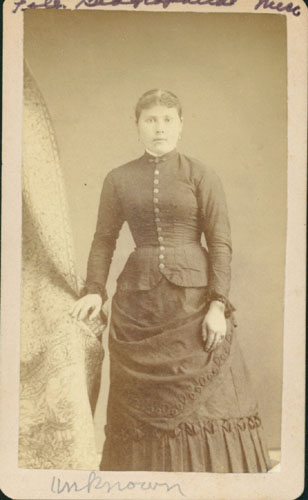
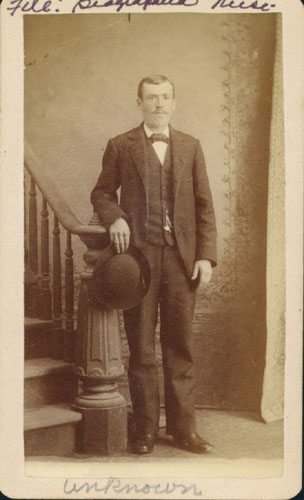
The Archives Research Center has a number of cartes-de-visite, which were used as photographic calling cards in the early days of print photography. (The peak years of the carte-de-visite were roughly from around 1860 to the 1880s.) Here is a sample of cartes-de-visite from the library's collections. Again, the names of the people and the story of their lives is unknown, but their images still can tell us something.
Both of these images were taken at the Wetherell Studio in Sandusky, probably in the mid-1880s.
(We will have more about the early history of photography -- and mystery photos -- in later entries.)