Showing posts with label Erie County Fair. Show all posts

Sunday, October 20, 2019

Buffalo Bill’s Wild West Show Visited Sandusky


The September 15, 1885 Sandusky Daily Register carried an advertisement for Buffalo Bill’s Wild West Show, to be held at the Sandusky Fair Grounds (in the area now known as Cable Park) for “positively only one performance,”  on Thursday, September 17 at 2:30 p.m. Admission was fifty cents for adults, and twenty five cents for children. Streetcars ran directly to the fair grounds, and railroads brought excursion groups to the show.


A grand parade was held at 10 a.m. on the day of the performance. The show advertised the appearance of Sitting Bull, White Eagle, and fifty-two braves, along with Miss Annie Oakley, Frisking Elk, and the phenomenal boy-shot Johnny Baker. The show claimed to have the largest herd of buffalo ever exhibited. 

Buffalo Bill was to shoot at clay pigeons while on foot, but he would shoot at glass balls while riding horseback at full speed. The ad continued to state that the ten cowboys who rode bucking horses were wilder than the horses themselves.  Equestrian acts, lassoing, and steer riders rounded out the program. Proprietors Cody and Salisbury promised to “fulfill every promise.”

Charles E. Frohman, in his Sandusky Potpourri, recounted Sandusky’s only buffalo chase.  After Buffalo Bill’s September 17th show closed, a buffalo escaped near the railroad depot at North Depot and Mcdonough Streets. The buffalo ran out Hayes Avenue, as a dozen Native Americans pursued it on horseback. It ran through the yard of C. C. Keech’s residence, and kept going through neighboring fields, destroying corn stalks along the way. After an hour’s pursuit, the buffalo was caught and taken back to the depot.


(About twenty years later, the C. C. Keech home later became part of Sandusky’s Providence Hospital, now the South Campus of Firelands Regional Medical Center.)
  
While the chase was in progress, two cows belonging to Patrick Gagen were frightened, and ran away. Dairy farmer Louis Benckart and his sons found the two cows, and refused to give them back, stating that the cows damaged their fields. Mr. Gagen took legal action to recover the cows.

Friday, August 09, 2019

1879 Fair of the Erie County Agricultural Society


According to the Premium List for the Fair, the twenty-first annual fair of the Erie County Agricultural Society was held in Erie County at the Fairgrounds from September 23 to September 26, 1879.


Entries in the Annual Premium List provided the amount of cash awards to be given to residents of Erie, Sandusky, Ottawa and Huron Counties who competed at the Fair in a wide variety of categories, including livestock, farm implements, manufacturers’ products, fruits, vegetables, handmade clothing, quilting, embroidery, photography, and flower arranging. In the Educational Department, students and teachers were awarded diplomas for excelling in such fields as spelling, reading, attendance, and record keeping. Scattered throughout the Premium List are advertisements from local companies.


The Adams’ Buckeye Land Roller was manufactured by the Sandusky Tool Company at the time of the 1879 Fair. This particular piece of equipment was known for its durability, though simple in design.


The Sandusky Register provided excellent coverage of the activities at the Fair. A large article on page 4 of the September 26, 1879 paper reported on the events of September 25, when it was estimated that fifteen thousand people attended the Fair.


On Thursday, there were horse races held at the Fairgrounds, as well as several teams that competed in a Hook and Ladder Tournament. John Krupp, who exhibited several pieces of furniture, also had on display a burglar-proof air-tight grave vault which was designed for protection against grave robbers.


At the fair, William Dilger had a display of plants that included an orange tree, a rare philodendron and a bridal bouquet of rare beauty. Photographer A.C. Platt featured a life size crayon portrait of President Hayes and Dr. I.B. Massey in his exhibit. D.C. Richmond stated that at the 1879 fair was the largest and best display of apples he had ever seen at any fair. Henry Lange, a grape grower from Kelleys Island, showed fair visitors a five foot stem of Concord grapes which contained over sixty bunches of grapes. During the wheat binding competition, local businessman J.A. Hosmer attempted to place a live pig inside a hot air balloon. It turned out that the young pig became too restless, so it was removed from the balloon. It was decided instead to place business cards from area merchants, as well as a copy of the Sandusky Register and a publication from the Erie County Agricultural Society inside the hot air balloon. Fair crowds grew excited as the hot air balloon headed to the north, toward the Marblehead peninsula. To read much more about the exciting 1879 Fair, visit the Sandusky Library Archives Research Center where you will find decades of local newspapers on microfilm, dating back to 1822.

Thursday, May 24, 2018

Day of Jubilee in Honor of the Fifteenth Amendment


According to the May 25, 1870 issue of the Sandusky Register, a Day of Jubilee was held in honor of the ratification of the fifteenth amendment to the U.S. Constitution, which prohibited federal and state governments from denying the right to vote based on that citizen’s “race, color or previous condition of servitude.”


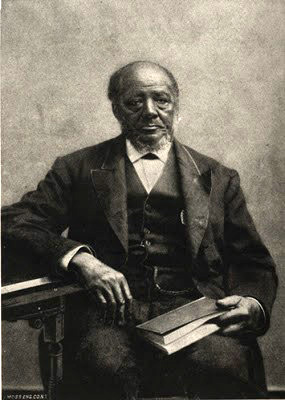
The Great Western Band led a procession to the Erie County Fairgrounds, then located south of Scott Street in the area now known as Cable Park. There were delegations here from several neighboring communities. The first feature of the activities was a glee club of five African American ladies who sang the song “America.” Rev. Thomas Holland Boston (below) offered up a prayer.


Mrs. Handy from Fremont read messages from President U.S. Grant and Secretary of State Hamilton Fish which proclaimed the ratification of the 15th constitutional amendment. The next speakers were Mr. Moore, and Mr. W. J. Scott, who had been an enslaved individual at one time. Well known attorney F.D. Parish also addressed the group. Mr. Parish had been an active participant of the Underground Railroad of the Firelands.


The final speech at the Jubilee was given by Oran Follett.


In the evening, a ball was held at Fisher’s Hall. Although African Americans did not actually receive full voting equality in some states for several years, in 1870 there was great celebration in honor of the 15th constitutional amendment.

Tuesday, April 12, 2016

Agriculture Has Played a Key Role in the History and Development of Erie County


Before the 1800s, nearly all Ohioans earned their living through agriculture. Even as industrialization expanded in the nineteenth and twentieth centuries, agriculture remained and continues to play an important role in our economy. A 2012 Census of Agriculture indicated that there were over 300 farms in Erie County, Ohio, with over 83,000 acres of farm land in the county. The market value of agricultural products sold was worth more than $88,000,000 dollars. The top crops in Erie County were listed as soybeans and corn. 

Several items in the Sandusky Library Archives Research and Sandusky Library reflect the importance of agriculture to our area. This is a ribbon from the Erie County Fair held in 1856:

             
The 1874 and 1896 historical Erie County atlases show the locations and property owners of the farms in rural Erie County. In the holdings of the Sandusky Library Archives Research Center are several ribbons and premium booklets from past Erie County Fairs, primarily from the nineteenth century. 

Man local citizens have been recognized over the years for their agricultural skills and innovations. Erie County resident Wells W. Miller served as Ohio’s ninth Secretary of Agriculture, from 1894 to 1906. The medal below was presented to Charles J. Messer for his corn sheller at the 1858 Ohio State Fair, which was held in Sandusky. Mr. Messer’s threshing factory was located at the corner of Water and Warren Streets. An early annual report the Ohio State Board of Agriculture reported that Messer’s power corn sheller had no superior.


The Hero Reaper was manufactured by the Sandusky Machine and Agricultural Works in the 1880s.


The well-known Hoover Potato Digger was made at the same time in Avery, just a short distance south of Sandusky. Using the wealth derived from the invention, the Hoover family became prominent investors in the Lakeside Chautauqua community in Ottawa County. 

In 1911 the National Corn Exposition was held in Columbus, Ohio from January 30 to February 11.  Milton Earle donated this ribbon from the Corn Exposition to the Sandusky Library Archives Research Center.


The National Corn Exposition of 1911 featured exhibits from thirty five states. Scientific displays were exhibited by over twenty agricultural colleges and agricultural experimental stations. The National Corn Banquet was held on February 3, 1911, and President Taft spoke at the Exposition on February 10. 

If you would like to learn more about the history of agriculture in Ohio, there are many books available for loan through the ClevNet system on the topic of farms in Ohio.

Thursday, July 04, 2013

Fourth of July Celebration in Sandusky in 1889


During the latter part of June, 1889, George Frohman spent three days putting up posters all over Erie County, informing residents of the upcoming Fourth of July Celebration to be held in Sandusky. According to a lengthy article in the July 5, 1889 issue of the Sandusky Register, the July Fourth Celebration in 1889 was a huge success. The weather was perfect, and people came from near and far for the festivities. The day’s events began with a concert by the Great Western Band. A parade was held at 10 a.m. and included the bicycle club, the Great Western Band, City Police and Firemen, men from the McMeens Post G.A.R., the G.A.R. Drum Corps, and many city officials. Several businesses had floats in the parade. The Sandusky Wheel Company, Sandusky Box Company, Germania Basket Company, Sandusky Tool Company, Sandusky Ice Company, and many other manufacturers and merchants from Sandusky participated in the parade. The Weier Brothers Scrapyard had a display of junk on a wagon for the parade.


At 1 p.m., the crowd proceded to the Fair Grounds, where Major E.B. King gave a stirring patriotic address. At 2 p.m., a variety of races were held,  which included horse and goat races, a bicycle race, foot race, and a farmers’ wagon race. After the races, the crowd was mesmerized as Professor King Burk went 1,000 feet up into the sky in a hot air balloon. After he cut the ropes from the balloon, he abruptly landed in a field near the railroad. The Fouth of July festivities concluded with a display of fireworks held at the Grandstand at the Fair Grounds from 8:30 to 10:30. (In the latter half of the nineteenth century, the Erie County Fair Grounds were located on Wayne Street, south of Scott Street.)


An article in the July 5, 1889 Sandusky Register stated that the “parade was a dandy,” and that the executive committee had done a fine job. Visit the Sandusky Library Archives Research Center to read the complete article about the 1889 Fourth of July festivities, in the 1889 Sandusky Register, now on microfilm.

Thursday, September 27, 2007

Horse Races in Sandusky


Although we have not had horse races in Sandusky for quite a while, the trotters were popular in town for many years, beginning about 150 years ago.

When the Ohio State Fair was held in Sandusky in 1858 the new fairgrounds (off Wayne Street, where Cable Park is today) included a state-of the-art race track. The Sandusky Register previewed the racecourse in its August 7, 1858 edition, declaring that it "will be one of the finest courses in the state." It was a mile-long oval, fifty feet wide, "with a 'home-stretch' of 100 rods" (2.5 furlongs, or 550 yards). Its inaugural races were held on September 2, 1858, with races all during the state fair in September. Entrants in those early races appear to have been mostly residents of nearby communities who wanted to show off the quality of their horses and their racing carts. Winners at the fair's races received purses of $50.


By 1874, the Sandusky Trotting Association was established to manage the races. The first meet sponsored by the Trotting Association began at 10:30 AM on Wednesday, August 1, with eight horse races, and human foot races in between. (Foot races were frequently held on the track.) The highly popular Great Western Band performed throughout the day. (You can see the band marching in an 1876 parade on the track in the image above.) Each race was run as a best-three-of-five, or two-of-three, series of heats. One of the races was a match race between Gottlieb Epple's double team and Clark Center and his horse, Silversmith Maid -- a race the Register said was run as a "side bet." After losing the first heat, Silversmith Maid won the next two races to take the prize. (Sadly, there was no indication as to how much was bet.)

Additional newspaper articles show that the races were still popular into the 1920s, with a track record $5000 purse (worth about $50,000 today) offered on July 30, 1924.

Tuesday, August 08, 2006