Showing posts with label barbers. Show all posts

Saturday, January 08, 2022

Daniel Kunz, German Immigrant and Business Owner


Daniel Kunz (sometimes spelled Kuntz) was born in Bavaria, Germany in 1845 to Mr. and Mrs. Philip Kunz. He emigrated to the United States as a youngster. In 1866, he married Christine Gilcher, the daughter of Peter Gilcher, a pioneer settler of Sandusky also of German descent. By 1867, he was working as a barber in Sandusky on Water Street (between Columbus Ave. and Jackson St), where he also operated a bath house. 

Lime kilns were prominent along the Sandusky waterfront in the 19th century

In 1878 Daniel Kunz began a new business venture when he built lime kilns at the foot of Hancock Street. A steam barge was named for him in 1888, built in Sandusky by Savord and Ratti. By 1890 Mr. Kunz had several business ventures underway. He was president of the Lake Erie Coal and Transit Company, president of the Point Marblehead Lime Company, and he was a partner in Kunz and Johnson, stone dealers. 

In 1900 he purchased property that had been occupied by the National House hotel at the northwest corner of Market and Wayne Streets. He had the hotel razed, and built a multi-story brick building. At the street level was commercial property with large glass windows that would be home to the Cohn's department store for many years. On the upper floors were apartments that could be reached by either stairs or an elevator. Each apartment was modern, with hot and hot running water, steam heat, and a gas range in each kitchen. The Kunz block can be seen below on the 1905 Sanborn Fire Insurance Map, across from the Lea block, which is still there today.


Mr. Kunz was president of the Home Savings and Loan Company of Sandusky in 1903. After his wife died, he moved to Toledo, Ohio, to make his home with his daughter. 

In April, 1935 the Sandusky Masonic Bulletin, edited by Dr. C.H. Merz, announced that Mr. Kunz had recently celebrated his 90th birthday. At the time of his death in 1938, he was the oldest living member of Perseverance Lodge, 329, F. & A.M. He had been prominent on Masonic circles for several years. Mr. Kunz was survived by a son, three daughters, and several grandchildren, nieces, and nephews. Graveside funeral services were conducted by Rev. Donald Wonders, and burial was at Oakland Cemetery.

Thursday, January 02, 2020

Bobbed Hair

Members of the Sandusky High School Class of 1928

The bob cut hairstyle was popular in the United States in the 1920’s. It was a hairstyle for women with the hair cut to neck or chin length, all around the head. The public reaction to bobbed hairstyles varied widely. An Associated Press article featured in the September 6, 1921 issue of the Sandusky Register was entitled “Bobbed Hair Argument Gets Serious.” Some employers banned the new shorter hair styles. The AP article reprinted editorials which represented opposing points of view on bobbed hair. One editorial stated, “Bobbed haired girls may not be vapid and silly, we don’t say they are, but you can’t get around the fact that they look that way. And, naturally, a girl that appears frivolous is not wanted in business, even though she may be serious minded.”


Another editorial thought bobbed hair was sensible. “Bobbed hair is not a foolish fad. It is the most sensible way for business girls to wear it. They don’t keep looking at the mirror all the time, and it gives them a chance to type a letter all the way from the ‘replying to you favor’ to the ‘we beg to remain’ without having to fidget around trying to keep stands from trickling the ears or blowing in the eyes.”

In the picture below, three young ladies are getting bob haircuts at the McMahon Barber Shop, inside the Hotel Rieger, in 1925.


Visit the Sandusky Library Archives Research Center to view historical photographs and high school yearbooks, to see the fashions and hairstyles of past generations in Sandusky and Erie County.

Monday, December 30, 2019

African American Barbers in Sandusky


There have been barbers for as long as history has been recorded.  Razors have been found dating back to the Bronze Age, and shaving is mentioned in the Bible. In Sandusky there were many barber shops located within local hotels, for the convenience of out of town travelers.  Pictured below is the J. and F. Bock Barber Shop, at 810 Water Street around 1886.  Joseph and Frank Bock’s father Matthias G. Bock was listed as a barber in the 1855 Sandusky City Directory.


Barbering was one of the few professions open to black men in the nineteenth century, so several shops in Sandusky were operated by African Americans. In the Firelands Pioneer of July 1888 Rush Sloane states that Grant Ritchie, an African American, opened the first barber shop in Sandusky. Ritchie “was the earliest and most active agent of the line [Underground Railroad] and always successful in his operations.” Another African American agent of the Underground Railroad was John Lott, who barbered in Sandusky in the 1840’s and 1850’s.  It is thought that many discussions and plans for the freeing of fugitive slaves via the underground railway took place in barber shops, where African American men could speak freely.

Mr. Lott’s advertisement appeared in The Daily Sanduskian on January 31, 1851.


John Lott was among the several African American citizens of Sandusky who presented Rush Sloane with a silver headed cane in appreciation of his efforts on behalf of seven fugitive slaves whom he represented in 1852. You can still see this cane at the Follett House Museum. Unfortunately, no known photographs exist of Mr. Ritchie or Mr. Lott.

Barber shops continue to thrive all over America, particularly in the African American community, where people can get a haircut as well as catch up on the local gossip. Barber shops have been the inspiration for books, magazine articles, barbershop quartets, and even a major motion picture in 2002.

Wednesday, December 10, 2014

Barber Shops in Sandusky


According to the July 1888 issue of the Firelands Pioneer, the first barber shop in Sandusky was operated by Grant Ritchie, an African American who was also active in the Underground Railroad in the Sandusky area, a network of individuals who aided fugitive slaves find their way to freedom in Canada. In the 1850s, most of the barber shops in Sandusky were in the downtown area of the city. Though the picture below is not in color, the J. and F. Bock Barber Shop, located at 812 Water Street in 1886, featured the familiar red, white, and blue pole in front of the shop. The red and white pole (with blue usually added in American poles) has long been a symbol of the barber’s trade.


The 1902 Sandusky City Directory listing for barber shops included the names of thirty three barbers. Harry Parker’s barber shop was in the Sloane House hotel at that time. In the first part of the twentieth century, several hotels in Sandusky had their own barber shops for the convenience of their guests. Barbershops were found in the West House, Commercial Hotel, Murschel House, Hotel Rieger, the Wayne Hotel and the Hotel Breakers at Cedar Point. Below is a photograph of Jerry McMahon’s barber shop in the Hotel Rieger about 1935. Jerry McMahon is on the right. The other barbers in the picture are: Bill Foley, Chet Martin, and Bill Wells. Charles Alexander, in the back of the shop, worked as a shoeshine porter.


John Martin Luipold worked as a barber in Sandusky for over sixty years. In this picture of his barber shop on Hayes Avenue in 1915, you can see a wooden rack holding the shaving  mugs of several of his regular customers.


Today, Sandusky still has several traditional barber shops, though some hair styling businesses cater to both male and female customers. The Acme Barber Shop on Columbus Avenue (below, in 1922) has operated under various owners since 1901.


To read more about the history of barbers in Sandusky, see Article 40 in volume two of From the Widow's Walk, by Helen Hansen and Virginia Steinemann.

Sunday, February 20, 2011

Luipold's Barber Shop


John Martin Luipold is pictured above in his barbershop at 1607 Hayes Avenue in June, 1915.  A sign above the mirror indicates that Mr. Luipold is a Union Barber. Wildroot is advertised as a remedy for dandruff or eczema. An article in the December 24, 1959 issue of the Sandusky Register stated that Mr. Luipold had retired in 1956 after having been a barber for sixty years. John Martin Luipold was born in Germany, but came to the United States as a young man. He married Anna Marie Schmidt on December 26, 1898 at the parsonage of Zion Lutheran Church. 

In another scene from Luipold’s Barber Shop, it appears that some of the regular customers left their shaving mugs at the barber shop, on a rack next to the mirror

To read more about barber shops in Sandusky, see Article 40 in volume II of From the Widow's Walk, by Helen Hansen and Virginia Steinemann.

Sunday, February 28, 2010

Transporting Baby in Sandusky

An image of a baby stroller appeared in Punch in 1847. An article found online states that the earliest carriages and prams were made of wicker or wood, and the infant would recline in the carriage. Strollers allow for a young child to sit up. Today a wide variety of baby strollers, car seats, and travel systems are available for parents of young children.

These images from the Sandusky Library Archives Research Center show examples of youngsters being transported around the turn of the twentieth century. The baby pictured below is in a wicker carriage in front of the Bock Barber Shop.
Children of Ferdinand V. Seibert are seen in a carriage in front of a residence on Third Street in Sandusky.
Ruth Beach is pictured below about 1905.
This vintage collapsible doll buggy can be seen in the toy room of the Follett House Museum.
A newspaper advertisement from the March 2, 1901 issue of the Sandusky Daily Star features a Sleep Go-Cart from Goebel’s Big Store. The product is upholstered, and contains a parasol to protect baby from the sun.

Monday, August 28, 2006

Labor Day

In honor of the working men and women throughout the history of our community, this post commemorates Labor Day. Labor Day was first celebrated in 1882 in New York. It was made a national holiday in 1894.


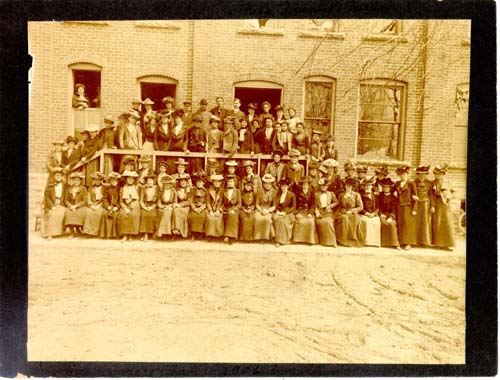
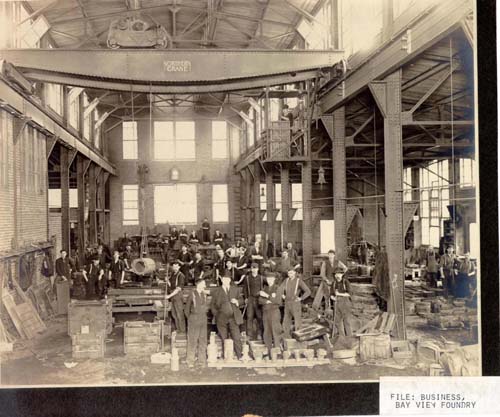
The men in the picture on the left (below) are workers at the Bay View Foundry (which operated from around the beginning of the 20th century to the 1930s), at Shelby and Water Streets, circa 1905; the photo on the right (above) shows the women workers (and their male supervisors) at the Jackson Underwear Factory, North Depot and McDonough Streets, circa 1906. The Jackson Factory operated from 1899 to around 1933.

If you have historical documents describing the activities of working people in Sandusky and Erie County -- documents such as: labor union records; photographs of people at work; personal letters and papers; business records; etc. -- please consider donating those documents to the Sandusky Library Archives Research Center. Contact the Archives Librarian via email or at 419-625-3834.