Showing posts with label Water Works. Show all posts

Friday, September 20, 2019

Bouncing Owl Club on a Boat in the Bay


Several men and women were on a small boat near Meigs Street in Sandusky on September 20, 1908. The picture was entitled “Bouncing Owl Club.” What this club was and who its members were is unknown. In the background, the city water works plant is visible. (It appears that the water works plant was having some work done to the roof.) At this time, Theodore Roosevelt was nearing the end of his term as President of the United States. Sandusky had almost 20,000 residents, while Perkins was home to about 3500 people. Looking at the microfilmed copy of the Sandusky Register for September 20, 1908, the weather was fair on this date. The new Herb and Myers store announced its grand opening, and both Jessie Meenan and Carrie Freyensee advertised that their stores had recently received shipments of their new fall hats. Baseball games were being played at League Park, and members of the Shamrocks Baseball Club were going on an excursion to Leamington, Canada.

But we don't know anything about the Bouncing Owl Club. Do you?

Tuesday, May 01, 2018

Sandusky City Street Sprinklers


Pictured above is an old water sprinkling apparatus, seen outside of the old Sandusky Water Works before that structure was demolished. Water from the barrel was sprinkled along unpaved streets to help keep the dust down. It appears that a rider could sit on the seat alongside the barrel, and the cart would have been drawn by a horse. The street sprinkling process also kept the city air a little healthier, as it diluted the amount of manure and urine left on the streets from horses used to draw buggies and carriages before automobiles became the more common mode of transportation. 

Gottlieb Epple was one of the men employed as a street sprinkler in Sandusky.


Below is the listing for the Epple and Son business in the 1908 Sandusky City Directory:


An article in the May 1, 1901 issue of the Sandusky Register announced that the beginning of May would also be the beginning of water sprinkling for the season.


Eventually street sprinkling became obsolete as most of the city’s streets became paved. 

Friday, November 14, 2014

Stereograph Cards by A.C. Platt


Stereographs are a pair of nearly identical images that give a three dimensional effect when viewed through a device called a stereoscope. Several stereographic cards are found in the collections of the Sandusky Library and the Follett House Museum. Above is a stereograph card of the Erie County Courthouse created by Sandusky photographer A.C. Platt, probably around 1876. A group of stereographs created by Mr. Platt were donated to the Sandusky Library by Mrs. John H. Jacques. The cards originally belonged to her father, Willis Merry. Mrs. Jacques was a direct descendant of Ebenezer Merry, a pioneer settler of the Firelands. A view of Sandusky High School and the old academy building can be seen in the stereograph card below. The academy building was used as a courthouse prior to the construction of the Erie County Courthouse in 1875. It was torn down in 1884.


This view of downtown Sandusky was taken from the upper level of the Erie County Courthouse. The steeples of the Congregational Church, then in Washington Park, are visible. This church was demolished in 1896, and a new church was built at the northwest corner of Columbus Avenue and Jefferson Street. In the background, you can see a portion of the Cedar Point peninsula


     In 1875, the first city water works was under construction, at Meigs and Washington Streets. Here you see construction scaffolding around the standpipe. If you look closely, you can see men at the top of the scaffolding.


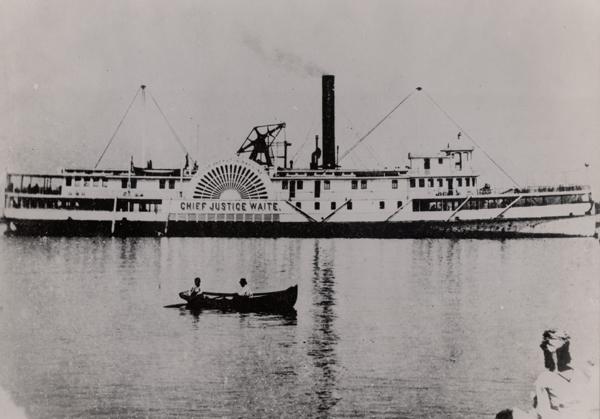
Below is a view of the Sandusky’s waterfront in the early 1880s. The vessel Chief Justice Waite is partially obscured by an unidentified ship in Sandusky Bay.


Thanks to A.C. Platt’s stereograph cards, we can get a sense of what life was like in Sandusky in a bygone era.

Friday, May 07, 2010

George W. Melville, Artist and Engraver

George W. Melville was an artist, designer, and engraver. He was born in Sandusky, Ohio to Mr. and Mrs. William Gordon Melville in February, 1856. An early example of Melville’s work is found in the 1882 Sandusky City Directory, which features an engraving of the pump house and standpipe of the Sandusky Water Works.


The Melville engraving below lets area residents know that Sandusky photographer W. A. Bishop has his studio all on the ground floor. This image appears on the back of a photograph taken by W. A. Bishop of a Marsh family member.
By the late 1880’s, George Melville had moved to Chicago. He illustrated and published Gems of Wonderful Chicago and the World’s Fair and a book about the first twenty-four mayors of Chicago. He also created panoramas of the World’s Fairs in St. Louis, Portland, and San Francisco. His last years were spent in California, where he lived in Hollywood and was active in the St. Thomas Episcopal Church. He died in California in 1928.

Helen Hansen provides historical background information about the Melville family in Article 23 of At Home in Early Sandusky. At times, some family members went by the double last name of Melville-Milne, in accordance with Scottish tradition. The home of William Gordon Melville-Milne is listed on the National Register of Historic Places.

Wednesday, March 17, 2010

Annual Reports of the Sandusky Water Works

An ordinance for the establishment and construction of a Water Works for the City of Sandusky was passed January 11, 1875. In the Sandusky Library Archives Research Center, the Annual Reports of the Water Works for the City of Sandusky have been bound into a large volume, covering the years 1875-1900. The Water Works was considered one of the major projects of the city in the latter half of the nineteenth century. Contaminated water was one a major factor in the outbreak of cholera in 1849. In 1876 the Water Works began filtering and pumping water to most homes and business in the city of Sandusky. Hewson L. Peeke wrote in his 1916 book A Standard History of Erie County, that the water works plant had a capacity of 17,000,000 gallons daily, and service was provided to every part of the city of Sandusky as well as to the Soldiers’ and Sailors’ Home and the Erie County Infirmary, which were outside the city limits.

Pictured below is a stereograph image, created by A. C. Platt, of the standpipe under construction, on Meigs Street about 1875.

In the First Annual Report of the Trustees of the Sandusky Water Works, published in 1877, appears a breakdown of the contracts awarded for the building of the various components of the water works system. Mr. Vincent Kerber was awarded the contract for building the smoke stack. The annual report stated that Mr. Kerber “exhibited great care and perfection of workmanship in its construction.”In the report of the chief engineer from the First Annual Report, the exact dimensions and length of pipe distribution throughout Sandusky was itemized. Fire hydrant locations as well as the names of the manufacturers of the hydrants were listed on pages 35 through 37.

Included in the annual reports are financial statements, balance sheets, and a listing of expenses paid out through the previous year. For example, in the Sixth Annual Report, from 1881, I.F. Mack was paid $30.85 for blank books, C.M. Thorpe was paid $124.47 for coal, Louis Zistel was paid $5.30 for the use of his boat, and mats and a duster were purchased from E.H. and R.M. Wilcox for a total of $3.50. In the combined 1894-1895 Annual Reports, William Thom was paid $9.00 for horse shoeing services, and dynamite was purchased from J. J. Butts for $248.08. It is interesting to see the names of local businesses with which the city of Sandusky contracted.

The standpipe of the Water Works was seriously damaged during the 1924 tornado. By the fall of 1940, a new water works plant was built at Big Island, located at the eastern end of First Street. It was built during the depression with the aid of a federal grant.