Showing posts with label Taft. Show all posts

Tuesday, September 27, 2022

Visitors to the Ohio Soldiers’ and Sailors’ Home


Now the Ohio Veterans Home, the Ohio Soldiers’ and Sailors’ Home in Erie County, Ohio, was established in the late 1880s to provide homes for honorably discharged Veterans. Its earliest residents served in the Civil War. Through the years several notable persons have visited the home.

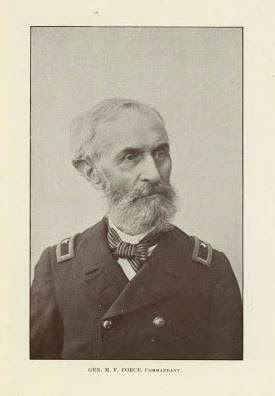
In 1890 and 1892, former President Rutherford B. Hayes visited Manning Force, the first Commandant of the Ohio Soldiers’ and Sailors’ Home.

R.B. Hayes and Manning F. Force were lifelong friends. Hayes and his wife  Lucy named their youngest son after him. Born in 1873, young Manning Force Hayes died as an infant in 1874.

In February 1894, William Henry Gibson, a former Civil War General, gave an address at the Ohio Soldiers’ and Sailors’ Home in commemoration of George Washington’s Birthday.

Known as the “Silver Tongued Orator,” General Gibson spoke about George Washington’s leadership, President Abraham Lincoln’s accomplishments, and he recalled several of his own experiences in the Civil War. The Sandusky Register of February 23, 1894 printed highlights of General Gibson’s speech.

In 1908 future president William Howard Taft visited Sandusky. He spent the night at the home of Edward H. Marsh, and visited the Ohio Soldiers’ and Sailors’ Home, where he gave a speech of a non-political nature.

In November of 1912,  the editor of the National Tribune, J.M. McElroy spoke at the Home. Between 500 and 600 veterans listened as McElroy encouraged all to vote for President Taft in the upcoming election. Of course, Woodrow Wilson went on to win the election for the presidency in 1912.

Happenings at the Home have been covered by the local newspapers for many years.  Below is a portion of the “Soldiers’ Home News” from the Sandusky Register of January 29, 1913.

Monday, June 20, 2022

Edward H. Marsh, Friend of William Howard Taft


Edward H. Marsh was born in Cincinnati in 1851, and came to Sandusky with his father in 1872. Edward Lockwood Marsh, the father, was a pioneer in the gypsum business. Both Marsh men were involved with a plaster business in Sandusky, and later developed a larger gypsum business in Ottawa County. Edward H. Marsh eventually became the sole owner of the gypsum business.

In 1879, he married Caroline Mackey Lea, the daughter of James Davis Lea, a Sandusky businessman. She was known as “Carrie.” The couple was married by Rev. Josiah Strong at the Congregational Church. A reception was held at the home of Mr. and Mrs. Lea on Wayne Street, where the Great Western Orchestra provided musical entertainment. The couple left on the evening train for a trip touring the Southern United States. Upon their return, the newlyweds lived at a lovely home at the corner of Washington and Franklin Streets.

Sadly, on June 10. 1885, Carrie Lea Marsh died, leaving her husband a widower with two very young children, Edward Lea and Caroline Marsh. Mr. Marsh would never remarry. An article from the Grace Episcopal Church tells of Carrie Lea Marsh having been a Sunday School teacher at the St. Luke’s Chapel of Grace Episcopal Church for many years. The chapel did not have a bell, so after Mrs. Marsh’s death, a fund was designated for the purchase of a bell. This bell is now located just outside the side door of Grace Episcopal Church, in memory of Carrie Lea Marsh. The Marsh family also gave a processional cross and a window to Grace Episcopal Church.

After the death of Mrs. Marsh, Edward H. Marsh continued to live at 334 E. Washington Street. It was at this home that William Howard Taft visited Edward H. Marsh in 1908. The two were classmates in Cincinnati. Pictured below is William Howard Taft with Edward Lea Marsh in the front seat of an automobile. J. Warren Kiefer is sitting beside Edward H. Marsh in the back seat.


Edward H. Marsh died on December 17, 1921. On the day of his funeral, which was held at Grace Episcopal Church, the entire U.S. Gypsum Co. closed down, in respect of Mr. Marsh.

To read more about the Marsh and Lea families, see Helen Hansen’s book At Home in Early Sandusky at the Sandusky Library. This title is also available for purchase at the circulation desk at the library.

Monday, December 31, 2018

"Happy New Year to the Ladies of Sandusky"


In 1877 eight gentlemen from Sandusky wished the “Ladies of Sandusky” a Happy New Year. Possibly this was in conjunction with a party or dance that was held to celebrate the New Year. We do not know details about all the men, but some of the surnames included in the group come from families that were prominent in the early years of Sandusky’s history. In the 1870s  Fred M. Woolsey worked with his father, J.V. Woolsey in a factory that made wagon and carriage wheels. Charles L. Mills and Grayson Mills were both grandsons of Isaac Mills, who was one of the co-founders of the city of Sandusky. Fred Woolsey and C.L. Mills are two of the men in the picture below (at a "leap year party" the previous January); unfortunately we do not know which ones they were.


Edward H. Marsh was involved in the plaster business in this area.  He was a personal friend of President William Howard Taft. You can see Edward H. Marsh in a white jacket in the picture below, when future President Taft was campaigning in Sandusky in 1908.


Sunday, January 24, 2016

Cooperages in Sandusky


Throughout much of the world, wooden barrels have been the primary method for storing and transporting bulk materials for centuries. Those who make and repair casks, barrels and other containers are known as coopers, and a cooperage is their business place. (A famous cooper from the past was John Alden, hired as the ship’s cooper on the Mayflower.) Though no cooperages are listed in today’s Sandusky telephone directory, they were an important business in Sandusky, Ohio in the 19th and early 20th centuries.  In the 1867 Sandusky City Directory, there were over fifty listings for coopers, many who worked from their own home or barn.


At the Elks’ Fair in 1909, President William Howard Taft won a barrel of sauerkraut. The barrel holding the sauerkraut had been made by the Michel Cooperage Company of Sandusky. Hewson Peeke wrote in his book A Standard History of Erie County, Ohio (Lewis Publishing Co., 1916), that barrels made in Sandusky were found all over the U.S. as well as in foreign countries.  Lumber was shipped to Sandusky lumberyards via the Great Lakes. Local cooperages then made barrels and kegs that were filled with goods and products made in Erie County. The railway system enabled efficient delivery of the filled barrels and kegs to other cities in Ohio and across the United States.


An article from the September, 1921 issue of The National Coopers’ Journal reported on a manufacturers’ display at Cedar Point, which included several cooperages from Sandusky. At that time the Michel Cooperage Company manufactured containers for wine, pickles, beer and oil. The Brumm brothers were known for their fruit barrels, while the Kilbourn Cooperage made primarily fish kegs at that time. 

As packaging and shipping innovations developed in the twentieth century, the number of cooperages in Sandusky began to decline. In 1912, only five cooper shops were listed in the Sandusky City Directory. And to compound matters, the 1924 tornado did severe damage to both the Michel and the Kilbourn Cooperages.


The Sandusky Register of May 6, 1934 reported that only one cooperage remained in Sandusky, the cooper shop operated by Fred Schwab at 317 Perry Street. Besides technological advances, other factors leading to the decline in the cooperage manufacturing in our location included Prohibition, the disappearance of thousands of acres of forests, as well as the lack of laborers skilled in the art of cooperage. Today there are still a number of cooperages throughout the United States. The Associated Cooperage Industries of America, Inc. is a trade association which is located in the state of Delaware. To read a general history of barrels, you can borrow the book Wood, Whiskey and Wine, by Henry Work, (Reakton Books, 2014), available for loan through the ClevNet system.

Thursday, September 18, 2014

Judge William Howard Taft’s Visit to Sandusky in 1908

Early in September of 1908, William Howard Taft gave a speech in Sandusky in 1908 that was generally regarded as the first speech of his active campaign for the U.S. presidency as the Republican candidate in 1908.  On September 7, after arriving in Sandusky aboard the Lake Shore Electric Railway from Fremont, Judge William Howard Taft, General J. Warren Kiefer, General Henry Corbin, along with Mrs. Taft and young Charlie Taft, were driven from the Lake Shore Electric station to the residence of Edward H. Marsh, where the visitors would spend the night.  A representative from the Sandusky Register met Judge Taft at the station, where he was greeted with the well known “Taft smile.” The party had dinner at the Marsh home at 6 p.m. Sandusky photographer W.A. Bishop took this picture of William Howard Taft, General Kiefer, Edward Marsh and Edward Lea Marsh, during Taft’s visit to Sandusky.


On the morning of September 8, 1908, Judge Taft, General Kiefer, and General Corbin, went to the Ohio Soldiers’ and Sailors’ Home, where they gave addresses of a non-political nature.


Judge and Mrs. Taft visited several of the residents of the Home who were too frail to leave their rooms to hear Taft’s speech in person. At noon, Judge Taft addressed a large audience at the Opera House in Sandusky. The theater was filled, with only a few seats left vacant.  Judge Taft spoke for thirty minutes, having his speech interrupted with applause several times. According to a lengthy article in the September 9, 1908 issue of the Sandusky Register, Taft stated that if elected “he would spend his time suggesting to Congress means by which the Rooseveltian policies might be clinched” After his speech, Judge Taft shook hands with several ladies and gentlemen who gathered around him on stage at the Opera House. Judge Taft departed from the Big Four station on the 1:40 p.m. train, on his way to make more speeches in the Cincinnati area. Pictured below is William Howard Taft in his top hat, surrounded by several people as he got ready to leave Sandusky.


Of course, William Howard Taft did go on to win the election in November of 1908, defeating William Jennings Bryan. To read more details about William Howard Taft’s visit to Sandusky, see the September 8 and September 9, 1908 issues of the Sandusky Register, available on microfilm at the Sandusky Library Archives Research Center. The text of the speech presented by William Howard Taft in Sandusky was reprinted in the book Political Issues and Outlooks: Speeches Delivered Between August, 1908 and February, 1909, by William Howard Taft (Doubleday, Page and Co., 1909.)


Saturday, June 25, 2011

Letter from William Howard Taft to E. H. Marsh

On June 25, 1908, William Howard Taft, who was then serving as the U.S. Secretary of War, sent a letter to Edward H. Marsh of Sandusky, Ohio. (The typist incorrectly spelled Mr. Marsh’s surname as Marsha.) Mr. Taft was responding to the telegram that Edward H. Marsh had sent him on June 18, 1908, congratulating Taft for having been selected as the Republican candidate for President. President Theodore Roosevelt heartily endorsed William Howard Taft as the presidential candidate, though they would part ways in the years ahead. Taft easily defeated his opponent William Jennings Bryan in the 1908 Presidential election.


Helen Hansen wrote in At Home in Early Sandusky that William Howard Taft and Edward H. Marsh had been classmates in Cincinnati. During the 1908 campaign, Mr. Taft visited Sandusky to give a speech at the Ohio Soldiers’ and Sailors’ Home. While in Sandusky, Taft visited the Marsh residence at 334 East Washington Street. Mr. Marsh made a special trip to Cleveland to purchase a bed that would be large enough for his friend Mr. Taft, who is well known as having been the President with the heaviest weight.

Tuesday, May 04, 2010

Edward Lea Marsh and Elizabeth D.G. Moss

When Edward Lea Marsh married Elizabeth D. G. Moss, the society page of the Sandusky Daily Star reported that the bride and groom represented two of Sandusky’s largest and best known families.

Edward Lea Marsh was the son of Edward H. Marsh and Caroline Mackey Lea. Edward’s grandfather, Edward Lockwood Marsh, was a pioneer manufacturer of plaster of Paris in Ohio.

Edward Lea Marsh’s father, Edward H. Marsh, also in the plaster business, was a personal friend of President William Howard Taft. Elizabeth D. G. Moss was the daughter of banker Charles H. Moss and his wife, the former Elizabeth Griswold Lane. Elizabeth D. G. Moss’s grandfather William Griswold Lane and her great-grandfather Ebenezer Lane were both well respected judges in Erie County, Ohio.

The couple was married at the home of Mr. and Mrs. Charles H .Moss on Wayne Street in Sandusky. The Moss drawing room was decorated with palms and ferns. The two ministers who officiated at the wedding were Rev. Winfield Baer, rector of Grace Episcopal Church, and Rev. Dr. Gilbert of Southport, an uncle of the bride. The bridal party was made up of the best man, Vaughn McFall; ushers, Mr. Goodwin, Mr. Perkins, Mr. McKinley, and Mr. Hargrave; maid of honor, Miss Emeline Moss; and bridesmaids, Miss Ethel Mack, Miss Adah Kunz, Miss Knapp, and Miss Carrie Marsh.

While not all the individuals in the wedding party have been identified, the bridal party is pictured below, in a photograph taken by W.A. Bishop. Edward Lea Marsh is the young man seated in front. His bride, Elizabeth D. G. Moss Marsh, is the third person in the second row.

Emeline Moss (later Mrs. Ira Krupp) is the second person in the third row. Caroline Lea Marsh, sister of the groom, is the fourth person in the third row.
The wedding guests were served dinner in the Moss dining room, and each guest received a box of wedding cake, decorated with the monogram M M. After the wedding dinner, the couple left for their cottage at Plaster Bed in Ottawa County. Later they were to take a wedding trip to Black Hall, Connecticut. Pictured below are the newly married Mr. and Mrs. Edward Lea Marsh in Plaster Bed in Portage Township of Ottawa County.
When future President William Howard Taft visited Sandusky on September 8, 1908, Edward Lea Marsh was standing next to Mr. Taft in a photograph taken that day. (to Mr. Taft’s left.)
Edward Lea and Elizabeth Marsh had two daughters. One of them is pictured with her first grade class in Sandusky about 1910. Elizabeth Griswold Marsh is third individual from the right in the second row.
Helen Hanson wrote in At Home in Early Sandusky that Edward Lea and Elizabeth Marsh moved to Lyme, Connecticut in the 1920’s. Edward Lea Marsh died on November 21, 1937 in Old Lyme, Connecticut. An obituary for Mr. Marsh appeared in the November 22, 1937 issue of the Sandusky Daily News. He was survived by his wife , son, and two daughters, and a sister. Edward Lea Marsh had just been to Sandusky earlier that month, while on a business trip with the United States Gypsum Company. He had visited with many of his old friends at that time, and appeared to be in excellent health. Mrs. Marsh died in Connecticut in 1960. While many members of the Moss, Marsh, and Lane families are buried at Oakland Cemetery in Sandusky, Mr. and Mrs. Edward Lea Marsh were buried in Old Lyme, Connecticut.

Edward Lea Marsh, Jr., who died in 1996, was an attorney in Connecticut for sixty years, and was elected as State Representative from Old Lyme in 1937. He was Speaker of the House of the Connecticut General Assembly from 1945 to 1946. Edward Lea Marsh, Jr. lived on a pioneer farm in Old Lyme, and one of his cows was “Elsie the Borden Cow,” who was once exhibited at the New York World’s Fair.

Tuesday, March 10, 2009

Charles J. Stark, Newspaper Man

Charles J. Stark was born in Wooster, Ohio in 1882. He was a graduate of Ohio State University, and served as President of Penton Publishing Co. in Cleveland for many years. About 1911, Charles J. Stark married Penelope Mack, daughter of Sandusky newspaper publisher, John T. Mack. Charles J. Stark came to the Sandusky Register in 1942, serving as Vice President. Later he was General Manager, and served as Chairman of the Board of Directors of Sandusky Newspapers until his retirement in 1965.

In the 1960’s, Charles J. Stark was President of The Robert A. Taft Memorial Association of Erie County. The purpose of this non-profit organization was to “perpetuate the ideals” of the late Senator, Robert Alphonse Taft. The group had annual dinners, and donated books on constitutional government to local school libraries. During some years, honor students from the various public and parochial schools in Erie County were invited to attend the annual dinner. By the end of the 1970’s, The Robert A. Taft Memorial Association was dissolved. Charles J. Stark died on December 17, 1978. He and his wife, Penelope Mack Stark, who died in 1974, are both buried in Knollwood Cemetery, Mayfield Heights, Ohio.

John T. Mack, father-in-law of Charles J. Stark, began his association with the Sandusky Register, first working with his brother I. F. Mack.
In 1874, John T. Mack bought an interest in the paper, and he became the business manager of the Sandusky Register. In 1909, I. F. Mack withdrew his connection with the Register, and John T. Mack became publisher and editor of the Sandusky Register. Son Egbert H. Mack was secretary and business manger, while another son, John D. Mack served as treasurer. John T. Mack remained at the helm of the Sandusky Register until his death on July 8, 1914.
To learn more about the Mack family and its longtime connection with the Sandusky Register, see Sandusky's Editor, by Charles E. Frohman, which focuses on I. F. Mack. This book is available at the Archives Research Center of the Sandusky Library.

Monday, October 23, 2006

Political Campaigns in Sandusky

As election day is approaching, it's a good time to talk about political campaigns that passed through Sandusky. I know it's not a presidential election year, but let's talk about some candidates for President of the United States who made campaign visits to Sandusky.


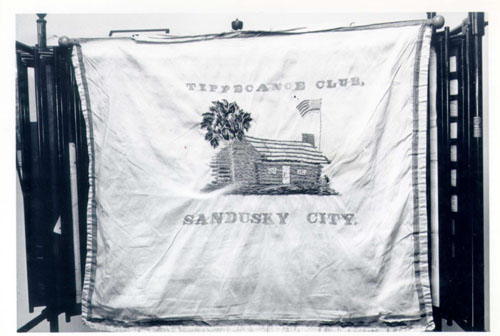
Possibly the earliest campaign visit to Sandusky by a presidential candidate was in 1840, when William Henry Harrison, the Whig Party candidate, came to town. To commemorate his visit, several women of Sandusky (including Mrs. Eleutheros Cooke) created an embroidered banner in honor of the campaign (shown above in a b&w photo). The banner, showing a log cabin on one side and an eagle on the other, is on display at the Follett House Museum. This story behind this banner is related on page 13 of the October 1896 issue of the Firelands Pioneer, available in the Genealogy section of the Sandusky Library.

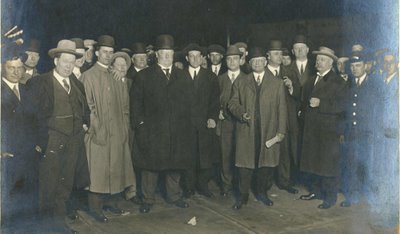
During his successful 1908 presidential campaign, William Howard Taft spoke at the Ohio Soldiers' and Sailors' Home (now the Ohio Veterans Home). The photo below shows the soon-to-be President-Elect with a group of local dignitaries outside of the Soldiers Home. Taft was a close friend of Sandusky resident Edward Marsh, and apparently visited the area several times for social occasions.


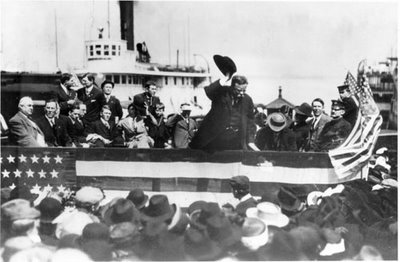
Taft's former political ally, Theodore Roosevelt, became his political opponent during the 1912 presidential campaign. Believing that Taft betrayed the progressive principles that formed the core of Roosevelt's beliefs, "TR" ran for president that year as the candidate of the Progressive Party (often called the "Bull Moose" party, in honor of a popular nickname for Roosevelt). In May of that year, Roosevelt gave a whistle-stop speech at the foot of Columbus Avenue to a large crowd of Sanduskians. Here is one of several images of that event from the library's photo collections:

In the 1916 election, Charles Evans Hughes was the Republican candidate for president, seeking to unseat President Woodrow Wilson from his position. In September 1916, Hughes gave a speech in front of the American Crayon factory on Hayes Avenue. (Unfortunately, that photo will not post properly on Blogger.)

Another interesting local story of presidential campaigns can be found in the November 11, 1940 issue of Life magazine. In an article titled "The People's Choice," the publishers used Erie County, Ohio as a microcosm for the nation, with images of local residents and descriptions of why they chose to vote the way they did. You can read the article, and see photographs of local residents of the time (as well as a picture of candidate Wendell Willkie in Sandusky), in the Sandusky Library. Ask a reference librarian for that issue of Life magazine from closed storage.