Showing posts with label Castalia. Show all posts

Wednesday, July 19, 2023

The Cowell Family of Castalia


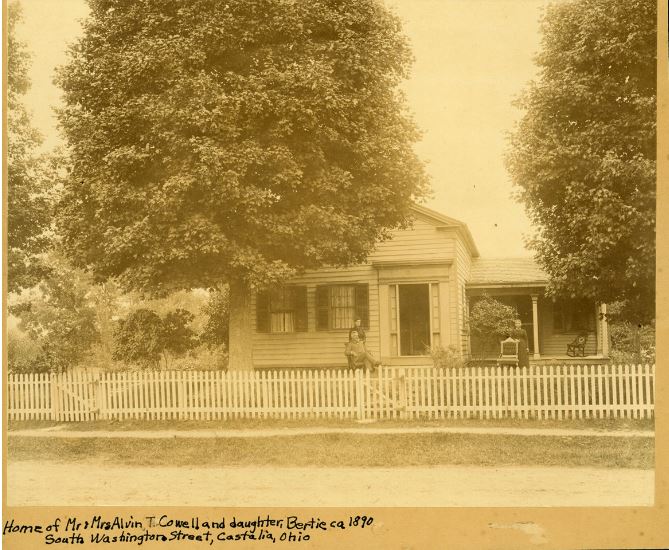
For many years Mr. and Mrs. Alvin T. Cowell resided in a home on South Washington Street in Castalia, approximately where the Castalia Branch of Civista Bank is now located. Mr. and Mrs. Cowell are in front of the house, and their daughter Frances Alberta Cowell, known as “Bertie” or “Fannie” is standing by a chair.

The book A Standard History of Erie County, Ohio, by Hewson L. Peeke provides biographical information about Alvin Cowell and his family:

Alvin T. Cowell was reared in Castalia, attended the public schools there, and was about seventeen years of age when the country was thrown into the confusion resulting from the outbreak of the Civil war. A few years later he responded to the call of his patriotism and enlisted on May 2, 1864, in Company I of the One Hundred and Forty-fifth Volunteer Infantry of Ohio. He was out about four months, and spent most of the time with his regiment in guard duty at Arlington Heights, just across the Potomac River from Washington. On receiving his honorable discharge he returned to Erie County, and subsequently .had the advantage of a brief attendance at the Notre Dame University in South Bend, Indiana. With this preparation for practical life he became a farmer, and for many years conducted a large farm of more. than 200 acres in the vicinity of Castalia. While a man who has been known for his strict attention to his business, he has at different times consented to serve in the public interest and for six years was a trustee of Margaretta Township. At the present time he is living in Castalia, and has all the conveniences and comforts he needs for the evening of life.

On February 28, 1910, Mr. Cowell was called upon to mourn tine loss of his faithful companion who had shared with him in the joys and sorrows of existence for nearly forty years. On December 26, 1871, he married Catherine Cooper, who was born in Mount Vernon,. Ohio, a daughter of Cyrus and Sarah (Mitchell) Cooper. Her father was for many years a resident of Knox County, Ohio, and came from there to Margaretta Township where he was a prosperous farmer, but finally sold his land and spent his declining years at Clyde, Ohio, but his body now rests in the cemetery at Castalia. Mr. and Mrs. Cowell became the parents of two children. Fannie A. is the wife of Rev. Charles J. Dole, who is pastor of the Congregational Church at Chelsea, Michigan. The only son, Philip C., is now deceased. Rev. Mr. Dole and wife have five children named Marie L. Catherine Irene, Alberta A., Edward C. and Charles R.

Frances Alberta Dole married a Congregational minister, Rev. Charles Joel Dole in 1891. In the late 1800s, Rev. Dole served as the minister of the Castalia Congregational Church. Two of the Dole daughters had long careers with the Sandusky Library. Miss Irene Dole was the librarian for the Castalia Branch Library from 1942 to 1968. During her time as librarian, the library was housed in the former Town Hall on Main Street in Castalia. The former town hall in Castalia is pictured at the left, in the post card below, about 1905.

Mrs. Alberta Dole Smith was the children’s librarian at Sandusky Library during the 1950s and early 1960s. Mrs. Smith’s picture appeared in the Sandusky Register during National Library Week, on March 19, 1958. The article stated in part: “Children’s librarians feel that none of their patrons will turn out to be a Johnny or Joan who “can’t read” as they are accustomed to having books around the home, and visiting a store house of wonderful and exciting book friends.”

Saturday, June 10, 2023

When Picnics Were in the News


On Kelleys Island

Picnics in Sandusky and the Lake Erie Islands area were held quite often, by families, church groups, companies, and clubs. The proximity to Lake Erie provided nice lake breezes for the picnic-goers. Local newspapers frequently reported on picnics held in the area. The Sandusky Register of September 8, 1868, announced the “Grandest Pic-Nic of the Nineteenth Century” when students of the Buckeye and Great Western Business College chartered steamers for a picnic at Put in Bay.

In 1911, the Castalia Telephone operators enjoyed a picnic at the Blue Hole, while two other Castalia groups met at Rye Beach with their lunch baskets.


The Sandusky Star Journal of July 30, 1931 reported on a picnic at Bay View Park held for members of the Sandusky Typographical Union, #237, who were employees of the Sandusky Register and the Sandusky Star Journal. A ball game between the two newspapers started off the festivities. Other contests included horseshoe pitching, egg throwing, nail driving, a wheelbarrow race, and a blindfolded fly swatting contest.


In 1942, about 300 members of the Eagles Club and their families had their annual picnic at Lions Park. Some of the events were rolling pin throwing, balloon blowing, and a peanut scramble.


Cedar Point has been a popular picnic destination for large group picnics for over a century.


The Jaycees held a picnic at Cedar Point in August of 1954.


In this picture, it appears as though the employees of the Sandusky Library in the 1920s had an impromptu picnic outside the library building:

If you would like to see if the names of your family members ever appeared in local newspapers, whether for a picnic or other news event, browse through the historical Sandusky newspapers on microfilm at the Sandusky Library Archives Research Center, or check Newspaper Archive, accessible from home with a Sandusky Library card number.

Wednesday, February 01, 2023

Grover Cleveland Enjoyed Fishing in Ohio


An often forgotten President, who is the subject of a recent book (available at the Sandusky Library), Grover Cleveland enjoyed fishing in several spots across the United States, during and after his terms as U.S. President. The Sandusky Star Journal of September 11, 1926 reported that during his administration, President Cleveland “sought refuge from the affairs of state by fishing in the streams fed by the cold waters from the mysterious ‘Blue Hole’ of Castalia,” as a member of the Castalia Trout Club.

A trout stream at the Blue Hole circa 1940

An article in the May 10, 1956 issue of the New York Times reported about a time that Ex-President Cleveland had arrived in Sandusky, Ohio to spend several days fishing at Middle Bass Island. Accompanying President Cleveland were Professor John Lloyd, Judson Harmon, and Charles Foster, former Secretary of the Treasury.

In 1906, the former President wrote a book called Fishing and Shooting Sketches; this book is available in full text at the Internet Archive.


One of the chapters in the book was “A Defense of Fishermen.”

To learn more about the history of Castalia, read Glenn Kuebeler’s book Castalia, Cold Creek, and the Blue Hole (Arcadia Publishing, 2007.)

Monday, November 23, 2020

Castalia, by Burton Frye

Born in Huron, Ohio in 1920, from the age of nine, Burton Frye lived in Castalia, Ohio with his parents Roy and Mary Frye and his older sister Bernetta. He graduated from Margaretta High School, served in the U.S. Army during World War II, and was a graduate of Miami University.  He worked in the literary field as a writer, publisher, and a book reviewer.


Most of the books Burton Frye wrote were works of poetry, although his thesis on file at Miami University Libraries was a book of short stories, titled Stories of Soldiers and Italy. On February 12, 1949, The Book Shop, at 115 West Monroe Street in Sandusky, gave an autograph party in his honor.  Mr. Frye signed copies of his book, Castalia, a book of poetry. Although he had connections to Castalia, Ohio, he titled he book Castalia for the celebrated fountain in Greece. It is said that the waters found at the Castalian Spring inspired those who drank of them with poetic power.

The first poem in Castalia reads:

Who’s afraid to turn a word 

Into a scarlet-breasted bird,

Or bounce a statement quick as light

Into the brawl of wrong and right.

In the winter of 1950 Mr. Frye lectured at several schools in Erie County. He spoke on “Ballads and Ballad Makers” and “Modern Poetry: For or Against Us.” In his presentations, Mr. Frye sang ballads in both English and Italian, and recited lyric poetry. In an article in the February 17, 1955 issue of the New Orleans State newspaper, he was described as a "troubadour," who was performing in the city during Mardi Gras season.

Burton Frye passed away June 10, 1982 in Myrtle Beach, South Carolina. He was survived by his wife, the former Virginia Chapin. 

Friday, August 28, 2020

Dr. Smith Gorsuch of Castalia

Dr. Smith Gorsuch practiced medicine in Castalia, Ohio from 1902 until shortly before his death in 1945. He was born in Delaware County, Ohio in 1870, and was a graduate of the Ohio Medical University, now known as the College of Medicine, Ohio State University. Through the years, Dr. Gorsuch was in attendance at many births and deaths, and he treated several patients who were injured in farm and automobile accidents. He was a member of the American Medical Society, Ohio State Medical Society, and the Erie County Medical Society. He was also the President of the Castalia Bank, and served on the board of directors of the Erie County Investment Company. For nine years, Dr. Gorsuch was the physician at the Erie County Home.

On October 8, 1943, he and his wife, the former Lucinda Rich, celebrated their golden wedding anniversary. Dr. Smith Gorsuch passed away on May 23, 1945. His obituary is found in the 1945 Obituary Notebook at the Sandusky Library. The article read in part, “Known as a humanitarian, Dr. Gorsuch was held in high esteem by his patients in all walks of life.” Dr. Gorsuch was buried at Castalia Cemetery. He was survived by his widow, a son and two daughters.

Sunday, June 02, 2019

Leisure Moments in Sandusky and Erie County


In the collection of historical pictures at the Sandusky Library Archives Research Center are several photos of people enjoying their leisure time. Men are pictured above relaxing in a garden in Sandusky in the early twentieth century. While not all the men have been identified, some of the men in the photograph are: Charles Metzger, Harry Green, Christy Koehler, Ossi Baumeister and Gus Schoepfle. 

A freelance photographer took this picture of two unidentified children playing dress up on Reese Street in 1912:


About 1920 the Sprau family gathered at Winnebago Park, now known as Lions Park. You can see Sandusky Bay in the background:


Members of the Sandusky Daily News baseball team posed for a picture at Huron Park in May, 1937:


These men are fishing at the Rockwell Trout Stream in Castalia in 1940:


This candid picture was taken at  the Boy with the Boot fountain in Washington Park on July 28, 1955:


Wednesday, January 10, 2018

An Area Known as Mustcash


According to The History of the Fire Lands by W. W. Williams (Leader Printing Co., 1879), the area known as Mustcash or Muscash was located in the northwest section of Margaretta Township in Erie County, Ohio. Some of the families who lived in this area included the Prentice, Wadsworth and Neill families. A description of Mustcash is found on page 37 of History of the Descendants of the Families of Ira Barnes, Hiram Barnes, Richard Wadsworth and Levi Prentice of Mustcash, Ohio : From 1817 to 1913, by N.E. Prentice,  (Payne, Ohio, 1913). the author describes the area as “the point of land that extends into Sandusky Bay on the south shore.”  It was first called Mustcash Point, and then the word “Point” was dropped. 

The area considered Mustcash eventually included the land of the families living further back from the water, along what is now Wahl Road. (Note: People have argued about the exact location of Mustcash for over one hundred years.) This brief article from the September 13, 1876 issue of the Sandusky Register tells us that the Margaretta Hayes Wheeler and Foster Club was to meet at Neill’s school house in Mustcash to discuss the election of 1876.  Rutherford B. Hayes did indeed win the presidential election, with William A. Wheeler serving as his Vice President. Republican Charles Foster served four terms in the House of Representatives, and later he was Ohio’s Governor, in office from 1880 to 1884.


In the late 1800s, there was a small Lutheran church in Mustcash served by Rev. Jacob Dornbirer, who later was the pastor of Zion Lutheran Church in Sandusky. This picture from History of Zion Lutheran Church shows the interior of St. Paul’s Lutheran Church at Mustcash:


The Mustcash congregation was later combined with the Lutheran church in Castalia, now Grace Lutheran Church. 

The (possibly apocryphal) origin of the name Mustcash/Muscash is explained briefly in Hewson Peeke’s Standard History of Erie County (Lewis Publishing Co., 1916):  “The name Muscash is said to be of Indian derivation, and arose from the fact that the tribes brought their skins here for barter, and not being able to speak English, and wanting money instead of produce, insisted on "Muscash" or must cash.”

In this map of Castalia from the 1896 Erie County Atlas, you can see Mustcash Road leading in the northwest direction, away from the village of Castalia:


Tuesday, November 08, 2011

T.C. Adams, Civil War Veteran and Merchant


Thomas C. Adams was born in England about 1839 to Thomas and Catherine (Cooley) Adams. When quite young, Thomas C. Adams came to the United States with his parents, and they settled in Edmeston, New York. During the Civil War Thomas C. Adams enlisted with the 121st New York Infantry. He rose to the rank of Lieutenant, but was seriously wounded in battle. Notes in the 1890 Veterans Schedules, accessible at Ancestry Library Edition, indicate that he lost his left arm during the war. In the early 1860s Thomas C. Adams married Emily Bower. Their first two children, Nelson and Robert, were born in New York State. Mr. and Mrs. Adams had several more children after they moved to Erie County, Ohio. The Combination Atlas Map of Erie County, published by Stewart & Page in 1874, shows that the Adams family resided close to Cold Creek, just west of Depot Street in 1874.


According to the publication Margaretta Township, Castalia Village, Past and Present, put out by the Cold Creek Girl Scouts in 1976, Mr. T.C. Adams, along with several other businessmen, formed Castalia Milling Company in 1875. The mill could produce 125 barrels of flour a day. Eventually T.C. Adams and his son ran a wholesale flour, fruit and produce business in downtown Sandusky. For most of his life, T.C. Adams resided in Margaretta Township, but he did move to Sandusky for a few years, and then returned to the Castalia Area. T.C. Adams and Son provided supplied flour to the Ohio Soldiers and Sailors Home for the year 1896. T.C. Adams retired from active business about 1901, and his son took over the business. On November 13, 1903, T. C. Adams passed away while visiting with the Quinn family in Sandusky County. Thomas C. Adams left behind a widow, five daughters, and two sons. Rev. C. L. Johnson of Trinity Methodist Church conducted services at the Adams home, and burial was at Castalia Cemetery.

Tuesday, September 06, 2011

A View of Castalia in 1930

The picture above was taken by Mound Photographers about 1930. At this time the Blue Hole Restaurant was on Route 269 in the heart of Castalia, where Kuns Family Medicine is now located. A Fleet Wing service station was on the south side of the street. Note that the street is made of bricks. At the top of the Blue Hole Restaurant building is a sign indicating that the entrance to the Blue Hole is only 2000 feet away. A long time tourist attraction, the Blue Hole is now privately owned and closed to the general public. You can read more about the Blue Hole and Margaretta Township in Glenn Kuebeler’s book Castalia, Cold Creek, and the Blue Hole.

Sunday, June 13, 2010

Main and Mutual Telephone Exchanges in Erie County

When dial telephone service was begun, telephone numbers often consisted of the first two letters of a word, followed by five numerals. Glenn Miller’s band played the song “Pennsylvania 6-5000,” and the title of the John O’Hara novel Butterfield 8 was a reference to the telephone exchange of the characters.

Between 1958 and 1962, the telephone exchange for Sandusky was MAIN, and the exchange for Castalia was MUTUAL. By correlating the first two letters of each of those exchanges to the telephone buttons, the numeric equivalent is 62 for MAIN and 68 for MUTUAL.

As demand for telephone service grew, the decision was made to switch to all number calling, which allowed for more efficient use of the supply of numbers. An article from the May 11, 1962 Time magazine entitled “By the Numbers” referred to the all number calling plan as a “numerological nightmare.” Dr. Leo Goldberger stated that the use of seven numbers without the letter exchange was similar to an Army serial number, with a loss of individual identity. He continued “one becomes…not only an insignificant cog in a great machine, but anonymous as well.”

Of course, now in the U.S. telephone numbers must include the area code, with the result of each phone number having a total of ten digits. Cellular telephones and phone service through Cable have added exponentially to the number of telephone numbers that exist. The Archives Research Center of the Sandusky Library owns historical city directories for several decades. Browsing through these directories, you can find the names of people and businesses from the past, sometimes with a telephone number listed.

Before the advent of direct dialing, operators placed telephone calls for customers. Pictured below is a group of telephone operators from Sandusky from the 1930’s or 1940’s.

Thursday, May 27, 2010

Log House on the old Castalia Road

The image below is a graphical depiction of one of earliest log houses in Erie County. Notes which accompanied this item stated: It stood on the Venice Road just off the Castalia Road and was occupied by the family of Isaac Mills. In 1847 it was bought by Orlando Ransom. The latter's daughter, Mrs. William Marshall was born there in 1848. Mrs. William Marshall, the oldest daughter of Orlando Ransom, donated this item to the Sandusky Library Archives Research Center.

The book FOUR OHIO RANSOM LINES, by Mervin and Alberta Ransom, provides historical background information about Orlando Ransom and his family. Orlando Ransom was born in 1814 at Colchester, Connecticut. He taught school in Colchester, Connecticut for a year. In 1836 he traveled to Ohio by horseback. He stopped at Clarksfield in Huron County, where he taught school for one year. After he moved to Sandusky, Ohio in 1837, he taught school there until 1841.

In 1841 Orlando Ransom and his wife, the former Louise Newton, moved to Margaretta Township, where they rented a log cabin which was owned by Isaac Mills, a pioneer settler of Erie County. The Mills farm was located at the northwest corner of Homegardner Road and State Route 101. (State Route 101 was known as the Castalia Road in the 1800’s.) The first three Ransom children were born in the log cabin, Emma, William, and Clara Ransom. Shortly after Clara was born, Louise Newton Ransom passed away. This same year, Orlando and the children moved to the farmhouse on the Mills property, after Mr. Mills moved to Sandusky. Orlando married Ellen Osborne in 1852, and they had several children.

Orlando Ransom died in 1902, having outlived both his wives. He was survived by five sons and four daughters. Mr. Ransom was buried at Oakland Cemetery. Visit the Sandusky Library to learn more about the Ransom and Mills families. Ask for assistance at the Reference Services desk.

Sunday, April 19, 2009

The Reverend Philip Ried, of Castalia

Rev. Philip Ried (sometimes spelled Reid) was the first pastor of Grace Lutheran Church in Castalia. Rev. Theodore Stellhorn had taught catechism to some of the young people in Margaretta Township in the early 1900’s, but in the summer of 1901, Rev. Ried was called to minister to three different parishes, those in Mustcash (an area of Western Erie County near Crystal Rock), Groton Township, and Castalia. Rev. Ried traveled between the congregations on horseback and taught catechism classes in his home.

A building fund was started in 1905, and the cornerstone for the Lutheran Church in Castalia was laid on October 2, 1910. Dedication of the new church building was held on August 27, 1911. In February of 1912, only five months after the church’s dedication, Rev. Philip Ried died. He had been attending a session of Luther League in Toledo, when he was suddenly was taken ill. Rev. Ried had been well respected in the community. His obituary, from the front page of the February 6, 1912 Sandusky Daily Register reported that Rev. Reid was “a faithful worker and an excellent preacher as well as a man whose advice and counsel was sought in affairs of citizenship as well as religion, the Rev. Mr. Reid had none but friends. There were many manifestations of sorrow when the announcement of his death was received at Castalia.”

Rev. Philip Ried’s parents outlived him by many years. At the Castalia Cemetery, there is a striking monument on the Ried family plot. The cross is inscribed with the words “Simply to thy cross I cling.”
At the base of the Ried monument is the Ried surname, formed in the shape of tree branches.
A booklet marking the 75th anniversary of the founding of Grace Lutheran Church provides a history of the church. It is found, along with many other church histories from Erie County, at the Archives Research Center of the Sandusky Library.

Monday, August 06, 2007

"The Margaretta"

Margaretta High School, first called “Castalia High School,” was established in 1867. Mr. Tiffany of Oberlin was the first teacher. The second teacher was Wells W. Miller, former president of the Ohio State Board of Agriculture and a personal friend of President McKinley. The first high school in Castalia held classes in a small stone building, while the second school, built in 1874, was located on Lucas Street near the intersection of Lucas Street, Bardwell Road, and Bogart Road. In 1914 the 1874 school was torn down and a new building was constructed at the same location, at a cost of $50,000. It was “commodious, light, fireproof, furnished with all the modern improvements.” Middle school classes are still held in the 1914 school building.


Genevieve McGookey was the editor-in-chief of the 1916 yearbook entitled “The Margaretta.” The publication provides readers with a history of the school, an alumni directory, and several photographs of the students and faculty. For the yearbook, Genevieve composed a poem honoring the members of the Senior Class. Below are several stanzas:

A stands for Adams,
It’s Thomas I mean –
Who sure was the star
Of our Basket Ball Team.

B stands for Borchardt,
She’s next on the string,
Oh! yes it was Lucia
Who taught us to sing.

C stands for Cowie
Who never comes last,
‘Cause he can make
Wooden engines, that run very fast.

D stands for Dobrunz
Daisies, Drane and all the rest,
But of all these
Our Emma D’s the best.

E stands for Eggert,
And elocution, by gum,
But to truly describe her
It ought to be the first letter in “fun.”

F stands for Fischer
Tho’ she is quiet as a rule,
She works hard at lessons
And does good work in school.

G stands for Geneva
Who mustn’t think she’s slighted
Because we did this to place her
Near the boy whose life she blighted.

H stands for Havice
Basketball manager, I’ll have you know,
And also I’d like to add
He’s now Mabel’s beau.

To learn more about the Margaretta High School class of 1916, visit the Archives Research Center of the Sandusky Library. The 1916 edition of “The Margaretta” is Box-H-10 in the “Neighboring Communities” collection.