Showing posts with label Winkler. Show all posts

Wednesday, August 04, 2021

The Sandusky High School Orchestra in 1904


Mr. George Johnston donated this photograph of the 1904 Sandusky High School Orchestra to the Sandusky Library Archives Research Center.  Pictured are: Bottom row: Verna Murphy and Edna Becker; Middle row: George Lehrer, Bess Lawrence, Theresa Winkler, and Mr. Cornelius Schnaitter, director; Top row: Maude Claus, Ralph Scherz, and Marguerite Andrews.

Edna Becker and Bess Lawrence went on to become longtime teachers with the Sandusky Public School system. Dr. Ralph Scherz was a leading physician on Cleveland’s west side for over fifty years. George J. Lehrer, who was son of a Mayor of Sandusky with the same name, was a charter member of the Actors Equity Association, and was nationally known as an actor and director.  Locally, Mr. Lehrer was associated with the Lloyd-George Studios for the production of stage scenery and costumes. A biographical sketch of Cornelius Schnaitter is found in volume two of Hewson L. Peeke’s A Standard History of Erie County; Mr. Schnaitter was a prosperous merchant tailor in Sandusky for many years, in addition to being a noted musician. Theresa Winkler, who later became Mrs. Norman Jessen, donated several historical items from the Winkler family to the Follett House Museum and the Sandusky Library Archives Research Center.

Sunday, September 29, 2019

Letter to Private Lehnhard Winkler in 1864


On her fifty-third birthday, September 26, 1864, Mrs. Justina Winkler of Sandusky, Ohio wrote a letter to her son, who was serving in Company I of the Third Ohio Cavalry. Mrs. Winkler told her son Lehnhard (sometimes spelled Lenhart; later he was called Leonard) about a recent plot to free some prisoner’s at the Johnson’s Island prison. She told her son how the Winkler home was saddened without Lehnhard’s presence, and that she and the family wished him well. John Schwab, another Civil War soldier who had recently returned home from war, also sent greetings to Lehnhard.  The Winklers’ neighbor’s son was unable to adapt to the rigors of life in military service. Mrs. Winkler assures Lehnhard that the family back home was well, and she was most anxious to be re-united with her son.

Dr. Norbert A. Lange translated Justina Winkler’s letter to her son from the German:


Private Winkler did return safely from the Civil War. He was discharged from the service on August 4, 1865. He brought home with him a photograph album which contained several tintypes of soldiers that he had met.


In 1871 Leonard Winkler married Theresa Weber.


Mrs. Justina Winkler passed away in 1877. She was buried at St. Mary’s Catholic Cemetery. Her son Leonard died on May 29, 1893, and the G.A.R. conducted burial services for him at Oakland Cemetery. Theresa Weber Winkler lived well into her 80’s; she died on January 5, 1935 and was buried in the Winkler family lot in Block 76 of Oakland Cemetery. Leonard and Theresa (Weber) Winkler named one of their daughters Justina, in honor of Leonard’s mother.

Saturday, September 03, 2016

Leonard and Theresa Winkler


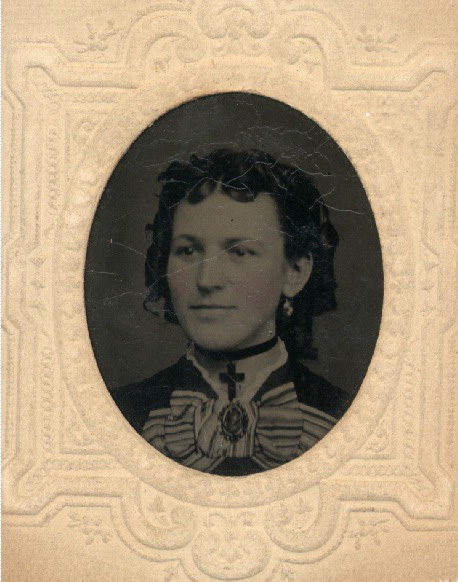
This tintype picture of Theresa Weber Winkler was most likely taken before her marriage to Leonard Winkler in 1871. The couple was married in Monroeville, Ohio.


Theresa was born in Germany in 1847. Her future husband, Leonard Winkler, was also a native of Germany. During the Civil War, Leonard Winkler served in Company I of the Third Ohio Cavalry. Here he is in a picture taken in 1863:


Leonard and Theresa Winkler had a large family of children which included three sons and three daughters. Mr. Winkler worked as a delivery man for a brewery. 

These portraits of Leonard and Theresa Winkler were taken later in life.


Leonard Winkler died on May 26, 1893, following a bout of bronchitis. He was buried at Oakland Cemetery. Following his death, some of his military items were donated to the historical museum of the Sandusky Library, and are now housed at the Follett House Museum.


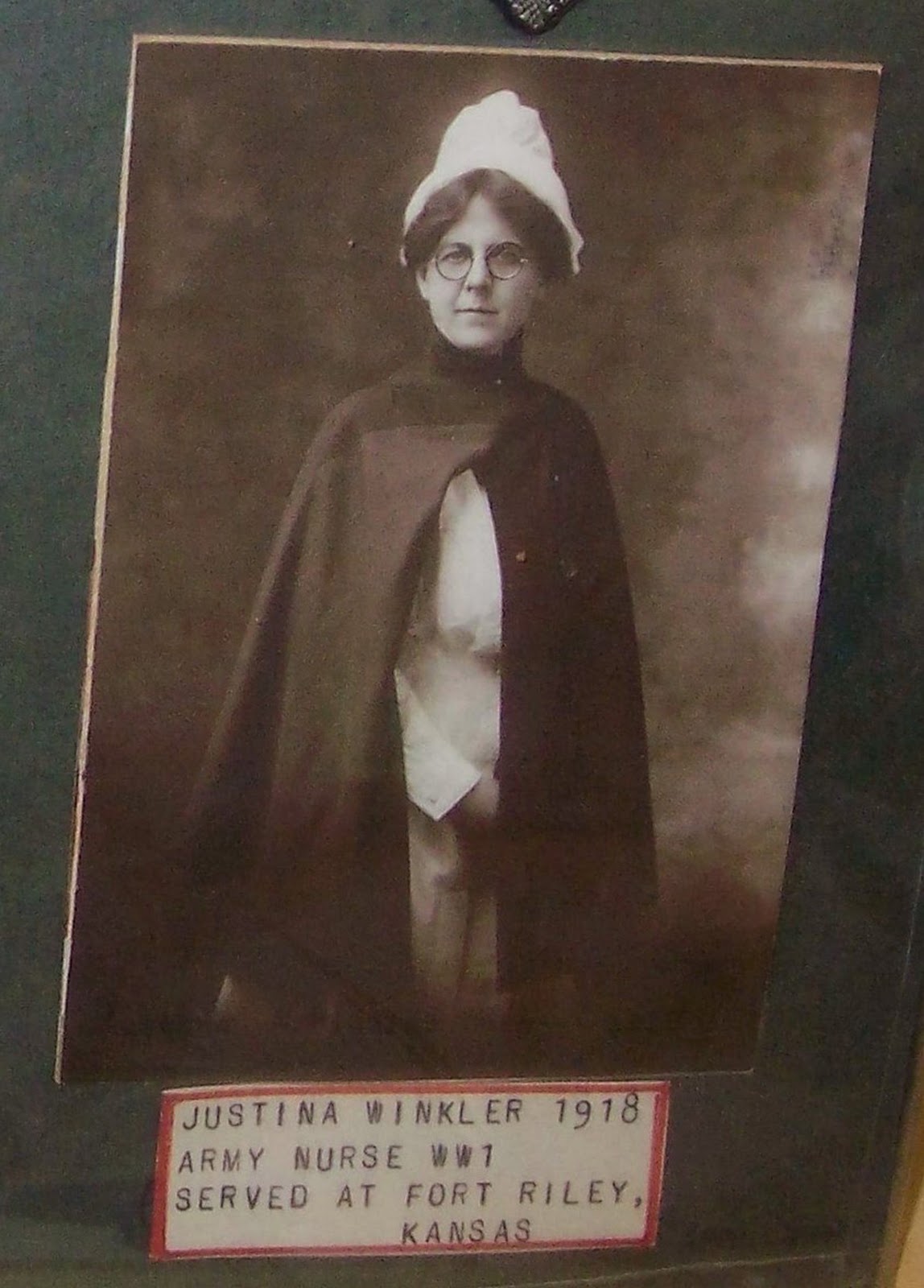
A daughter of Leonard and Theresa Winkler, Justina Winkler, was a nurse who served in World War I and later worked at Providence Hospital. A grandson, also named Leonard, was a teacher for several years, and he was known as the “Voice of Sandusky Athletics."

Friday, January 23, 2015

Sandusky High School Orchestra in 1903


Pictured above is the Sandusky High School orchestra in 1903. The students are seated on the north steps of the old high school, which later became Adams Junior High School.  Another picture of the same group was taken with the musicians standing.


Notes on the back of the picture have identified the students:


Though the notes say that the year was 1904, the pictures were most likely taken in 1903, since the names of several of the members of the orchestra appeared in the 1903 Sandusky High School commencement program. Andrew Prout and Ralph Scherz both went on to become prominent doctors. Two of the students in the 1903 orchestra went into the field of education. Miss Bess Lawrence taught in the Sandusky City Schools for over thirty years, retiring in 1944. Edwin Williams became a professor of languages at the University of Nevada and the University of Redlands in California.

Saturday, March 02, 2013

Len Winkler, Voice of Sandusky High School Athletics


Leonard Winkler, son of William and Emma Winkler, was a 1923 graduate of Sandusky High School. According to the March 2, 1966 issue of the Sandusky Register, Len Winkler coined the phrase “Blue Streaks” as the nickname for Sandusky High School athletes. In the early 1920s, Len was a reporter for the Sandusky Star Journal.  Another reporter had called Sandusky High School athletes the “Blue Devils.” After Winkler called them the “Blue Streaks,” the nickname stuck. For several years Len Winkler resided in an apartment underneath the home grandstand at Strobel Field. (Now Strobel Field at Cedar Point Stadium.) Click here to read an article at Fandy.com for more details about other residents of the apartment beneath Strobel Field.


For almost thirty years, Len Winkler was the “Voice of Sandusky High athletics.” He announced almost every Sandusky High School football game, basketball game, track and wrestling match from 1936 to 1965. Due to illness, Len was forced to quit announcing in 1965. At that time he also resigned his teaching job at Sandusky High School. On October 9, 1965, Sandusky Mayor William Harbrecht proclaimed that day as “Len Winkler Day.” Later that night Len Winkler announced his final game at Strobel Field. Len Winkler died on March 1, 1966 after a lengthy illness. He had been a teacher of industrial arts, mathematics and physics at Sandusky High School. He was a graduate of Ohio State University, where he earned an engineering degree. While Len was employed at the Ohio Public Service Company, he supervised the installation of public address system at the SHS stadium. Len Winkler was survived by his wife Mary, two sisters, and several nieces and nephews. Funeral services for Len Winkler were held at the Charles J. Andres’ Sons Funeral Home, and burial was at the Castalia Cemetery.

Friday, October 05, 2012

Sandusky High School Orchestra in 1904


The group of students with Mr. Cornelius Schnaitter made up an early orchestra at Sandusky High School in 1904. Pictured are: Front row, Verna Murphy and Edna Becker; middle row, George Lehrer, Bess Lawrence, Theresa Winkler, Mr. Schnaitter; top row, Maude Claus, Ralph Scherz, and Margeruite Andrews. Edna Becker went on to teach at Sandusky City Schools for twenty five years. George Lehrer became involved in theatrical productions, and was known nationally for his Lincoln impersonation. Ralph Scherz got his medical degree and practiced medicine in Cleveland for over fifty years.

Visit the Sandusky Library Archives Research Center to view this and hundreds of other vintage photographs from Erie County and Sandusky.

Monday, March 07, 2011

Justina Winkler, World War I Nurse

Miss Justina M. Winkler was born in Sandusky on March 4, 1872 to Leonard and Theresa Winkler. She earned her diploma as a graduate nurse from St. Vincent’s Hospital in Toledo in 1908. During World War I, Justina worked as a nurse at the hospital located on base at Fort Riley, Kansas.
After the war, Justina worked as a nurse at Providence Hospital and for the Metropolitan Life Insurance Company. She was a member of the Commodore Denig Post of the American Legion, the Erie County Chapter of the American Red Cross, and she was a charter member and past president of the Santa Clara Auxiliary, United States Spanish War Veterans. Miss Winkler also served as secretary of the Erie County Soldiers’ Relief Commission. On August 24, 1939, Justina Winkler passed away after a lengthy illness. She was buried at Oakland Cemetery with a full military service. Funeral services were held at the home of her sister, Mrs. Norman Jesson, as well as at St. Mary’s Church. The 1939 Obituary Notebook at the Sandusky Library features several obituaries for Justina Winkler. One read, in part:  “Miss Winkler was known for her faithful and energetic work as officer and member of several patriotic, church and civic organizations. Nearly every patriotic holiday in the last twenty hears found Miss Winkler aiding in some capacity in the observance.”

Below is a certificate issued to Justina Winkler in recognition of her service to the American Red Cross.

Wednesday, November 11, 2009

Third Ohio Cavalry

On August 6, 1861, the Governor of the State of Ohio commissioned Lewis Zahm, of Norwalk, to raise a regiment of volunteers for a cavalry unit for service to the United States during the Civil War. Men were recruited from northwestern Ohio, and they were trained at Camp Worcester just south of Monroeville, Ohio. The first chapter of The History of the Third Ohio Cavalry, by Thomas Crofts, describes conditions at Camp Worcester. (A reprinted edition of this book, with many photographs, is available at the Sandusky Library.) Food was not ideal, and in the first few weeks, men had to bring blankets from home, and sleep upon piles of straw. In the evenings, the men sang songs, and ran races.


Clark Center, who later was a Sandusky councilman, enlisted as a Second Lieutenant in Company I, of the Third Ohio Cavalry and was later promoted to First Lieutenant. Colonel Darius E. Livermore was a former Sandusky resident who served as a Lieutenant Colonel in Company S of the Third Cavalry. (Col. Livermore’s daughter Jessie May was the designer and creator of the lovely stained glass in the doors and windows of the Adams Street entrance of the Sandusky Library.)

Edwin Niver lost his life in the Andersonville Prison on June 19, 1864. His sister’s book about Edwin’s experiences in the war, Reminiscences of the Civil War and Andersonville Prison, is located in the Archives Research Center of the Sandusky Library. Emogene Niver Marshall was devoted to aiding Veterans throughout her life.

Private Leonard Winkler served in the same unit as Edwin Niver, Co. I of the Third Ohio Cavalry.

He carried a photo album of soldiers’ photographs with him, and at the Battle of Peach Tree Creek, Georgia, on July 2, 1864, a shot hit the album, which broke the album and caused the bullet to glance off and injure Leonard’s right arm.

Here are images of some of the tintypes from Private Winkler’s photograph album:


Private Winkler’s photograph album can be seen at the Follett House Museum. While we do not know if the album contained the actual photographs of the soldiers at the scene of the battle, the Archives Research Center was given a set of twenty-four tintypes of soldiers from Co. I of the Third Ohio Cavalry, which were owned by Leonard Winkler. These photographs have been reproduced in the 1997 reprint of The History of the Third Ohio Cavalry, and are also available online.

Leonard Winkler died in May of 1893, and was buried at Oakland Cemetery. Judge Elijah M. Colver, who also served in the Third Cavalry, gave the eulogy for Leonard Winkler. Services were conducted by the McMeens Post of the G.A.R. Mr. Winkler’s obituary in the Sandusky Register, May 29, 1893, stated that funeral services for Leonard Winkler were “attended by a large concourse of friends, many of whom were comrades of the departed during the rebellion…The floral tributes were many and beautiful.”