Showing posts with label Arrow (steamer). Show all posts

Saturday, June 08, 2019

Sandusky’s Busy Waterfront


As Leola M. Stewart pointed out in her article Sandusky, Pioneer Link Between Rail and Sail, Sandusky has one of the finest natural harbors on the Great Lakes. In the picture above, three excursion boats can be seen in Sandusky’s harbor around the turn of the twentieth century. After the passengers got off the steamships, this is what they might have seen:


Visitors flocked to Sandusky by rail and by steamer in the late 1800s and early 1900s. Cedar Point was a popular destination for many.


By 1920 automobiles parked at the foot of Columbus Avenue. At this time, streetcar lines ran down Columbus Avenue as well.


 In this scene from the mid to late 1950s, you can see cars from the Baltimore and Ohio Railroad which was still in operation in downtown Sandusky. The Cedar Point boat dock had a festive sign which was brightly lit at night.


Visit the Sandusky Library Archives Research Center to view this and hundreds of other vintage photographs of Sandusky and Erie County. An article by Leola M. Stewart is found at the website of the Ohio Historical Society.  Sandusky, Pioneer Link Between Rail and Sail provides historical background on the natural harbor found at Sandusky Bay, as well as the development of transportation and natural resources found in this area of the Great Lakes region.

Tuesday, February 06, 2018

A Look at the Foot of Columbus Avenue in the 1890s


In the late nineteenth century, the foot of Columbus Avenue looked quite different from Sandusky’s waterfront today. People could board trains as well as steamships here. The interurban also had tracks that brought people to these docks. From downtown Sandusky, visitors could travel to Cedar Point, the Lake Erie Islands, and even to Detroit. 

The business at the left side of the picture below shows a stand that sold cigars and newspapers. A popcorn stand was located beside the news stand. A diamond shaped railroad crossing sign warned people to look out for railway cars. A group of men were deep in conversation in front of the fountain.


In this close-up view of the Arrow, you can see two men walking on the deck. A bicycle is visible on the lower level, suggesting that a passenger planned to take a bicycle ride once they got to their destination in the Lake Erie Islands area.


The steamer R.B. Hayes can be seen right next to the Johnson’s Island boat landing. A faded sign on the dock read “Over 12 Million Passengers.”


Visit the Sandusky Library Archives Research Center to view hundreds of historical photographs from Sandusky and Erie County. You can also access historical photos online at the Past Perfect Local History Archives.

Friday, November 06, 2015

The Bustling Waterfront in Sandusky in the 1910s


This photograph of a busy day in downtown Sandusky’s waterfront district was taken in the 1910s. The steamer “R.B. Hayes” was docked at the Cedar Point pier, while the “Arrow” was out in Sandusky Bay, most likely heading towards Cedar Point.  A third vessel, the “Ottawa,”  is on the western side of the Cedar Point pier. Several people are located near the train, including some local policemen. In this closer view, you can see a Penny Arcade located near the pier, as vacationers head towards the boarding area. 


On the very right side of the full picture, you can see the steps on the side of the Post, Lewis & Radcliffe building, now 101 East Water Street. In the view below, you can read the words New York Central Lines on the U.S. mail car number 105.


In the close-up view below, the abbreviation CCC & STL appears on the locomotive. The Cleveland, Cincinnati, Chicago and St. Louis Railway, also known as the “BigFour was an affiliate of the New York Central System for much of the first half of the twentieth century.


The foot of Columbus Avenue in Sandusky has long been the  hub of activity and transportation center, especially during the warm weather months. Visit the Sandusky Library Archives Research Center. to learn much more about the history of Sandusky and Erie County. 

Tuesday, September 15, 2015

Excursions on Lake Erie in 1912


Retired lake freighter captain, Wendell Parry, donated the poster which advertised Toledo Excursions on the Steamer Arrow. On the Sundays of September 15, 22, and 29 in 1912, the Arrow took passengers on an excursion to the Lake Erie Islands and Toledo. The Arrow left Sandusky at 7:30 a.m., and left Toledo at 4:30 p.m. Round trip fare for the excursions was fifty cents (about $12.60 in today's money). These steamer excursions gave local residents a break from the summer heat, for a very reasonable price. Pictured below is the Arrow at the foot of Columbus Avenue in the early twentieth century.


The Frank E. Kirby also ferried passengers to the Lake Erie Islands area in Detroit in the summer of 1912. The seating capacity on the Frank E. Kirby was 3500.  Round trip fares from Sandusky to Detroit cost seventy five cents.


Before it was the custom for almost every middle class family to own and operate an automobile, the steamers on Lake Erie provided inexpensive transportation for summertime fun for hundreds of residents of the North Coast.

Sunday, September 21, 2014

Fountain at the Foot of Columbus Avenue


A public fountain was at the foot of Columbus Avenue in downtown Sandusky in the late nineteenth and early twentieth centuries, not far from the waterfront.  In the picture above, the Post, Lewis and Radcliffe building, which dates back to 1866, can be seen just to the east of the fountain. Ellie Damm wrote in her book Treasure by the Bay, (Bucknell University Press, 1989), that the square where the fountain was located was often filled with activity as people gathered to meet the trains and boats as they arrived in Sandusky.  

The photograph below was taken sometime before 1903. The steamer "Arrow" is at dock; the "R.B. Hayes" is approaching (or leaving) the dock; another unidentified steamship is visible in the background, heading out into the bay. A fruit stand is at the lower right of the image; a newsstand/cigar shop is next to the dock; the Sandusky Fish Co. is slightly visible at the extreme left of the image.

  
We know that this photograph was taken in either 1903 or 1904:


Just past the railroad tracks, to the northwest of the fountain, the building with the large balcony was the Terminal Inn. This business opened in 1903 and was destroyed by a massive fire on June 21, 1904. Today a modern fountain at the Schade-Mylander Plaza welcomes visitors to historic downtown Sandusky.

Tuesday, May 01, 2012

Views of the Steamer Arrow

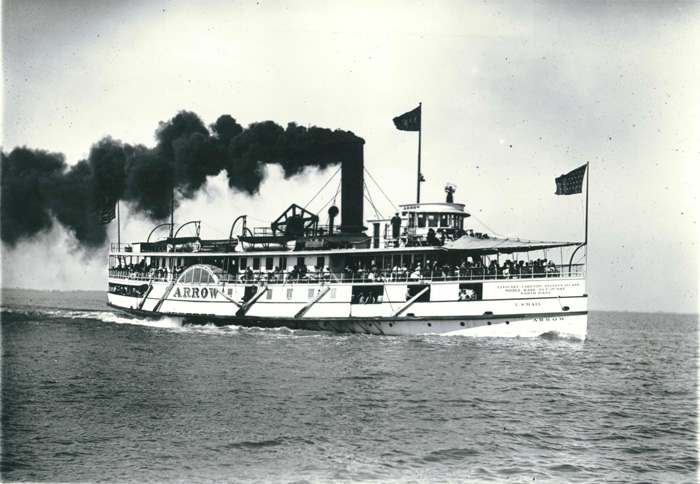
The steamer Arrow was built by the Detroit Dry Dock Company in Wyandotte, Michigan in 1895. Her first captain was George A. Brown. The Arrow was 165 feet in length, and 28 feet wide, with a net tonnage of 182. From 1895 until 1922, the Arrow sailed on Lake Erie taking passengers from Sandusky to Kelleys Island, Middle Bass, North Bass, and Put-in-Bay. Her cabin was furnished in light mahogany, and a grand piano was featured in her salon. Round trip fares in 1912 cost fifty cents. There were several steamers on the Island route in the early twentieth century.

Visitors to Cedar Point and the Lake Erie islands often arrived at the docks in Sandusky by passenger train.

The photograph below by Ernst Niebergall captures the Arrow vividly as it travels across Lake Erie.

Tuesday, December 06, 2011

Captain George A. Brown

George Arthur Brown was born in Canada on December 6, 1841 to Joseph and Ann (Arbor) Brown. He began his long career with Great Lakes vessels as a deck hand when he was age sixteen. At age twenty one, he was made mate on a ship that operated out of Detroit. In the early 1860’s, Mr. Brown was appointed captain of the J.O. Moss, a ship owned and operated by the Gilcher & Shuck Lumber Company. Captain Brown was connected with several ships throughout his lengthy career. For a time he owned and operated the Champion, a ship that carried lumber. For thirty two years, Captain Brown was on the route between Sandusky and the Lake Erie Islands. He was captain of the steamers Jay Cooke, the City of Sandusky, and the Arrow.


An article in the December 22, 1910 issue of the Sandusky Register stated that Captain Brown “was known by practically every islander and many people from different parts of the United States, who acquaintance he made during the summer seasons…He was a personal friend of Grover Cleveland and many other notables. During all his experience as a lake captain he never met with a serious mishap.” After a lengthy illness, Capt. George A. Brown passed away at Providence Hospital, on December 21, 1910. He was survived by his wife, a son, daughter, and several siblings. The funeral for Captain George A. Brown was held on the day after Christmas in 1910 at the Masonic Temple. Burial was at Oakland Cemetery. Captain Brown was involved in many aspects of life on the Great Lakes. He transported mail, goods, as well as hundreds of individuals to a variety of locations in the Lake Erie Islands.

Tuesday, May 11, 2010

Sandusky’s Columbus Avenue

Columbus Avenue was located in the very center of the 1818 Plat Map of Sandusky. Known as the Kilbourne Plat, downtown Sandusky was laid out in the shape of the Masonic emblem.

Local historian James A. Ryan wrote in the January 20, 1932 issue of the Sandusky Star Journal that while Water Street was the location of the very earliest Sandusky businesses, Columbus Avenue saw significant growth in development between 1850 and 1880. W.T. and A.K. West operated a dry goods store on Columbus Avenue before they opened the West House hotel located at the southwest corner of Columbus Avenue and Water Street in 1858.
William A. Graham operated a drug store on the southeast corner of Columbus Avenue and Water Street.
Columbus Avenue continued to be part of the major transportation and business center of the city of Sandusky. Several modes of transportation can be seen at the foot of Columbus Avenue about 1900. (The steamers A. Wehrle, Arrow, and R.B. Hayes are visible in this image.)
Parades held in Sandusky were often routed down Columbus Avenue. A parade held by the Knights of St. John took place in 1910.
Visit the Sandusky Library Archives Research Center to view a variety of books, newspapers, photographs, and other archival resources relating to the history of Sandusky and Erie County.