Showing posts with label Nielsen. Show all posts

Wednesday, October 21, 2020

The Former Lehrer Clinic on West Washington Street


In 1916 Dr.  Henry William Lehrer opened his medical practice at 1015 West Washington Street in Sandusky, Ohio. He practiced medicine at that location until his retirement in 1977. During his long career, Dr. Lehrer served as chief of medical staff at both the former Providence and Good Samaritan Hospitals. He also served on the Advisory Board of BGSU Firelands College. The article below appeared in the February 4, 1974 issue of the Sandusky Register, when Dr. Lehrer was honored, along with several other area physicians.


Dr. Henry G. Lehrer joined his father’s medical practice in 1946, and another son, Dr. David R. Lehrer, came on board in 1948.
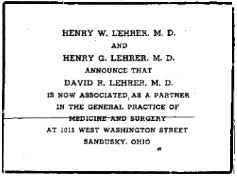

The senior Dr. Lehrer died in 1980. Eventually, Dr. David R. Lehrer left the Sandusky area. When Dr. Henry George Lehrer retired in 1983, it was the first time in sixty-seven years that there was not a Dr. Lehrer in the medical office at 1015 West Washington Street.

According to the Ohio Historic Inventory for Erie County, the man who was constructing the original building became sick with cholera and died in 1849. Later the building was a boarding house, a millinery shop, and a doctor’s office. In 1906. Dr. G.H. Boehmer had his medical office at 1215 Washington Street, the former address of the Lehrer Clinic. In 1901, this ad appeared in the January 15, 1901 issue of the Sandusky Star.


In the 1990s, Doctors Jay and Jerri Nielsen (known for her experience as a cancer patient in Antarctica) had their offices at 1015 West Washington Street, followed by an After-Hours Medical Center. Though this location no longer serves as a medical office, hundreds of Sandusky area patients were treated at the former Lehrer Clinic throughout many decades of the twentieth century.

Monday, March 20, 2017

Sandusky Furniture Company


The Sandusky Furniture Company opened in 1894, with three partners: Carl G. Nielsen, August Muehlhauser, and F.W. Molitor. The office and factory was on South Depot Street in Sandusky, Ohio. In the picture above, you can see engine number 441 from the old Lake Shore and Michigan Southern Railroad. An advertisement in the October 9, 1894 issue of the Sandusky Register stated that the Sandusky Furniture Company manufactured bar, bank and office fixtures. The company also did stair and grille work, and made folding doors and bay windows.


The interior of Henry Dehnel’s jewelry store in Sandusky was furnished by the Sandusky Furniture Company, as seen in this picture which appeared in the 1895 publication Men of Sandusky.


In the 1890s, the Sandusky Furniture Company began making household window screens, so that local residents could keep the flies out of their homes. In 1895, the company built a new desk and office furniture for the Sandusky Post Office. The Third National Bank purchased new office furniture from the company around the same time.

An article in the July 18, 1979 issue of the Sandusky Register reported that the Follett House Museum had taken cabinets made by the Sandusky Furniture Company to the attic level, where they were to display military items from the Spanish-American War and World War I.

In 1901, the Sandusky Furniture Company suffered a devastating fire, and by 1902 the company had gone into receivership. Though this local company was only in existence for a few short years, it provided excellent quality materials for many area businesses and homes while it was in operation.

Sunday, October 21, 2012

The Sandusky Theatre


In the picture above, three individuals can be seen painting a sign and the building of the Sandusky Theatre, about 1930. The Sandusky Theatre had a long, rich history according to an article by John Himmelein in the Twin Anniversary Edition of the Sandusky Register-Star-News from November 24, 1947. The theater was built in 1877 by Andrew Biemiller. It was first known as the Biemiller Opera House, located at southwest corner of Water & Jackson Streets on property that had originally been owned by William T. Townsend.


Biemiller’s Opera House accommodated 1,500 persons, and featured cushioned seats and excellent acoustics. The cost of the original building was $48,000. The spacious stage was sixty-six feet wide and thirty-three feet deep. The first opera to play at Biemiller’s Opera House was Wagner’s “Lohengrin.” In May of 1895, the building was purchased by Carl Neilsen. Mr. Nielsen remodeled the Opera House and changed its name to the Neilsen Opera House.

John A. Himmelein acquired the building in 1902. Again, the theater was remodeled. Mr. Himmelein stated that several types of amusements were performed here, including opera, dramatic, musical, minstrel, vaudeville, and plays by stock companies. The first attraction after the remodeling project was the play “York State Folks,” which opened on September 7, 1905. Between 1905 and 1907, the building was known as the Grand Opera House. By 1908, the name was changed to the Sandusky Theatre, after the building was leased to O.S. Hathaway. The Seitz Amusement Company leased the building in 1936 to show motion pictures, bought it in 1950, and sold it four years later. The building was razed in 1955.


Visit the Sandusky Library Archives Research Center to see a variety of programs from performances at this former Sandusky landmark.