Showing posts with label Barker. Show all posts

Saturday, May 29, 2021

Dramatic Entertainment, May 29, 1874

On May 29, 1874, a program of Dramatic Entertainment was given at the Sandusky High School, now known as Adams Junior High School in Sandusky. It was considered “A Very Serious Drama in Two Acts.” The first act was “Among the Breakers,” and the second act was “The Day After the Wedding.”

An article in the May 29, 1874 issue of the Sandusky Register reported that the dramatic entertainment was put on by the Sandusky Dramatic Association, and was a most enjoyable affair. Many familiar names were part of the cast. George P. Barker, cast in the leading role, was later a Major during the Spanish American War. Oran Follett Foster, who portrayed Larry Divine, was the grandson of Oran Follett, a well known publisher. Jessie and Allie Stem were the daughters of former Indian agent Jesse Stem, who was killed in Texas in 1854 when his wagon was ambushed. Miss Emma Marsh later married C. Webb Sadler, and they were the parents of C. Webb Sadler, Jr., once the City Manager of Sandusky, Ohio. Charles Livingston Hubbard married Jennie M. West, the daughter of early Sandusky businessman William T. West.

Major George P. Barker, during the war with Spain

Visit the Sandusky Library Archives Research Center to view this program, and many other primary sources from Sandusky and Erie County, Ohio.

Saturday, May 23, 2020

A Military History of the Eighth Ohio Volunteer Infantry by Franklin Sawyer

During the Civil War, Franklin Sawyer was the commanding officer of the Eighth Ohio Volunteer Infantry from May of 1862 until the unit was mustered out. A prominent lawyer from Norwalk, he achieved the rank of Brevet Brigadier General. Mr. Sawyer wrote a book about his unit, called A Military History of the Eighth Regiment Ohio Volunteer Infantry. It was published in 1881 by Fairbanks and Company of Cleveland, Ohio.


A copy of this military history, donated by Hattie Bretz, is housed in the Sandusky Library Archives Research Center. The book originally belonged to Hattie’s father, William Bretz, who served in Co. E of the Ohio Eighth Infantry. A reprint of this book, with additional photographs, was published by the Blue Acorn Press in 1994. This edition of Franklin Sawyer’s books is found in the Local History and Genealogy collection in Reference Services.

General Sawyer tells about the Eighth Ohio’s participation in many battles, including Antietam, Fredericksburg, Gettysburg, Spotsylvania, and Cold Harbor. During the Battle of Antietam, a barn on a nearby farm was used as an operating room. Wounded and dying men covered the ground around the barn. Sandusky native Horace Harper Bill, who was then with Company K, died at Antietam. In the author’s preface, Franklin Sawyer stated, “There were many individual acts of bravery and fortitude, on the part of both officers and men.”

Many men from Sandusky and Erie County were in Company E of the Ohio Eighth Volunteer Infantry. Sawyer’s book lists the names of all the officers and soldiers in each company. The unit’s chaplain, Rev. Lyman N. Freeman, had served as rector of Grace Church in Sandusky from 1845 to 1850. Zenas W. Barker, Jr., the son of the former Mayor of Sandusky, died at Oakland, Virginia on August 28, 1861. Wells W. Miller, who was a Captain in the Ohio Eighth Infantry, went on to serve as Ohio’s Secretary of Agriculture. To read many more details about the Eighth Ohio, visit the Sandusky Library to view this historic accounting of the unit.

After the war Franklin Sawyer was elected to the Ohio legislature. He died in Norwalk, Ohio on August 22, 1892. Reunions of the Veterans of the Ohio Eighth Infantry were held for several years. A reunion was held at the Dixie restaurant in Sandusky on September 18, 1922. According to the Sandusky Star Journal of August 7, 1922, four of the former soldiers of Company E of the Ohio Eighth Infantry were living in Sandusky. Their names were E.E. Warren, William Braby, Charles Chapman and Romeo Foster.


Monday, June 17, 2019

June is a Popular Month for Weddings


An article appearing in the June 25, 1935 issue of the Sandusky Register reported that 41 marriage licenses had been issued in that month. The highest number of marriage licenses issued in Erie County in the month of June was in 1929, when a record of 55 marriage licenses had been issued. 

Several wedding related items are housed at the Follett House Museum and the Sandusky Library Archives Research Center.  Below is an undated picture which shows the interior of Saints Peter and Paul Catholic Church during a wedding ceremony.
   

This bride had her picture taken at the former Sandusky Business Women’s Club. Though we do not know the name of the bride, the photograph was taken by Torow Studio.
 
         
The wedding of Arthur Moosbrugger and Lucille Holtz also took place in 1938, at St. Mary’s Church.


Laura Elizabeth Cooke was the daughter of Pitt Cooke and Mary Townsend Cooke. Laura is pictured below in her wedding dress on December 8, 1886. Laura’s groom, Franklin S. Barker, was a photographer in business with Mr. W. A. Bishop at the time of his wedding.


In 1891, Sakie Prout married Charles Merz. Dr. Charles Merz was a physician in Sandusky, as well as an expert on Masonic history. Dr. Merz’s best man was George Prout, and Sakie’s maid of honor was Mary Bookwalter Prout.


Visit the Sandusky Library Archives Research Center to view these and many more historical photographs.

Saturday, June 02, 2018

The Graduating Class of Sandusky High School, 1872


Pictured above are several members of Sandusky High School’s graduating class of 1872. In the front row are: Lula Hayes; Sarah Lawler; Charles McLouth and Antonia Springer. In the middle row are: Hattie Miller; Frank Barker; Emma Hages; Robert Walsh and Eunice Williams. In the back row are: Ella Rayl ; Alex Camp; Emma Alder; Hattie Keech; Henry Moore; Laura Wetherell; Alice Kinney and Ella Kelham. 

By 1876, Ella Kelham was an elementary school teacher for Sandusky City Schools. Frank Barker became the city clerk of Sandusky, and he married Laura Cooke, the niece of Civil War financier Jay Cooke. (Barker Street in Sandusky was named for Frank Barker’s ancestors.) Hattie Keech was the daughter of Sandusky businessman and philanthropist, C.C. Keech. She would go on to marry Edmund H. Zurhorst, who was very active in politics in Sandusky. Alice Kinney was the daughter of newspaper publisher J.C. Kinney, and Alex Camp’s ancestors were instrumental in the founding of the city of Sandusky. These students were all born before the Civil War, and most lived well into the twentieth century.  They saw many changes in technology in their lifetimes. 

To see more historical photographs from Sandusky and Erie County, visit the Sandusky Library Archives Research Center, on the lower level of the Sandusky Library.

Monday, October 17, 2016

The Barker Family Left Its Mark on Sandusky


If you have ever seen Barker School (now a Day Care Center) or driven down Barker Street on Sandusky’s west side, then you are familiar with the surname of a family whose many members  have made contributions to the development of the city of Sandusky. Zenas Ward Barker, who served in the War of 1812, moved his family from Buffalo, New York to Sandusky, Ohio in 1834. He was one of several individuals who helped organize Grace Episcopal Church in Sandusky in 1835. He was Erie County Clerk in 1838-1839. In the early 1840s, he was one of the directors of Sandusky’s public schools, and was Sandusky’s Mayor in 1846. This Zenas W. Barker died in Sandusky in 1879. His father, also named Zenas Ward Barker (1765-1834) was a pioneer settler of Buffalo, New York. One of the sons of Zenas W. Barker (1818-1879) also named Zenas W. Barker (1834-1861), became a First Sergeant in Company E of the Ohio 8th Volunteer Infantry. He lost his life during military service on August 28, 1861. 

Another son of Zenas Ward Barker, the former Sandusky Mayor, was Jacob A. Barker.


Jacob A. Barker began working at the Mad River and Lake Erie Railroad in 1846. He eventually became the freight agent for the railroad. From the early 1860s until he retired in 1891, he was the local agent for the United States Express Company. He was a member of the Sandusky City Council, the Board of Education of Sandusky City Schools, and he was a senior warden of Calvary Episcopal Church for several years. An article in volume 14 of the Firelands Pioneer said of him: “He was possessed of a generous, kind disposition and many instances of his generosity will be gratefully remembered by the recipients.” Jacob A. Barker died on December 22, 1898, and he was buried in the family lot at Oakland Cemetery. He was survived by his wife, the former Mary E. Paterson, and four sons. 

The son of Jacob A. and Mary Paterson Barker was George P. Barker:


He was born in Sandusky in May of 1852, and was associated with the United States Express Company in Sandusky for over forty years. From 1915 to 1929 Mr. Barker was storekeeper at the Ohio Soldiers’ and Sailors’ Home. During the Spanish American War, he rose to the rank of Major. He began with Company B of the Sixteenth Infantry, and mustered out with the Sixth Infantry. For four months Major Barker held the position of military governor of the district of Santa Clara in Cuba. On January 24, 1930 George P. Barker died as a result of heart disease. Funeral services for Major Barker were held on January 27 at Grace Episcopal Church, and burial was at Oakland Cemetery following a military salute at the gravesite. Many other members of the Barker family are also buried in the family lot in the North Ridge section of Oakland Cemetery.

Sunday, July 17, 2011

Major George P. Barker

George Putnam Barker was the son of Jacob A. and Mary (Paterson) Barker, and grandson of former Mayor of Sandusky, Zenas W. Barker. He was born in Sandusky in May of 1852, and was associated with the United States Express Company in Sandusky for over forty years. From 1915 to 1929 Mr. Barker was storekeeper at the Ohio Soldiers’ and Sailors’ Home.

During the Spanish American War, George P. Barker rose to the rank of Major. He began with Company B of the Sixteenth Infantry, and mustered out with the Sixth Infantry. For four months Major Barker held the position of military governor of the district of Santa Clara in Cuba.

On January 24, 1930 George P. Barker died as a result of heart disease. His wife, the former Alice Lyman, had predeceased him in 1925. Funeral services for Major Barker were held on January 27 at Grace Episcopal Church, and burial was at Oakland Cemetery. A military salute was fired at the grave, and taps were played. The honorary pallbearers for Major Barker were Gen. Perry Null, Dr. J.T. Haynes, Edward McCune, A.V. Brown, Roy T. Rogers, and Alva S. Humiston. Active pallbearers were members of the Spanish American War Veterans, including John Bamberl, George Schiller, A.C. Schultz, John Wunder, Thomas Schwank, and Ralph Stockdale. Obituaries for George P. Barker are found in the 1930 Obituary Notebook at Sandusky Library.

Saturday, July 09, 2011

Election Handbill in German


The handbill above was donated to the Sandusky Library Archives Research Center by Dr. Norbert Lange, who also provided the English translation:

German Fellow Citizens!
Do not neglect to vote for the
school candidates on the Volks-Ticket:

For members of the Board of Education:

Jacob A. Barker
Cornelius Schnaitter

The election will be held in the court house on
Tuesday the 9. of  July 1872.
Polls open until 5 o’clock in the evening.

In 1872 there were many German social groups which met in Sandusky, and it is most likely that when they met, this handbill was distributed just prior to the July 1872 election. According to the 1893 Annual Report of the Board of Education of City of Sandusky, Cornelius Schnaitter served on the Board of Education for the Sandusky City Schools from 1872 through 1876, while Jacob A. Barker was on the Board of Education from 1872 through 1878.

Monday, October 12, 2009

East Market Street Primary School

Charles E. Frohman wrote in his book, A History of Sandusky and Erie County, that following a public meeting on October 14, 1843, a committee consisting of Moors Farwell, Alexander Porter, and Zenas Barker met to prepare a plan for the erection of one or more school houses for the education of the young people of Sandusky. Two stone school houses were built at the end of West Market Square and the south side of East Market Square. Another school was erected on the west side of Camp Street at Adams, and the high school was located on the West Public Square.

Pictured below is the building that was formerly used as the East Market Primary School located on East Market Street. The school was in operation from the mid 1840’s through the 1870’s. The view is from Franklin Street, and the Variety Village Drive-Through can be seen adjacent to the former school building.
The Archives Research Center of the Sandusky Library has in its local schools collection an attendance register from the East Market Primary School, covering the years 1848 through 1853.

On the register page dated August 18, 1851, are the names of Melissa and Minerva Bell. These twin girls lost their parents, Horace and Sarah Bell, during the cholera epidemic in Sandusky in 1849. Mary and Rosa, daughters of well known lawyer and abolitionist F. D. Parish, are also seen on this page. (Rosa was also known as Damask Rose. See the book, Stories of Sandusky, for a touching, possibly fictionalized story about Damask Rose Parish.)

Many familiar names of the children of early Sandusky residents can be seen throughout the attendance register. A student named Theodore Hosmer would become the first Mayor of Tacoma, Washington.

An interesting report form was found from August 19, 1853. Besides recording attendance, absence and tardiness, the following items were also recorded by the teacher: number of communications for the week, number of pupils engaged in quarreling, and the number of cases of falsehood, uses of profane language and cases of obscene language. The final item to be tallied was the number of corporal punishments inflicted in the classroom for the week.
Visit the Sandusky Library to find a variety of historical items relating to Sandusky and Erie, including historical yearbooks and city directories and county histories of several counties in Ohio.

Wednesday, July 08, 2009

Laura Cooke Barker

Laura Elizabeth Cooke was the daughter of Pitt Cooke and Mary Townsend Cooke. (Pitt Cooke was the brother of Jay Cooke, the Civil War financier.) Laura is pictured above in her wedding dress on December 8, 1886. Laura’s groom, Franklin S. Barker, was a photographer in business with Mr. W. A. Bishop at the time of his wedding. Later Frank worked as an accountant in Sandusky.

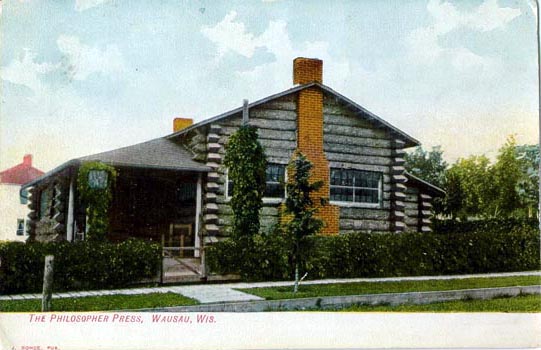
Laura Cooke Barker wrote several books . Her first book was entitled A Strange Experiment, published in 1897 by the Philosopher Press of Wisconsin.

Laura’s book of poems, Mezzotints, was also published by the Philosopher Press. The Sandusky Register reported in its April 29, 1900 issue that Laura’s poems were “especially interesting from a psychological standpoint, showing how the mind of the woman of strict orthodox training refines and interprets human desires.” Society Silhouettes, a collection of short stories, was published in Cleveland, Ohio in 1898.

Two of Laura’s later books were published by the Roycrofters, a small handicraft community with a publishing company in East Aurora, New York. Looking Upward was a collection of inspirational verse, published in 1928. The Immutable Law was published in 1921, shortly after the death of Laura’s husband. According to an article which appeared in the October 30, 1921 Sandusky Register, The Immutable Law was “a study of contrasted temperaments upon which play fires of avarice, sorrow, hatred, love, cynicism and lesser passions.” The dedication of this title read: “In undying remembrance of my well beloved husband, Franklin Sydnor Barker, born in spirit and his inheritance of ecstasy eternal on April 3, 1920.” Accompanying this dedication was the Biblical verse, “And God shall wipe away all tears from their eyes; there shall be no more death, neither sorrow, nor crying, neither shall there be any more pain; for the former things are passed away, and he that overcometh shall inherit all things.” It appears that Laura devoted herself to her writing, following the death of her beloved husband Franklin.

Mrs. Laura Cooke Barker died on April 30, 1927, following a lengthy illness. She was survived by her sister, Mary Cooke. Laura was buried next to her husband in the North Ridge section of Sandusky’s Oakland Cemetery.