Showing posts with label football. Show all posts

Monday, October 03, 2022

New Athletic Field for Sandusky High School Dedicated in 1922


Though Sandusky High School was located on Adams Street at Washington Park in 1922, the School Board purchased property for a new athletic field on the south side of town, between Hayes Avenue and Camp Street, south of the railroad tracks. The 1915 map of Sandusky, pictured below, indicates the approximate location of the new athletic field.


The new field had a football field, track and grandstands. Strobel Field, now Strobel Field at Cedar Point Stadium. was dedicated in 1936. Dr. C.L. Knoble said, about Sandusky’s new field, “The local field will compare favorably with any in this part of the state and is the equal to those of many colleges.”

Coach Gosnell Layman stated in the September 10, 1922 issue of the Sandusky Register that the new field was ready. The yard lines were marked off, and the grass was in perfect condition.


The first game of the high school football season was played on September 23, when Sandusky faced Lincoln High from Cleveland, Ohio; 1100 people attended the game which ended in a tie. The new athletic field was officially dedicated on October 15, 1922, before the Fremont-Sandusky game.

The Fremont High School band opened the dedication ceremony. Sandusky High School officials and members of both football teams assembled on the new athletic field. The Star Spangled Banner was sung, followed by Sandusky High’s Victory song. Sandusky beat Fremont 32 to 0. The Sandusky Register reported, “Sandusky completely outclassed the visitors in every way.” Team captain Carl Borders scored the first touchdown of the game, after Walton threw a perfect forward pass.


A lineup and summary of the game appeared in the Sandusky Register.


If you would like to read more about the history of the Sandusky Blue Streaks football teams, visit the Sandusky Library where several titles are available for loan.

Circa 1940

Saturday, September 14, 2019

Photographic Postcards of the Sandusky High School Football Team of 1920


Several postcards in the Sandusky Library Archives Research Center feature the 1920 Sandusky High School football team. The team is pictured above outside the former Sandusky High School, which later became Adams Junior High. Below are eleven key players for the 1920 team.


In the back are, left to right: Abe Cohen, Joe Dise, Jim Kelley, Ray Baker. In the front are: Matt Lauber, Arden Krebs, Hank Krebs, H. Dean, unidentified, Carl Borders, and Axline Dewitt. 

Matt Lauber was the team’s captain.
       

The Sandusky High School Fram of January 1921 stated that the Sandusky High School football team in the fall of 1920 was not very successful. In league play, Sandusky won two and lost three games. An article in the October 24, 1920 issue of the Sandusky Register reported that though Lorain beat Sandusky on October 23 by a score of 7 to 0, many people felt that referee Tommy Neill had made a bad call during the game, which gave Lorain its only touchdown. Sandusky’s Coach Mackey felt that if a protest were to be made, it would not be in the best interest of the league, so no formal protest was initiated.  


To learn more about Sandusky High School's football rivalry with Fremont Ross, look for Vince Guerrieri's book, The Blue Streaks and Little Giants: More Than a Century of Sandusky and Fremont Ross Football, which covers the long standing football rivalry between the Sandusky Blue Streaks and the Fremont Little Giants; it is available for check-out at the Sandusky Library.


Tuesday, March 05, 2019

Knute Rockne Addressed the Sandusky Kiwanis Club in 1925

Image from Library of Congress Prints and Photographs Division
A front-page article in the March 6, 1925 issue of the Sandusky Register reported that football genius Knute Rockne gave the address at a Sandusky Kiwanis banquet which was held at the Elks Club on March 4, 1925.  The Register article stated, “With raptor like forensic thrust and fairly bubbling with the college athlete spirit, the man who last year coached the first national collegiate football eleven in the nation’s history, gave what was unanimously declared to be the best address scholastic athletes ever heard here.” 

Sandusky City Solicitor Edmund H. Savord, a Notre Dame alumnus, introduced Knute Rockne to the crowd of two hundred fifty people. In his opening remarks, Coach Rockne recalled his summers at Cedar Point, where his boss had been J.F. Singler. Rev. William F. Murphy, who had officiated at the wedding of Knute Rockne to Bonnie Skiles, sat next to Rockne at the speaker’s table. 

According to Rockne, there were five components of success needed in football. They included brains, ambition, hard work, dependability, and proper psychology. Knute Rockne stated that the ideals of college athletes also “make for better men and better citizenship.”  In his closing remarks, Coach Rockne quoted the words of Theodore Roosevelt, “Don’t foul, don’t flinch; and when you hit the line, hit hard.”   


Members of the Sandusky High School football and basketball teams attended the banquet. Each of the football players have been identified in this picture from the 1925 Fram, which covered the school year of 1924-1925.


The uniforms of the basketball players for SHS in 1924-25 were quite different from the high school uniforms we see today.


After Coach Rockne’s address, George W. Wiles led the group in singing. Sandusky High School’s “Victory” song was sung by the high school athletes first, and then sung again by all guests at the banquet. Lloyd Weninger, who wrote the words and music to the “Victory” song, was given an ovation. 


Tuesday, November 08, 2016

Sandusky High School Football

The football team at Sandusky High School is having a successful season this year -- just a few days from a second-round playoff game, at the time this was published. This has been one of many good years for SHS football over the past 120 or so years.


Sandusky students played their first football games in the 1890s, but it appears that these teams were at more of a club-level rather than varsity, playing whatever nearby teams were available; records of those games are not readily available. What we might call varsity football began in 1901, when the team pictured above defeated Norwalk and Cleveland West High Schools, while losing to Toledo Scott in a three-game season. Judging from the picture, they may have been a somewhat disorganized bunch, with no standard uniforms.


Sandusky's first undefeated football season was in 1906, when the team won five games without allowing a single point!


The 1930s was a great time for Sandusky football, with winning records every year, including five undefeated seasons. The remodeled and expanded stadium (Strobel Field) was dedicated in 1936.


Many still remember the "Sensational 60's," when Sandusky football seemed nearly unbeatable, and produced future stars in both the playing and coaching ranks, as well as politics and other professions.


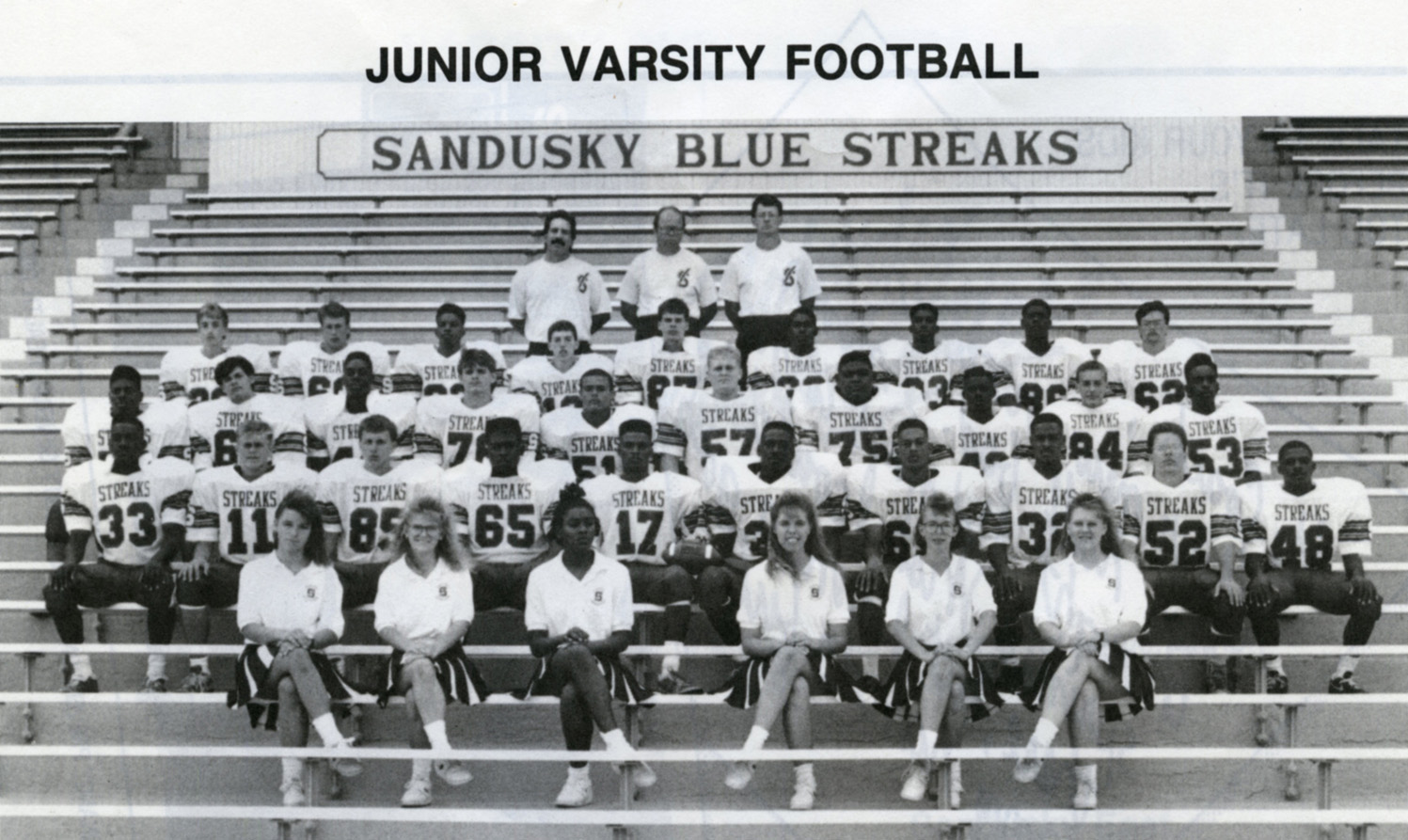
Do you recognize number 75 in the picture below? He is Sandusky's Pro Football Hall of Famer Orlando Pace, with his 1991 Junior Varsity squad.


Good luck to the Sandusky High School football team!

Monday, October 10, 2016

Charles E. Fleming, Sandusky High School Chemistry Teacher


Born on October 2, 1887 in Adams Mills, Ohio to J.D. and Alice Fleming, Charles E. Fleming was a graduate of Denison University and the University of Chicago. He moved to Sandusky in 1908, and was an instructor of chemistry at Sandusky High School from 1909 until the early 1940s. Mr. Fleming taught chemistry at Sandusky High School during the senior year of Norbert A. Lange, who would go on to become a chemistry professor at the Case Institute of Technology (now a part of Case Western Reserve University), and is still well known for writing the classic text Handbook of Chemistry

From 1909 to 1913, Mr. Fleming also coached the Sandusky High School football team. In an article in the May 28, 1955 issue of the Sandusky Register Star News, it was recalled that Mr. Fleming often told the story that one time SHS quarterback Leland Spore played almost an entire game with a broken arm.  

Charles E. Fleming is the person on the left in the back row.

 In the Sandusky High School faculty picture below, most likely taken in the 1930s, Charles E. Fleming can be seen on the far right in the back row.

He was active in the Masonic lodge and a member of the First Congregational Church.On May 5, 1942, Charles E. Fleming passed away at Good Samaritan Hospital, after having been ill for some time. Funeral services for Mr. Fleming were held at the Charles J. Andres’ Sons Funeral Home, and burial was in the Castalia Cemetery. He was survived by his wife, the former Catherine Winters (married in 1915), and a daughter, Mrs. R.E. Willison of Kentucky

Thursday, September 08, 2016

The 1932 Sandusky High School Football Team

Recently we ran into a team photo of the Sandusky High School football from the academic year 1932-1933. The individuals in the picture have been identified.

Top row (left to right): Null, Alden Feick, James Earl, Eddie Bryant, Maag, Kleinfelder, Steuk, H. Maag
Middle row: Coach Bob Whittaker, Ken Stauffer, Les Gast, London Gant, White, Jordan, Dehnel, Coach Wallace Glenwright
Bottom row: Young, Ted Roth, Gene Burns, Davis Chaffee, Al Hess, A. Missioni, Johnny Baum, and Carroll

Number 77 was London Gant, who was a legend in Sandusky High School football history. In Sandusky High School athletic records, He still holds the record for the most all-time career touchdowns and the most games played in career. Near the end of the football season in Gant's senior year, Johnny Dunn, sports editor of the Lorain Journal paid tribute to him in his newspaper column. It was reprinted in the October 20, 1932 issue of the Sandusky Register. A portion of the column read:


Sportswriter Dunn pointed out that “a united sigh of relief along the Northern Ohio football front,” will be heard when London Gant takes off his uniform for the last time at Sandusky High School. 

On the Thanksgiving Day football game of 1932 between the Sandusky High School Blue Streaks and the Fremont Ross Little Giants, Sandusky beat Fremont 33 to 0. It was estimated that 5000 spectators attended the game at Strobel Field. The victory was attributed to "sensational forward passing," according to an article from the November 25, 1932 edition of the Sandusky Register.


Visit the Sandusky Library Archives Research Center to read more about Sandusky High School’s past football seasons on microfilmed copies of the Sandusky Register and Star Journal. A book by Vince Guerrieri, The Blue Streaks & Little Giants chronicles the long rivalry of the football teams of Sandusky High and Fremont Ross.

Thursday, September 03, 2015

Sandusky High School Football Team of 1914


Pictured above are some of the members of the 1914 Sandusky High School football team. Notes on the original item, part of the Norbert A. Lange Collection, have identified the team players. In front from left to right, are: Bill Meese, Carl Kerber, Clarence Homberger, Herb Taylor, Amandus Smith, Bill Busch, and Joe Page. In the back from left to right are: Eugene Close, Hans Slackford, Bill Boehm, and Bill Smith. At the far right, Coach Bill Kinder is standing. In Northern Ohio League play in 1914 Sandusky won three out of four league games, including a win of 35 to 0 over the Fremont Little Giants. 

In 1914 Sandusky High School was still located on Adams Street, and future congressman James T. Begg was the school superintendent.


Coach Kinder went on to serve as an ambulance driver for the American Field Service during World War I. He then went back to seminary in order to become a clergyman. Rev. William Kinder became a well-known rector in the Episcopal Church in Detroit, Michigan and Youngstown, Ohio. 

Wednesday, August 28, 2013

Back to School. . .

As students in our area head back to school, here is a look back at students in Sandusky and Erie County from the historical collections of the Sandusky Library Archives Research Center. In the picture below, the Sandusky High School football team can be seen on the practice field in the 1920s.


J.W. Dietz took this picture of the 1903 Sandusky High School orchestra on the steps of the old Sandusky High School.


Dr. Norbert Lange donated this class photo of the third grade class at Monroe School from about 1900. Clarence E. Thompson, who is number 38 in the picture, went on to become a doctor. He practiced medicine in Chicago for over forty years.


The students and teacher of the District 3 School in Oxford Township were photographed by commercial photographer E. H. Schlessman  in the 1910s.


Saturday, March 02, 2013

Len Winkler, Voice of Sandusky High School Athletics


Leonard Winkler, son of William and Emma Winkler, was a 1923 graduate of Sandusky High School. According to the March 2, 1966 issue of the Sandusky Register, Len Winkler coined the phrase “Blue Streaks” as the nickname for Sandusky High School athletes. In the early 1920s, Len was a reporter for the Sandusky Star Journal.  Another reporter had called Sandusky High School athletes the “Blue Devils.” After Winkler called them the “Blue Streaks,” the nickname stuck. For several years Len Winkler resided in an apartment underneath the home grandstand at Strobel Field. (Now Strobel Field at Cedar Point Stadium.) Click here to read an article at Fandy.com for more details about other residents of the apartment beneath Strobel Field.


For almost thirty years, Len Winkler was the “Voice of Sandusky High athletics.” He announced almost every Sandusky High School football game, basketball game, track and wrestling match from 1936 to 1965. Due to illness, Len was forced to quit announcing in 1965. At that time he also resigned his teaching job at Sandusky High School. On October 9, 1965, Sandusky Mayor William Harbrecht proclaimed that day as “Len Winkler Day.” Later that night Len Winkler announced his final game at Strobel Field. Len Winkler died on March 1, 1966 after a lengthy illness. He had been a teacher of industrial arts, mathematics and physics at Sandusky High School. He was a graduate of Ohio State University, where he earned an engineering degree. While Len was employed at the Ohio Public Service Company, he supervised the installation of public address system at the SHS stadium. Len Winkler was survived by his wife Mary, two sisters, and several nieces and nephews. Funeral services for Len Winkler were held at the Charles J. Andres’ Sons Funeral Home, and burial was at the Castalia Cemetery.

Sunday, October 02, 2011

Ben Wilson, Football Coach at Sandusky High School


Before Sandusky High School’s “Sensational Sixties,” the 1958 and 1959 Sandusky High School football teams were coached by Ben Wilson. Jack Wilson and Bob Seaman were assistant coaches in the fall of 1958. Team members were known as Wilsonmen according to the FRAM.


In 1942, Ben Wilson was the starting center for Dover High School’s undefeated football team. After graduating from Heidelberg College in 1947, Ben Wilson coached at Wellston, Mount Vernon, and Warren Harding high schools. From 1965 to 1968, he was the offensive coordinator at the University of Virginia. In 1968 Ben Wilson was hired to be the head football coach for Wichita State University. Bob Seaman, who was an assistant coach at Sandusky High, also served as Ben Wilson’s assistant coach at Wichita State.

A tragic plane crash in Colorado took the lives of Ben Wilson, his wife, several Wichita State football players and other individuals on October 2, 1970. Twenty nine people lost their lives in the accident, and two later died as a result of their injuries. A ceremony of remembrance is held each year on October 2, to honor those who perished in the plane crash of 1970. The Ben and Helen Wilson Memorial Scholarship was established at Wichita State University in their honor. A documentary created by Public Television station KPTS, entitled “Black & Gold: Remembering the WSU Plane Crash,” features interviews with survivors of the plane crash, and family members of those who lost their lives.

Saturday, October 16, 2010

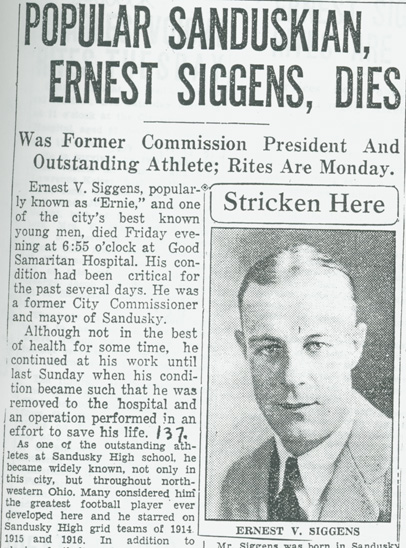
Ernest Siggens: Star Athlete, Mayor of Sandusky


Ernest V. Siggens, who was known as Ernie, was born in Sandusky on May 7, 1897 to George and Emily Siggens. He was a star of the Sandusky High School football teams of 1914, 1915, and 1916. From 1923 to 1925, Ernie played in the backfield for the Sandusky Maroons. (He is seen at the far right of the front row in the photo below, which was taken in 1923.)

Other teams which Ernie Siggens played for included the Parks Junior Basketball Team, who were the area champions in the 1913-1914 season, and the Sandusky Elks baseball team.
During World War One Ernie Siggens served in the United States Army from May to December, 1918. For several years, Ernie was the proprietor of the Siggens Electric Service store on Wayne Street in Sandusky. On January 1, 1932, Mr. Siggens was elected Mayor of Sandusky. He remained in that office January of 1934. On April 12, 1935, Ernest V. Siggens died at Good Samaritan Hospital following a brief illness. He was only age 37 at the time of his death. Mr. Siggens was survived by his wife, the former Mildred Atwood, a daughter, Mary Jane Siggens, and his mother, Mrs. Emily Siggens. Burial was in Oakland Cemetery. A touching tribute to Ernie Siggens appeared in the April 12, 1935 issue of the Sandusky Star Journal.

Thursday, January 28, 2010

Bill Mallory, Hall of Fame Football Coach


Bill Mallory, a 1953 graduate of Sandusky High School, had a long successful career as a college football coach -- just as he predicted. The caption of his graduation photo in the 1953 Fram yearbook (pictured above) stated that he "will coach the athletes of tomorrow," and he lived true to that message. (How often does a yearbook message match the future accomplishments?)

Graduating from Miami University (known as the "cradle of coaches") in 1957, Mallory eventually became head coach of his alma mater in 1969, compiling a 39-12 record in five seasons at Miami, including an undefeated record and a victory over Florida in the Tangerine Bowl in the 1973 season. After a successful five-year stint at Colorado, and four years at Northern Illinois, Coach Mallory moved on to Indiana University in 1984, becoming IU's winningest football coach in a 13-year tenure with the Hoosiers. He took an Indiana football program, seldom known for its quality of teams, and led them to six bowl games (when bowl games were still significant accomplishments). He came one game shy of making the Rose Bowl in the 1987 season, losing to the Michigan State Spartans at the end of the season; he is still remembered for his gracious speech in the winning team's locker room, with a pep talk for their upcoming Rose Bowl game.


Coach Mallory is a member of both the Miami University Athletic Hall of Fame and the Indiana Football Hall of Fame.

Friday, September 25, 2009

Strobel Field

On the evening of September 25, 1936, the new $100,000 Sandusky High School stadium at Strobel Field was dedicated, prior to the football game between Sandusky and Elyria High Schools. The 1937 Fram recorded that the stadium was built of reinforced concrete, with a height of thirty-seven feet, and was two hundred feet in length. Total seating capacity was between 5,600 and 6,000.The stadium featured a press box, broadcasting booth, two locker rooms, training rooms, and a coaches’ dugout. A quarter mile running track encircled the football field. The field had electric lighting, so that night games could be played.

According to articles in the September 25 and 26, 1936 issues of the Sandusky Register, the stadium was a WPA project, with Thomas C. Millar as superintendent of construction, and William Helm, field engineer. S.D. Downing was the WPA administrator in charge of the project. Harold Parker, architect for the stadium, said at the dedication: “Dedication of this stadium marks fulfillment of a dream or thought cherished during the past seven years to plan or supervise construction of a stadium for the board of education, the students and citizens, to be judged by those who know as a layout of the first rank not only in this section of the state but in this section of the United States.” Mr. Downing said, “The WPA of Ohio looks to this project with great pride, not only as a project, but in keeping people at work.” He presented the blueprints to Dr. C.R. Knoble, president of the Sandusky Board of Education.


The Sandusky Board of Education had purchased the property at the site of the new stadium, in 1921. It was named Strobel Field, in honor of C. J. Strobel, for his years of outstanding service to Sandusky City Schools. C. J. Strobel was a member of the Board of Education of Sandusky Schools for forty-eight years. When elected, he was the youngest member of the board, and when he left, he was the oldest member who had ever served on the board. Mr. Strobel also had worked at Citizens Banking Co. for fifty seven years. Mr. Strobel was considered an expert in the field of school finance.


On the night of the dedication, WPA officials, and school officials, including Frank J. Prout, Superintendent; Dr. C. R. Knoble, Board president; and Karl E. Whinnery, High School principal, sat on a platform under the lights. By 7:30 p.m. the bleachers and stands were packed. Frank J. Prout estimated the crowd in attendance to be 7,500 to 8,000, not including all the bands. A parade of bands was held, beginning at the southeast corner of the stadium. Drum majors led each band down the field. The combined bands played the “Star Spangled Banner” as the flag was raised.


The 1936 Sandusky Blue Streaks football team was coached by Bob Whittaker, who was coming into the September 25th game with 35 successive wins. The Blue Streaks beat Elyria, 16 to 7. Sandusky’s touchdowns were scored by Roy Gant and Harold Krause. Sandusky would finish that season with a record of 9 and 1, with the one loss occurring at the game between Sandusky and Toledo Waite. The 1937 Fram editors stated “We feel that as long as Whittaker-coached teams represent Sandusky High School these teams will continue to rank as one of the best in the state.”

To learn more about the history of Sandusky schools, visit the Archives Research Center of the Sandusky Library. There you will find old yearbooks, newspapers on microfilm, and a Finding Aid which will guide you through our archival collections.

Tuesday, September 01, 2009

Sandusky High School Football, 1912

The Sandusky High School football team about 1912:Pictured are:
Top row: C. E. Fleming, Leonard Osberg, George Singler, Frederick Slackford
Middle: Charles Abele, Frank Field, Howard Earnshaw, Wilbur Schoepfle, Estes Drake, Bob Judson
Front: Bill Busch, Roy Hazen, Wilson Harris, Gene Close, Don Hand, George Giesler, Art Wieland

Charles E. Fleming would go on to teach chemistry at Sandusky High School for thirty four years. Leonard Osberg served three two year terms as the Mayor of Vermilion in the 1940’s. Robert Judson retired as plant manager from the American Crayon Company in 1964, having been with the company for forty seven years. Wilbur Schoepfle was a Navy Ensign during World War One. He majored in mechanical engineering at the University of Michigan. Wilbur moved to California, and lost his life in an automobile accident in Orange County, California in 1941. The football team photograph pictures the young men with all their hopes and dreams ahead of them, years before the two world wars were thought of, and without the responsibilities of a job and family.

Visit the Archives Research Center of the Sandusky Library to learn more about the history of the people who have made Sandusky and Erie County their home.