Showing posts with label Musicians. Show all posts

Tuesday, June 25, 2024

Rosemary Schultz Riccardi, aka Xavora Pove


Rosemary Schultz became a talented pianist at a very young age. She was the daughter of Sandusky residents Frank and Mary Schultz. Her mother, the former Mary Walker, had been an opera singer. At the age of three, Rosemary studied piano with Paul Browne Patterson, who operated a music school in Sandusky and founded the Sandusky Choral Society. Later she studied under the popular Swiss musician, Rudoph Ganz. At the age of five, she appeared at the Masonic Auditorium in Cleveland before an audience of 4,000. 

Here she is (center) pictured below with local performer Bonnie Schwerer (left) and another unidentified woman:  

After graduating from St. Mary’s High School, Rosemary moved to New York, where she continued working as a pianist, and took up modeling. In the 1960s, she wrote an astrology column for Harper’s Bazaar, under the pen name Xavora Pove. The following article about Rosemary appeared in the Sandusky Register of January 14, 1967.


In 1968, she helped develop a television game show “Guess My Sign,” which aired in New York City. Through the years Rosemary entertained people throughout the Midwest., and eventually she moved back to Sandusky. She passed away on November 27, 2016, and was survived by her son David. Her husband Patsy Riccardi predeceased Rosemary and is buried in Arlington National Cemetery.

Wednesday, August 04, 2021

The Sandusky High School Orchestra in 1904


Mr. George Johnston donated this photograph of the 1904 Sandusky High School Orchestra to the Sandusky Library Archives Research Center.  Pictured are: Bottom row: Verna Murphy and Edna Becker; Middle row: George Lehrer, Bess Lawrence, Theresa Winkler, and Mr. Cornelius Schnaitter, director; Top row: Maude Claus, Ralph Scherz, and Marguerite Andrews.

Edna Becker and Bess Lawrence went on to become longtime teachers with the Sandusky Public School system. Dr. Ralph Scherz was a leading physician on Cleveland’s west side for over fifty years. George J. Lehrer, who was son of a Mayor of Sandusky with the same name, was a charter member of the Actors Equity Association, and was nationally known as an actor and director.  Locally, Mr. Lehrer was associated with the Lloyd-George Studios for the production of stage scenery and costumes. A biographical sketch of Cornelius Schnaitter is found in volume two of Hewson L. Peeke’s A Standard History of Erie County; Mr. Schnaitter was a prosperous merchant tailor in Sandusky for many years, in addition to being a noted musician. Theresa Winkler, who later became Mrs. Norman Jessen, donated several historical items from the Winkler family to the Follett House Museum and the Sandusky Library Archives Research Center.

Sunday, March 28, 2021

Pearl of the Sea by Karl Merz


In 1878 Karl Merz wrote the sheet music for a waltz entitled Pearl of the Sea. It was published by S. Brainard & Sons in Cleveland, Ohio. The sheet music was sold in Sandusky in the late 1870s at Hammond’s Music Store on Columbus Avenue. 

Karl Merz had been born in Germany in the 1830s. He learned how to play the organ and violin while quite young. In 1854, he emigrated to the United States, and by 1861 was was on the faculty of the Oxford Female College in Oxford, Ohio (later incorporated into Miami University). In 1882, he was asked to organize the music department at the College of Wooster. While at Wooster, he also wrote a column for Brainard’s Musical World. Eventually he became the editor of this publication. 

As a prolific composer, many of his musical pieces are preserved at the Library of Congress. During the summer of 1888, when Mrs. P.A. Follett operated a Summer Musical Institute, she arranged for  Merz to give a series of lectures at the Sandusky High School. Merz often visited Sandusky to pay a visit to his son, Dr. Charles Merz, and family. Dr. Merz was a leading Sandusky physician, and he was also an expert on Masonic history. 


Karl Merz's grandson, who was also named Charles Merz, was the editor of the New York Times from 1938 to 1961. 


Karl Merz died from pneumonia on January 30, 1890. The March 1890 issue of Brainard’s Musical World was dedicated to the memory of its former editor. An obituary honoring the memory of Karl Merz appeared in the February 1, 1890 issue of the Sandusky Register


Karl Merz was greatly missed by the musical community. A beautiful monument honoring the memory of Karl Merz was unveiled at the Wooster Cemetery on Memorial Day in 1894.

Sunday, January 17, 2021

Professor Ferdinand Puehringer, Conductor and Composer

Ferdinand Puehringer led a band at Cedar Point in the 1880s. He is pictured below with several  band members, including Fred Bauman, Maxwell Godfrey, J. Bolton, Ed Pelding, M. McAdams, Joseph Bock, and Max Wintrich. (Fred Bauman was a pioneer musician in Sandusky, having also been director of the Great Western Band and a member of Ackley’s Band. Read more about Fred Bauman in the 1922 Obituary Notebook, located in the Archives Research Center.)

Before moving to Cleveland in 1872, Ferdinand Puehringer was a professor at Wittenberg College. While in Cleveland, he was associated with many musical groups, including the Boys Band, a singing and orchestra school, and the Philharmonic Orchestra. In 1889, Professor Puehringer accepted a position with the S. Brainard Sons Company, a musical publishing house in Chicago. He wrote the Chicago Life Waltz in 1890, and also produced several operas, including The Czar and Zimmerman, and The Bohemian Girl.

Ferdinand Puehringer died in 1930, and his wife Mary Emich Puehringer died in 1938. They left behind a daughter Ritta Caldwell. 

(*Note: As often is the case in the spelling of surnames of European origin, Ferdinand’s last name was alternatively spelled Pueringer or Pureinger.)

Saturday, August 22, 2020

Paul Browne Patterson, Music Educator

Paul Browne Patterson was the son of Rev. and Mrs. Charles D. Patterson, born in 1876 in LaPorte, Ohio. Rev. Patterson had formerly been a minister in the Perkins Methodist Episcopal Church. Paul Browne Patterson graduated from the Oberlin Conservatory of Music in 1896, with a double major in piano and voice. Following graduation, Paul spent three years studying music in England, France, and Germany. From 1900 to 1903, he operated the Patterson School of Music in Sandusky. In 1903 he moved the school to New Castle, Pennsylvania. Below is the cover of a brochure from The Patterson School of Music when it was located in New Castle, Pennsylvania.

While in Pennsylvania, he formed the Festival Choral Society of New Castle, which was comprised of one thousand voices. Through his musical career, Mr. Patterson was the conductor of many symphony orchestras, including orchestras in Minneapolis, Cincinnati, Indianapolis, Pittsburgh, and Dresden, Germany, during their guest appearances with the Choral Society. In 1935 Mr. and Mrs. Patterson moved back to Sandusky, and he helped to organize the local Choral Society. He served as director of the choir at the First Congregational Church for many years, and was active as a teacher of piano and voice at his school, the Patterson School of Music, on East Park Street, until his retirement in 1966. Mrs. Patterson also taught piano lessons. Pictured below is a program from the vocal recital of Mary Louise Clary, a pupil in the Patterson School of Music.

Mrs. Patterson, the former Mary Evelyn Blocher, was a gifted singer, pianist, teacher, and accompanist. She served as the secretary-treasurer of the Patterson School of Music. 

Paul Browne Patterson died on January 12, 1971, at the age of 98, survived by his wife Mary, a daughter Mrs. Thomas Monroe, a granddaughter, and two sisters. He was buried at Sandusky’s Oakland Cemetery. He had been a former member of the American Guild of Organists, and was listed in the International Who’s Who in Music. Mrs. Patterson passed away in 1995, at the age of 90. The cultural life of Sandusky was deeply enriched by the musical talent of both Mr. and Mrs. Paul Browne Patterson.
Thursday, March 12, 2020

Michael A. McAdams, Musician and Printer


Michael A. McAdams was born in Quebec, Canada in 1856. He came to Sandusky, Ohio in 1891 to play with the Cedar Point band. He can be seen with his tuba in the back row of the Ackley Band at Cedar Point in the picture below; he was a member of the band for more than twenty years.


During the winter seasons, Mr. McAdams traveled as a musician with several theatrical groups, including Howe and White’s Circus, the Buffalo Bill tent show, and Bailey & Myers tent show. 

Besides being a popular musician, Michael McAdams also was employed as a printer for several years by the Register Publishing Company. Around 1918 his eyesight began to fail. An article in the March 13, 1924 issue of the Sandusky Register featured an article about a benefit concert performed on his behalf by the Ackley Band. The article stated, in part, “From the moment the conductor raised his baton for the first note of the Sousa March ‘Fairest of the Fair’ till the echoes from the last notes of the ‘The Star Spangled Banner’ died away in the final offering, the program was one of artistic portrayal and mastery of detail.” Mr. McAdams surprised the audience by coming onto the stage and playing a tuba solo, “My Old Kentucky Home,” and “Asleep in the Deep.” This was his first appearance in a public concert in a number of years, and the audience was delighted with his performance. The Register article said that McAdams showed “old time expertness that always made him a favored player in the days of Sandusky’s crack bass bands.”  

On April 18, 1928, Michael A. McAdams died at the Union Printers’ Home in Denver, Colorado.  An obituary, found in the 1928 Obituary Notebook at the Sandusky Library, stated that McAdams had remained friends with E.B. Ackley and other Sandusky musicians throughout the years. The printers’ union as well as several benefit band concerts for Mr. McAdams, aided in making his last days more comfortable.

Saturday, August 03, 2019

Midsummernight Concert of the Philharmonic Orchestra Society


On Friday evening, August 5, 1892, Charles Baetz conducted the Philharmonic Orchestra Society in a concert held at Cedar Point’s Grand Pavilion. Many popular Sandusky musicians took part in the performance.


Michael A. McAdams played contra bass with the orchestra.


The Sandusky Register of August 4, 1892 reported that the Fenz Brothers, vocalists from Vienna, were to perform at the concert. 

Fare for the round trip from Sandusky to Cedar Point was twenty five cents, which included admission to the concert. The steamer R.B. Hayes ran extra trips to Cedar Point during weekday evenings in the summer of 1892, to accommodate the increase in visitors to the resort. 

An article in the August 6, 1892 issue of the Sandusky Register stated that the mid-summer concert of the Philharmonic Orchestra Society proved to be “one of the best features of the summer program at that famous resort and all our music loving people who heard it were thoroughly delighted.”


Wednesday, March 20, 2019

Myrtle Louise Meagher, Music Teacher


Miss Myrtle Louise Meagher was born in Sandusky in 1882, to John E. Meagher, and his wife, the former Margaret Lotz. Myrtle was of both Irish and German descent. Myrtle’s grandfather, Henry Lotz, ran a grocery store in from the 1850s until his death in 1887 at the northeast corner of Shelby and West Washington Streets, where Joe Sundae’s is now located. 

From 1900 through the late 1920s, Myrtle was a piano teacher, having been a student of well known local piano instructor Paul Browne Patterson. The advertisement above appeared in the March 21, 1908 issue of the Woman’s Endeavor, a locally published newspaper edited by Sandusky women. Below is an advertisement which was in the Sandusky Star Journal on October 25, 1922. 


Also appearing in the Star Journal of October 25, 1922 was a brief article by Miss Meagher about the value of music. She maintained that the family and friends of a music student would benefit from music instruction, as well as the individual who was receiving the training. She held many piano recitals in her home studio on Shelby Street.


 By 1957 her health was declining, and she moved to a nursing home. Myrtle Louise Meagher died on June 4, 1965. Miss Meagher’s funeral was held at the Frey Funeral Home, and burial was at St. Joseph’s Cemetery in Sandusky, Ohio.

Sunday, March 12, 2017

Hugo Engels' Scrapbook of Performances


From 1882 through the 1890s, Hugo Engels kept a scrapbook containing programs and newspaper articles from local concerts, recitals, and plays. Many of the newspaper articles are in German. 

Hugo Engels was born in Germany on February 9, 1863. He came to the United States with his family in 1876, when his father Herman came to Sandusky to take over the wine business of his uncle Jacob Engels, who had died in 1875. Herman and Louisa Engels had five children, Hermine, Otto, Hugo, and Paul. Hugo and his brothers worked with their father in the winery, which became the Engels and Krudwig Wine Company when R. P. Krudwig joined the company in 1878. Hugo’s brother Carl L. Engels was also associated with the “Big Store,” a Sandusky department store.  

On June 4 1885, Hugo Engels performed Das Bild der Rose in Harmony Hall. Gesang Vereins is the German phrase for Singing Association.


On May 28, 1890, Mrs. A. P. Lange and Hugo Engels played a duet entitled Kucken in a Musicale.


Hugo Engels died on November 7, 1912. His wife Charlotte Engels donated the scrapbook to the historical collections of the Sandusky Library after his death. By looking through the scrapbook, one can learn more about the musical entertainment of Sandusky area residents in the late nineteenth century. It is interesting to note that many of the pioneer residents of Sandusky shared the love of music with residents of German descent who came to Sandusky as immigrants. 

The obituary of Hugo Engels, in the November 9, 1912 Sandusky Register stated that he participated in all of the Elks entertainments, particularly the musical performances.


At the funeral, Mayor John J. Molter delivered an address in German. Music was performed by a string quartet, under the organization of George F. Anderson. Hugo Engels was buried at Oakland Cemetery, with the Elks Lodge conducting the graveyard services.

Monday, April 18, 2016

Who Was Grandpa Corell?


This nineteenth century cabinet card is housed in the Arts Collection of the Sandusky Library Archives Research Center. It pictures men in a three-piece string band. The only individual who has been identified is “Grandpa Corell” on guitar, in the center of the group. On the back of the card is the name of the photographer, C.A. Cross.


Notes with the original item indicate that the  picture was taken sometime between 1885 and 1900. To determine the identity of Grandpa Corell, we consulted print sources  in our collection, as well as online genealogical databases. The book Sandusky Then and Now indicates that Christoph. Correll, who was born in Odenbach, Bavaria, Germany in May of 1819, and moved to the Sandusky area about 1849. Christopher Correll (often spelled Corell) married Catherine Christopher. In the 1870 U.S. Census, there are several children listed to Christopher and Catherine Corell, including sons named Charles, William and Ira Corell.


It turns out that Charles Corell died relatively young, and William Corell moved to Michigan. The 1890 Sandusky City Directory listed Christopher Corell, a carpenter; and Ira J. Corell, a plane maker.


By doing some quick math, in 1890 Christopher Corell would have been about 71 years old, and Ira J. Corell would have been 31 years of age. Since the guitar player looks to be a young man, the logical conclusion is that “Grandpa Corell” is very likely named Ira J. Corell. After doing a search for Corell  in our PastPerfect Database, other Corell family items which were donated appear to have come from the Ira Corell family, giving further evidence that this cabinet card most likely came from the Ira Corell family as well. If you have family photographs, be sure to the label people in your pictures, for the benefit of future generations who may have an interest in family history.

Saturday, December 19, 2015

Thirteenth Regiment Band of New York Performed in Sandusky


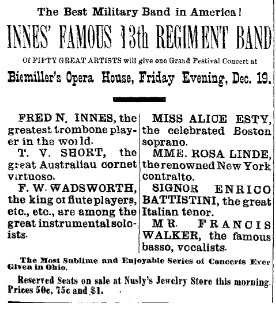
The following notice appeared in the December 19, 1890 issue of the Sandusky Register.


Fred N. Innes and his 13th Regiment Band from New York gave a concert in Sandusky on Friday, December 19, 1890. Mr. Innes was considered “the greatest trombone player in the world.”  Tickets for the concert were on sale at Nusly’s Jewelry Store, and sold for fifty cents, seventy five cents and one dollar. The concert was held at Biemiller’s Opera House, which once stood at the southwest corner of Water and Jackson Streets.


A brief article in the Sandusky Register of December 29, 1890, reported that the famous 13th Regimental band gave a superb concert at the Opera House, and “the music loving people of Sandusky who attended were more than pleased.” The audience was not as large as was expected, due to the closeness of the holidays. The article continued, “The members of this band are all artists of the highest rank, and under the matchless leadership of Mr. F. N. Innes this musical organization is one of the strongest in the country, not excepting the great Gilmore’s band.”

Friday, January 23, 2015

Sandusky High School Orchestra in 1903


Pictured above is the Sandusky High School orchestra in 1903. The students are seated on the north steps of the old high school, which later became Adams Junior High School.  Another picture of the same group was taken with the musicians standing.


Notes on the back of the picture have identified the students:


Though the notes say that the year was 1904, the pictures were most likely taken in 1903, since the names of several of the members of the orchestra appeared in the 1903 Sandusky High School commencement program. Andrew Prout and Ralph Scherz both went on to become prominent doctors. Two of the students in the 1903 orchestra went into the field of education. Miss Bess Lawrence taught in the Sandusky City Schools for over thirty years, retiring in 1944. Edwin Williams became a professor of languages at the University of Nevada and the University of Redlands in California.

Monday, August 11, 2014

Elmer J. Frank, Musician, Instructor, and Conductor

Young Elmer Frank, with his parents, Julius and Emma
Elmer J. Frank was born in Sandusky in 1904 to Julius and Emma Frank, both of German descent. As a youth, Elmer studied piano with Elmer F. Steuk, a well known Sandusky piano instructor. In 1931 he went to Austria to study piano under Madam Bree. He also studied composition, harmony, and instrumentation under Johanna Muller Herman, and choral and orchestra conducting under Professor Julius Katay. Mr. Frank’s musical studies took him also to Germany, France, Switzerland, Poland, Czechoslovakia, Hungary, Romania, Italy, and Tunisia. During the summer of 1939 he was on a scholarship in Poland to study folk and classical music, and while there, Poland was conquered by Nazi Germany. Luckily he made it home safely. During World War II, he served for two years in the Panama Canal Zone with the United States Army.

Back in the United States, Elmer Frank was the organist and choir director for several churches. He also taught music for several years, having studios in the Odd Fellows Hall and later in the Feick Building. He organized the Sandusky Choral Society and the Sandusky Male Chorus, and served as the director of both organizations for many years. Later he was the director of music at the International School of Art, which was at 507 Wayne Street. 

Mr. Frank is the conductor in the group picture of the Sandusky Choral Society, taken around 1940 by photographer William Mound.


On April 14, 1961, Elmer J. Frank died at Good Samaritan Hospital. He had been hospitalized after an automobile accident six weeks prior to his death, but he died from an underlying illness. Funeral services were held at the Quick’s Funeral Home, where Christian Science Services were held. He was buried in Oakland Cemetery. On November 4, 1962, a Memorial Concert in honor of Elmer J. Frank was held at Adams Junior High School. Jay Perine, Tenor, provided musical performance, with William E. Didelius accompanying, assisted by Beryl Beckwith Dureck.


Saturday, March 01, 2014

Alex H. Osterman’s History of Bands in Sandusky


In the Arts Collection of the Sandusky Library Archives Research Center is a binder with typewritten pages, in which Alex H. Osterman presented a history of bands and orchestras in Sandusky, from 1851 to 1934. The binder was given to the Sandusky Library from the library of Dr. Norbert A. Lange. Local musicians Ed Senne and Fred W. Bauer assisted Mr. Osterman in gathering information, as many of the musicians in the early bands were deceased by 1934. The first known band in Sandusky was the Jaeger Band, which was organized in 1851.


Mr. Osterman related how Charles Baetz’s stern discipline helped the Great Western Band to build up an enviable reputation. The band performed from 1867 to the early 1890s, and had several different directors. The Great Western Band is pictured below in the 1870s.


While Mr. Osterman’s history provides us with details about relatively well known bands, such as Ackley’s Band, the Cedar Point Orchestra, and Scouton’s Concert Band, he also covered little known bands, such as the Sandusky Light Guard Band, the Big Five Band, and the Curtiss Orchestra. Below is a list of members of the Harlemetts Orchestra, an orchestra made up of African Americans from Sandusky.


In the back portion of Mr. Osterman’s history binder are letters and anecdotes from local musicians, as well as notes from Dr. Norbert A. Lange with further details about Sandusky’s rich musical history.

Alex H. Osterman died on November 10, 1945, at the age of 69. He had been a restaurant operator in Sandusky from 1896 to 1901, and he served as the street superintendent of Sandusky from 1928 to 1933. In his later years, he was employed at the Erie China Company on Cleveland Road. Mr. Osterman’s little black binder helps us know more about music in a time gone by in Sandusky. An article in the Sandusky Star Journal of April 7, 1934, Alex H. Osterman stated that his history of bands in Sandusky was written “to perpetuate the memory of those men who were always ready and willing to give their time so that their music might be means of bringing joy and pleasure to tired bodies and saddened hearts.” 

Thursday, October 31, 2013

Who Are the Men in the Under the Baton Banner?

The Sandusky Library is pleased to announce the documentary film Under the Baton: Music at Old Cedar Point. The premiere screening will take place on Friday, November 1 at 7:15 p.m., with additional presentations on Thursday, November 7 at 6:30 p.m., Thursday, November 14 at 10:30 a.m., and Friday, November 15 at 1:30 p.m., all at the Sandusky Library’s Program Room. The television premiere will be on November 14 at 8:00 p.m. on WGTE, Toledo.

You may be wondering about the names of the men featured in the picture of Ackley’s Band, which appears on the promotional flyers related to the documentary:


This photograph of Ackley’s Band was taken in the early 1900s. From left to right in the back row are: Ed Senne, John Bauman, M. McAdams, A. Becker, William Hauser, J. Thomas, F. Ortman, and F.W. Bauer. In the front row are: N. Bergmoser, Elmer Center, W. Scott, J. Samsel, F. Bauman, George Godfrey, C. Schaufelberger, and E.B. Ackley.  We know more details about some of the band members than others. Ed Senne played in several local musical groups, including the Great Western Band, Dials Concert Orchestra, and in the orchestra of the Lakeside Association, besides playing in Ackley’s Band. William Hauser, an uncle of Dr. Norbert Lange, also played in several bands through the years, and survived the tornado of 1924; he was inside his home, which was seriously damaged, but he was not injured. There were three members of the Bauman family in Ackley’s Band. Elmer Center was in the plumbing business for over thirty years, and he also operated the Center Hotel. F.W. Bauer went on to serve as Erie County Auditor, and he was instrumental in the founding of Winnebago Park, now known as Lions Park.

George Godfrey conducted a series of free concerts at the Big Store in the spring of 1902.  Mr. Godfrey’s musical composition entitled Sandusky’s Big Store March and Two-Step was published by the C.L. Engels Company in Sandusky, Ohio.


 E.B. Ackley was well known as a band leader and musician.


He also published postcards, operated a billiards parlor, was director of music at Cedar Point and served as the instructor of the Sandusky Band and Orchestra. He wrote the Cedar Point March in 1902, the first piece of music dedicated to the resort. Ackley’s Band contributed greatly to the cultural heritage of Cedar Point and Sandusky. Many of our grandparents and great grandparents had the pleasure of hearing them play, when live music was a significant form of entertainment, before radio and television brought music to the masses.

Tuesday, October 15, 2013

Music and Musicians at Cedar Point

(Reposted) The premiere of the video presentation, Under the Baton: Music at Old Cedar Point, will be at the Sandusky Library on Friday, November 1, at 7PM; a lecture on the subject by Dr. Steven Plank, Oberlin College, with a question & answer session, will follow. 

Since the late nineteenth century, a variety of bands, orchestras, and singers have been associated with Cedar Point.  Highlighted in this post are just a few of the individuals and groups associated with the resort's long, rich musical history. Charles Baetz an early general manager at Cedar Point, founded the Great Western Band in 1867. Baetz was born in RenghausenGermany in 1836, where he learned the violin and cornet as a young man.  In 1854 he immigrated to the United States. He was the principal musician for Company A of the 128th Ohio Volunteer Infantry during the Civil War.  He participated in seven battles, and then returned home where he directed the military band at the federal prison on Johnson's Island, which was just across the bay from Sandusky.


The Great Western Band performed at Cedar Point for concerts and dances until about 1892.


The Ackley Band, founded by E.B. Ackley, was the successor to the Great Western Band.


E.B. Ackley came to Sandusky in 1893. He was the instructor of the Sandusky Band and Orchestra, and he also worked as the director of music at Cedar Point. Several members of Ackley's Band appear in the picture below, taken at Cedar Point.


In 1902, E.B. Ackley published the Cedar Point Two-Step. The music was arranged for Band, Orchestra, Mandolin and Guitar, and was dedicated to the Cedar Point Pleasure Resort Company.


Other compositions of sheet music dedicated to Cedar Point include Cedar Point March, by Francesco P. Russo (1910), the Cedar Point March composed by T. J. Martin (no date listed),  and Cedar Point That’s the Place, composed in honor of G.A. Boeckling by J. Otto Martin in 1922.

Charles Bauman was a member of both the Great Western Band and Ackley's Band.


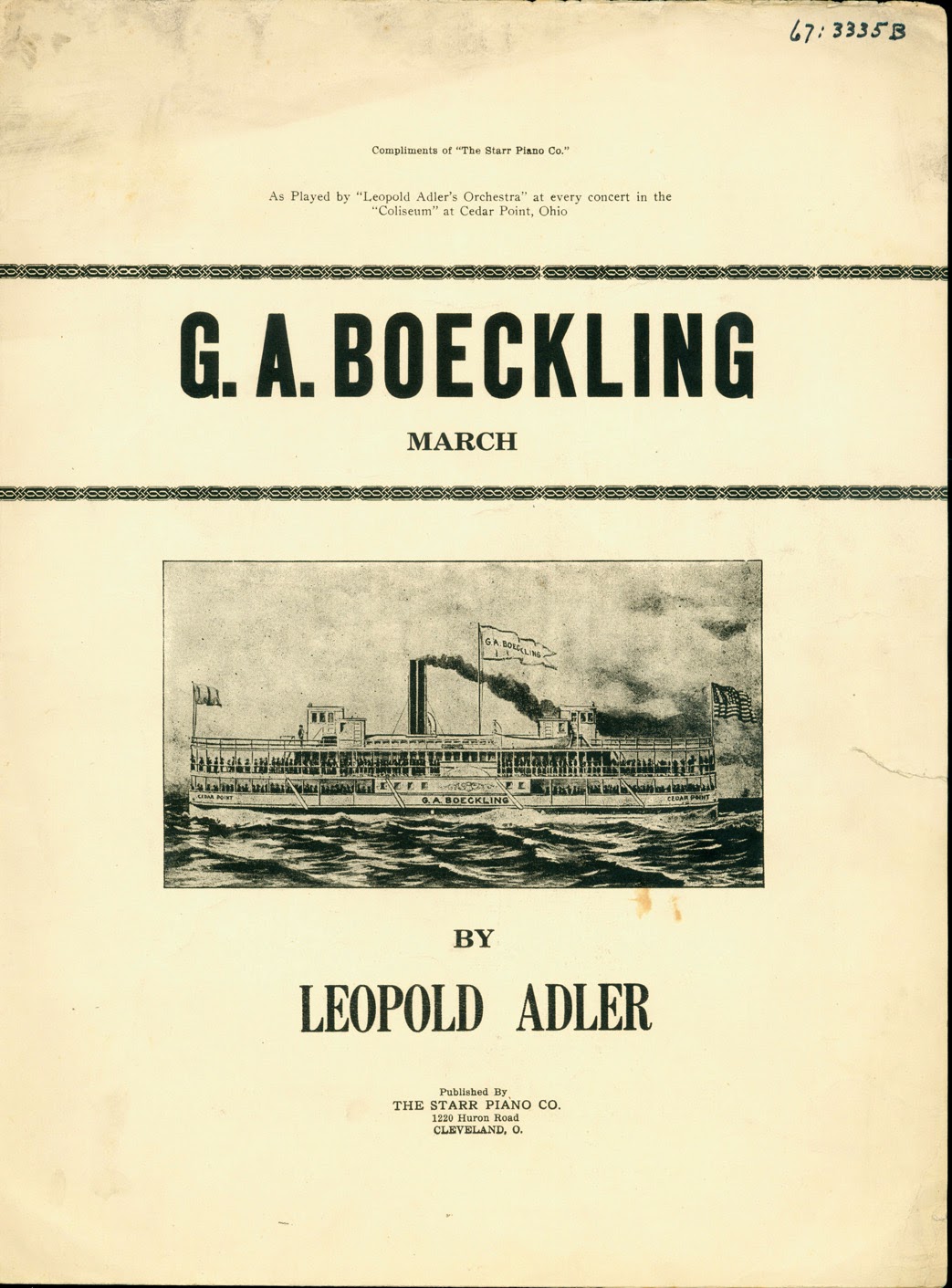
From 1914 to 1919, Leopold Adler was the popular director of the orchestra at Cedar Point. He conducted hundreds of concerts in the Coliseum.


 Leopold Adler composed the G.A. Boeckling March in 1916. The G.A. Boeckling March was played in the Coliseum at every concert directed by Leopold Adler.


During the Great Depression and World War Two, big bands performed in the Coliseum's Grand Ballroom. Bands included: Woody Herman, Blue Barron, Guy Lombardo, Benny Goodman, and Ozzie Nelson’s band.


Today several venues at Cedar Point offer live musical performances throughout the park's season. To read more about the history of Cedar Point, see the book Cedar Point: The Queen of American Watering Places, by David W. and Francis (Amusement Park Books, 1995), available at the Sandusky Library.