Showing posts with label Courts. Show all posts

Monday, September 15, 2014

Judge E.B. King


Edmund Burritt King was born on a farm in July 4, 1850 in Medina County, Ohio to Cyrus and Harriet (Bennett) King. After attending the Oberlin Academy and Baldwin-Wallace University, Edmund studied law. He was admitted to the Ohio Bar in 1873, and in 1875 he moved to Sandusky, where he practiced law for twenty years. He was associated with several attorneys at various times in Sandusky, including W.W. Bowen, S.F. Taylor, E.M. Culver, and Lynn Hull. From 1894 to 1899, Mr. King was Judge of the circuit court for the Sixth Judicial Circuit of Ohio. Judge King is pictured below with fellow circuit judges Robert S. Parker and George S. Haynes.


In 1899 Judge King returned to private practice with W.E. Guerin, and later, in a law partnership with Russell K. Ramsey. From 1880 to 1898, he was a member of the Ohio National Guard, attaining the rank of major. Judge King was a presidential elector in 1888 and was a delegate to the fourth constitutional convention of the state of Ohio in 1912. In 1916 Judge King served as president of the Ohio State Bar Association. An article in volume 62 of the Ohio Law Bulletin stated that at the thirty-eighth annual meeting of the Ohio State Bar Association, which met at Cedar Point, “Hon. E.B. King further distinguished himself as the presiding genius of the several sessions of the meeting, gracefully controlling and firmly pressing the business in hand to prompt conclusions.” 

Late in 1933, Judge King began suffering from heart problems. He passed away from heart disease on December 30, 1934. Judge King was survived by his wife, the former Edith E. Hackett, daughter Cora King Graves, and son Clifford King. Funeral services for Judge E.B. King were held at the Masonic Temple under the auspices of the Thirty-third Degree Scottish Rite Masons, as well as at the Presbyterian Church with the Rev. A.J. Funnell officiating. Burial was at Oakland Cemetery. Shortly after Judge King’s death, Judge Roy Williams stated that “it will be a long time before Erie County again has a citizen of the outstanding principles of Judge King. His predominating character was his unselfishness. There was not a movement in the community that he was not to the fore in. Sandusky has lost one of its finest friends.” You can read Judge King’s history of the early years of the Erie County Bar Association in chapter 25 of Hewson Peeke’s book  A Standard History of Erie County, Ohio (1916).

Monday, September 20, 2010

Judge James L. DeWitt

James Lloyd DeWitt was born on September 20, 1848 in Perkins Township of Erie County, Ohio to Mr. and Mrs. James DeWitt, pioneer settlers of the Firelands. (He was usually known as Lloyd DeWitt.) He attended Oberlin College, and studied law in Sandusky. In April of 1873, J.L. DeWitt was admitted to the bar. Mr. DeWitt practiced law in Sandusky, until he was elected Mayor of Sandusky and served as Mayor from 1883 to 1886. From 1887 until 1890, James L. DeWitt was the Common Pleas Judge for Erie County, Ohio.

On the afternoon of October 11, 1890, Judge J. L. DeWitt was killed while walking along the Lake Shore Railroad tracks just east of Sandusky. Some young boys saw the judge walking, and he stepped aside to avoid a freight train approaching from the west. He did not see the other train which was coming from the east. Judge DeWitt was struck by the east bound train, and died instantly. The judge’s faithful dog did not leave his side. His pocket watch was found to have stopped exactly at eight minutes to four o’clock, the accident having caused it to stop. A front page article about the tragic accident appeared on the front page of the October 12, 1890 issue of the Sandusky Register. The first paragraph read in part, “No man in the city was more generally known or better liked by people of all classes than Judge DeWitt, and the expressions of sorrow on all sides were most sincere and heartfelt.”

On the day of the funeral of Judge DeWitt, several members of the bar formed a procession and marched in a unit from the Erie County Courthouse to the DeWitt residence on Columbus Avenue, where the funeral was held. The courtroom of the Erie County Common Pleas Court was draped in mourning, as an expression of sympathy felt by the members of the bar and officials of the Courthouse. Newspaper accounts stated that funeral services were officiated by Rev. J. F. Brant of the Methodist Episcopal Church, and included several hymns. The red cedar casket was covered with broadcloth, and the plate on the casket bore his name. Burial was at Oakland Cemetery. In the proceedings of the Ohio Bar Association in 1891, E.B. King made these remarks:

Mr. DeWitt was at the time of his death a Common Pleas Judge in the first sub-division of this district, and had been holding that position for four years. He was a young man, in the prime of his life, and in the full vigor of his strength and manhood, and was regarded, both by the bar and a very large circle of acquaintances and friends, both as a citizen and as a judge, as a man of perfect, upright character, conscientious and faithful, to a fault, in the discharge of judicial duties, exceedingly careful in the decision of causes and the rendition of opinions, and popular with all classes of his fellow men. He was elected to the Bench at the age of thirty seven years, and in his forty-first year was accidentally and suddenly killed by a railroad train. No event that has happened in our community for a score of years cast the gloom over society and the public in general that the death of Judge DeWitt did, under the circumstances that it occurred.
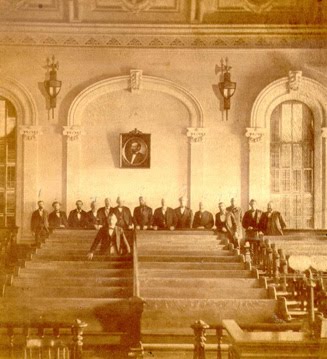
Judge J. L. DeWitt was survived by his wife and a son and daughter. Judge DeWitt is the first individual on the left in picture below. This stereographic image of the Erie County Common Pleas Courtroom was created by A.C. Platt in 1874.

Wednesday, October 29, 2008

William Griswold Lane

William Griswold Lane was born in Norwalk, Ohio in 1824 to Ebenezer Lane and Frances Griswold. When William was twelve years old he became acquainted with fellow student Rutherford B. Hayes, at the Maple Grove Academy, in Middletown, Connecticut. They became lifelong friends. William Lane attended college at Yale and Harvard, and spent a year studying law in Berlin, Germany.

After returning to the United States, William practiced law with his father. In 1850, William married Elizabeth Diodate Griswold. In February 1873 William G. Lane was appointed Judge of Common Pleas for the Fourth Judicial District.

William G. Lane died in October 1877, at the age of 52. Resolutions from the Court and Bar of Erie County appeared in the Sandusky Register. One resolution stated “In this death, the bench and bar have lost an able, impartial and upright Judge – one of the most esteemed, high minded and scholarly members of the profession – and this community a citizen of great mental and moral worth – a man just, honorable and honest in all his dealings with his fellow men and conscientious and faithful in the discharge of all the public and private duties that devolved upon him. While we mourn his loss we delight to honor his memory.”

The Lane family monument at Oakland Cemetery is a beautiful sculpture in honor of William Griswold Lane and his family. I.F. Mack wrote in an article in the June 1882 Firelands Pioneer, that Judge William G. Lane was “without doubt, the wisest counsellor we ever had at our bar.” A memorial tribute to Judge William G. Lane is on file at the library at the Rutherford B. Hayes Presidential Center in Fremont, Ohio.

A view below of the Lane Family monument at Oakland Cemetery in Sandusky, Ohio. Several family members’ names are inscribed on the stone.

Tuesday, October 14, 2008

Ulysses Thompson Curran, Educator and Judge, and His Son Charles, Artist

Ulysses Thompson Curran was the superintendent of the public schools in Sandusky from 1872 through 1880. After leaving the field of education, U. T. Curran practiced law in Sandusky. He served as Erie County Common Pleas Judge in the Probate Division, from 1899 to 1905. He was a lifetime member of the National Education Association.
Under Mr. Curran’s leadership, the “Sandusky Training School” was founded in 1874. New teachers were mentored by more experienced teachers to prepare them for their profession. Miss Mary Alice Chenoweth was the lead teacher at the training school. Mary Alice later changed her name to Helen Hamilton Gardener. She was a suffragist leader, an author, and was appointed to the U.S. Civil Service Commission by President Woodrow Wilson in 1920. (She willed her brain to Cornell University for medical research.)

On February 28, 1914, Ulysses Thompson Curran died at the home of his son Charles Courtney Curran in New York City. Charles Courtney Curran graduated from Sandusky High School in 1879. After high school, Charles Curran attended the Cincinnati School of Design, and later the Art Students’ League, and the National of Academy of Design in New York City. In 1888, he won the Academy’s Hallgarten Prize for his painting, A Breezy Day. Also in 1888, Charles Courtney Curran married Grace Winthrop Wickham, daughter of Huron County Judge Charles Preston Wickham.

After his marriage, Charles Curran studied art in Paris, where he developed his impressionistic style. Three works by Charles Courtney Curran can be seen at the Follett House Museum, including Laurel Among the Rocks, pictured below.

Charles Courtney Curran painted a portrait of his father, which is also on display at the Follett House Museum. Local author Patty Pascoe wrote about both U. T. Curran and Charles Courtney Curran in the book, Elected to Serve, available from the Sandusky Library.