Showing posts with label Kuebeler. Show all posts

Friday, October 28, 2022

The Twin Homes of the Kuebeler Brothers


The homes of August and Jacob Kuebeler were pictured in the 1894 publication, Art Work of Huron and Erie Counties. Built in 1885, the residence of August Kuebeler was at 1319 Tiffin Avenue, and is still standing. Jacob Kuebeler had an almost identical home built across the street at 1318 Tiffin Avenue. It no longer stands. Dick’s Carry Out is now at this location.

You can see the location of the Kuebeler brothers’ homes in an early 20th century Sanborn Insurance Map:

The Kuebeler homes are in pink, roughly facing each other

Before 1915, the addresses were 909 and 910 Tiffin Avenue. The former Kuebeler homes were built in the Eastlake architectural style. Each home was three stories high, constructed from brick, with decorative trim around the windows.

The brothers were prominent in the brewing industry in Sandusky, Ohio. The Kuebeler brewery was established in 1867.

The Kuebeler brewing plant was on Tiffin Avenue near Broadway on Sandusky’s west side. (You can see the proximity of the plant to the men's homes in the map above.) It was built in 1893 after the previous plant had been destroyed by fire. In 1896 the Kuebeler and Stang breweries merged. Two years later the Kuebeler-Stang brewery became part of the Cleveland Sandusky Brewing Company. Most of the Sandusky breweries closed during Prohibition, but one of the former Kuebeler-Stang plants manufactured soft drinks into the mid 1930s.

For several years the former home of August Kuebeler housed the Erie County Detention facility. Longtime city commissioner George Mylander was a direct descendant of Jacob Kuebeler.

Thursday, April 15, 2021

Small Appliances Made in Sandusky


From about 1929 through 1934, the Made Rite Manufacturing Company was in business in Sandusky at the southwest corner of Shelby and Water Streets. The pie sealer, pictured above, prevented the pie filling from spilling out of the crust and making a gooey mess in the oven. 

The Made Rite electric toaster from the 1930s looks a lot different than the toasters we use now:


Other products made by the company included waffle irons, mixers, and a unique incubator in which the chicks could regulate the temperature by themselves. An article in the April 13, 1934 issue of the Sandusky Star Journal featured an advertisement from the M.R. Herb Company where parents were urged to bring their children in to the store to see the live baby chicks housed in Made Rite chick-o-matic incubators. 

From 1932 to 1934, the officers of the Made Rite Manufacturing were George C. Hill, president; Norbert J. Kuebeler, vice- president; and Arthur Cronenberger, secretary. Ultimately, the company was acquired by the Weinig Products Company, and eventually all operations in Sandusky ceased. The Follett House Museum is home to several locally made products. Visit the museum to see clothing, household items, furniture, photographs, and many other historical items from Sandusky and Erie County.

Sunday, January 05, 2020

Men of Sandusky


In 1895, a booklet promoting Sandusky was printed by the I. F. Mack & Brother Printers in Sandusky, Ohio. On page 3 is the beginning of an introductory essay by C. S. Van Tassel, the publisher of this book. According to Ohio Authors and Their Books, Charles Sumner Van Tassel was born in Wood County, Ohio in 1858, and worked at several Ohio newspapers, including the Sandusky Register, before he retired from the field of journalism to focus on writing books on local history.


Men of Sandusky begins with a brief history of the city of Sandusky. Photographs taken by Platt feature scenes of Sandusky, including city parks, churches, schools, and government offices. Several pages of the booklet are devoted to the businesses, newspapers, and transportation services of the Sandusky area. Pages 17 through 21 focus on the Ohio Soldiers and Sailors Home, now known as the Ohio Veterans Home. On page 15, General Sheridan is quoted as saying “Sandusky ought to be made the most beautiful city on the Lakes….”

Forty nine leading male citizens are pictured in the second half of Men of Sandusky. Jacob Kuebeler and John E. Stang were both connected with local brewing businesses.


I.F. and John T. Mack were the co-owners of the Sandusky Register


An index (pp. 57-59) to the men pictured in Men of Sandusky gives a very brief description of the prominent Sandusky men whose portraits appear in the booklet.

Visit the Archives Research Center of the Sandusky Library to view Men of Sandusky.

Saturday, August 24, 2019

“Ye Oak Meadow” Farm and Gun Club


Between 1907 and 1919, Mr. and Mrs. Ira C. Krupp lived on South Hayes Avenue, on the property formerly owned by the Palmerton family. (Ira Krupp’s mother Ida Palmerton Krupp was the daughter of J. E. Palmerton.)  The Palmerton property in 1896 is pictured below:


Ira C. Krupp, son of local undertaker Charles J. Krupp, operated a dairy farm at this location in the 1910’s. 

In June of 1911 Ira Krupp was a founding member of  “Ye Oak Meadow Gun Club,” which was organized at the Sunyendeand Club. The officers were: August Kuebeler, President; Lea Marsh, Vice President; W.A. Magoon, Secretary; Dr. J. K. Douglass, Treasurer; Ira Krupp, Manager; and Dr. J. D. Parker, Captain. According to the June 6, 1911 Sandusky Register the membership was made up of the best trap shooters in Erie County. Roy Parker, also known as Leroy Parker, had the high score at the regular shoot at the Gun Club on August 26, 1911.  He was an Erie County Commissioner from 1920 through 1924. 


C. Webb Sadler was also a member of  the club.


He was the grandson of Judge E. B. Sadler, and was associated with many other area clubs, including the Blue Hole, Castalia Farms, and the Rockwell Trout Club. According to Helen Hansen’s At Home in Early Sandusky, C. Webb Sadler was the driving force behind the development of Battery Park. 

A large turkey shoot was held in November 1911. By this time the grounds included a club house and a firing range. Mrs. Ira Krupp, the former Emeline Moss, was hostess for a bridge party and luncheon in December 1911.Around 1919 news articles about Ye Oak Meadow Gun Club ceased, and in the 1920’s  Mr. and Mrs. Krupp moved to Connecticut. While they were in Erie County, however, they were very active in the social and agricultural circles of the area.

Sunday, April 15, 2018

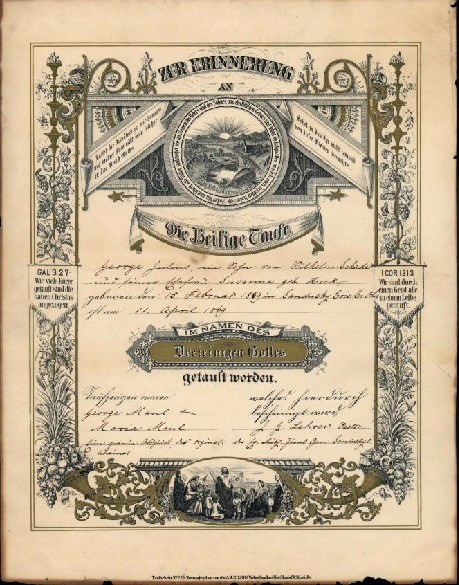
Baptismal Certificate of George Schade


A baptismal record for George Julius Schade is in the collections of the Sandusky Library Archives Research Center. George J. Schade was born on February 15, 1869, in Sandusky. His parents were Wilhelm (later known as William) Schade and Susanna Heck Schade. Rev. J.G. Lehrer, pastor of Zion Lutheran Church officiated at the baptism, which took place on April 11, 1869. The baptismal sponsors were George and Maria Maul. All the words on this baptismal record are in German. Bible verses from Galatians and I Corinthians are found on either side of the document, which is decorated with intricate engravings.  

The life of George J. Schade is well documented at the Sandusky Library. This carte de visite shows him as a young man.
   

From the early 1900s to 1921, George J. Schade was the manager of the Schade Coal Company, located at 810 West Water Street, across from the Big Four Depot. At the time of his death in 1937 he had served longer on the Sandusky City Commission than any other person. Mr. Schade had been a pharmacist, and owned the Schade Theater.  Page 40 of the 1937 Obituary Notebook features a lengthy obituary which had been clipped from a local newspaper.

            
George J. Schade was married to Anna Schade, the daughter of pioneer brewer Jacob Kuebeler. He was the grandfather of George L. Mylander, who went on to serve his community as a well-respected educator, philanthropist and civic leader. They are buried in the family mausoleum at Sandusky’s Oakland Cemetery.


When you look closely at the door to the Schade-Mylander Mausoleum, you can learn a bit of family history of several members of the Schade and Mylander families.


Friday, December 09, 2016

Products Sold by the Cleveland and Sandusky Brewing Company


According to this advertisement, which appeared in the December 18, 1906 issue of the Sandusky Register, several types of beer could be delivered to Sandusky homes in 1906. Two dozen pints of C & S Special beer sold for $1.25. A case of Hof-Brau beer also sold for $1.25. A case of Crystal Rock or Amber beer sold for $1.00. 

The Stang Brewery on King Street
From about 1898 until Prohibition, the Kuebeler-Stang plants of the Cleveland and Sandusky Brewing Company distributed beer locally. In the 1904-1905 Sandusky City Directory listed Jacob Kuebeler as the first vice president and general manager of the local plants, while John E. Stang served as the assistant manager. The general office of the company was on the east side of Tiffin Avenue, near the Lake Shore and Michigan Southern railroad. The branch office was on the east side of King Street, north of Madison Street.


Frank Stang started the Stang Brewing Company in 1880. His younger brother John Stang took over as president in 1890. Pictures of John Stang and Jacob Kuebeler appear in the 1895 publication, Men of Sandusky.

Jacob and August Kuebeler founded the Kuebeler Brewing Company in 1867. Around 1885 the Kuebeler brothers both built virtually identical large brick homes on Tiffin Avenue. Mr. and Mrs. Jacob Kuebeler lived at 1318 Tiffin Avenue. (This home no longer stands.) The August Kuebeler residence was built at 1319 Tiffin Avenue, and is still standing today.

The Kuebeler & Stang Breweries merged in 1896.  Two years later the Kuebeler-Stang Breweries merged with Cleveland breweries to form the Cleveland and Sandusky Brewing Company. Many breweries closed during Prohibition, but the Stang plant continued doing business as Crystal Rock Products Company, selling soft drinks. The picture below shows a float sponsored by the Kuebeler Stang Brewing Company in the late 1800s.

To read more about the Kuebeler and Stang Brewing Companies and other brewing companies, see the book, Brewing Beer in the Buckeye State, by Dr. Robert A. Musson, available for loan through the CLEVNET system.

Thursday, March 17, 2016

Lucile Dehnel Burch


Lucile Dehnel was born on July 14, 1895, to William Dehnel and Annette Kuebeler Dehnel. William Dehnel was a jeweler in Sandusky, and Annette was the only daughter of Mr. and Mrs. August Kuebeler. Mr. Kuebeler was active in the brewery business in Sandusky with his brother Jacob.  In 1900, Lucile was listed in U.S. Census records as residing in the Kuebeler mansion on Tiffin Avenue, with her parents and maternal grandparents.


On June 26, 1909, Lucile was chosen to christen the G.A. Boeckling with a bottle of Hommel Champagne. She is seen below, beside George A. Boeckling, the namesake of the ship.

  
In early September of 1922, Lucile Dehnel married Albert C. Burch. The wedding took place at the Dehnel home on the Cedar Point Chaussee, officiated by Rev. E.G. Mapes of Cleveland. Lucile’s attendants were her close friends, Mrs. C.W. Hord and Mrs. Albert H. Uhl. A lengthy article about the wedding appeared in the society pages of the Sandusky Star Journal of September 2, 1922.


Below is a picture in which Lucile is surrounded by family and friends on her wedding day. Several other pictures from the Dehnel-Burch wedding are housed in the biographical collection of the Sandusky Library Archives Research Center.


Lucile’s husband, Albert C. Burch, died in 1948. Lucile did not remarry after her husband’s death.  She passed away on June 4, 1979, at the age of 83. She had lived a full life, having helped in the management of the Dehnel Jewelry Store, and she had been an active member of Grace Episcopal Church and several community organizations. 

Friday, January 15, 2016

George Mylander: Rooted in (and for) Sandusky

On January 3, 2015, Sandusky lost a well-respected community leader, George L. Mylander.  Mr. Mylander came from a long line of civic-minded individuals in his own family tree. His great grandfather was Jacob Kuebeler, who along with his brother August Kuebeler, was a pioneer in the brewing industry in Sandusky.


 Mr. Mylander's maternal grandfather was George J. Schade, a Sandusky businessman who was a pharmacist, and then manager of a coal business, before he opened and managed the Schade Theater on West Market Street in Sandusky. Mr. Schade served several terms on the Sandusky City Commission, and was Mayor of Sandusky from 1934 to 1936.


Dr. Lester Mylander, his father, was founder of the former Sandusky Memorial Hospital. These families are the namesakes for the Schade-Mylander Plaza, which is a focal point of many activities in downtown Sandusky. 

Mr. Mylander is pictured below, when he was ex-officio Mayor, at a rededication ceremony for the Sandusky City Building in 1983. 


George L. Mylander was a teacher and administrator in the Sandusky City Schools for 27 years. He served four terms on the Sandusky City Commission, and was ex-officio Mayor of Sandusky from 1980 to 1985. He was a former director of the Citizens Banking Company, and served on the Board of Directors of the Firelands Regional Medical Center and the Bowling Green State University Foundation Board. In 2003, he donated two million dollars to the B.G.S.U. Foundation, and recently he donated one million dollars to BGSU Firelands in support of the Allied Health and Sciences Project. BGSU Firelands changed the name of its West Building to George Mylander Hall in honor of Mr. Mylander’s generous contributions to the  college.  Mr. Mylander's final resting place is at the Schade Mylander Mausoleum in Oakland Cemetery.


Wednesday, March 26, 2014

George Schade’s Runabout Automobile


George Schade’s Runabout automobile is pictured above, in front of the Kuebeler-Schade home on Tiffin Avenue in the very early 1900s. The Runabout was manufactured by the Sandusky Automobile Company. The Courier was another model made in Sandusky.


A longtime city commissioner in Sandusky, George Schade was one of the first automobile owners in Sandusky. Mr. Schade was the husband of Anna Kuebeler, daughter of  Jacob Kuebeler, a pioneer in the brewing industry.


The Sandusky Automobile Company, founded by James J. Hinde, was only in business for a few years in the first decade of the twentieth century. To read more about the early automobile age in Sandusky, see chapter 18 of the book Sandusky's  Yesterdays, by Charles E. Frohman.

Wednesday, November 20, 2013

The Kuebeler and Stang Breweries

The production of beer was a major industry in nineteenth century Sandusky, with the Kuebeler and Stang families among the most successful brewers. In 1880 the Stang Brewery was founded from an earlier brewery that had first been operated by Phillip Dauch and Andrew Fischer. The Stang Brewing Company was located at the corner of Madison and King Streets. (Shown here in 1940, long after the plant was closed.)

Frank Stang started the Stang Brewing Company. His younger brother John Stang took over as president in 1890. Pictures of John Stang and Jacob Kuebeler appear in the 1895 publication, Men of Sandusky.


Jacob and August Kuebeler founded the Kuebeler Brewing Company in 1867. About 1885 the Kuebeler brothers both built virtually identical large brick homes on Tiffin Avenue. Mr. and Mrs. Jacob Kuebeler lived at 1318 Tiffin Avenue. (This home no longer stands.) The August Kuebeler residence was built at 1319 Tiffin Avenue, and is still standing today.


The Kuebeler Brewing Company was on Tiffin Avenue.

 The Kuebeler & Stang Breweries merged in 1896.  Two years later the Kuebeler-Stang Breweries merged with Cleveland breweries to form the Cleveland and Sandusky Brewing Company. Many breweries closed during Prohibition, but the Stang plant continued doing business as Crystal Rock Products Company, selling soft drinks. The picture below shows a float sponsored by the Kuebeler Stang Brewing Company in the late 1800s.


To read more about the Kuebeler and Stang Brewing Companies and other brewing companies, see the book, Brewing Beer in the Buckeye State, by Dr. Robert A. Musson, available for loan through the ClevNet system.

Monday, September 17, 2012

Marriage of Annette Kuebeler and William Dehnel


On September 18, 1894, the only daughter of Mr. and Mrs. August Kuebeler, Annette, married William Dehnel, the son of Sandusky jeweler Henry Dehnel.


An undated Sandusky Register article on file in the biographical files of the Sandusky Library Archives Research Center, reported that the couple was married at the Tiffin Avenue home of Mr. and Mrs. August Kuebeler. August Kuebeler and his brother Jacob Kuebeler were associated with the Kuebeler Brewing and Malting Company. The Kuebeler brewery was one of the largest businesses in the city, and later became part of the Cleveland and Sandusky Brewing Company.


August and Jacob Kuebeler built identical homes on Tiffin Avenue. (You can see one of the homes in the image above.) The August Kuebeler home, now privately owned, still stands at 1319 Tiffin Avenue.

The wedding was officiated by the Rev. A. H. Dornbirer. The ceremony took place “in the presence of the immediate families of the high contracting parties.” After the ceremony, the newlyweds took a trip to New York City and Niagara Falls. The article about the Kuebeler-Dehnel marriage concluded with, “Mr. William A. Dehnel is a highly respected young business man, and his bride is a young lady whose excellent personal qualities have endeared her to a host of friends, all of whom will extend hearty wishes for the future welfare of the newly married couple.

William A. Dehnel passed away at his home at 1319 Tiffin Avenue on November 22, 1931. His funeral was held at his home on November 24, 1931, and burial was at Oakland Cemetery.  Mrs. Annette Dehnel died on June 19, 1952, and she was buried in Oakland Cemetery. At the time of her death in 1952, Mrs. Annette Kuebeler Dehnel had been residing with her daughter Lucile Dehnel Burch.

Tuesday, May 20, 2008

The Western Liberties

The “Western Liberties” was a section of lots in Erie County west of and adjoining the Sandusky tract (the original section of the city, what is now the downtown area), created in 1836. Mills Street was the western boundary of the Western Liberties and Camp Street was the eastern boundary. The Mad River and Lake Railroad’s engine house and shops were located in the northern section of the Western Liberties. It is not clear why this region was called the Western Liberties, but a possibility is that it was adapted from the name used by William Penn for land outside of the city of Philadelphia. (Certain tracts of land were called "the liberty land or free lots," because these lots were given free of charge to first purchasers of land in the colony. Whether this policy was followed in the Sandusky Liberties is unknown.) At the time of its creation, the Western Liberties were at the western edge of the city.

Early settlers in this portion of the city were predominantly immigrants, particularly Germans and Irish. The lots and houses were generally smaller than in other parts of the city, and thus more likely to attract those making a new beginning in a new land. An 1855 article in the Daily Commercial Register described the region as a "busy, thriving town, composed chiefly of a foreign population," and predicted continued growth from German and Irish immigration.

The first Catholic Church in Sandusky, Holy Angels Church, was established in the Western Liberties, drawing many of its parishioners from this immigrant population. Father Joseph Machebeuf (who was the inspiration for the title character in the Willa Cather novel, Death Comes for the Archbishop) was the priest when the first church building was completed in 1845. The Catholic cemeteries of Sandusky, at Mills and Seneca Streets, are near the southern boundary of the Western Liberties.

During the cholera epidemic of 1849, the August 3, 1849 issue of the Daily Sanduskian reported that a temporary orphan asylum was established in a frame cottage in the Western Liberties, near the Catholic Church. Contributions of money, bedding, and provisions were accepted by John M. Brown, F.M. Follett, F.T. Barney, Rev. Goesbriard, and David Souter.

By the 1890s August and Jacob Kuebeler had established the Kuebeler Brewing Company on Tiffin Avenue. Though the brewery is no longer in existence, the former home of August Kuebeler is still standing at 1319 Tiffin Avenue, located directly across the street from the spot where the brewery once stood. (A similar house, owned by his brother Jacob Kuebeler, was across the street.)
Two historical atlases of Erie County are housed in the Archives Research Center of the Sandusky Library, dating from 1874 and 1896. By browsing through these atlases, you can see how drastically Erie County has changed though time. Churches, businesses, government offices, and information about early area residents are all documented in the Erie County historical atlases.