Showing posts with label Cholera. Show all posts

Monday, July 24, 2023

Nearly All of the Loeffler Family Died in the 1849 Cholera

St. Joseph's Cemetery, Sandusky

According to the book, Sandusky Then and Now, in the course of a few days, John Loeffler, his wife Catherine, and four children all died from cholera in the summer of 1849. The only member of the family to survive was the youngest child, Johannes/John Loeffler, Local residents took the young child in, and the younger John Loeffler lived in Sandusky until his death in 1928 at age 82. He never married, and he worked as a gardener, tending to gardens and lawns all over Sandusky.

The elder John Loeffler came from Rentheim, Baden, Germany to Sandusky in 1835. He married Catherine that same year. Eventually, he ran a tailoring business, in conjunction with a tavern and grocery store at the corner of Fulton and Market Streets. John Loeffler was the first in the family to die from cholera, on July 24, 1849. On July 26, Catherine, Frank and George died. The last child to die was Conrad, who passed away on July 28, 1849.

John Loeffler, the young child who survived the deadly epidemic, made a career as a caretaker of lawns and gardens, and was buried at St. Mary’s Cemetery in Sandusky in 1928.

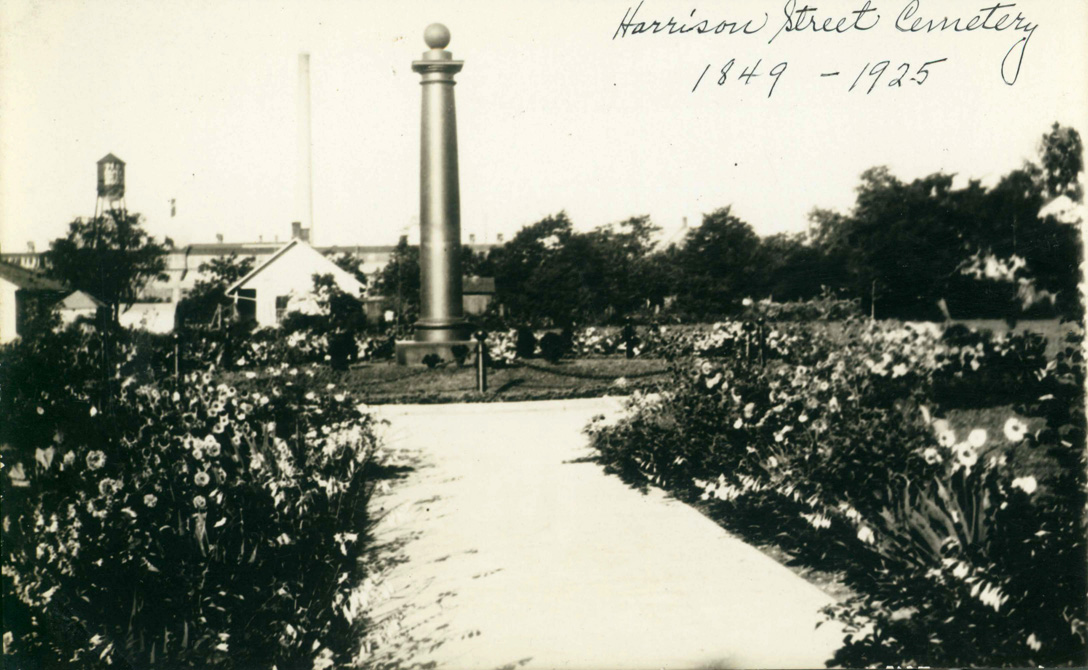
Though no stones have been located, St. Joseph’s Cemetery records list all six members of the Loeffler family as having been buried in Section B at St. Joseph’s Cemetery. A total of 357 persons died from cholera in 1849, and smaller epidemics took place in 1852 and 1854. While many have tombstones at Oakland Cemetery and St. Joseph’s Cemetery, most victims were laid to rest at the Cholera Cemetery on Harrison Street. An historical marker was placed at the Cholera Cemetery in 1966.

You can read more about the cholera epidemic in Sandusky in Hewson Peeke’s book, A Standard History of Erie County, Ohio (Lewis Pub. Co., 1916.)

Saturday, March 26, 2022

Alonzo W. and Jane Hendry


According to the book History of Erie County, Ohio, edited by Lewis Cass Aldrich (Mason & Co., 1889), Alonzo W. Hendry was born in Erie County, New York. He moved to Lorain County, Ohio in 1834, and he was admitted to the bar in 1842. Mr. Hendry moved to Sandusky in 1843. He married Jane Penfield in Lorain County on August 4, 1848. Jane Penfield had been born in Penfield Township of Lorain County. The township was named for her father’s family, who had been early settlers there. She was a graduate of the Ladies Course of the Oberlin Collegiate Institute in 1847. 

Alonzo Hendry was vehemently opposed to slavery. In an article in the abolitionist newspaper, the Michigan Liberty Press, on April 21, 1848, Alonzo W. Hendry was on a committee that prepared several proclamations relating to keeping “free soil.”  The second resolution read in part:

“As free sons of a free soil and a free Government, we make the cause our own, and in the majesty and strength of justice, of truth, and right, proclaim to the world our unalterable opposition to extending the blighting curse of slavery over one foot of soil now free.”

In 1878, Mr. Hendry published an article in the Firelands Pioneer about the settlement of "Africa," on the edge of Sandusky, where free African Americans resided in the 1830s and 1840s (before the advent of the Fugitive Slave Act). 

A.W. Hendry’s name appeared in the listings of attorneys in Sandusky in the Daily Sanduskian of October 27, 1849. His office was in the upper level of the West block in downtown Sandusky.

The first child born to Mr. and Mrs. Hendry was a daughter, Maria, who was born on July 11, 1849, while Sandusky was in the midst of a deadly cholera epidemic. They had a total of seven children, including a set of twins. 

Alonzo’s recollections of Sandusky during the cholera epidemic of 1849 appeared in Hewson Peeke’s History of Erie County, Ohio (Lewis, 1916), in the chapter, “The Three Cholera Years.”  His description of Sandusky at that time read:

 "The railroad connection between Sandusky and Cincinnati had just been completed and the large amount of travel and traffic over its line was unprecedented in the West.  Large shops, docks and warehouses at Sandusky became a necessity, laborers with their families were crowded into small buildings with insufficient accommodations and it often happened that several families would occupy a small building hardly sufficient in size for one.  Temporary cabins and boarding houses were hastily erected and soon crowded to overflowing.  When the visitation of cholera came the city was wholly unprepared.  There were no hospital accommodations and the force of local physicians was wholly insufficient for the emergency.  Hospitals had to be improvised and physicians like the good Samaritan of old came in from the neighboring cities.  The first death from the cholera was Mrs. Allen, July second.  Three prominent ministers of the gospel passed away - Rev. N. W. Fisher, pastor of the Congregational Church; Rev. H. P. Ward, of the Methodist Church and Rev. T. C. Cooper in charge of the Bethel Church.  They are buried side by side in Oakland Cemetery near the city.  A single marble shaft bearing the names of each was erected by kind friends as a monument to mark their last resting place.  The cholera again visited Sandusky in 1852 and 1854 but in a mild form compared with 1849."

From 1848 to 1852, Mr. Hendry served as the Erie County Prosecuting Attorney. He served as Erie County Probate Judge from 1863 to 1869. After the death of his wife in 1881, he moved to Shawnee, Oklahoma. 

Alonzo W. Hendry died in Oklahoma on April 15, 1901. His remains were returned to Sandusky, for burial in Sandusky’s Oakland Cemetery. An obituary for Mr. Hendry, which appeared in the April 19, 1901 issue of the Sandusky Star reported that he had been a “prominent and highly respected resident of Sandusky.”  To read more about former Judge Hendry and many other of Erie County’s elected officials, see the book, Elected to Serve, by Patty Pascoe.

Monday, September 06, 2021

A Love Letter to Dr. Lauderdale


A letter and envelope once intended for Dr. Edward Lauderdale is now in the historical files of the Sandusky Library Archives Research Center.


Here is a transcription of the letter:

Gretna Green

My Dear Sir,

I sigh for thee, I sigh for thee,

And oh you may depend on me –

I’ll weep for thee, I’ll die for thee;

And that will be the end of me.

Long has this tender feeling dissolved my heart. Long have I sighed to call thee mine – can tears avail? Our ingon patch is broad and long – Can sweetness touch thy heart? Our lasses tub is deep and full -Have soft petitions power to move? Come to the mush pot on our stove.

And if with these I now can charm thee,

Come quickly with thy love to arm me –

That I may conquer every foe,

And call thee mine, while winds do blow.

Molly Sweet


Though Dr. Lauderdale never married, it appears that long ago a young lady was quite fond of him. The letter was from someone who called herself Molly Sweet, from Gretna Green. Learning more about Gretna Green and its symbolism, we have to wonder if there was a cryptic message that goes deeper than a simple love letter: the original Gretna Green is a location in Scotland along the border with England, where English couples would go to get secretly married to avoid certain restrictions in England (e.g., age limits, parental consent). "Gretna Green" eventually became adopted as a slang term for any location that allowed marriages for non-residents. Of course, "Molly Sweet" (if that was her real name) could have been writing from Scotland, but is that likely? We actually do not know if the letter was ever delivered, or what Molly's true motives were. 

Dr. Edward Lauderdale was a physician who became noted for caring for Sandusky patients who were stricken with cholera during the epidemic of 1849. Dr. Lauderdale’s office was in the old Post Office. In 1850 Dr. Lauderdale moved to Detroit, Michigan, and served as Detroit’s city physician, Wayne County Coroner, and later as Assistant Surgeon in the 24th Michigan Infantry during the Civil War. Dr. Lauderdale died in Pontiac, Michigan in 1883, and he was buried in the family lot in Temple Hill Cemetery in Livingston County, New York. 

Dr. Lauderdale’s name is included on the historic marker at the Cholera Cemetery which lists the names of the doctors who helped Sandusky residents during the dreaded cholera epidemic of 1849.

Thursday, May 06, 2021

Cholera Cemetery Headstones


Have you ever wondered why there are only three headstones in the Cholera Cemetery? It has been something that has bothered me since my first visit to that cemetery. In preparation for an upcoming program, I decided to dig into this question, and the real answer was strange and just raised more questions. Just as a refresher, the largest outbreak of cholera here in Sandusky was 1849. All of those who died, 382 people, were buried in what is now called the cholera cemetery. This cemetery did exist before the outbreak, but after the cholera epidemic it was mainly thought of as the cholera cemetery. Shortly after the outbreak was over, the cemetery was abandoned, and Oakland Cemetery became the new city cemetery. Once Oakland Cemetery was opened, the cholera cemetery fell into disrepair and was not maintained.  

Now, fast-forward to December of 1893. The Sandusky Register runs an article about the Cholera Cemetery. It states that the headstones are stacked in the corners of the cemetery and the cemetery itself has been plowed for planting crops, and pigs may have been butchered in one corner. This caused an uproar in the community. The Sandusky City Council formed a committee to investigate what happened. In less than a month this special committee reports to the City Council. They find that the head of the Cemetery Committee, Voltaire Scott, paid a Peter Cann to move all the headstones from the Cholera Cemetery to Oakland Cemetery. Cann was paid $25.00 to move the headstones (about $733 today). It seems that Scott asked each member of the Cemetery Committee if they would agree to having the headstones moved to Oakland Cemetery. While each member of the committee did agree to this, there was never a formal vote at either a Cemetery Committee Meeting or a City Council meeting. It also seems that Scott never checked to see if the headstones were moved. This resulted in the stacked headstones as described in the Register article. Scott, after only consulting with one committee member, leased out the land to be farmed by a local farmer. It is interesting to note that Scott was invited to be interviewed as part of the special committee’s investigation to this but decided not to show up.


Once all of this comes out, the City Council decides to act! First, they hold a vote that the headstones should be replaced in the cemetery at the expense 
of Voltaire Scott. This vote fails by a small margin. There is never another vote to move the headstones back to the Cholera Cemetery. Next, a motion is made to impeach Scott since all his actions were done without authority by the City Council and made those acts illegal. This motion is tabled to be brought up another time but as far as my research goes, Scott was never impeached or punished for his actions in anyway. Finally, the City Council votes to build a fence around the cemetery and put up a monument to honor those who died during the first cholera outbreak. This project will be funded by selling off land that is technically part of the Cholera Cemetery. I can find no record of the city ever selling land that was connected to the cemetery. An iron fence was built sometime before 1924 but I was unable to find out when that fence was built. The current monument in the cemetery was built in 1924 and funded by private donations.  


Of course, none of these answers the question where are the headstones from the cemetery? The short answer is, who knows! I was able to track down about a dozen of the headstones that are now in Oakland Cemetery. The rest are, unfortunately, lost to history. There may be something in the old legend that they were broken up and used in paving projects around town. Sandusky was doing some major road work in 1894 and those headstones would make good gravel. It also raises the question, where did the three headstones that are currently in the Cholera Cemetery come from. Are they originals that made their way back into the cemetery or were they put there later? If they are the original, how did they get back in the cemetery? If put in later, then who put them there? As I said in the beginning, the story of the missing headstones is strange and raises many more questions that will probably never be answered. 

Saturday, August 01, 2020

Rice Harper, Erie County Clerk of Courts


Rice Harper was born 1803 in Lake County, Ohio to John and Loraine (Miner) Rice. After studying law in the office of Wheeler and McClurg, he was admitted to the bar in 1827. He left the legal field due to health problems, and for a time he worked in the mercantile business. Mr. Harper was one of the original incorporators of the Ohio Railroad, a predecessor or the Lake Shore and Michigan Southern Railway. In about 1838, he moved with his wife, the former Susannah Montgomery, to Sandusky, Ohio.


Mr. Harper served as Erie County Clerk of Courts from 1839 to 1855. During his term of office, a cholera epidemic hit Sandusky. Oakland Cemetery opened shortly after the last major outbreak, and a monument was placed in the cemetery to honor three local ministers who died in the cholera of 1849; it was erected on the Rice Harper family lot. Most likely, Mr. Harper was among the members of the local Civic Committee who raised funds to provide a fitting monument to the three ministers: Rev. N.W. Fisher of the Congregational Church, Rev. H.P. Ward of the Methodist Church, and Rev. H.P. Ward, of the old Bethel Church.


During his years in Sandusky, Rice Harper fought vigorously for improvements in the city parks. At one time, the park in downtown Sandusky was an open space that allowed for people and animals to walk freely through the park. Mr. Harper pushed for the placement of post and rail fences to be placed around the park squares on each side of Columbus Avenue, that were later replaced by picket fences. The park squares stayed enclosed until 1875, when horses, cattle and other livestock were prohibited from running at large in the city, and the fences were removed. The beautiful park system in downtown Sandusky as we know it today, was helped immensely by Rice Harper’s leadership in the nineteenth century.


Mr. Harper was a member of Grace Church since 1839, and he served as a church warden for several years. Along with William G. Lane, he was instrumental in organizing the former Good Samaritan Hospital.

Rice Harper died from pneumonia on February 19, 1891. A lengthy obituary that appeared in the February 20, 1891 issue of the Sandusky Register read in part, “Mr. Harper was one of Sandusky’s most active citizens, serving in various official capacities and always taking a leading part in public affairs. He was one of those self-made men who laid sure the foundations of character and built well the superstructure of the intelligent honorable citizen.” Funeral services for Rice Harper were held at the family residence, and burial was at Oakland Cemetery. He was survived by his wife and a daughter.

Wednesday, May 20, 2020

Mrs. Erastus Cooke


Fannie Anderson, born in New York in 1807, was the sister of pioneer Sandusky physician Dr. George Anderson. On November 1, 1826, she married Erastus Cooke; they had three children, James, George and Emma. 

By 1829 the Erastus Cooke family was residing in Sandusky, Ohio; Mr. Cooke served as Sandusky’s postmaster from 1836-1841. During the cholera epidemic of 1849, Mr. Cooke died of the dreaded disease (the same illness that had earlier killed her brother, Dr. Anderson), leaving Fannie a widow with three children. Shortly after Mr. Cooke died, both of Fannie’s sons became sick with cholera, but they both survived. 

According to an undated newspaper clipping, Mrs. Fannie Anderson moved from Sandusky to Fremont in 1869. Later she moved to Saginaw, Michigan, where she resided with her daughter Mrs. William H. Mills. In 1892, Fannie Anderson Cooke passed away in Saginaw, Michigan at the home of her daughter. Her remains were brought back to Sandusky, where she was buried in Block 61 of Oakland Cemetery. An undated Memorial said about Mrs. Cooke, in part, “She was identified with every good work: well may they say: She stretcheth out her hand to the poor. Yes, she reacheth forth her hand to the needy. Through many trials she came out triumphant.”