Showing posts with label Washington Park. Show all posts

Friday, July 02, 2021

Postcards of Downtown Sandusky in the 1950s


Above is a postcard from the Rich-Holt Company created in the 1950s. The view is looking north on Columbus Avenue towards Sandusky Bay.  At that time State Route 12 was routed to the city of Sandusky, but now the eastern terminus of State Route 12 is at State Route 53 in Sandusky County. You can see the signs for the Lasalle’s store, J.C. Penney and the Manhattan Clothing Co. The State Theatre is barely visible in the distance, on the 100 block of Columbus Avenue. Note the classic red and blue mailbox on the corner of Washington Row and Columbus Avenue, next to the Western Security Bank. 

In the Rich-Holt postcard below, the bodies of several vehicles are in shades of red and teal.

When shoppers went to downtown Sandusky in the 1950s, the ladies almost always wore skirts or dresses, and sometimes even hats and gloves. Do you have fond memories of shopping in downtown Sandusky?

Here is a George Canalos postcard with the view looking to the south:


The marquee of the State Theatre indicates that the featured films were “Never Steal Anything Small” with James Cagney and Shirley Jones, and a second movie entitled “Silent Enemy.”  

Visitors to Cedar Point could catch a ferry at the foot of Columbus Avenue at Shoreline Drive. For many years, the Boeckling building, on the left in the image, was used as an administration building for the Cedar Point company.


And we can't leave downtown Sandusky in the 1950s without checking out the flowers in Washington Park, next to the Boy with the Boot. 

Sunday, February 14, 2021

Sandusky’s Valentine was a Sleet Storm in 1909


Between February 14 and 16, 1909 a severe ice and sleet storm coated most of central and northern Ohio. Local weather official E.E. Nimmo reported that the track of the storm was very narrow, heading from east to west along the lake. Sandusky was in the very center of the storm’s fury. Many telephone, telegraph and electric wires were damaged, under the weight of three quarters to an inch of ice. Trains and interurbans were delayed, and the Lake Shore railroad had to resort to using manual signals, due to having no electricity.

John A. Giedeman, from the Sandusky Telephone Company, stated that “It is the worst storm of the kind we have ever had.”   The telephone company sent out ten men to work on the damaged wires. The electric company did not lose its ability to generate electricity, but it could not get that energy out to the local customers due to so many wires being damaged.  Residents and businesses resorted to using old gas lights and candles. The fire alarms in Sandusky were all out of service. Local police officers assisted in removing trees and downed wires that fell across the city’s streets and walks. The picture below shows a portion of Columbus Avenue, at the intersection of Hayes Avenue. 

In the picture postcard below, you can see Old Calvary Church on the left side of the picture, old fire engine house number 3 in the center, and Sycamore School can be seen in the background on the far right. There was severe damage to telephone poles and wires at this location, near the intersection of Sycamore Line and First Street.

Employees of the Lake Shore Electric Railway are seen  clearing the right of way on Camp Street in the postcard below.


An article in the February 16, 1909 issue of the Sandusky Register thanked those who helped the storm edition of the Register get to press. The Register staff had to hand-set the type. The Sandusky Democrat loaned a non-electric motor to the Register, and Ohio Motor Company brought in a 15 horsepower engine to help the press room get the paper out. 25,000 readers of the Sandusky Register got their papers delivered at 2 p.m. on Monday, the day after the big sleet storm first hit. 

To read more about Ohio’s severe sleet storm on 1909, visit the Sandusky Library Archives Research Center, where historical issues of local newspapers are available on microfilm and online.

Saturday, August 01, 2020

Rice Harper, Erie County Clerk of Courts


Rice Harper was born 1803 in Lake County, Ohio to John and Loraine (Miner) Rice. After studying law in the office of Wheeler and McClurg, he was admitted to the bar in 1827. He left the legal field due to health problems, and for a time he worked in the mercantile business. Mr. Harper was one of the original incorporators of the Ohio Railroad, a predecessor or the Lake Shore and Michigan Southern Railway. In about 1838, he moved with his wife, the former Susannah Montgomery, to Sandusky, Ohio.


Mr. Harper served as Erie County Clerk of Courts from 1839 to 1855. During his term of office, a cholera epidemic hit Sandusky. Oakland Cemetery opened shortly after the last major outbreak, and a monument was placed in the cemetery to honor three local ministers who died in the cholera of 1849; it was erected on the Rice Harper family lot. Most likely, Mr. Harper was among the members of the local Civic Committee who raised funds to provide a fitting monument to the three ministers: Rev. N.W. Fisher of the Congregational Church, Rev. H.P. Ward of the Methodist Church, and Rev. H.P. Ward, of the old Bethel Church.


During his years in Sandusky, Rice Harper fought vigorously for improvements in the city parks. At one time, the park in downtown Sandusky was an open space that allowed for people and animals to walk freely through the park. Mr. Harper pushed for the placement of post and rail fences to be placed around the park squares on each side of Columbus Avenue, that were later replaced by picket fences. The park squares stayed enclosed until 1875, when horses, cattle and other livestock were prohibited from running at large in the city, and the fences were removed. The beautiful park system in downtown Sandusky as we know it today, was helped immensely by Rice Harper’s leadership in the nineteenth century.


Mr. Harper was a member of Grace Church since 1839, and he served as a church warden for several years. Along with William G. Lane, he was instrumental in organizing the former Good Samaritan Hospital.

Rice Harper died from pneumonia on February 19, 1891. A lengthy obituary that appeared in the February 20, 1891 issue of the Sandusky Register read in part, “Mr. Harper was one of Sandusky’s most active citizens, serving in various official capacities and always taking a leading part in public affairs. He was one of those self-made men who laid sure the foundations of character and built well the superstructure of the intelligent honorable citizen.” Funeral services for Rice Harper were held at the family residence, and burial was at Oakland Cemetery. He was survived by his wife and a daughter.

Wednesday, June 03, 2020

Picture Postcards by Louis Pesha


Louis Pesha was a photographer who was well known for his photographs of the Great Lakes area in the early twentieth century. The Pesha Postcard Company was located in Marine City, Michigan.

Pictured below is a Pesha postcard of Scott Park in downtown Sandusky. Scott Park was the original home of the Boy with the Boot statue, along with two maids of the mist statues.


The Erie County Courthouse can be seen in the postcard below, which features a fountain in Washington Park.


The steamer G.A. Boeckling is just one of the many Great Lakes vessels photographed by Louis Pesha. The G.A. Boeckling was christened on June 12, 1909, and transported guests to Cedar Point until 1951.


Tragically, on October 1, 1912 Mr. Pesha died in an automobile accident as he was traveling to visit his childhood home in Euphemia, Ontario.

Wednesday, December 25, 2019

Christmas Greetings, With a Christmas Card Inspired by Sandusky’s Washington Square


In 1966, Eileen Detlefsen created a series of Christmas cards which were inspired by scenes from old Sandusky.  Mrs. Detlefsen used the linoleum block print technique to make the scenes on each holiday card. Each handmade card was stamped “Eileen’s Originals” on the back.  The card above features Sandusky’s public square, also known as Washington Square, about 1863. Buildings featured in the print include Grace Episcopal Church, the old Academy building, the former Congregational Church building, and at the far right, the First Presbyterian Church. An undated (and unsourced) photocopy in our historical files appears to be a copy taken from the page of a nineteenth century book. While the photocopy is not identical to the print created by Eileen, both images are quite similar.


Merry Christmas!

Friday, August 24, 2018

The City of Sandusky Has Beautiful Parks


In a 1907 article for the Ohio Magazine, the Honorable Charles S. Reed wrote, “It can fairly be said that there are few cities in the country that can boast of such beautiful and well kept parks as Sandusky. They are the admiration and envy of the thousands and thousands of people who visit the city annually…”   The Sandusky Library Archives Research Center has several historical images of Sandusky’s City Parks in the Parks Collection of photographs. 

Here an employee from the City of Sandusky’s Park Department admires a floral mound labelled “Flora.” This picture was taken before the Erie County Courthouse was renovated in the 1930s:

   
In 1950, a worker mows the grass on a mound that features the Masonic emblem:

              
In 1955, Chris Goelz, then supervisor with the Sandusky Parks and Greenhouse can be seen working on a mound that reads “Drive Slow - Save Lives.” In the 1950s, Mr. Goelz often traveled to parks throughout the United States and Canada to get new landscaping ideas.

    
In the picture below, four city workers are hard at work getting the floral lighthouse ready for the summer season at Washington Park.

                                          
This picture of the city of Sandusky’s Greenhouse employees was taken about 1980. Three of the four people are identified: Ernest Erdman is standing at the back of the group; next to him is Mary Bloker; one of the other men is Fred Bloker.
  

Wednesday, August 15, 2018

The Early Days of the Boy with the Boot


In 1895 Sandusky hotel owner Voltaire Scott made improvements to the small park opposite his hotel, then located at the southwest corner of Water and Wayne Streets.  Mr. Scott paid for the park’s improvements himself, under the supervision of the city park superintendent. A statue of the Boy with the Boot was the focal point of the Scott’s Park. The statue had been cast by the J.W. Fiske ironworks in New York City. 

Other statues in the park included two dolphins that sprayed water and two females known as “Maids of the Mist.”  A drinking fountain at the park’s entrance was topped by a statue of a lady with an urn.

 
Scott’s Park was a favorite spot for picture taking by visitors to Sandusky as well as local residents.

    
The tornado of 1924 severely damaged Scott’s Park. In the 1930s, Scott Park was leveled, and the Boy with the Boot was moved to a fountain in Washington Park. After being vandalized in the early 1990s, the original Boy with the Boot was moved to Sandusky’s City Building, and a bronze replica was placed in the fountain. 

Here is a picture of the Boy with the Boot fountain in 1963:


The lady with the urn statue is now housed at the Follett House Museum, after having been repaired from the damage it incurred during the tornado:

    
You can read much more and Sandusky’s Boy with the Boot in Article 58 of From the Widow’s Walk, by Helen Hansen and Virginia Steinemann, as well as an article on the Sandusky Register website by Special Collections Librarian Ron Davidson.

Saturday, November 04, 2017

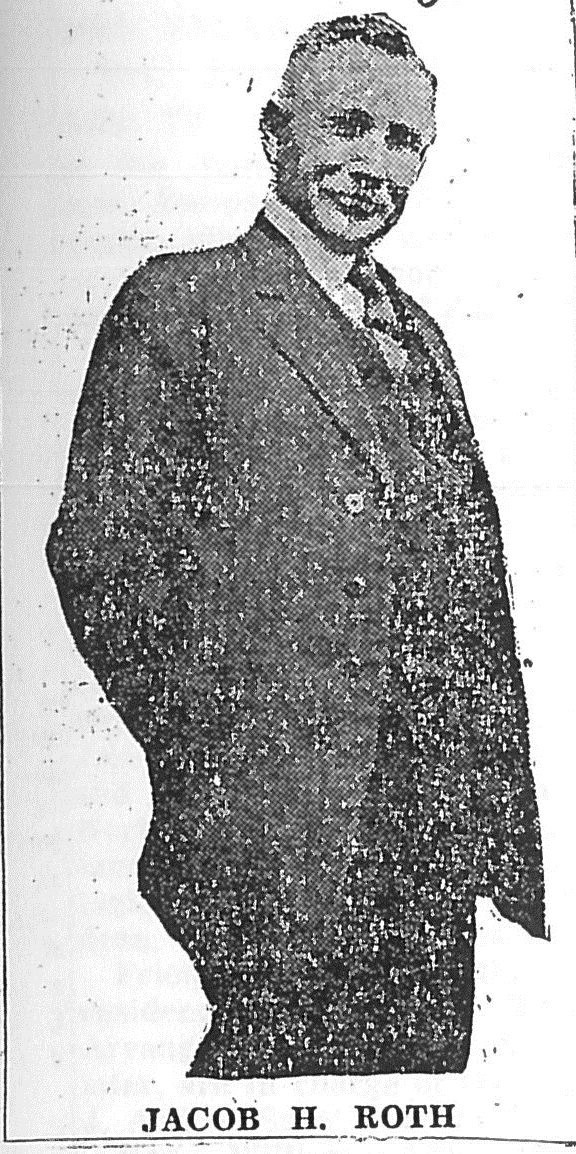
Jacob H. Roth, Former Superintendent of Sandusky Parks


After working as a gardener for the city of Sandusky for a few years, on September 3, 1897 Jacob H. Roth was appointed superintendent of parks, a position he held until his retirement on January 1, 1940. He was born in Germany in 1869, and studied gardening at Heidelberg University in Germany, though he did not graduate from high school. He emigrated to the United States as a young man, and on May 22, 1895, married Christine Hacker. They had two children, Helen who died in 1926, and Ferdinand, who died in 1938.  

In 1930, Jacob H. Roth achieved some local fame by crossing a lemon with a grapefruit; the result was a fruit that was larger than an ordinary lemon, but smaller than a grapefruit. The “synthetic lemon” was a big attraction at the city greenhouse’s “Mum Show” held in November of 1930.  

Mr. Roth made news in the April 27, 1933 issue of the Sandusky Register, when he caught four youngsters, all about the age of ten, trampling flower beds in Washington Park. He marched all four of the youths to the Sandusky Police Station, where Sergeant Al Tremper gave them a lecture. Since the boys promised to stay away from the flower beds in the city parks, Sergeant Tremper let them go to enjoy the rest of the day. Sergeant Tremper was impressed that Mr. Roth not only caught the boys, but none of the young men escaped on the walk to the police station. 

In 1936 a highlight of Washington Park was a fifteen foot loving cup, made from over 14,000 plants.


When it was announced that Mr. Roth would be retiring soon, Sandusky City Manager, R.L.J. Wagar said, in part, “Under Jacob Roth our parks have been one of our main attractions for drawing people to Sandusky and a constant joy for all of us to behold and we cannot afford to let the parks be neglected in any way when Jake leaves us.” Indeed, the city parks of Sandusky are still a beautiful asset to our city. 

Jacob H. Roth died on April 9, 1948. He was a member of St. Stephen’s Evangelical and Reformed Church, and the Woodmen of America. He was survived by his widow Christine, and two granddaughters. Burial was in Oakland Cemetery. 

Below is a picture postcard of Washington Park, taken during the time that Jacob H. Roth served as superintendent of the parks of the city of Sandusky.


Friday, October 21, 2016

Light’s Golden Jubilee in 1929

While Patent Number 223,898 was issued to Thomas A. Edison on January 27, 1880, the experiments done by Edison and his team in October of 1879 enabled the first practical commercial incandescent light bulb to become a reality. On October 21, 1929, Light’s Golden Jubilee was held in honor of the fiftieth anniversary of Thomas A. Edison’s improvements to the incandescent light bulb.


Sandusky’s Division Manager of the Ohio Public Service Company, C. B. Wilcox, pictured above, announced in the July 23, 1929 issue of the Sandusky Star Journal, that Sandusky would pay tribute to the work of Thomas A. Edison by illuminating the fountain in Washington Park with a display of brightly colored lights. (This was before the Boy with the Boot made its home in Washington Park.) Employees of the Ohio Public Service Company were to install the special lighting display, which was to continue throughout the summer and fall months.

                            
A floral mound in the park also paid honor to Thomas A. Edison in 1929.

 
The Sandusky Star Journal of October 22, 1929 reported that hundreds of Sandusky residents sat at home by candle light or gas light, as they listened to the radio program in which Thomas A. Edison recreated his electric light over NBC Radio, at Henry Ford’s Greenfield Village in Dearborn, Michigan, where the Edison laboratory had been re-created. The reception during the program was exceptionally clear that October evening.


U.S. President and Mrs. Herbert Hoover as well as Henry Ford all took part in the Golden Jubilee of Light Celebration. Read more about Light’s Golden Jubilee at the websites of the Henry Ford Museum and the Library of Congress.

Wednesday, July 20, 2016

Members of Florida Lions Clubs Visit Sandusky


In July of 1937, members of the Lions Club from several Florida cities passed through Sandusky on their way to the annual convention of the Lions Club International, held July 20-23 in Chicago. On the trip to Chicago, the Florida Lions’ motorcade passed through Georgia, South Carolina, Virginia, Washington D.C., Pennsylvania, Ohio and Indiana. The return trip took them through Indiana, Kentucky, Tennessee and Georgia.

While in Sandusky, the Floridians drove in a caravan downtown along Washington Street.


The annual Lions Club convention in 1925 was held at Cedar Point. The Sandusky Register described Helen Keller’s speech to the Lions Club members in a front-page article in the July 1, 1925 edition. Miss Keller spoke at the convention to solicit aid for the American Foundation for the Blind.

Wednesday, October 07, 2015

Looking Towards Sandusky Bay from St. Mary’s Steeple, Circa 1920


Robert Frank donated this photograph which features the view from the steeple of St. Mary’s Church, looking down Central Avenue towards Sandusky Bay about 1920.  Many landmarks (some no longer standing) are visible in the picture. At the top left of the picture is the Sloane House. To the right of the Sloane House (across Columbus Avenue) is the Kingsbury Block, shortly before a portion of it was replaced by the Commercial National Bank building. In the far distance, northeast of the Kingsbury Block, are storage silos and buildings in the waterfront district of Sandusky, close to the B & O Railroad tracks. The Erie County Courthouse is in the same location as it is today, but in 1920 it had not yet been remodeled in the Art Deco style, which was a WPA project in the 1930s.  You can see Sandusky High School to the east of the Courthouse, before it was expanded. (This building later became Adams Junior High School.) The steeple of Emmanuel Church is visible, at the northeast corner of Columbus Avenue and Adams Street. Only the rooftop of the Sandusky Library can be seen, opposite the Courthouse on Adams Street, which is very close to the Erie County Jail. A private residence and later Dr. J.D. Parker’s office, stood between the library and the jail for many years. At the upper right of the picture is the smokestack of the Water Works. Apartment buildings and businesses are seen along Central Avenue. The diagonal direction of Central Avenue forms a portion of the Masonic emblem. Hector Kilbourne laid the city of Sandusky out in the shape of the square and compasses of the Masonic emblem.


This historical marker in Washington Park honors Hector Kilbourne, the surveyor who laid out the original plat of Sandusky in 1816.


Monday, August 04, 2014

Floral Mounds in Washington Park


Floral mounds have been a popular feature of the parks in downtown Sandusky for decades. The mound pictured above, which was located near the Erie County Courthouse in 1910, contained an urn and was entitled “Flora.”  

This patriotic themed floral mound, sponsored by the Perry Post, No. 83, American Legion, was in the park sometime between 1910 and 1920. In the 1920s, the Perry Post of the American Legion was re-named the Commodore DenigPost, No. 83.


In 1917, another floral mound with a patriotic theme featured an eagle atop the globe, with a floral flag of the United States on the main portion of the mound.

         
OLEIDA (Ohio Lake Erie Island District Association), which promoted tourism in the 1930s, sponsored the floral mound in this picture.


In 1960, a mound honoring the 125th anniversary of the American Crayon Company was located in Washington Park, facing East Washington Street.


Local residents and tourists from all over the U.S. (and beyond) enjoy Sandusky’s beautiful parks every summer. Visit the Sandusky Library Archives Research Center to see more historic photographs from Sandusky and Erie County.

Thursday, December 19, 2013

Christmas in Sandusky in 1950

A series of pictures featuring holiday decorations in Sandusky’s Washington Park in 1950 is found in the historical collections of the Sandusky Library Archives Research Center. The Industrial Nut Corporation sponsored this Santa Claus decoration.      


A large group of singing carolers is seen here in front of faux stained glass windows.


Hinde and Dauch sponsored this candy cane display.


Rudolph and a sleigh full of gifts were sponsored by the Lyman Boat Company.


You can see the Ohio Edison office in the Odd Fellows building behind this large candle display in Washington Park.


The New Departure Division of General Motors sponsored this display of singers.


 Looking through microfilmed issues of the Sandusky Register Star News from 1950, we learn that at the Sears store in downtown Sandusky, shoppers could purchase a recording of their child’s conversation with the store’s Santa Claus. An ad from Cooper Chevrolet on Cleveland Avenue stated that the new 1951 Chevrolet was “America’s largest and finest low-priced car.” The Jaycees encouraged everyone to put a light in every window for the holiday season. Bing’s Furniture sold a wide variety of small and large appliances for the holiday season. The Frankel’s store offered a lay-away service, offering to “keep secrets safe” until the week of Christmas, and the J.C. Penney store in downtown Sandusky was selling men’s bomber jackets for $8.90. Herman’s Furniture advertised Lane hope chests for “a gift that starts the home.”