Showing posts with label Berlin Heights. Show all posts

Wednesday, February 26, 2020

Job Fish Taught School in Erie County for 53 Years


Job Fish was born in Niagara County, New York, in 1828, to Elias Fish and the former Betsy Van Wagner. He traced his Quaker ancestors back to Thomas Fish, who resided in Rhode Island in the 1640s. Elias Fish and his family moved to Geauga County, Ohio in 1843, where Job attended the local schools. Two of his teachers were Joseph W. Gray, the founder of the Cleveland Plain Dealer, and his older brother Charles Fish, an attorney in Cleveland. 

The young Job Fish worked as a driver on the towpath of the Erie Canal in the summer of 1843. He attended the Western Reserve Seminary in 1845 and 1846, and Dr. Lord’s school in Kirtland in 1846 and 1847. Later he studied law at the law office of his brother Charles. When he was 17, he started his own debating school. In 1848 and 1849, Fish began giving lectures in various towns in northern Ohio. He settled in Erie County in 1854, and he taught in the county for over fifty years. 

Hewson Peeke provided a listing of the schools where Job Fish taught in his book A Standard History of Erie County (Lewis Publishing Co., 1916.)


Mr. Fish also conducted sessions for the training of teachers.


An article about Job Fish in the Firelands Pioneer began with the sentence, “No one has exercised in Erie County a larger influence as a teacher than the venerable Job Fish.” The author said of Mr. Fish, “All his life his greatest interest has been in human beings. His heart went out to each and every one of his pupils: and so manifestly genuine was his desire to help them make the utmost of themselves that all their natural timidity and reserve vanished, and they freely and unconsciously unfolded to him their better natures, which were thus in the most favorable condition for development.” Mr. Fish never had to resort to punishment, threat, or exhortation. Dozens of students made Mr. Fish their confidante and counselor. Job Fish could speak in nine different languages, and he learned how to read French, German, Spanish and Dutch after he was fifty years old. 

On February 27, 1923, Job Fish died in Illinois at the age of 95. His wife had passed away in 1904. He was survived by three sons and three daughters. He was buried at the Shadyside Cemetery in Auburn Corners, Geauga County, Ohio.

Saturday, February 11, 2017

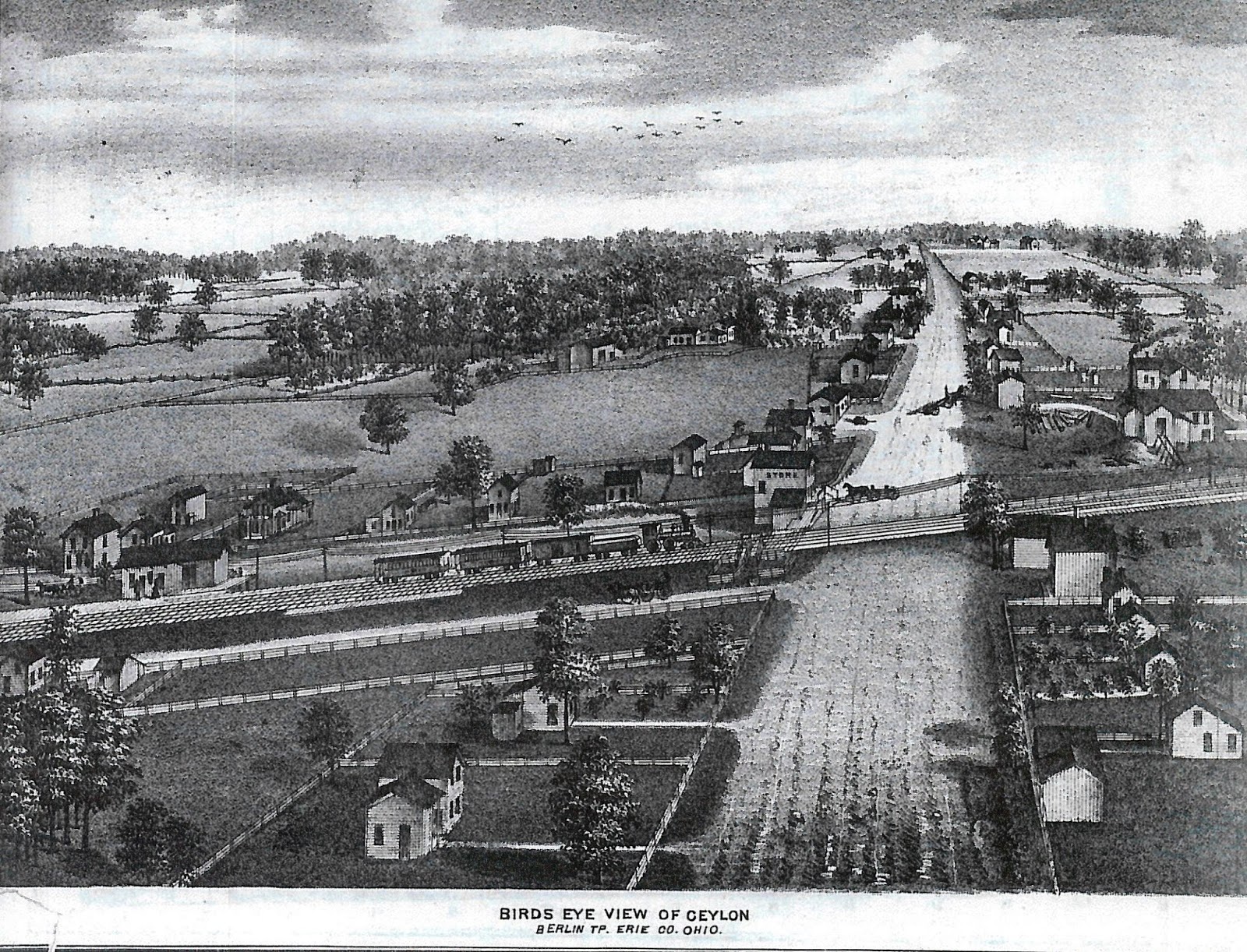
Ceylon, Ohio


Ceylon is a small unincorporated community north of Berlin Heights in Erie County, Ohio, along Route 61 and just east of Old Woman Creek. It was a stop for the Lake Shore and Michigan Southern Railroad, and later was a station on the Lake Shore Electric Railway route. A small refreshment stand served both automobile and interurban customers. Aldrich’s History of Erie County stated that in 1889 Ceylon had “two stores, two saloons, a hotel, a post office and a sawmill.”  The May 6, 1881 Sandusky Daily Register reported that Ceylon was “one of the leading shipping points on the Northern division of the Lake Shore Road.”  In the fall of 1880, twenty five thousand bushels of wheat were shipped out of Ceylon. There was a Post Office in Ceylon until September 14, 1904. (It was established as the Berlin Station Post Office in 1858, and the name was changed to the Ceylon Post Office on Oct. 2, 1871.)   Mail was delivered by stage coach for many years.

The Peake Cemetery is located just east of the intersection of Ceylon Road and Route 2. The cemetery was named after the Peake (sometimes spelled Peak) family which resided in the Ceylon area in the late 1800’s and early 1900’s. An obituary for Oliver Peak, one of Ceylon’s earliest settlers, is found in the July 1878 issue of the Firelands Pioneer.


The final line of Mr. Peak’s obituary says that “The deceased was an industrious farmer for many years, a man of sterling qualities, genial spirits, and went down before the Great Reaper as a shock of corn ripe for the harvest.”

Saturday, May 28, 2016

Books by Hudson and Emma Tuttle


This small paperback book from the Lyceum Series was written in 1874 by Hudson and Emma Tuttle, who lived on a farm in Berlin Heights. Hudson Tuttle and his wife, the former Emma Rood, were authors who were also very active in Spiritualism. In the story “How an Acorn Becomes an Oak,” the Tuttles point out that from one small acorn, a huge tree eventually grows, and it not only withstands the winds of storms, but it provides food and shelter to birds and small animals. In “The Beautiful Lady” a young girl learns how a caterpillar transforms into a lovely butterfly. A review of the book which appeared in The Lyceum Stage stated that the book was “an elegant little volume to put into the hands of the young.” The book was nonsectarian, and sold for twenty five cents. 

An engraving of Mr. and Mrs. Tuttle is found on page 487 of The History of the Fire Lands, by W. W. Williams (Leader Printing Co., 1879.)


Several books by Hudson Tuttle are available full-text online at the Internet Archive. In 1907, the Tuttles published A Golden Sheaf, which was a souvenir of their golden wedding anniversary.


Visit the Sandusky Library Archives Research Center to view the book written by Hudson and Emma Rood Tuttle. Hewson L. Peeke provides biographical information about Mr. and Mrs. Hudson Tuttle on pages 1048-1051 in his book A Standard History of Erie County, Ohio.