Showing posts with label Mackey. Show all posts

Sunday, April 30, 2023

Maryette Goodwin Mackey, Educator


Maryette Goodwin was born in 1865, the daughter of Sandusky attorney Homer Goodwin and his wife, the former Marietta Cowles. She graduated from Wellesley College in 1888, and married attorney Denver John Mackey in 1892. In the early years of the twentieth century, Maryette Goodwin Mackey served on the Board of Trustees of the Sandusky Library Association. By 1910, Mr. and Mrs. Mackey were residing in Los Angeles County, California with their two young daughters, Florence and Margaret.

In 1908, Maryette Goodwin Mackey and her sister in law Mary Mackey Stuart co-authored the book, The Pronunciation of 10,000 Proper Names


In 1924, the Handbook of Proceedings of the California Library Association listed Maryette G. Mackey as the Principal of the Foreign Extension Department of the Los Angeles Public Library. During her tenure, she wrote this article:


Mrs. Maryette Goodwin Mackey passed away in California in 1933. She seems to have been connected to books and libraries for most of her life.

Tuesday, August 09, 2022

Red Arrow Auctions in Sandusky


In 1930 and 1931, several "Red Arrow Auctions" were held at the Junior High School in Sandusky.

Local businesses gave customers “Red Arrow Money” which could then be redeemed for items at a "Red Arrow Auction." Clarence E. Depew, an advertising man from Springfield, Illinois promoted the Red Arrow Auctions. The auctions took place in the midst of the Great Depression, providing an entertaining diversion for Sandusky area residents. Dozens of Sandusky businesses participated in the program. The Cohn’s store was considered a “Red Arrow Store.”


At the first Red Arrow Auction, held May 28, 1930, Rev. J.A. Griffith won a $25.00 breakfast set, for which he paid $18 of Red Arrow money. O.F. Kopp of Hayes Avenue paid $466 of Red Arrow money for window screens valued at $41.00. Prior to the Red Arrow Auction, entertainment was provided by junior high school students, under the direction of Miss Mary Helen Homegardner and Carl Mackey.

An “Our Gang Comedy” movie was the entertainment at the July, 1930 Red Arrow Auction. In September, 1930, the Auction featured a doll costume contest, with cash prizes given out. Usually the crowds at the auctions numbered from 1800 to 2000.

An article in the May 27, 1931 issue of the Sandusky Register reported that no more Red Arrow Auctions would be taking place, though Red Arrow Money could be redeemed until June 25. The article stated about the most recent auction: “All of the auctions held in the past have attracted good attendance, but the crowd Tuesday night was declared to have been the best ever and there was spirited bidding shown for the many fine articles of merchandise that were offered by local merchants.”

Wednesday, December 23, 2020

James D. Lea, Lumber Merchant


James Davis Lea was born on July 21, 1817 in Lycoming County, Pennsylvania. He moved with his family to Ohio when he was a young man. After working for a time as a school teacher and then as a carpenter, he established himself as a lumber merchant. Below is an advertisement from J.D. Lea’s business, from the 1855 Sandusky City Directory.

Through the years, Mr. Lea had several different partners in the lumber business, including Lewis Moss, Frank Sloane, and finally his son in law, Mr. William H. Herbert. In 1897 Mr. Lea retired from the lumber business, and in retirement devoted his time to real estate. The Lea Block, at the southwest corner of Wayne and Market Streets was named for James D. Lea.


His wife was the former Caroline Mackey, and together the Leas had six children, three of whom survived to adulthood. On  January 8, 1901, James D. Lea died at his home on Wayne Street. An article in the Sandusky Star of January 8, 1901 reported that Mr. Lea had been “one of the most prominent and respected citizens of Sandusky.” He was remembered as someone who was honorable and fair, and was missed by a wide circle of friends. Mr. Lea had been a trustee of the Sandusky Water Works, and was a member of the Science Lodge, Sandusky City Council, and the Knights Templar. Funeral services were held at the family’s residence on Wayne Street, under the auspices of the Science Lodge, and burial was at Oakland Cemetery.

Thursday, May 28, 2020

Sandusky High School’s Centennial Reunion


The Centennial Reunion of alumni of Sandusky High School was held on May 28, 1955. Tickets to the banquet were sold for $2.00 per person.


Reunion events included a band concert on the Sandusky High School lawn at 4:00, dinner at the Junior High School at 6:15, a program at Strobel Field at 7:45, and a dance at 9 p.m. at the Junior High featuring the fourteen piece band of Jimmy Dulio. During the program at Strobel Field, several special people were introduced to the crowd.


Charles E. Frohman served as the Master of Ceremonies. Principal Wallace Glenwright and Mayor Richard Fuller both gave remarks of welcome. Former school administrators James T. Begg, Frank J. Prout, Karl E. Whinnery, and Wayne C. Blough were introduced. Retired teachers attending the reunion were Miss Lucy Carter, Miss Elsie Denham, Miss Bessie Taylor, Miss Edith Howell, Miss Berta Jackson, and Miss Marie Reiff. Superintendent Carl L. Mackey spoke to the Sandusky High School alumni, and several musical numbers were presented. Harold C. Kaufman directed the A Cappella Choir and led the choir in three songs, including “Halls of Ivy.” The combined band and choir of Sandusky High School performed the Battle Hymn of the Republic. The program ended with a musical benediction sung by the high school A Cappella Choir.

The Sandusky Register Star News of May 28, 1955 contained a special feature devoted to the Centennial Reunion.


A copy of this special edition newspaper is housed at the Sandusk y Library Archives Research Center. Included in the special feature are pictures of graduating classes, a history of the one hundred years of Sandusky High School, and brief biographical sketches of outstanding graduates of Sandusky High School. An article entitled “A Century Stream of Teaching at Sandusky High” began with this paragraph:

Tennyson’s quotation “Men may come and men may go, but I go on forever,” referred to a little flowing brook, might also be applied to the stream of education which has been flowing through Sandusky High School for the past 100 years, and which, from all indications, will flow on indefinitely.
The newspaper issue contained commemorative ads from many businesses, including this advertisement from the Ohio Bell Telephone Company.


Sunday, October 22, 2017

Sandusky High School Dedicated in 1957


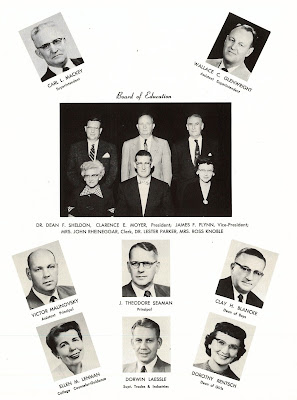
The new Sandusky High School was considered “a dream come true” when it was dedicated on October 22, 1957. According to Superintendent of Schools, Carl L. Mackey, an eighteen acre plot of land at the corner of Hayes and Perkins Avenues was purchased for $13,000 in 1946, following a study by the Bureau of Educational Research of Ohio State University. The study had recommended that the school be built in close proximity to the stadium at Strobel Field.  In 1954 voters of Sandusky passed a bond issue of $3,740,000, to be used for the construction and equipping of a new Sandusky High School building.  School officials and Board of Education were pleased with the overwhelming approval of local residents for the exciting new project.

Architects for the new school were Mclaughlin and Keil from Lima, Ohio. Contractors included Knowlton Construction, Utilities Line Construction, J.F. Stephens Company and E.W. File and Son. Several local firms also worked on site development. Before the formal dedication of the school building on October 22, 1957, an estimated 20,000 people toured the new school in pre-dedication open house tours.
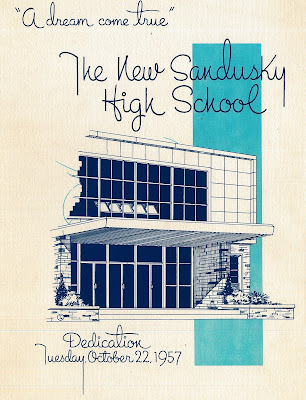

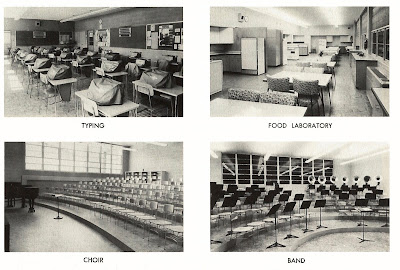
At the formal dedication, several flags were given to the school. Mayor Richard B. Fuller gave a civic testimonial. The dedication address was presented by Dr. Edward E. Holt, the State Superintendent of Public Instruction. Superintendent Mackey also spoke, and local clergy gave the invocation and benediction.  The program for the dedication included a message from Mr. Mackey in which he explained that the school was designed to the meet the educational needs of Sandusky's young people for many years to come. The new school provided for many new classes in science, business and English, and allowed for additional course offerings in Industrial Education. Each teacher had his or her own classroom, which eliminated the need for “traveling teachers” who had to move from room to room in the old school building. Several photographs of classrooms in the new Sandusky High School were included in the program.

In this page from the dedication program, entitled “Campus Looking East,” you can see the high school and the stadium:

The Sandusky Register published a special section in the October 22, 1957 issue to commemorate the dedication of the new Sandusky High School building. This feature included details about school leaders, the contractors for the project, and several pages of advertisements from businesses associated with the construction of the new school, as well as many local companies giving messages of congratulations on a job well done.


Sunday, April 16, 2017

Carl L. Mackey, Superintendent of Sandusky City Schools


Carl L. Mackey was born in Marietta, Ohio in 1895. He graduated from Marietta College in 1918, where he played baseball and football, and he was on the track team. Shortly after graduation, he entered an officers’ training camp, but as he was about to receive his orders, the war ended and he was honorably discharged. Late in 1918, he was hired by Sandusky High School to be the Athletic Director. He also taught Science and Civics. He coached Sandusky’s basketball team during the 1918-1919 academic year, where the team played to capacity crowds at every game. In the mid-1920s, he took a job in Oberlin, but by 1928, when Jackson Junior High School was opened, Mr. Mackey was the principal of the new school.


The opening of Jackson Junior High School was an exciting event in Sandusky. The school had a swimming pool and a large gymnasium which was also used as a community center from the late 1920s through the 1940s.  By the early 1950s, Mr. Mackey had become the assistant superintendent of Sandusky City Schools, and from 1953 to 1958, he served as superintendent of the school system.


Mr. Mackey was superintendent of schools in Sandusky when the new high school building opened in 1957.


Mr. Mackey was not only active as a teacher and administrator, but he was very involved in other community affairs as well. In the 1940s, he was the president of the local chapter of the Lions Club, and he was involved with the first Safety Town in Sandusky, sponsored by the Rotary Club in 1956. 

After retiring from Sandusky City Schools, Mr. Mackey moved to High Point, North Carolina; he died in North Carolina on March 25, 1976. He was survived by his wife, two sons, and four grandchildren. In his time in Sandusky, Mr. Mackey got to know many local residents through his many years of committed service to the school system and the community. 

Wednesday, March 29, 2017

Sandusky High Schools Girls Basketball Team of 1922


These young ladies were on the Sandusky High School girls basketball team during the academic year 1921-1922. In the back are: Hyacinth Brownworth, Ruth Thom, and Coach, Mrs. Carl Mackey. In the front are; Elsie Hofer, Betty Grulich, Ruth Laux, Vesta Dwelle, and Alyne Wiedenhaefer. All the members of the team earned a letter at an assembly held at Sandusky High School in March of 1922.


Hyacinth Brownworth, later Mrs. John Rheinegger, served as the Clerk of the Board of
Education of the Sandusky City Schools for several years. In 1957 Hyacinth Rheinegger was honored at a dinner party for “the meticulous and efficient way” she ran her office. Several school officials, past and present, attended the dinner at the Rockwell Springs Trout Club in her honor.