Showing posts with label Roosevelt. Show all posts

Saturday, May 20, 2023

George T. Lehrer, Mayor of Sandusky


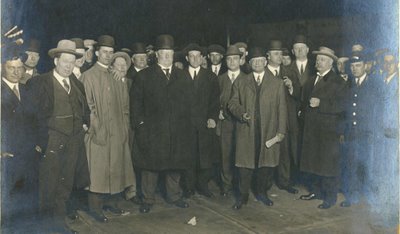
George T. Lehrer is seen at the far right above, in an undated photograph which shows a group of men at the back of a train car. He was born in 1863 to Rev. J.G. Lehrer, one of the earliest pastors of Zion Lutheran Church, and the former Susanna Kneb. 

For forty years, Mr. Lehrer was the owner of a drug store on Washington Street in Sandusky.

Besides being well known as a Sandusky businessman, Mr. Lehrer was prominent in Republican political circles. He was director of the Erie County Infirmary for several terms. In the fall of 1909, he was elected Mayor of Sandusky, defeating J.J. Molter, who had been mayor for four terms.


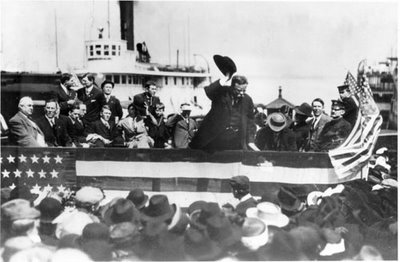
When Theodore Roosevelt was campaigning in Sandusky in 1912, as a member of the Bull Moose Party, Mayor Lehrer was seated on the platform, not far from the American flag.

During his first term as Mayor, Lehrer authorized the purchase of the first motorized fire equipment for the city of Sandusky. When Sandusky went to the Charter form of government, Mr. Lehrer was appointed City Manager. In 1918, he resigned his position, and was succeeded by George M. Zimmerman. 

On March 6, 1938, George T. Lehrer died at the age of 74, just weeks after he celebrated his Golden Anniversary with his wife, the former Elisa Schmidt. The final resting place of Mr. and Mrs. George T. Lehrer is Sandusky’s Oakland Cemetery.

Thursday, May 14, 2020

Theodore Roosevelt on the Campaign Trail in Sandusky in 1912


On May 15, 1912, Theodore Roosevelt spoke in Sandusky, Ohio while he was campaigning for president on the Progressive (Bull Moose) Party ticket. Roosevelt had already served as United States President for two terms, from 1901 to 1909, following the assassination of President William McKinley.

In this closer view, you can see TR addressing the crowd from a platform at the foot of Columbus Avenue:


According to the May 16, 1912 issue of the Sandusky Register, about 2,500 people were in the crowd. Roosevelt arrived by train in Sandusky on Wednesday morning, May 15, 1912. Ackley’s Band entertained the crowd until his arrival. The train, consisting of two Pullmans and a day coach, was due at 8:45, but did not get to town until 9 a.m. Roy H. Williams introduced Mr. Roosevelt. When Roosevelt saw veterans from the Ohio Soldiers’ and Sailors’ Home, he addressed them as “boys” and “comrades.”

In the picture below, Theodore Roosevelt can be seen raising his hat with his typical enthusiasm:


Sandusky Mayor George T. Lehrer is seated on the left of the platform. According to the Oyster Bay Historical Society, Mr. Roosevelt’s speech in Sandusky was one of fourteen speeches he gave in Ohio in May 15.

President William Howard Taft also visited Sandusky, Ohio on May 15, 1912. President Taft spoke from 8:30 to 10:30 p.m. to an enthusiastic audience at the Sandusky Theatre. The theater held 1,500 people, but it was estimated that several thousand people cheered and applauded Taft as they waited outside the theater for a glimpse of President Taft.

Though Theodore Roosevelt and President William Howard Taft campaigned vigorously in 1912, in November of 1912, Woodrow Wilson became the 28th United States President. On May 12, 2012, Gib Young portrayed Theodore Roosevelt at the foot of Columbus Avenue, re-enacting the visit of TR one hundred years after his original visit

Friday, January 25, 2019

Roosevelt Birthday Balls Held in Sandusky


From 1934 through 1942, balls in honor of Franklin D. Roosevelt’s birthday were held in Sandusky, Ohio. Sponsored by the National Committee for Birthday Balls, a portion of the proceeds from the dances went to the Warm Springs Foundation for their work for the sufferers of infantile paralysis, a disease that had had seriously impacted President Roosevelt himself. 


In 1934 and 1935, the National Birthday Ball for the President was held at Jackson Junior High School. The gymnasium was decorated to resemble the Georgia Hall at Warm Springs. On the morning of January 31, 1934, assemblies were held in Sandusky schools, to educate the students about the history and work of the Warm Springs Foundation. Each youngster was asked to donate one penny as a contribution to the Foundation.


In 1934, Sandusky residents raised $623 at the Roosevelt Birthday Ball. Nationwide there were 600 celebrations, which raised over one million dollars for the Warm Springs Foundation. Beginning in 1936, and continuing until 1942, most years the Roosevelt Birthday Balls were held at the Elks and Eagles Lodges. In 1942, the Plum Brook Ordnance Works sponsored a Birthday Ball for the President at Rainbow Garden in Fremont.  Irving Berlin composed a song in 1942 in honor of the President’s Birthday. Below is a copy of an announcement for the 1940 President’s Birthday Ball from the January 27, 1940 issue of the Sandusky Register.


Today the March of Dimes Foundation continues to raise funds used to improve the health of women and infants.

Saturday, December 16, 2017

When Railroad Tracks Ran Through Downtown Sandusky

Beginning in the 1850s, when a landfill project added more land to downtown Sandusky, moving the shoreline well north of Water Street, railroad lines traveled along the north end of downtown Sandusky, along the bay.


This view of the foot of Columbus Avenue was taken from the water, around 1900-10. Sandusky’s waterfront has been the hub of a variety of modes of transportation in Sandusky, including horse and buggies, boats, trains, the interurban, and later automobiles, motorcycles, and even Segwave tours.  The West House hotel was popular with tourists in Sandusky for many years. The State Theatre is now at the site of the former West House hotel. 

Below, we see the train tracks on Railroad Street (now Shoreline Drive) in downtown Sandusky about 1908.


The A. Booth and Company’s fish house and the Johnson’s Island boat landing were just north of the tracks. A water tower on the roof of the Hinde and Dauch factory is visible in the distance. 

The 1905 Sanborn Map shows three different railroads in operation through downtown Sandusky at that time: the Baltimore and Ohio, the Cleveland, Cincinnati, Chicago and St. Louis Railway Company (later known as the “Big Four”), and the Lake Shore and Michigan Southern Railway.


A recent view of this location can be seen at Google Maps.  

Look at the huge crowd gathered in downtown Sandusky to hear Theodore Roosevelt when he visited here during his unsuccessful race for the presidency in 1912:


Society has changed in many ways throughout the last one hundred years, but downtown Sandusky remains a popular destination for visitors and area residents alike. Visit the Sandusky Library to learn more about the city of Sandusky’s rich history. The website of the Erie County Historical Society hosts several historic walking tours of sites around town. 

Thursday, March 03, 2016

Roosevelt Days in Sandusky


On March 4, 1933, President Franklin D. Roosevelt gave his first inaugural address to the nation. The U.S. was in the midst of the Great Depression, and referring to the country’s condition at that time he famously stated, “The only thing we have to fear is fear itself.” The merchants of Sandusky, Ohio celebrated the inauguration of FDR by sponsoring “Roosevelt Days” on March 3 and 4, 1933. An article in the February 27, 1933 issue of the Sandusky Star Journal reported that “the greatest merchandise value-giving event in the city’s history will be afforded.” Every merchant was to offer one super special item at a reduced cost. All the streets in the downtown district were decorated in the national colors of red, white and blue. A full page in the March 2, 1933 issue of the Sandusky Register was devoted to the “red hot bargains” to be offered during Roosevelt Days.


During Roosevelt Days, the Perry and Bretz men’s store were selling Gold Medal hats for $3.50 and Fifth Avenue hats for $5.00.


The J.H. Herman store’s ad stated that they were offering a “March of Miracle Values at their furniture store.


Many of our ancestors lived through the Great Depression, and Sandusky merchants were making an effort to offer affordable products for Sandusky area residents in 1933, to ease the financial woes so many were facing at that time.

Thursday, March 27, 2008

The Fall of the Commercial Banking and Trust Company

In late February and early March of 1933, the country stood at the edge of a precipice of a national crisis. President Herbert Hoover was in his last weeks as President, and Franklin D. Roosevelt was poised to take the oath of office. Across the nation, confidence in the banking system was falling rapidly, and there was concern that panicked citizens would rush to the bank to withdraw all of their holdings and that banks wouldn’t be able to meet the demand for cash. In late February, the governor of Michigan declared a bank holiday in order to avoid a panic, and caught the attention of the entire nation. On March 5th, 1933, one day after taking the oath of office, President Franklin Roosevelt declared a four day national bank holiday, in order to stabilize the country’s banks. All financial transactions were halted, and businesses and individuals had to work with cash on hand in the interim.

In order to reopen after the bank holiday, every bank in the country had to prove it had sufficient funds in reserve to cover all of the funds on deposit. On March 15th, ten days after the bank holiday was declared, two Sandusky banks, Third National Exchange Bank and the Citizens Banking Company reopened their doors for business. The Commercial Banking and Trust Company waited for permission to resume business as usual.
Days passed without any word on the fate of the bank until the March 25, 1933 Star Journal announced that the Commercial Banking and Trust Company was coming back bigger and better. Plans were to reorganize the bank and open branches throughout Erie County, with capital stock of $300,000. The new bank was to be known as the United Bank of Erie County.

On May 30, 1933, the disappointing news that, after weeks of effort, it was impossible to organize the Commercial Banking and Trust due to the amount of money needed to provide working capital. Thus it became more important than ever to go ahead with the planned United Bank of Erie County. Plans to liquidate the Commercial Banking and Trust were outlined in the local newspaper. On June 15th, plans for a new bank were dashed when the Glass-Steagall bank legislation was passed. The Glass bill required newly organized banks to have more than $625,000 in capital and surplus, more than double the figure that had been planned for the Erie County bank. On Saturday, July 21, the bank was taken over by the state superintendent of banks. Depositors were requested to file proofs of claim before November 30th.

Eventually, the matter of the bank liquidation ended up in court, and dragged on for years. In March, 1941, the building was finally sold. In November, 1941, it was announced that depositors would receive a final dividend of 21.65 percent. In the intervening years, the bank paid out sixty percent of the claims of depositors, totaling $1,771,377.39. It also charged off $1,336,106.30 to loss.

Depositors of the bank faced real losses. Claims under $100 were paid a flat ten dollars, a substantial loss in 1941. The money was tied up for years as the liquidation process played out. The keys to the building were handed over by the liquidator on January 2, 1942, and the final report was filed February 26, 1942.

In the meantime the Western Securities Bank moved into the building that the Commercial Banking and Trust Company had constructed in the early 1920s. The Western Security Bank was located at the corner of Columbus and East Washington Row until it relocated in 1974.

Monday, October 23, 2006

Political Campaigns in Sandusky

As election day is approaching, it's a good time to talk about political campaigns that passed through Sandusky. I know it's not a presidential election year, but let's talk about some candidates for President of the United States who made campaign visits to Sandusky.


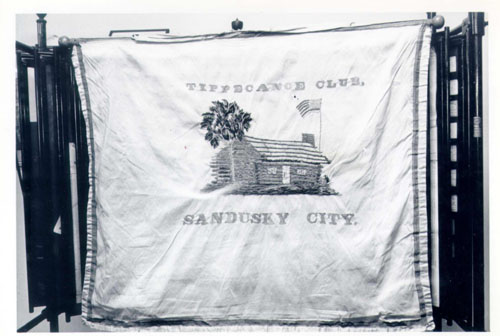
Possibly the earliest campaign visit to Sandusky by a presidential candidate was in 1840, when William Henry Harrison, the Whig Party candidate, came to town. To commemorate his visit, several women of Sandusky (including Mrs. Eleutheros Cooke) created an embroidered banner in honor of the campaign (shown above in a b&w photo). The banner, showing a log cabin on one side and an eagle on the other, is on display at the Follett House Museum. This story behind this banner is related on page 13 of the October 1896 issue of the Firelands Pioneer, available in the Genealogy section of the Sandusky Library.

During his successful 1908 presidential campaign, William Howard Taft spoke at the Ohio Soldiers' and Sailors' Home (now the Ohio Veterans Home). The photo below shows the soon-to-be President-Elect with a group of local dignitaries outside of the Soldiers Home. Taft was a close friend of Sandusky resident Edward Marsh, and apparently visited the area several times for social occasions.


Taft's former political ally, Theodore Roosevelt, became his political opponent during the 1912 presidential campaign. Believing that Taft betrayed the progressive principles that formed the core of Roosevelt's beliefs, "TR" ran for president that year as the candidate of the Progressive Party (often called the "Bull Moose" party, in honor of a popular nickname for Roosevelt). In May of that year, Roosevelt gave a whistle-stop speech at the foot of Columbus Avenue to a large crowd of Sanduskians. Here is one of several images of that event from the library's photo collections:

In the 1916 election, Charles Evans Hughes was the Republican candidate for president, seeking to unseat President Woodrow Wilson from his position. In September 1916, Hughes gave a speech in front of the American Crayon factory on Hayes Avenue. (Unfortunately, that photo will not post properly on Blogger.)

Another interesting local story of presidential campaigns can be found in the November 11, 1940 issue of Life magazine. In an article titled "The People's Choice," the publishers used Erie County, Ohio as a microcosm for the nation, with images of local residents and descriptions of why they chose to vote the way they did. You can read the article, and see photographs of local residents of the time (as well as a picture of candidate Wendell Willkie in Sandusky), in the Sandusky Library. Ask a reference librarian for that issue of Life magazine from closed storage.