Showing posts with label Butler. Show all posts

Thursday, November 28, 2024

Happy Thanksgiving

This is a repost from 2006

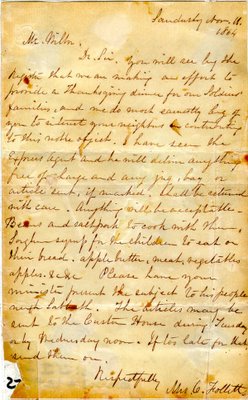
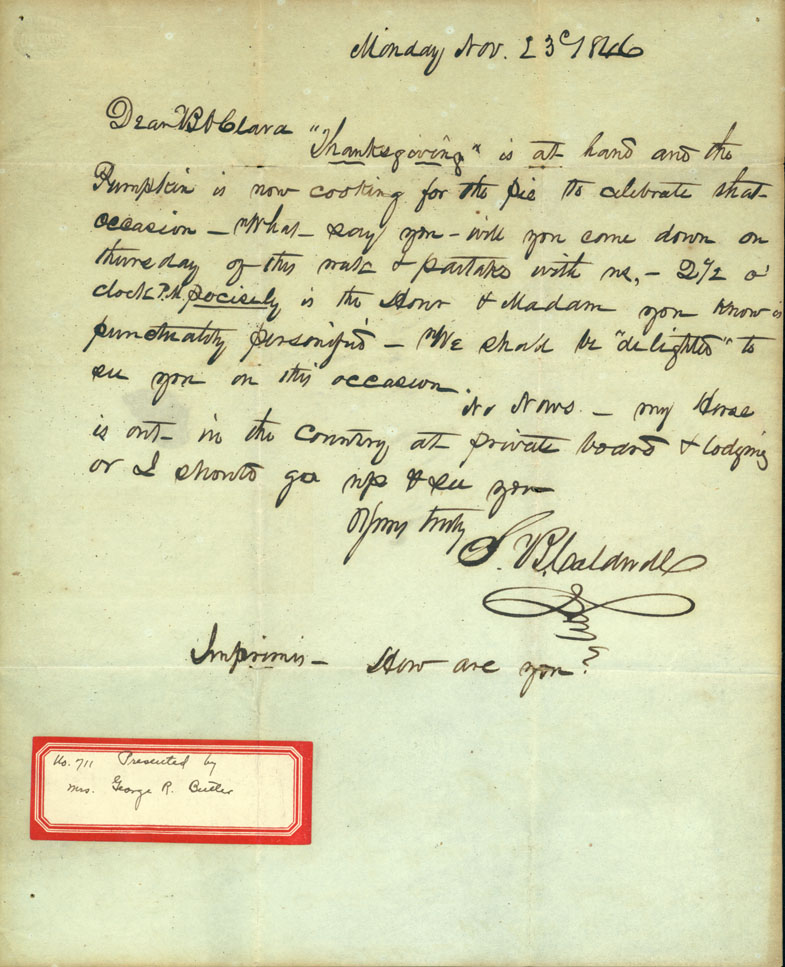
As many of you might remember learning in grade school, the first "official" Thanksgiving was proclaimed by President Abraham Lincoln during the height of the Civil War, in 1863, in honor of the first Thanksgiving held by the pilgrims in Plymouth during the 17th century. But even before President Lincoln made Thanksgiving a holiday, it was traditionally celebrated by many people. The first letter below is evidence of that:

In this letter, Judge Samuel Caldwell of Sandusky has invited Samuel Butler and his wife Clara to his home for Thanksgiving dinner. (We know pumpkin pie was on the menu!) The date of the letter is November 23, 1846, nearly twenty years before the national holiday was observed. (It is also interesting to note that even then Thanksgiving was celebrated on a Thursday in November -- nobody seems to know for sure why this day was chosen.)


The second letter is from Eliza Follett, the wife of Oran Follett, requesting contributions from local residents to provide Thanksgiving food to the wives and children of soldiers serving in the Civil War. Mrs. Follett was very active in community service and charitable work, as can be inferred from this letter.

Have a happy Thanksgiving. . .

Saturday, September 28, 2024

The Dorastus Snow Family and a Wartime Raid in Margaretta Township


 According to the September 1860 Firelands Pioneer, Dorastus P. Snow was the first white settler in Margaretta Township. He built a log house and also constructed a grist mill on Cold Creek. In 1813, there were three families living in the area of Cold Creek, those of Dorastus P. Snow, and the families of Mr. Butler and Mr. Putnam.

A copy of the map of Dorastus Snow's property along Cold Creek in 1823

In June of 1813, while the men were in the fields, the women and children of the families were attacked by sixteen Odawa (Ottawa) men allied with the British who controlled Fort Detroit during the War of 1812. The women were told they would be taken to Detroit. Mrs. Hannah Snow, however, was physically unable to travel due to an illness (or pregnancy), so she and three of the children were killed, while the rest of the group was taken to Detroit and given over to the British agent named Ironside. All the survivors were eventually returned to safety by the Fall of the same year, when United States forces established contact with the British in Detroit.

After life returned to normal at the end of the war, Dorastus Snow married Anna Faulk in 1818, and they had a son named Charles Snow. (After Mr. Snow’s death in 1824, Anna married Philip Cowell, and they had several children.) The Firelands Pioneer lists the children of Dorastus Snow from his first marriage as: Henry, Alanson, Willard, Electa, and Laura. 

Charles and Willard Snow are both buried in the Castalia Cemetery of Margaretta Township.  The inscription on Willard Snow's tombstone (pictured below) is in memory of his mother and brother who were murdered in 1813. (Though the stone reads 1812, all other sources indicate that the killings took place in 1813.) Willard Snow died on January 22, 1875. He was a Veteran of the Civil War, having served in the 40th Illinois Volunteer Infantry.


There are several accounts of the Snow Massacre. You can read about it in Lewis Cass Aldrich’s A Standard History of Erie County, Ohio, as well as The History of the Firelands, by W. W. Williams, both available at the Archives Research Center of the Sandusky Library.

Friday, November 18, 2022

A Look Back at 242 Wayne Street


Notes on the postcard above state that the Biemiller Garage was located at 240-242 Wayne Street around 1921. Later operators of the garage at this address were Harry Baldridge, Cecil Smith, and a Mr. Roberts. From the late 1920s to the mid 1960s, the Lee B. Keller Funeral Home was at 242 Wayne Street.


This 1963 image of 242 Wayne Street appeared in the March 10, 1991 issue of the Sandusky Register:


Virginia Steinemann and Helen Hansen wrote in an article titled “Growth Devoured Picturesque Homes” that this home was originally built for the Samuel W. Butler family in 1876.

The building was razed in 1968 when Frisch’s Restaurant built a drive in restaurant at this location. Later Charlie’s Waffle House was in this spot. Now the property formerly known as 242 Wayne Street is part of the Social Security Administration office and parking lot. Below is a view of the 200 block of Wayne Street in Sandusky, Ohio from Google Maps.

Friday, August 09, 2019

1879 Fair of the Erie County Agricultural Society


According to the Premium List for the Fair, the twenty-first annual fair of the Erie County Agricultural Society was held in Erie County at the Fairgrounds from September 23 to September 26, 1879.


Entries in the Annual Premium List provided the amount of cash awards to be given to residents of Erie, Sandusky, Ottawa and Huron Counties who competed at the Fair in a wide variety of categories, including livestock, farm implements, manufacturers’ products, fruits, vegetables, handmade clothing, quilting, embroidery, photography, and flower arranging. In the Educational Department, students and teachers were awarded diplomas for excelling in such fields as spelling, reading, attendance, and record keeping. Scattered throughout the Premium List are advertisements from local companies.


The Adams’ Buckeye Land Roller was manufactured by the Sandusky Tool Company at the time of the 1879 Fair. This particular piece of equipment was known for its durability, though simple in design.


The Sandusky Register provided excellent coverage of the activities at the Fair. A large article on page 4 of the September 26, 1879 paper reported on the events of September 25, when it was estimated that fifteen thousand people attended the Fair.


On Thursday, there were horse races held at the Fairgrounds, as well as several teams that competed in a Hook and Ladder Tournament. John Krupp, who exhibited several pieces of furniture, also had on display a burglar-proof air-tight grave vault which was designed for protection against grave robbers.


At the fair, William Dilger had a display of plants that included an orange tree, a rare philodendron and a bridal bouquet of rare beauty. Photographer A.C. Platt featured a life size crayon portrait of President Hayes and Dr. I.B. Massey in his exhibit. D.C. Richmond stated that at the 1879 fair was the largest and best display of apples he had ever seen at any fair. Henry Lange, a grape grower from Kelleys Island, showed fair visitors a five foot stem of Concord grapes which contained over sixty bunches of grapes. During the wheat binding competition, local businessman J.A. Hosmer attempted to place a live pig inside a hot air balloon. It turned out that the young pig became too restless, so it was removed from the balloon. It was decided instead to place business cards from area merchants, as well as a copy of the Sandusky Register and a publication from the Erie County Agricultural Society inside the hot air balloon. Fair crowds grew excited as the hot air balloon headed to the north, toward the Marblehead peninsula. To read much more about the exciting 1879 Fair, visit the Sandusky Library Archives Research Center where you will find decades of local newspapers on microfilm, dating back to 1822.

Wednesday, August 02, 2017

Watson Hubbard, Sandusky Businessman


Watson Hubbard was born in Bloomfield, Connecticut on July 11, 1819. He married Georgiana A. Holcomb in 1845. Mr. and Mrs. Watson Hubbard, along with Watson’s brother Langdon, moved to Lexington, Michigan in 1848, where the brothers began work in the lumber business. The lumber business they founded developed into the firm of R.B. Hubbard and Company. 

Watson Hubbard moved to Sandusky, Ohio in 1860, where he lived with his family in the West House for eight years. He had a house built at the northwest corner of Wayne and Jefferson Streets, just down the block from the home of his cousin, Lester S.Hubbard. Watson Hubbard served as Director and Vice President of the Second National Bank, and he was on the Board of Directors of the Sandusky Plow Company and the Nes Silicon Steel Works. He was among the earliest contributors to Good Samaritan Hospital. 

Watson and Georgiana Hubbard had three children, but only one survived to adulthood, Elizabeth Hubbard. Elizabeth married Jay Caldwell Butler, a Civil War Veteran who ran a business in Sandusky that manufactured sashes, doors, blinds and other wooden items. Pictured below are the daughter and granddaughter of Mr. and Mrs. Watson Hubbard, Mrs. Elizabeth Hubbard Butler and Mrs. Elizabeth Butler Harten.


In 1955, the former home of Watson Hubbard and his descendants, at 429 Wayne Street, was razed, to make room for an office for the telephone company. Before the house was razed, a neighbor, Mary Dauch, made this sketch of the home at 429 Wayne Street.


To read a biographical sketch about Watson Hubbard, written by his daughter Elizabeth, see the April 1925 issue of the FirelandsPioneer.

Tuesday, December 06, 2016

The Former Home of W.W. Wetherell


Razed in 1997, the building that once stood at 507 Wayne Street had many different purposes throughout the many years of its existence. William W. Wetherell, the former proprietor of the Fulton Car Works built this red brick house about 1850. The Fulton Car Works was a business which manufactured wooden railroad cars for the Mad River and Lake Erie Railroad and other railroads. W.W. Wetherell was an early church leader and a strong opponent of slavery. He served as Mayor of Sandusky in the mid-1840s and was City Clerk in his later years; he died on March 4, 1884 at the age of 72, and was buried in Oakland Cemetery. 

The Samuel Butler family lived here from about 1859 to 1876. George A. Marsh lived here through the rest of the 1890s. After Mrs. Marsh died in 1905, the house became the home of the H.W. Parsons family. Mr. Parsons was with the American Banking and Trust Company, and the Vim Motor Company. 

From about 1910 through the mid-1930s, the property at 507 Wayne Street was the property of the Sunyendeand Club, a men’s social club made up of prominent Sandusky residents.


From 1939 and into the early 1940s, the International School of Art leased this property. In an article that appeared in the April 30, 1977 issue of the Sandusky Register, a former Sandusky resident recalled her memories of the School of Art. She said that Elma Pratt filled the rooms with wall hangings, ceramics and art objects from all over the world. At the same time Elmer Frank taught music classes to a number of students. In the early days of the Sandusky Choral Society, the group rehearsed in the ballroom upstairs. In 1944, Mr. and Mrs. Roy Sharpe operated a nursing home in the building. Through the years, several different nursing homes were in business here. The building at 507 Wayne Street was razed on April 30, 1977.

Monday, September 19, 2016

Resources for Locating Oakland Cemetery Burial Records


This week the Cemetery Walk: Titans of Transportation will be held at Oakland Cemetery on these days: Tuesday, September 20; Wednesday, September 21; Thursday, September 22; and Saturday, September 24 at 10:00 a.m. 

Even if you cannot attend one of the tours, there are many ways to access individuals buried at Oakland Cemetery!

Oakland Cemetery is the final resting place of thousands of former residents of Sandusky and Erie County, Ohio.. Though it is not 100% inclusive, there is an online database at the City of Sandusky’s website.


Simply enter the first and last name of the person you are researching, and the result will provide you with the date of death, and location of the gravesite. Below is the listing for Moors Farwell, Sandusky’s first Mayor.


Another online database that is helpful in locating Oakland Cemetery records is Find a Grave. This link will take you directly to Find a Grave’s Search Box for Sandusky’s Oakland Cemetery.

Resources that are available inside the Sandusky Library include the book Erie County Ohio Cemetery Census Before 1909. Interment information for Oakland Cemetery begins on page 355 of this reference book. Inside the Sandusky Library Archives Research Center are even more places where you can access Oakland Cemetery burial records. A standalone computer provides a database where you can search by first or last name to access burial information. The results vary, sometimes providing very little information, but sometimes giving the cause of death, date of death, and location of death. The interment card for Confida Textor, who died at the age of 2 is seen below.


Yet another place to access Oakland Cemetery records at Sandusky Library is on the microfilmed copies of interment cards in the Sandusky Library Archives Research Center. Complete up to the 1980s, the records are arranged first by cemetery, and then alphabetically by surname. Below is the interment card for Anne Hubbard Butler, the young daughter of Watson Hubbard and Susan Quay Butler.


If you have ancestors buried in Sandusky’s Oakland Cemetery, and you would like to learn more about them, consult some of the many resources of information available to you.

Sunday, November 29, 2015

The Boalt Family of Sandusky and Norwalk


Pictured above is the former home of John M. Boalt, who was president of the Sandusky Wheel Company in the 1860s. John M. Boalt was the son of Captain John Boalt and Ruth Lockwood Boalt. His first wife was Sarah Follett, daughter of Oran Follett; she died at age 20 in 1844. (He later married Fanny Griswold.)


The Boalt family settled first in Norwalk, but moved to Sandusky around 1823, where Captain Boalt was the proprietor of the Steamboat Hotel. John and Ruth Boalt had a large family. Their daughter Amanda Boalt was the first wife of prominent Sandusky attorney George Reber. Daughter Clara Boalt married Samuel W. Butler, who had a large commission business in the early days of Sandusky. Susan Boalt married Samuel B. Caldwell, an early Mayor of Sandusky. Portraits of both Samuel B. Caldwell and Susan Boalt Caldwell are housed in the Sandusky Library Archives Research Center.


Another child of Captain John Boalt was Charles L. Boalt, who was a well known attorney in Norwalk, Ohio. He was also associated with the Toledo, Norwalk, and Cleveland Railroad. Charles L. Boalt’s daughter, Fanny, became Mrs. Jay O. Moss. Mrs. Moss was the driving force behind securing funds from Andrew Carnegie for the purpose of building a public library in Sandusky.  


Charles L. Boalt’s son was John Henry Boalt, who was a prominent lawyer in California. There is a Boalt Street in Sandusky as well as in San Francisco.


The Boalt family members were deeply involved in civic and business affairs in both Huron and Erie Counties and beyond. Several books in the Sandusky Library chronicle our area’s rich local history. Among the titles are: The Centennial History of Erie County, by Hewson L. Peeke; History of Erie County, edited by Lewis Cass Aldrich; and History of the Firelands, by W. W. Williams.

Saturday, October 24, 2015

Sandusky Men in Libby Prison During the Civil War


This print of Libby Prison, as it appeared on August 23, 1863, was donated to the Sandusky Library by Mrs. I.F. Mack. Sandusky’s well known newspaper editor, Isaac F. Mack, was imprisoned in Libby Prison and two other Southern prison camps during the Civil War. Fortunately he survived the war and had a very successful newspaper career with the Sandusky Register. 


Many other area men spent time at Libby Prison, including Fred Frey, Jr., Delos Ransom, Foster Neill, Frank Colver, William B. Rice, Wilbur F. Cowles, and John M. Butler, the son in law of Jay Cooke. In December of 1863, the Ladies Aid Society from Sandusky sent packages of food which were distributed to local men who were imprisoned at the prison in Richmond, Virginia. Captains C.H. Riggs and O.H. Rosenbaum, with the 123rd Ohio Volunteer Infantry, sent a letter of thanks to the Ladies Aid Society, to the attention of Mrs. T.D. West, the Society’s secretary-treasurer. The men were thrilled to have such a package from their hometown in the midst of a dismal prison setting.  The letter appeared in the January 30, 1864 issue of the Sandusky Register, and read in part:

“To the ladies, first, (God bless them) we tender our most grateful thanks; secondly, to all others who in any way contributed thereto. Such form the bright spots in our life in Libby. Though irksome our stay in prison, we are of good cheer. Having been blessed with good health, we have no fault to find; full of confidence in the integrity of our Government, well assured that our interest are not forgotten there, and that, as soon as an exchange can be effected compatible with best interest of all, we will be released, we cheerfully submit. In conclusion, allow us to again thank the ladies and them our best wishes for their perfect success in the human work in which they are engaged, alleviating the sufferings of the sick, the sorrowful, &c. Colonel Wilson wishes to be especially remembered, and, with the other members of “Mess 32” will ever cherish in his heart of hearts the memory of the Ladies of Sandusky.”


To learn more about area men who served during the Civil War, visit the Sandusky Library Archives Research Center. Many sources, both online and in print, can aid in searching for information about Civil War soldiers.

Thursday, October 01, 2015

Research Using Erie County Cemetery Interment Cards


A valuable source of genealogical information is housed at the Sandusky Library Archives Research Center. In the 1980s, in preparation for the book Erie County,Ohio Cemetery Census Before 1909, volunteers from all townships of Erie County created note cards with interment information about the individuals buried in Erie County cemeteries. While the book features inscriptions about graves up to the year 1908, the index cards provide information about burials up to the decade of the 1980s. These hundreds of index cards were microfilmed, and are now found in the second drawer of the third section of the microfilm cabinet in the Archives Research Center.


When you load the microfilm onto the microfilm reader/scanner, remember to set the size to 16mm, as these films are a smaller size than the standard 35mm size microfilm.
Below is a copy of Anne Hubbard Butler’s interment card. The inscription that is on her tombstone is provided, as well as her birth and death years, and also noted is the fact that she was from Pennsylvania. Anne, who died when she was only eight years old, is buried in Block 61, Lot 14 at Oakland Cemetery. The inscription on her stone reads: Adored daughter of Watson Hubbard Butler and Susan Quay Butler. A little child shall lead them.


David Campbell, 1816 – 1855, was most likely a close relative of the David Campbell who founded Sandusky’s first newspaper, which eventually became the Register. This particular David Campbell was born in Homer, New York in 1816 and died in Delaware, Ohio in 1855. Though he was not born in Sandusky, Ohio, and he did not die in Sandusky, he was laid to rest in Sandusky, Ohio to be in the family lot at Oakland Cemetery.


By viewing the microfilmed interment cards, you can glean details about your ancestors beyond what appears on their tombstone, such as family relationships, military service, and place of residence. Visit the Sandusky Library Archives Research Center to dig into your own family history. 

Sunday, March 08, 2015

Theatrical Performance at Sidley Memorial Hall


In this image we see the cast from a play performed by members of the parish Dramatic Club in Sidley Memorial Hall, the auditorium of Saints Peter and Paul School, in the 1910s. From left to right are: Walter McGory, Cecelia Canning, Norm Gagen, Bernard McGory, Mrs. Leo Butler, Barney Gagen, Mr. Printy, Helen Esch, William Willmouth, Ralph J. Conley and Alica Hering. 

Sidley Memorial Hall was named in honor of Father R.A. Sidley, who was the pastor of Saints Peter and Paul Church in Sandusky from 1871 until just before his death in 1904. Father Sidley oversaw the building of the church which still stands today at the southeast corner of Columbus Avenue and Jefferson Street. Father Sidley left a bequest of over $13,000 for the building of a new school, which was completed in 1907. Major alterations were made to the school building in 1950, and in 1955 a large addition was made to the school. Though Father Sidley did not live to see the school completed, he had dreamed of a large school and auditorium to serve the families of his parish.


In 1916 two members of the dramatic club were married. Alicia Hering became Mrs. Ralph J. Conley. In the 1910s, the Dramatic Club of Saints Peter and Paul Church put on many plays at Sidley Memorial Hall. In the early 1930s, the Catholic Players met bi-monthly at the auditorium of Saints Peter and Paul Church, and put on plays throughout the year. The Catholic Players were just one of several amateur theatrical groups in the area. The group was part of a larger organization known as the Northwestern Ohio Little Theater Association. To read more about the rich history of Saints Peter and Paul Church, visit the Sandusky Library. The title Saints Peter and Paul Church: A Church and Its People chronicles the 125 years of the church’s history, from 1866 to 1991. Several other church histories are also available at Sandusky Library.

Tuesday, July 29, 2014

When the VFW Post 2529 was on Water Street


Before the Lowell C. Hein Post 2529, V.F.W.  opened its new home at 604 West Perkins Avenue in 1958, for a time in the 1950s the Post was located at 603 East Water Street, at the northeast corner of Water and Perry Streets. This spot had formerly been occupied by the Sandusky office of the Kelley Island Lime and Transport Company, and in the 1940s by the Billman Boat House. Much later the Surf’s Up Wave Action pool was built at the location; the site is now known as the Sandusky Bay Pavilion. In 1950, Robert Frank photographed  the officers of the V.F.W. for the 1950-1951 term.


An article in the April 7, 1950 issue of the Sandusky Register Star News reported that the new officers for the Lowell C. Hein Post 2529, V.F.W. included: Richard Heinz, Commander; Frank Silvania, Senior Vice Commander; Elroy Wild, Junior Vice Commander; Carroll D. Sartor, Adjutant-Quartermaster; Marvin Evans, Post Advocate; A.A. Moore, Surgeon; Richard Butler, Chaplain; and Alvin Adams, Trustee.


Officers for the Dads of Foreign Service Veterans were: Leo Watters, Sr., President; Alfred Uhl, Senior Vice President; James Shut, Junior Vice President; George Stan Smith, Secretary-Treasurer; Bernard McGory, Chaplain; Wilson McLaughlin, Judge Advocate; and William Wiedeman, Trustee. You can read more about the first fifty years of the Lowell C. Hein Post 2529, V.F.W.  in the September 19, 1982 issue of Sandusky Register. 

Sunday, February 12, 2012

Sandusky High School’s Mid-Year Commencement, 1909

Sandusky High School’s second mid-year commencement ceremony was held at Sidley Memorial Hall on February 12, 1909, on the hundredth anniversary of the birth of Abraham Lincoln. The class presented anecdotes of Lincoln. Edna Holzaepfel gave a talk on “The Private Life of Lincoln.” Marjorie Anderson, who later became a college professor, spoke about “Lincoln in Literature.” Mary Daly spoke on “America’s Debt to Lincoln.” Charles Feick’s presentation was on “Other Great Men of 1809.”

Graduates of the February 1909 class were: Marjorie Anderson, Elizabeth E. Butler, Mary R. Daly, J. Charles Feick, Edna A. Holzaepfel, Norman R. Holzaepfel, Leona E. Ohlemacher, Chester S. Schoepfle, and Anna M. Soutar. Among the faculty members were E. L. Moseley and E. B. Ackley, who directed the SHS Orchestra. George C. Dietrich was the principal of Sandusky High School in 1909, and H. B. Williams was the superintendent.

Visit the Sandusky Library Archives Research Center to see this and several other historical commencement programs, yearbooks, and photographs which cover a span of several decades of students and faculty of Sandusky High School.

Monday, August 22, 2011

George R. Butler, Civil War Veteran and Manufacturer

George R. Butler was born on April 3, 1848 to Samuel W. and Clarissa (Boalt) Butler in Sandusky, Ohio. During the Civil War, he served as a drummer in Company B of the 145th Ohio Volunteer Infantry.

After working for ten years with the passenger department of western railroads, George began working with his brother, Jay Caldwell Butler, in the lumber business. The company, located at the southwest corner of Water and Decatur Streets, manufactured sashes, doors, and blinds. George took over the business after the death of his brother in 1885. The George R. Butler factory can be seen in the picture of downtown Sandusky in the mid 1880’s.

On January 28, 1925, George R. Butler died at Good Samaritan Hospital after a lengthy illness. Rev. N.R.H. Moor officiated at funeral services, and he was buried at Sandusky's Oakland Cemetery. Mr. Butler was survived by his wife, the former Susan Barney, a son, and two daughters.

Tuesday, November 23, 2010

Letter from Jay Cooke to George R. Butler

On October 25, 1901, Jay Cooke wrote a letter to George R. Butler, owner of a manufacturing firm in Sandusky, Ohio. George R. Butler and Jay Cooke shared grandchildren, since Jay Cooke’s daughter, Sarah Cooke, married John Butler, the son of George R. Butler. In the 1901 letter, Jay Cooke wrote that he caught one hundred fifteen fish at East Sister Island, one hundred of them black bass. He instructs Mr. Butler to give two fish to Elly Kieffer, six fish to I.F. Mack, six fish to George Tollack, and to keep sixteen for himself. The letter was written on stationery from Jay Cooke’s home on Gibraltar Island in Ottawa County, Ohio
Jay Cooke, pictured above in a portrait taken by Philadelphia photographer Frederick Gudekunst, was the son of Sandusky’s first lawyer, Eleutheros Cooke. Born in Sandusky on August 10, 1821, Cooke was well known as a Civil War financier. Several photographs of the Cooke and Butler families can be viewed at Lake Erie’s Yesterdays, a collection of historic photographs from Northwestern Ohio.

Thursday, September 10, 2009

Letters Home, by Jay Caldwell Butler


In 1930, the book LETTERS HOME was privately published. Watson Hubbard Butler arranged the letters of his father, Jay Caldwell Butler, Captain of the 101st Ohio Volunteer Infantry.

The dates of the letters range from September 10, 1862 through August 28, 1864. Following Jay’s letters, included in the book are a letter from his mother dated April 23, 1865 and a telegram to Jay’s father on June 19, 1865. Jay Caldwell Butler was born on September 3, 1844 to Samuel W. and Clara Boalt Butler. Jay entered service as a Private in company B of the 101st Ohio Volunteer Infantry on July 22, 1862. He moved up through the ranks, and was commissioned as a Captain on February 10, 1865.

Near Springfield, Kentucky on Oct. 7, 1826 he wrote to his parents about marching with his friends Charles Dennis, Alexander Hosmer, (called Alick in Jay’s letters) and his brother John. Jay wrote about the Confederates taking 25 prisoners of the 3rd Ohio Cavalry and killing six horses belonging to Union soldiers. He also told his parents that he had seen Dr. McMeens, a Sandusky physician who would die during the war.

Following the Battle of Perrysville, Jay saw 150 dead and wounded soldiers. He wrote to his parents, “Don’t be uneasy about us. We have good faith in the cause, and if anything should happen you will know it as soon as possible. Excuse the shortness and poor writing, as it is done by campfire. Give my love to all. All send love and are first rate and of good cheer. I could write a great deal more but have a chance to start this on its way. Good-by.”

While traveling from Kentucky to Tennessee on Nov. 9, 1862, Jay wrote: “This is a dreary, desolate, barren and deserted looking country. All the small towns that we have passed through have been deserted…The houses and stores are either closed or smashed to pieces. Everything is going to utter destruction. Just think of two such armies passing through Ohio.” In the same letter he tells of hearing about the death of Dr. McMeens, hoping the report was not true, but of course it was true.

On December 7, 1862, near Nashville, Tennessee, Jay wrote to his parents that the regiment had not had devotions for six or eight weeks, because the Chaplain was tending to the sick and wounded. The water in is tent was frozen solid, and even his hair was frozen, and he was unable to comb it. He had eaten a dish of mush and molasses with his friend Alick that day. He wrote to his parents, mentioning his three younger brothers, “Give Frankie a kiss and tell him I would like to see him as badly as he would me, also George and Charley.” In January 1863 Jay wrote to his mother, telling her about Sergeant Simon Huntington of Kelleys Island having to have his leg amputated.

In Winchester, Tennessee, in July of 1863, Jay and Alick heard the sounds of a piano, and they went into the house of a Tennessee family. Jay wrote, "…we were attracted by the sound of a piano and thought there would be no more harm in going into the house than standing outside listening, so we went in – and found one of very good appearance seated at the piano – and her Mother was sewing in her easy rocking chair. They greeted us very cordially and treated us exceedingly kind. We excused our abruptness etc. When another young made her appearance, they played and sang for us. Although they acknowledged themselves secesh (secessionist) yet they would not converse nor sing any southern songs for us. Thus we spent a very pleasant hour indeed.”

According to the Official War Record of Jay Caldwell Butler, during the Battle of Nashville, on December 16, 1864, Jay was severely wounded, and he lay of the field for several days before receiving medical attention. He came home for a time following his injury, but Jay never truly recovered completely. Following the war, Jay worked with his uncle, John M. Boalt, in the manufacturing of sashes, doors, and blinds. In 1873, Jay married Elizabeth Hubbard, and they had two children, Elizabeth and Watson Hubbard Butler. Jay Caldwell Butler died on July 13, 1885. Over sixty of Jay’s employees filed by the casket at the time of his burial. An obituary of Jay Caldwell Butler is found in the 1888 Firelands Pioneer. The wife and daughter of Jay Caldwell Butler are pictured at the Sandusky History website.

By reading the letters home from Jay Caldwell Butler (and other men, including Horace Harper Bill) one gets a sense of the actual experiences of a young Civil War soldier. Jay saw the horrors of war, but he also grew close to his comrades, learned how to be a leader, and he strengthened family bonds through his letters to and from home.

Sunday, April 12, 2009

Ladies in Hats -- Mrs. Jay C. Butler and Daughter Elizabeth

Pictured below, in their fancy hats, are the wife and daughter of Jay C. Butler, a prominent Sandusky businessman. In the 1880’s Jay C. Butler and his brother George had a business at the southwest corner of Water and Decatur Streets. They manufactured doors, sashes, blinds, and other building materials and office furniture. Jay C. Butler had served as a Lieutenant in Co. B of the 101st Ohio Volunteer Infantry in the Civil War. He died in 1885, when he was only forty years of age.
Jay C. Butler’s wife was Elizabeth Hubbard, the daughter of Mr. and Mrs. Watson Hubbard. (She is on the right in the photograph above.) Elizabeth Hubbard Butler was born in Michigan on April 23, 1852. She resided at 429 Wayne Street, and lived to be 91 years old, passing away in 1943. Mr. and Mrs. Butler’s daughter, also named Elizabeth, (on the left in the photo) was born in 1884. Elizabeth Butler married Frederick Harten. In 1932, Fred Harten was the president of the Harten-Brooks Motor Company, at 424 Huron Avenue in Sandusky. In the 1930 Census, Mr. and Mrs. Fred Harten had two adopted children. Also living in the household were a nurse, a cook, a butler, and a chauffeur.

It appears that Elizabeth and Fred Harten may have divorced, as they are not buried in the same location. At Oakland Cemetery, Mr. and Mrs. Jay Butler are buried in Block 61, along with their daughter Elizabeth Butler Harten.

In 1930, Watson Hubbard Butler, the son of Jay C. Butler published a book of his father’s letters written during the Civil War. You can find the book Letters Home, by Jay Caldwell Butler, at the library of the R. B. Hayes Presidential Center. An obituary for Jay Caldwell Butler was carried in the 1888 issue of the Firelands Pioneer.

Saturday, November 22, 2008

Thanksgiving Concert in 1887

On Thanksgiving Night, November 24, 1887, “Ye Old Folkes” Concert was held at the Opera House in Sandusky. Mrs. John Mack donated the original concert program to the Sandusky Library. The November 25, 1887 Sandusky Daily Register gives a detailed account of the event. The reporter credited Mrs .S. W. Butler and Mrs. Leeson as the chief organizers of the concert. The paper stated: “Mrs. S. W. Butler proposed and planned the concert, and almost alone, through many discouragements, worked it through.”
Concert participants wore costumes from the style of “ancient days.” Hymns and tunes were sung, with Mr. A. J. Nusley serving as the “singing master.” A quartet called the “Foure of Ye Men Singers,” including Mr. Talcott, Mr. McFall, Mr. Lockwood and Mr. Stroud, were a crowd favorite and performed several encores. (Walter Talcott’s obituary, found in the 1926 Obituary Notebook in the Archives Research Center, details Mr. Talcott’s talent.) Miss Fannie Loomis sang a solo called “Jedediah.” Mrs. Norbert Becker sang a song as “Jubilee Pendegrass.” Another hit of the evening was “My Johnny was a Shoemaker,” sung by May Elwell as “Belinda Bugler.” Malcolm Jennings “rendered a solo with fine effect.”

Attorney S. C. Wheeler sang a solo entitled “Ri Ti Tu Ri.” The Register says that Mr. Wheeler was “called out a second time and finally led off the stage by the ear by Deliverance Higgins.”
The newspaper article listed the program from the concert, and stated that the concert would be “long remembered as one of Sandusky’s greatest local events.” To find historical documents, newspapers and photographs from Sandusky’s past, visit the Archives Research Center of the Sandusky Library.