Showing posts with label Schiller. Show all posts

Saturday, May 28, 2022

Memorial Day: Memorials to Local Soldiers


The archival collections at the Sandusky Library contain a number of items that memorialize soldiers of the United States. The poster above is dedicated to Company I of the Third Regiment Ohio Volunteer Cavalry, which was organized in Monroeville.

The paper above gives the order of a ceremony (possibly in 1932) in honor of Spanish American War veterans. George Schiller, who contributed to the program, was the last surviving local veteran of that war by the 1950s. 


In 1945, a temporary memorial to those from Erie County who died in World War II was erected in Washington Park:


These First World War era Boy Scouts have assembled to honor the dead on Memorial Day:

Wednesday, September 11, 2019

Sandusky Boosters: 100,000 in 1920


In 1912 two men from Cleveland spoke to a group of fourteen Sandusky businessmen. Charles F. Laughlin and Stanley L. McMichael, president and secretary of the Cleveland Real Estate Board, were in Sandusky on the evening of September 19, 1912. They encouraged the local men to consider the possibility of trying to increase the population of Sandusky to 100,000 by the time of the next U.S. Census, in 1920. According to a Sandusky Register article, Mr. Laughlin stated in part, “You people in Sandusky must anticipate the time when you will have 100,000 or 200,000 population. You will not always remain a small town. You are too geographically well located. You have the greatest prospects of any town in the state.”  The speakers felt that by Sandusky men becoming affiliated with the Ohio Association of Real Estate Exchanges that the community could experience significant growth.

The men who committed to starting a new organization to promote growth in Sandusky were:
Philip Buerkle, A. C. Lermann, A. C. Close, C. C. Bittner, T. E. Risk, D. E. Weichel, James Flynn, Jr., C. W. Sadler, H. J. Schiller, Lawrence Frandsen, C. H. Stubig, and J. C. Hauser.

While Sandusky’s population did not achieve the goal of the population reaching 100,000 by 1920, at the celebration of the 100th Anniversary of the Incorporation of the City of Sandusky, Ohio, held in the August of 1924, a poem entitled “Boost” appeared on the title page of the Official Souvenir Program. (Figures from the U.S. Census indicate that the population of Sandusky in 1920 was 22, 897.)


Monday, March 28, 2016

Local Heroes: The Carnegie Medal Awarded to Sandusky Residents


Between 1904 and 1969, nine Sandusky area residents were awarded the Carnegie Medal for acts of extraordinary civilian heroism. The medal pictured above was awarded to Earl Thomas, who saved Rolland Smith, age 16, from drowning, after Rolland fell into deep water off the railroad bridge at Mills Creek. Though Thomas was not a good swimmer, he swam over thirty feet to bring Smith to safety, where both men were pulled out of the water by another young man. Though young Smith was unconscious, and Thomas suffered from exposure, both recovered. 

By performing a search for Sandusky, Ohio at the website of the Carnegie Hero Fund Commission, you can read a brief summary of all the awardees who were from Sandusky. In 1904, William C. Brune saved George P. Pfanner from drowning. Another water rescue took place in 1905 when baker Henry Schiller saved Wendell B. Tussing from drowning while at Lakeside, Ohio. When the Mahala Block burned on November 18, 1909, George B. Knopf made his way to the top of the fourth floor building to rescue Emma Keyes from the fire.

  
On October 29, 1920, Harry May saved Martin Maier from being killed by a train. The locomotive was only two feet from the men when Harry pushed Martin to safety. Hilda Hertlein was only twelve years old when she lifted four year old Viola Poock off the track as a streetcar was approaching. In addition to the Carnegie Medal,  Hilda received $1,600.00, which she used towards her studies at Ohio State University. Henry Sherman Potter, Jr., was also quite young when he earned a Carnegie Medal. Henry was age thirteen, when he saved  ten year old Omar E. Meyer, Jr. from drowning, after Omar fell through the ice while skating on Sandusky Bay. Henry broke through the ice, and finally threw his sweater to Omar to help pull him to safety. An article about the heroic act of Henry Sherman Potter, Jr. appeared in the July, 1929 issue of Boys’ Life magazine. Omar E. Meyer, Jr. eventually became the owner and president of the local company O.E. Meyer & Sons. 

While in Lorain in 1932, William G. Lang saved twenty-two month old Leila Smith from being struck by a streetcar. While at the helm of the streetcar, Lang quickly applied the brakes and drastically reduced the speed, after which he grasped the toddler to safety. During a severe rainstorm on July 5, 1969, Larry E. Smith rescued LoRene Limbard from drowning, after she was trapped in a fruit cellar in her home after a basement wall collapsed. Two men outside the home helped Mrs. Limbard out a small basement window, after Smith helped her find her way to the window. As Larry Smith himself exited through the window, the water had risen to the ceiling light of the basement. Sandusky can be proud of the many heroic actions undertaken by these nine ordinary citizens who helped save others’ lives while risking their own life.

Sunday, July 17, 2011

Major George P. Barker

George Putnam Barker was the son of Jacob A. and Mary (Paterson) Barker, and grandson of former Mayor of Sandusky, Zenas W. Barker. He was born in Sandusky in May of 1852, and was associated with the United States Express Company in Sandusky for over forty years. From 1915 to 1929 Mr. Barker was storekeeper at the Ohio Soldiers’ and Sailors’ Home.

During the Spanish American War, George P. Barker rose to the rank of Major. He began with Company B of the Sixteenth Infantry, and mustered out with the Sixth Infantry. For four months Major Barker held the position of military governor of the district of Santa Clara in Cuba.

On January 24, 1930 George P. Barker died as a result of heart disease. His wife, the former Alice Lyman, had predeceased him in 1925. Funeral services for Major Barker were held on January 27 at Grace Episcopal Church, and burial was at Oakland Cemetery. A military salute was fired at the grave, and taps were played. The honorary pallbearers for Major Barker were Gen. Perry Null, Dr. J.T. Haynes, Edward McCune, A.V. Brown, Roy T. Rogers, and Alva S. Humiston. Active pallbearers were members of the Spanish American War Veterans, including John Bamberl, George Schiller, A.C. Schultz, John Wunder, Thomas Schwank, and Ralph Stockdale. Obituaries for George P. Barker are found in the 1930 Obituary Notebook at Sandusky Library.

Thursday, June 23, 2011

Sandusky Area Sesquicentennial

The celebration of the Sandusky Area Sesquicentennial took place from June 15 to June 23, 1968. It was an observance of the 150th anniversary of the founding of the city of Sandusky in 1818. The official seal for the Sandusky Area Sesquicentennial, created by Frank Smith, Art Supervisor of Sandusky City Schools, featured an image of the Walk-in-the-Water, the first steamboat on Lake Erie. The festivities were kicked off on Saturday, June 15 at Washington Park. The Queen’s Coronation Ball was held at Cedar Point, and a square dance for the general public took place at the Sandusky Plaza during the evening hours. Mrs. Francine Sengstock was selected as Sandusky Area Sesquicentennial Queen.

Each day of the Sandusky Area Sesquicentennial featured a theme. The themes were: Dedication Day, Religious Heritage Day, Commerce & Industry Day, Agricultural Day, Ladies Day, Youth Day, Military Armed Forces Day, and Pioneer & Senior Citizens Day. On Vacationland Day, which was Thursday, June 20, special reduced admission prices were offered for Cedar Point, the Blue Hole, and Lagoon Deer Park. During the evenings of June 18-22, a production entitled Where Have We Been – Where Are We Going was held at Strobel Field. The A. Rogers Production was written, produced, and staged by B. Louis Gregory. Bill E. Cline was the managing director, with Donna Cline serving as associate director.

The Sesquicentennial Parade took place on Saturday, June 22, going from Strobel Field to downtown Sandusky, and on to Battery Park. George S. Schiller, who served as Grand Marshall is pictured below with Connie Hartlaub.

Many floats, bands, horses, and decorated vehicles participated in the parade.

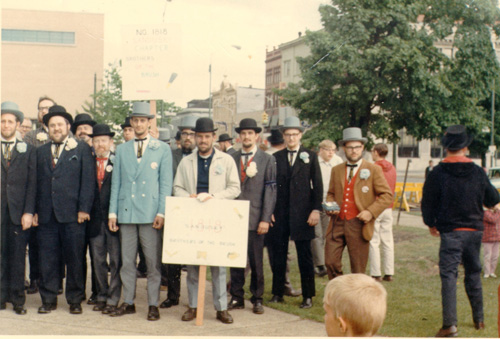
In the weeks leading up to the Sandusky Area Sesquicentennial, several men gave up shaving and grew beards. The men called themselves the Brothers of the Brush and they had a ceremonial burial of Ray Zor. (Get it?)

Visit the Sandusky Library to read about the Sandusky Area Sesquicentennial in Portraits from the Past, a souvenir booklet that sold for $1.75 in 1968. The Sandusky Library Archives Research Center also owns a bound copy of the special Sesquicentennial edition of the Sandusky Register from June of 1968. Ask at the Reference Services desk if you would like to view these items.

Wednesday, November 07, 2007

Veterans Day, Nov. 11: George Schiller, Last Spanish-American War Veteran in Erie County

At the time of his death in September 1977 at age 99, George S. Schiller was the last surviving Spanish-American War veteran in Erie County. In his own words: "I enlisted April 25, 1898, right after the sinking of the Maine." He served in Company B of the 16th Ohio Militia, which was renamed the 6th Volunteer Infantry after becoming part of the national army. Schiller and his unit were shipped off to Cuba on December 22, 1898, but by then the worst of the battles were over, with Spanish defeat following soon after. Company B returned home to Sandusky in May 1899, receiving a welcoming parade on Columbus Avenue, as seen below.
George Schiller lived a long and fruitful life, using his experience as an Army cook in a restaurant and catering career. He was an active member in several veterans organizations, including being elected National Senior Vice Commander-in-Chief of the United Spanish-American War Veterans at age 97. A lifelong resident of Sandusky, he is buried in Oakland Cemetery.