Showing posts with label Tebbutt. Show all posts

Sunday, October 28, 2018

Commercial Building at the Southeast Corner of Market and Wayne Streets


This picture of the Bing’s Furniture Store at 202 East Market Street was taken by Helen Hansen in 1983. At that time the building recently had a face-lift which included the addition of shutters over the upper level windows, and sandblasting of the exterior brick. This commercial building was built by Sandusky contractor George W. Doerzbach in the Spring of 1894. It originally was a one hundred foot square brick structure. An article in the Sandusky Register of March 30, 1894 reported that the foundations of the building were blasted out of the stone bedrock. The stone that was blasted was then used in the basement and the first floor. Klotz and Kromer provided the engines that drove the elevator. A tin roof was put in by J. Mertz and Son, and the interior painting was done by Holland and Tebbutt. Total cost was $40,000 (about $1.2 million today). 

Here is an illustration from the Sandusky Register which depicts the building as it originally appeared:

 From the Sandusky Register, Mar. 30, 1894
The basement was leased to Engels and Krudwig, who pressed 400 tons of grapes in the fall of 1893, while the construction was still ongoing. In April of 1894, the J.L. Hudson Store opened at this location, after having previously done business in the Hubbard Block. The J.L. Hudson Company, which had its headquarters in Detroit, claimed that their store was the largest and finest in Erie County.


The April 9, 1894 issue of the Sandusky Register reported that at Hudson's grand opening, Professor Theodore Taubert’s orchestra provided musical entertainment, and potted plants and ferns decorated the store. Mr. J.L. Hudson himself arrived from Detroit to be present at the opening of his store’s newest location. The store sold men’s clothing and hats, women’s apparel and dry goods. J.P. Hicks was the manager. Mr. Hudson died on July 5, 1912, and soon after, in the summer of 1913, articles in the Sandusky Register announced that the Sandusky store would soon be closing. 

For a short time, John J. Healy operated a retail store at the site of the former J.L. Hudson store. Jacob H. Herman sold furniture and carpets here for many years, until the Bing Furniture moved in to this site in the 1940s. Since 1987, Value City Furniture has been in business at the southeast corner of Market and Wayne Streets in Sandusky. 

*In January 2025, Value City announced it was going out of business. The future of the building is presently unknown.

Monday, December 12, 2016

The Ivonhoe Theatre


In 1914 and 1915, Charles L. Blatz was the owner and manager of the Ivonhoe Theatre, located on the west side of Jackson Street between Market and Washington Streets. An advertisement for the theatre stated that it was “built to conform to the Ohio State code, is absolutely fire and panic proof.”  Music was provided by a special musical instrument, the “American Photo Player,” which combined piano, organ, and musical and sound effects in one unit. In the lobby of the Ivanhoe, hung a painting by Ralph S. Tebbutt, said to be a rendition of a "Native American maiden." The model for the painting was Mr. Blatz’s niece, Ivon Gamble. Ivon was about nineteen years of age when Tebbutt did the painting.  


Ivon Gamble married Augustus Feick in September of 1921. Following the death of Mr. Feick in 1938, Ivon married John W. Campbell. Mrs. Ivon Gamble Feick Campbell passed away in 1985 at the age of 90. She is buried in Oakland Cemetery next to her first husband, Augustus Feick. Mrs. Ivon Campbell is pictured below in her later years.


Mr. Norbert Erney wrote a piece of sheet music entitled “Ivonhoe,” in honor of the theater. The sheet music is now located in the Arts Collection of the Sandusky Library Archives Research  Center. By 1916, the theater on Jackson Street became known as the Plaza Theater.


Saturday, March 14, 2015

Camptown


A neighborhood on the eastern part of Sandusky was once known as Camptown. It is located east of Sycamore Line and south of Scott Street, including First, Second, Third, Fourth and Fifth Street. Camptown was named after John G. Camp, John G. Camp, Jr. and Jacob A. Camp, who added this section of the city to the original plat of Sandusky in 1852.  In the 1800s, St. Ann’s Chapel was built in Camptown as an outreach of Grace Episcopal Church. This chapel later became Calvary Episcopal Church, which is now in use as a wedding venue. Around the turn of the twentieth century, Philip Schmidt ran the Camp Town grocery store at the corner of Monroe and Meigs Streets, on the edge of the neighborhood. In the 1870s, artist Samuel Tebbutt lived on Second Street. The neighborhood has always been primarily residential. Though no signs of the name Camptown remain today, thousands of tourists drive through the section of Sandusky formerly known as Camptown, on their way to Cedar Point each summer.

Thursday, May 31, 2012

Commodore Denig Post, American Legion

In the summer of 1920, a silk flag was presented to the Perry Post, No. 83, American Legion, by Mrs. Herbert Farrell. The ceremony took place in the garden of Mr. and Mrs. Farrell at 414 Wayne Street. Pictured from left to right are: Lieut. Commander August Wilhelm, C.H. Richardson, Wesley Till, Norbert Hemmerlein, Lester Tebbutt, Earl Krueger, Post Commander, Norman Gagen, Mrs. Herbert Farrell, Lieut. Claud Zerbe, Lieut. Chester Teasel, Carl Ziegler, Russell Hetrick, and Commodore Robert G. Denig. By 1927 the name of Sandusky’s American Legion Post was changed to the Commodore Denig Post, No. 83.


Commodore Robert G. Denig had a long and successful naval career. He graduated from the United States Naval Academy in 1873. Commodore Denig participated in a military expedition in Mexico in the 1870s, and later served in the Spanish American War. During World War I, Commodore Denig was an inspector of naval war materials. You can read a brief biography of Commodore Robert G. Denig, along with the biographies of several other World War I veterans, in the Erie County Edition, Honor Roll of Ohio, 1917-1918, housed at the Sandusky Library. Inquire at the Reference Services desk for more information.

Saturday, November 05, 2011

Samuel and Fredericka Tebbutt

Samuel and Fredericka Tebbutt were married in Erie County, Ohio in October of 1875. The former Fredericka Zanger was the daughter of John and Louisa Zanger. She was born in New York State. Samuel Tebbutt was the son of Samuel and Ann Tebbutt, who were both natives of England. The elder Samuel Tebbutt came to the United States in the 1860s, where he worked as a house painter. Ralph Smalley Tebbutt, another son of Samuel and Ann Tebbutt was a well known painter in Sandusky. The younger Samuel Tebbutt worked as a professional sign painter, but he painted landscapes as a hobby. This painting of a stone powder magazine from Johnson’s Island, by Samuel Tebbutt, can be seen at the Follett House Museum.


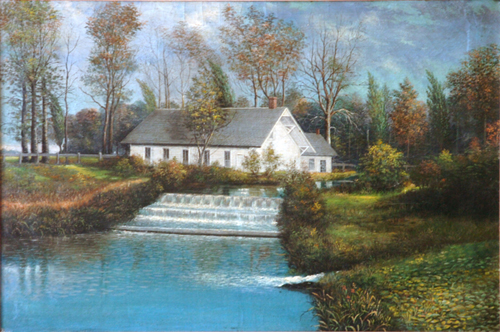
These New England scenes were also painted by Samuel Tebbutt.

 
Fredericka Tebbutt died in 1926, and Samuel Tebbutt died in 1939. They are buried in the family lot at Oakland Cemetery.

The book Artists in Ohio, 1787-1900: A Biographical Dictionary features brief biographical sketches of hundreds of artists from Ohio. To see this book inquire at the Reference Services desk at the Sandusky Library.

Monday, January 08, 2007

Ralph Smalley Tebbutt—Artist

Ralph Smalley Tebbutt was a well known Sandusky area artist. Born in England on May 14, 1849, he immigrated to Sandusky with his parents when he was five years old.

For sixty years he ran a painting and decorating business. For a time, was in business with another local artist, John Holland, but they dissolved their partnership in January, 1895. We know that in 1870, Tebbutt kept a studio in the Reber Block in downtown Sandusky.

Ralph Tebbutt lent his talents to local efforts. During the first World War, painted signs and banners for the Red Cross. In 1920, he painted two scenes for a pageant that was put on by local school children. One was a scene of the Santa Maria, and the other was for a sketch about Francis Scott Key.

Tebbutt enjoyed painting religious scenes, and several were given to area churches. Tebbutt used many mediums, including oil, pastel, charcoal and watercolor. He painted portraits, landscapes, religious themes, marine paintings, manufacturing plants, ships and animals.

An article appeared in the Register after his death detailing a quartet of four drinking scenes painted for a forgotten local brewery. The article described the paintings as “remarkably free in execution, that is they are natural and look as if they just flowed from the painter’s brush. The lights and shades, shadows and expression are handled with all the skill of a master painter.” No one knows what became of these paintings.

He painted for the love of the work, apparently never attempting to sell his work, although if offered a price and it suited him, he would sell and did sell many of his paintings. According to his son, Tebbutt painted constantly until his death. At the time of his death, art critics were saying that Tebbutt had many earmarks of a genius.

Ralph Smalley Tebbutt died March 4, 1930 at the age of 81. He is buried in a family plot in Oakland Cemetery.