Showing posts with label Industry. Show all posts

Wednesday, January 03, 2024

A Celebration at New Departure


In November 1954 the General Motors Corporation celebrated the production of its 50 millionth automobile, with commemorations at 114 General Motors plants throughout the United States. The New Departure plant in Sandusky, which made precision ball bearings for GM vehicles, participated in the event with a factory open house on November 23.  


The doors of the plant, on the corner of Hayes and Perkins Avenues, opened to the public at one o'clock. 


Visitors followed a directed route through the factory to view production operations, along with historic displays; the tour ended with an exhibit of the new 1955 model automobiles from Chevrolet, Buick, Oldsmobile, Pontiac, and Cadillac, as well as the new line of Frigidaire appliances. It was noted that all of these products used bearings manufactured at New Departure.


More than 4000 people attended the open house, according to New Departure officials.


The New Departure Company began in 1889, and was acquired by General Motors in 1916. The Sandusky plant opened in 1946. The Sandusky Library Archives Research Center holds a scrapbook compiled to commemorate the New Departure open house and the celebration of GM's 50 millionth automobile.

Wednesday, April 12, 2023

Scott Paper Company in Sandusky

1972 aerial picture of Scott Paper Co. from the Thomas F. Root Collection

From 1945 until it closed in 1981, Scott Paper Company did business on West Shoreline Drive, at the foot of Fulton Street. (In the 1940s and 1950s, Shoreline Drive was known as Railroad Street.) In 1945 the Scott Paper Company took over the assets of the Automatic Paper Factory, which had been in Sandusky since 1942. A page from the 1955 Sanborn Fire Insurance Map shows the Scott Paper plant adjacent to Sandusky Bay.


The Sandusky plant of Scott Paper was the Cut Rite Division, which manufactured wax paper. In a special section promoting local industry, an article in the November 9, 1956 issue of the Sandusky Register Star News reported that the Scott Paper Company concentrated on quality. The goals were to: make a limited number of consumer products of highest quality, manufacture them at the lowest possible cost, and to advertise widely. The advertisement below appeared in the Sandusky Register Star News of February 11, 1954.


Eventually the Scott Paper Company in Sandusky also began manufacturing disposable wipes. By 1980, the company had 400 employees. In 1980, there was talk of phasing out the Sandusky division of Scott Paper. Local efforts to keep Scott Paper in Sandusky included the catch phrase, “Great Scott, Don’t Go.”


However, company officials ultimately decided to close its facility in Sandusky. The Cut Rite waxed paper division moved to Fort Edward, New York, and the production of Baby Fresh wipes was transferred to Dover, Delaware. Today Kimberley Clark is the parent company of Scott Paper products.

Though it was only in Sandusky, Ohio for thirty five years, Scott Paper Co. provided jobs for hundreds of local residents. Looking through old copies of the Sandusky Register, you might notice the Scott Paper Company mentioned often in wedding announcements and obituaries.

Tuesday, June 29, 2021

The All American: Newsletters from the American Crayon Company


Seventeen issues of The All American newsletters from the American Crayon Company are housed in the business collections of the Sandusky Library Archives Research Center. The newsletters covered company news, information about the managers and employees of the company, photographs, poems, and travel articles. This item from the June 1922 issue paid tribute to the company president, L.L. Curtis, on the occasion of his seventieth birthday.

George Koch described the Art Department of the Kroma division of the American Crayon Company in the July 1925 issue. He stated that the view from his office, which faced Sandusky Bay, often gave him inspiration for his work. The employees in the Art Department created cover designs for the various styles and sizes of products.

In this article by C.W. Hord, who was with the American Crayon’s sales department for many years, he describes the process by which “Old Faithful” was chosen as a trademark for the company.

Though the American Crayon company is no longer in operation, for decades the company provided jobs locally and in other states for hundreds of individuals. To view the historic newsletters, which range in date from 1921 through 1925, visit the Sandusky Library Archives Research Center.

Thursday, April 15, 2021

Small Appliances Made in Sandusky


From about 1929 through 1934, the Made Rite Manufacturing Company was in business in Sandusky at the southwest corner of Shelby and Water Streets. The pie sealer, pictured above, prevented the pie filling from spilling out of the crust and making a gooey mess in the oven. 

The Made Rite electric toaster from the 1930s looks a lot different than the toasters we use now:


Other products made by the company included waffle irons, mixers, and a unique incubator in which the chicks could regulate the temperature by themselves. An article in the April 13, 1934 issue of the Sandusky Star Journal featured an advertisement from the M.R. Herb Company where parents were urged to bring their children in to the store to see the live baby chicks housed in Made Rite chick-o-matic incubators. 

From 1932 to 1934, the officers of the Made Rite Manufacturing were George C. Hill, president; Norbert J. Kuebeler, vice- president; and Arthur Cronenberger, secretary. Ultimately, the company was acquired by the Weinig Products Company, and eventually all operations in Sandusky ceased. The Follett House Museum is home to several locally made products. Visit the museum to see clothing, household items, furniture, photographs, and many other historical items from Sandusky and Erie County.

Monday, March 15, 2021

Bay Shore Manufacturing Company


This receipt from the Bay Shore Manufacturing Company in Sandusky, dated March 31, 1908, indicates that John Feick purchased 1452 feet of select poplar 4 x 4s from the company at a cost of $72.60. According to an annual report from the Ohio Secretary of State, the Bay Shore Manufacturing Company filed articles of incorporation on April 2, 1909. A brief notice in volume 31 of the American Bottler stated that the Brewers’ Bottle Case Association had purchased the Sandusky business of the Bay Shore Manufacturing Company, and was moving its operations to Cincinnati, Ohio. The company made cases for all kinds of bottles.

Another reference to a company known as the Bay Shore Manufacturing Company was mentioned in the December 30. 1914 issue of the Sandusky Register. 


The article explained that the “Always Full Grocery Cabinet” was going to soon be put on the market by the company. The Sandusky Sash, Door and Lumber Company had a contract to make the cabinets that Bay Shore designed. The “Always Full Grocery Cabinet” was patented by former Sandusky residents George W. Maley and Fred Schweinfurth. Below is a page from their patent:


Though these two companies existed and evidence of that fact is found in books and newspapers, there is no listing for the Bay Shore Manufacturing Company in any Sandusky City Directories dated between 1908 and 1914. Perhaps they were not in business long enough to appear in local directories. Many aviation and automobile companies also failed in the early twentieth century, as technology was changing so rapidly.

Saturday, April 27, 2019

Early Images of the Hinde and Dauch Paper Company


Pictured above are employees of the Hinde and Dauch Paper Company, probably around 1890. In 1888, Jacob J. Dauch and James J. Hinde took over the Sandusky Paper Mill, which was located at the southeast corner of Shelby and Filmore Streets. Both Mr. Dauch and Mr. Hinde had been farmers in Erie County, and they made extra income by baling straw and selling it to the Sandusky Paper Mill for use in making paper from the straw. 

The Hinde and Dauch Paper Company was incorporated in 1900.  That same year, this commemorative medal was presented to Hinde and Dauch at the Exposition Universelle in Paris, for the company’s achievements in the manufacturing of paper products.

Below are several of the company’s employees in 1905 at the Hinde and Dauch factory at the northeast corner of West Water Street and Decatur Streets, known in later years as the Keller Building.

        
The Hinde and Dauch Paper Company became known worldwide as a major manufacturer of corrugated boxes. The Water Street factory had to be re-built in 1906 in order to keep up with the demand for corrugated boxes. 

These Hinde and Dauch employees are seen riding on a truck, in preparation for a parade.

During the years of 1917-1918, the Hinde and Dauch Paper Company built a new factory at the site of the former Woolworth Handle Factory, which was across the street from the Water Street factory on a pier along Sandusky Bay. The general offices remained in the Water Street location.

In 1927, the general offices of the company were moved from the old Water Street factory to a new building at 407 Decatur Street, now home to the Sandusky City Schools Board of Education. In the first half of the 1900s, Hinde and Dauch had factories in several locations throughout the United States and Canada. In 1953, the company was acquired by Westvaco. For most of the 1980s, the company operated as Displayco Midwest, which was bought out by Chesapeake in 1989. The factory closed in 1997. The former Hinde and Dauch building, pictured above, at 401 West Shoreline Drive is now home to Chesapeake Lofts. An article which provides the history of the development of Hinde and Dauch is available online. 

Monday, April 15, 2019

Paul Swessinger, Sandusky Businessman


According to an article in the April 15, 1916 issue of the Sandusky Star Journal, Paul Swessinger was one of Sandusky’s best known German-American citizens. He was born in Nemigen, Germany on January 15, 1849. After first residing in Kelleys Island, Mr. Swessinger settled in Sandusky, Ohio. In the 1880s and 1890s, he was a dealer in groceries and provisions at the southwest corner of Lawrence and Adams Streets. For a time he also operated a saloon and beer bottling works along with the grocery store. The 1900 and 1902 Sandusky City Directory listed him as the proprietor of the Imperial Cafe, a popular bar and restaurant at the northwest corner of Columbus Avenue and Water Street in downtown Sandusky. By 1904 he was also the president of the Swessinger Manufacturing Company.


The  company, on South Depot Street near Hayes Avenue, made and sold bank, office, bar and store fixtures. In 1910, Mr. Swessinger was operating an automobile garage on Jackson Street.  Besides the many business ventures already listed, around the turn of the twentieth century, Paul Swessinger operated a Sight Seeing Car at the foot of Columbus Avenue.


The vehicle had open sides, solid rubber wheels, and was about the same size as a streetcar. It met the incoming boats and trains, to provide tourists with a tour of the city of Sandusky. 

Paul Swessinger died on April 15, 1916. He was survived by his wife, a son, daughter, three brothers and two sisters, one still living in Germany. Funeral services were held at his home on Central Avenue, and burial was in Oakland Cemetery.

Thursday, April 04, 2019

Enterprise Glass Works


Though it was only in existence for a relatively short time, the Enterprise Glass Works was once a booming business on Sandusky’s west side, on Superior Street. In the book What: Souvenir of Sandusky, Ohio (Hill and Dolly, 1903), an advertisement for the Enterprise Glass Works listed C.W. Smalley as President, A.J. Bates as the Vice-President and Manager, and J.E. Smalley, Secretary and Treasurer. A page in the 1905 Sanborn Fire Insurance Map shows the close proximity of the Enterprise Glass Company to Sandusky Bay. Pictured is Plant number 1. Plant number 2 was adjacent to Plant number 1.


In the early years, the glass made at Enterprise Glass Works was hand-blown. Once the glass was blown, it went to another part of the plant for flattening. At the end of the day, some of the employees made glass canes and other items from glass that was left over from the day’s work. One hundred men were employed at the company in 1910, but by 1916, the Enterprise Glass Company was in receivership. In the 1920s, the Sandusky Glass Manufacturing and Supply Company was in business at this site. Periodical Publishers Service Bureau also was at this location for a number of years. 

To read more about glass manufacturers in the city of Sandusky, see the Sandusky Register of February 18, 1995, now available on microfilm at the Sandusky Library Archives Research Center.

Saturday, December 15, 2018

A History of the Coal Docks


Two centuries ago, Sandusky’s founders assumed that Sandusky’s protected harbor destined the city to become the leading port on Lake Erie. Unfortunately, this was not to be the case. The problem was simply that the entrance to the bay was blocked by shifting sand bars, and the bay itself was shallow and difficult to dredge because of the underlying limestone. The original channel into the bay followed the convoluted course of the Sandusky River bed in the direction of Johnson’s Island and then turned south to the city’s waterfront. The channel and the waterfront docks were shallow and poorly marked. Ships often ran aground or hit submerged rocks, and Sandusky soon earned a reputation as a port to be avoided. Cleveland, Lorain and Toledo thrived. Sandusky languished.


Recognizing the situation, improvements were continually made during the course of the 19th and early 20th Centuries. In 1889, the “Straight” channel 17 ft. deep was dug from the foot of Warren St. to the tip of Cedar Point and the channel was marked, but the “Dock Channel” along the waterfront remained unmarked and quite shallow. In 1895, construction was begun on a Jetty at the tip of Cedar Point in an ongoing effort to prevent sand from blocking the entrance to the bay. 

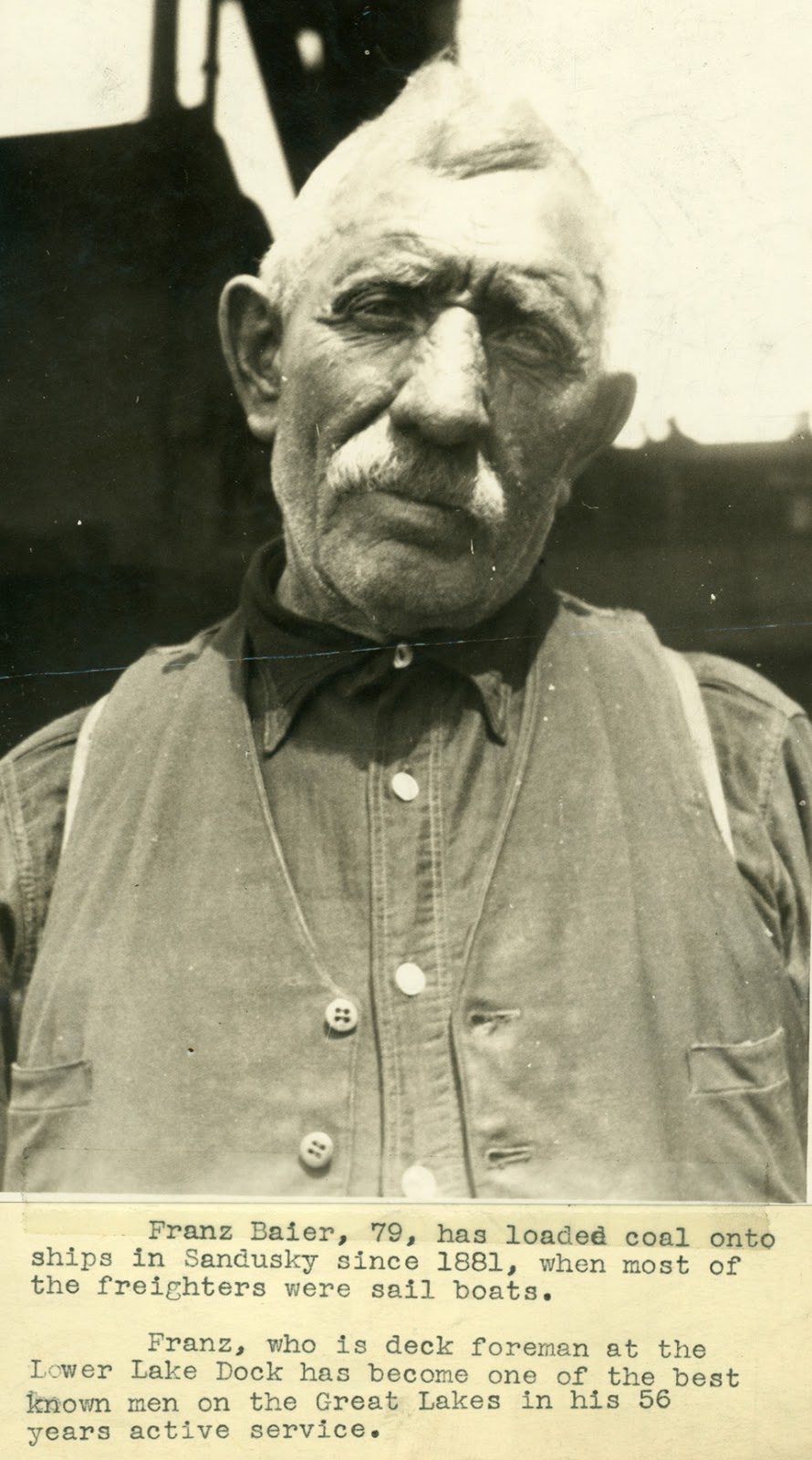
Iron ore, lumber, coal, and grain were shipped in large quantities from the B & O docks at the foot of Warren St. but as ships got bigger and bigger, these improvements proved to be  too little and too late. The mouths of the Maumee, Black and Cuyahoga Rivers were easy to dredge. Sandusky Bay was not. Sandusky prospered, but it was unable to attract heavy industries such as steel manufacturing that depended on deep water ports. One by one companies began to close their shipping operations in Sandusky in the early years of the 20th Century with one notable exception – the Coal Docks.


In 1891, the Sandusky & Columbus Short Line Railroad Company opened a straight track from Sandusky to Columbus and constructed the original Coal Dock later known as Pier #1 at the foot of King St. The City of Sandusky helped fund construction of the pier and the cost of dredging to allow lake freighters access to the pier. The small freighters of the day were initially loaded by hand using wheelbarrows, but in 1893, Pier #1 was equipped with a steam driven loading apparatus known as the “Whirly.” Workmen loaded coal in buckets that were then whirled over the side of the freighter where they were dumped and then whirled back in a continuous circle. In 1898, the “Whirly” was replaced by a new ship loader that could lift a coal car to a level above a ship’s deck from where its contents could be dumped into the cargo hold. It could unload fifteen coal cars per hour which meant that a four and a half ton cargo could be loaded in just under six hours.

In 1902, the Sandusky & Columbus Short Line Railroad was purchased by the Pennsylvania Railroad and the coal dumper on Pier #1 was replaced with one that could handle up to 25 cars per hour. Coal demand was high, and in 1914, a second dumper was installed on Pier #2 located just to the west of Pier #1. The coal shipped from the docks was originally destined primarily for power production, but the docks were beginning to supply more and more coal for steel production.  In 1937, with Piers #1 and #2 operating around the clock and larger and larger freighters being constructed, the Pennsylvania Railroad announced a mammoth project that was destined to transform the Sandusky harbor and finally resolve the issues associated with the harbor’s channels.


A new Pier, designated #3, was to be constructed west of Pier #2 that would be almost a mile long and 600 ft. wide. A new dock channel with a wider turning basin, and a “Bay Channel” that would permit ships to return to the lake to the north of the “Dock Channel” were part of the project.   Eleven million tons of steel sheeting and pilings and the 2.5 million cubic yards of silt and debris that were dredged from the bay were used in the construction of the pier. The crowning achievement was the construction of a giant new Coal Dumper which Sanduskians have enjoyed watching operate to this day as it lifts coal cars high in the air and dumps their contents into the holds of today’s huge lake freighters. The new dumper stands 172’ above water level and could dump 30-35 50 ton rail cars per hour.  In 1944 when the demand for coal peaked, a record 14.3 million tons of coal were shipped from Piers #1, #2 and #3.

People enjoy watching freighters enter and leave the bay and sometimes wonder why we don’t see as many freighters these days. The answer is simple. In 1955 Sandusky loaded 1123 lake freighters with 8.1 million tons of coal. It would only take 270 of today’s much larger freighters to haul the same amount.  Piers #1 and #2 could not accommodate the larger freighters which resulted in Pier #2 being closed in 1957, and Pier #1 being closed in 1969.


When the docks were sold to the Norfolk and Western Railway Company in 1964, plans were soon underway to add a coal stockpiling and reclaiming facility to Pier #3. It was designed to provide space for one million tons of stockpiled coal and incorporated nearly 2.56 miles of interconnected conveyer belts. Three silos were installed 40 ft. in diameter and 194 ft. tall each with a capacity of 3,500 tons. Two large pieces of equipment were constructed to move stockpiled coal of different grades to the silos or directly to a waiting freighter. The “Bucket Reclaimer” which stands 45 ft. tall and weighs over 320 tons can move 3,000 tons of coal per hour. The “Bandwagon” which stands over 90 ft. tall and weighs 310 tons can stack coal into storage piles and work in conjunction with the “Reclaimer” to transport coal from storage piles directly to vessels. These two pieces of equipment increased vessel loading capacity from 3000 to 7,000 tons per hour and on September 3, 1988, Pier #3 loaded a 989’ long freighter with 59,058 tons of coal, a record for the Great Lakes.

Now owned and serviced by Norfolk Southern and operated by Sandusky Dock Corporation, the Pier #3 coal dumper has been in operation for 79 years. Remarkably, it is able to efficiently handle today’s 100 ton rail cars that are 50 tons heavier than those of the 1930’s.  Today 95% of the coal shipped from Sandusky is used in the manufacture of steel.

Sandusky, like most cities in along the Great Lakes has lost much of its industry during the past forty years, but the Sandusky Dock Corporation continues to evolve and prosper utilizing ever more advanced equipment and technology. Orders for different grades of coal can be filled promptly and efficiently thanks in large part to the foresight of the men who designed Pier #3 many years ago. The Sandusky Docks are a tremendous asset for our community. The Pier #3 coal dumper ranks with the Top Thrill Dragster as one of Sandusky’s premier attractions.  Sandusky would not be the same without it.


Thursday, October 25, 2018

Brown Clutch Company and Brown Industries


Though it is no longer in business, for many years the Brown Clutch Company, later Brown Industries, played an important role in several different lines of manufacturing. The Brown Clutch Company of Elyria, Ohio began doing business in Sandusky in 1907. It was located at the site of the former Dunbar Manufacturing facility at what is now 1737 Camp Street, where the Sandusky Automobile Company had been in business from 1902 to 1904. In the early years of the automobile industry, the Brown clutch was widely respected as a very reliable clutch, which allowed for the starting of a gasoline engine without moving all the machinery that was attached to the engine.


Later the company also manufactured gears for motorboats. 

T.T. Morgan was the general manager in 1908, and he became president of the company in 1913.


Under his leadership, the Brown Clutch Company grew from a small business to a manufacturing facility that was known all over the United States for its excellent workmanship. 

This is a view of the fly wheel with pulley, made by the Brown Clutch Company in the 1920s:
 

In the 1930s, the Brown Clutch Company became known as Brown Industries. After Oliver Rinderle, Sr. took over management, the company concentrated on foundry and pattern shop production. During World War II, over half of the production of  Brown Industries was devoted to heavy gasoline and diesel engine manifolds and cylinder heads, for use in tanks, trucks, cranes, shovels, marine unites, and many other motor-powered units which were valuable to the war effort. 

Brown Industries merged with the Sterling Foundry Company in 1972.  Today J & V Pallets is in operation at the site of the former Brown Industries. Visit the Sandusky Library Archives Research Center to view a 1922 catalog from the former Brown Clutch Company.

Tuesday, October 16, 2018

Ohio Structural Iron Company, Predecessor to Mack Iron Works


John D. Mack and A.C. Blinn founded the Ohio Structural Iron Company in 1901, after they purchased the Crandall Iron and Fence Company, located on Warren Street in Sandusky. These advertisements, the one below from an early issue of Park and Cemetery and Landscape Gardening, let us know exactly what types of products were made by the Ohio Structural Iron Company.


In 1903, the Ohio Structural Iron Company manufactured 200 lawn seats for the parks of the city of Toledo, and 100 lawn seats for the National Soldiers’ Home in Dayton, Ohio. The company built a fire escape that could fold up like an accordion for the Donahue building in Sandusky in 1905. 

After John D. Mack bought out Mr. Blinn’s interest in the company, he changed the name to Mack Iron and Wire Works. This company got a contract for building an iron fence around the Confederate Cemetery at Johnson’s Island, according to an article which appeared in the September 2, 1912 issue of the Sandusky Register. The fence was four feet in height and had ornamental posts and arched gates. 

A tornado seriously damaged the Mack Iron and Wire Works building in June of 1924.


In 1925, as the company was re-building, John D. Mack hired his son-in-law to manage the Iron Works, so he could devote more time to the Sandusky Register, where he served as Vice-President and Treasurer. Having weathered setbacks during the Great Depression, in the 1940s, Mack Iron made defense materials in support of the U.S. War Effort. So many of Mack’s regular employees went off to serve in World War II, that to keep up production the company brought in German prisoners of war from Camp Perry to work on the lines. After the war, Mack Iron moved from foundry work to metal fabrication. A lengthy article in the April 22, 2001 issue of the Sandusky Register reported that projects made by Mack Iron can be seen at Sandusky City Schools, the Erie County Jail, the County Parking Garage, a coaster at Cedar Point, and many other area buildings. 

You can read more about the history of Mack Iron Works in the Sandusky Register of April 22, 2001, now on microfilm at the Sandusky Library Archives Research Center. The company motto of the Mack Iron Works Company is:  “Quality people doing quality work.” 
 
An aerial view of Mack Iron, taken by photographer Thomas Root in the summer of 1965.


Friday, September 28, 2018

Iron Skillet Made in Sandusky


This iron skillet, now housed at the Follett House Museum, was created at the Co-Operative Foundry in Sandusky, Ohio. The top of the handle of the skillet featured an opening for ease of storage in one’s home kitchen.


The Co-Operative Foundry was located at the southwest corner of Water and Shelby Streets in the 1890s and early 1900s. In 1900, the president of the company was John J. Molter, who once served as Sandusky’s Postmaster, and later as its Mayor.


According to the 1900 Sandusky City Directory, the Co-Operative Foundry employed founders and machinists. The company specialized in brass and grey castings, and also did blacksmithing “in all its branches.” The 1893 Sanborn Map shows the exact location of the Co-Operative Foundry:


A brief article in a 1906 issue of the Foundry magazine stated that the Co-Operative Foundry and Machine Company had been taken over by the Sandusky Foundry and Machine Company, later known as Sandusky International, and now the Sandusky International Division of MetalTek International.

Friday, August 03, 2018

The O-P Craft Company


The O-P Craft Company was organized in November, 1929, with these officers: Earle F. Opie, president and general manager; Leland Spore, vice-president; Charles E. Frohman, secretary; and Albert L. Opie, treasurer. In the early years, the company was located in the 600 block of Hancock Street, and made school supplies. The company logo contained the letters O and P, and looked like a person holding up a hand.


In the 1932 Sandusky City Directory, Earle F. Opie was also listed as the educational manager of the American Crayon Company. By 1935 the O-P Craft Company had moved to 161 E. Water Street. In 1946, the company announced plans to move to a new building in the 400 block of Warren Street. 

Catalog No. 57 of the O-P Craft Company featured products that designed for consumers to decorate themselves, such as boxes, frames, buttons, relish trays, bookends and other decorative items. The basswood hinged lid boxes were a popular item. Pictured below are some hinged boxes from a 1976 O-P Craft catalog.


In this undated advertisement from The N.O.W. Scene, Strickfaden Nursery had a craft shop that carried decoupage craft items with the raw materials supplied by O-P Craft Company.


Bill Opie, the son of Albert L. Opie, eventually took over the business. He expanded the company into plastics. In the early 1980s, O-P Craft Co. became known as Laffer Industries. Laffer Industries later became FormPac. In 1996, FormPac was acquired by Tuscarora, Inc. In 2003, Tuscarora closed its Sandusky plant.