Showing posts with label Mayors. Show all posts

Saturday, May 20, 2023

George T. Lehrer, Mayor of Sandusky


George T. Lehrer is seen at the far right above, in an undated photograph which shows a group of men at the back of a train car. He was born in 1863 to Rev. J.G. Lehrer, one of the earliest pastors of Zion Lutheran Church, and the former Susanna Kneb. 

For forty years, Mr. Lehrer was the owner of a drug store on Washington Street in Sandusky.

Besides being well known as a Sandusky businessman, Mr. Lehrer was prominent in Republican political circles. He was director of the Erie County Infirmary for several terms. In the fall of 1909, he was elected Mayor of Sandusky, defeating J.J. Molter, who had been mayor for four terms.


When Theodore Roosevelt was campaigning in Sandusky in 1912, as a member of the Bull Moose Party, Mayor Lehrer was seated on the platform, not far from the American flag.

During his first term as Mayor, Lehrer authorized the purchase of the first motorized fire equipment for the city of Sandusky. When Sandusky went to the Charter form of government, Mr. Lehrer was appointed City Manager. In 1918, he resigned his position, and was succeeded by George M. Zimmerman. 

On March 6, 1938, George T. Lehrer died at the age of 74, just weeks after he celebrated his Golden Anniversary with his wife, the former Elisa Schmidt. The final resting place of Mr. and Mrs. George T. Lehrer is Sandusky’s Oakland Cemetery.

Saturday, August 07, 2021

Charles Cross, Mayor of Sandusky 1853-56

Charles Cross was born in England in 1812. In July 1830 he, along with Dr. I. B. Ward and several other families, sailed on the packet ship Hudson from Portsmouth, England to New York. Dr .Ward went on to settle in Zanesville, but Charles Cross remained in Sandusky.


On St. Patrick’s Day in 1844 Mr. Cross was on a committee which promoted celebrating the holiday according to the principles of temperance. He was very active in the Roman Catholic Church in Sandusky. In 1853, he was elected Mayor of Sandusky, and served through 1856.  He also served as councilman, city clerk, secretary of the Board of Water Works, and Justice of the Peace. In 1874 he was the magistrate for two cases involving Rush Sloane, another Sandusky Mayor.

Mr. Cross had been widowed while a young man. One son, also named Charles Cross, became a photographer in Sandusky.


His grandson, Nicholas Charles Cross, became “Brother Sulpicius” in the Xaverian Order of the Catholic Church, having started out as a catechist at Sandusky’s Holy Angels parish.

On November 18, 1889, Charles Cross, Sr. died suddenly from heart disease. His obituary in the Sandusky Daily Register stated that “it can truthfully be said that he did not rob the public nor use office to multiply fees and increase the burden of taxes.”  He was interred in St. Joseph’s Cemetery.

To read more about Charles Cross’s trip to America, see the article “An English Colony” by Hudson C. Ward in the Sandusky Daily Register of December 3, 1889, on microfilm in the Archives Research Center of the Sandusky Library, or via the Newspaper Archive online database, available through the library's website.

Monday, March 22, 2021

E.W. Altstaetter, Mayor of Sandusky


After having served as City Commissioner of Sandusky during the early 1920s, Edward W. Altstaetter was Sandusky’s Mayor from 1926 to 1930. Mr. Altstaetter issued several proclamations during his years as Mayor. In 1926, He made a Proclamation of Art Week from April 11 to 18, which was published in the Sandusky Star Journal on April 10, 1926. 


The proclamation indicated that an appreciation of art would result in “better and more artistic homes, more harmonious and attractive dress, and a more beautiful city and community.” An article in the Sandusky Register of November 9, 1927 printed an Armistice Day issued by Mayor Altstaetter. A portion of the Armistice Day read: 


An interesting proclamation issued by Mayor Altstaeter on January 30, 1929, was his endorsement of “Brake Test Week.” In this proclamation, the Mayor called on the citizens of Sandusky to test the brake equipment of their automobiles, and have faulty brakes adjusted or repaired, to reduce the number of traffic accidents in the city. The Mayor also issued a proclamation urging local citizens to attend the ceremony of the opening of the Sandusky Bay Bridge, which was a huge accomplishment at the time. This proclamation appeared in the Sandusky Star Journal on January 30, 1929. During Mayor Altstaetter’s term as Mayor, the Jackson Junior High School was opened, as well as the Post Office, which for many years stood at the intersection of Central Avenue, Washington Street, and Jackson Street.

Of course E.W. Altstaetter was also Mayor when the Stock Market crashed in October of 1929. When Mr. Altstaetter passed away in 1970 at the age of 91, he was the oldest insurance agent in the city of Sandusky. His concern for the well being of the citizens of Sandusky was definitely evident by the words of his many proclamations during his tenure as Mayor.

Saturday, January 23, 2021

William H. Wilson, Former Mayor of Sandusky


William H. Wilson came to Sandusky in the early 1860s, from Seneca County, Ohio.  After having worked in the stone business and the lumber industry in Sandusky, he worked for several years as a representative of the Kelley Island Lime and Transport Company, traveling out of the company's office in Cleveland. In 1877, he was elected Mayor of Sandusky, serving between the terms of George Daniel and Rush R. Sloane. Mr. Wilson was active in Masonic circles in Sandusky, as well as a member of the United Commercial Travelers. 

While on a trip to Attica, Indiana, Mr. Wilson was suddenly taken ill. A fellow Mason summoned a doctor, and telephoned the Wilson family in Ohio, to tell them of the illness. Mr. Wilson died shortly after he was taken sick. A lengthy article by Professor E. Leon of Mansfield appeared in January 21, 1909 issue of the Sandusky Register describing Mr. Wilson's final moments. 


William H. Wilson was buried in Sandusky’s Oakland Cemetery. He was survived by his wife Elizabeth, and daughters Ella Wilson and Mrs. Albert Krudwig. 

Tuesday, November 17, 2020

Philip Buerkle, Mayor and Publisher of the Sandusky Demokrat


Philip Buerkle was born in Bergen County, New Jersey, to Mr. and Mrs. August Buerkle, who were both natives of Germany. When Philip was a young child, he moved with his family from New Jersey to Sandusky, Ohio. He learned the printing trade when in the office of the Sandusky Herald. He worked as a journeyman printer in several different cities throughout the U.S., and returned to Sandusky in 1879. Mr. Buerkle worked at the Sandusky Tribune, the Sandusky Register, and later he became president of the Sandusky Demokrat Publishing Company. In the picture below, he can be seen in the upper window of the Demokrat Publishing building on Water Street.


In 1891, he was elected Mayor of Sandusky, and he was re-elected to that office in 1893. After his service as mayor, in 1897 he formed a partnership with A.C. Lermann in the insurance and real estate business. 

Philip Buerkle died on March 26, 1926, after he suffered a stroke. An obituary which appeared in the March 26, 1926 issue of the Sandusky Star Journal read in part, “For many years Mr. Buerkle was a leading figure among those of German birth and descent in Sandusky, and was prominent in German organizations.” He was survived by his wife, the former Sophia Giedeman, and two daughters, Mrs. W. B. Moon and Mrs. Charles J. Neff, and five grandchildren. The two sons in law of Philip Buerkle were partners in the Neff-Moon Toy Company from 1923 to 1927.


To read more about the business leaders of Sandusky and Erie County, Ohio, visit the Sandusky Library Archives Research Center.

Tuesday, July 17, 2018

Getting to Know Horatio Wildman, Former Mayor of Sandusky


Horatio Wildman was born in 1828 in Fairfield County, Connecticut, to Frederick Seymour Wildman, and his wife the former Julia Ann Starr. Horatio’s grandfather was Zalmon Wildman, one of the proprietors of the city of Sandusky. When addressing the Firelands Historical Society at its fall meeting on October 10, 1895, Horatio Wildman recalled his grandfather’s connection to the city of Sandusky. He said about Sandusky, that “Zalmon Wildman said the Almighty meant this location for a town. As a natural location it is unsurpassed by any in Northern Ohio.”  

Horatio Wildman was a graduate of Yale University. After studying law in Connecticut, he moved to Sandusky in 1848. By 1851, Mr. Wildman was the Mayor of Sandusky. In the 1870s, he served as the city solicitor. 

In the 1860 Sandusky City Directory listed Horatio Wildman and his wife Emma (sometimes listed as Emily) as boarding at the Townsend House, along with their two young sons Horatio and Augustus. Soon a third son, Seymour was born.

Eventually the family moved to a home at the northwest corner of Washington and Lawrence Streets in Sandusky. 

After suffering serious health issues, Horatio Wildman died on May 16, 1909. An obituary appeared in the Obituary Record of the Graduates of Yale University.


A lengthy obituary also appeared in the Sandusky Register of May 20, 1909. The article reported that the funeral was held at the family residence at the corner of Lawrence and Washington Streets, with the Ref. W. Ashton Thompson of Grace Church officiating. Members of the Erie County Bar Association attended as a body. Honorary pallbearers included Judge Thomas M. Sloane, E.B. King, Malcom Kelly, U.T. Curran, C. Webb Sadler, T.B. Hoxey, and Hewson L. Peeke. John T. Beecher, an honorary pallbearer, could not be present. Active pallbearers were George C. Beis, W.J. Feisinger, C.H. Cramer and R.B. Fisher. There were numerous floral tributes. A circular wreath was given by the Bar Association. The B and O Railway Office sent a star and crescent tribute. Horatio Wildman was buried in Block 57 of Sandusky’s Oakland Cemetery. Mrs. Wildman passed away in 1915, and she too is buried at Oakland.

Monday, February 01, 2016

Keep the Sidewalks Clear of Snow! (That is, if we ever get any this year)


On February 1, 1881, the following proclamation was made by Sandusky Mayor Rush R. Sloane.
Mayor’s Proclamation
To whom it may concern
Mayor’s Office
Sandusky, O. February 1st, 1881

Whereas, it is by ordinance of said city ordained
“That it shall be unlawful for the owner or occupant of any premises in the city of Sandusky, or the owner or agent of any occupied premises in said city, to allow any snow or ice to remain upon any stone, brick or plank sidewalk abutting on his or her premises, for more than twenty four hours after the same shall have fallen or accumulated on said sidewalk.”
And any person violating said ordinance is liable to prosecution before the Mayor upon complaint of the City Commissioner of Streets and upon conviction shall be fined from one to twenty five dollars and shall be imprisoned until the fine and costs are paid.
It is also made the duty of the Commissioner to clean all sidewalks not cleaned by the owner or occupant and to report the names of the occupants on the premises thus cleaned that they may be proceeded against as required by said ordinance.
I hereby give notice that said ordinance will be duly enforced.
Witness my hand and seal this 1st day of February A.D. 1881
RUSH R. SLOANE, Mayor


The Mayor’s proclamation appeared in the Sandusky Register of February 5, 1881. It appears that someone in the city of Sandusky was not clearing off  their sidewalks in a timely manner. Mayor Sloane wanted to inform all the citizens of Sandusky that this ordinance was to be diligently enforced. Anyone who has spent the winter in Sandusky knows that the snowfall can be quite heavy and frequent. Below is just one example of how snowy the city can become. In 1913, the snow was piled high along West Water Street, in front of George Rinkleff’s hardware store.


Saturday, October 10, 2015

Ferdinand Geiersdorf, Former Mayor of Sandusky


Ferdinand Geiersdorf was born in Munich, Germany (then Bavaria) on December 5, 1831. When he first came to Sandusky he was a poor butcher’s apprentice, but eventually he became quite wealthy in the fish business. Mr. Geiersdorf’s image can be seen in the image above on the upper left, from Plate IV in the book, Sandusky Einst und Jetzt. Below is an advertisement which appeared in the 1869 Sandusky City Directory.


From 1863 to 1867, Geiersdorf served as Sandusky’s Mayor. He was the first individual of German descent to become Mayor of the city. In his inaugural address, which was published in the April 15, 1863 issue of the Sandusky Register, he stated that because of the ongoing rebellion (the Civil War), local residents would be taxed rather heavily until the war’s end. Mayor Geiersdorf called for immediate cleaning of the streets and gutters in town, to maintain the excellent health of the residents of Sandusky. He hoped to see that the principal roads coming in to Sandusky would be maintained in good condition, to ensure the ability of visitors being able to travel to Sandusky, to frequent its offices and businesses. Mayor Geiersdorf concluded his address with the words of President Jackson, “The Union must be preserved.” 

When Ferdinand Geiersdorf died on September 22, 1870, he was greatly mourned.  In a biographical sketch in Sandusky Then and Now, it was said about him that “His goodness and readiness to alleviate need with an open hand will live after him.” The former Mayor was buried at Sandusky’s Oakland Cemetery.


A large letter G is at the top of the monument of Ferdinand Geiersdorf. The letters of his surname, appearing at the base of the monument, were designed to resemble tree branches.

Read Sandusky Then and Now, translated into English from the German version of Sandusky Einst und Jetzt, to learn more about the earliest German American residents of Sandusky.

Tuesday, January 20, 2015

Early Veterinarians' Bills


In 1878 and 1879, Jay Bogert, who ran a livery service in Sandusky for many years, paid Dr. William B.H. Hunt for his services as a Veterinary Surgeon. Dr. Hunt attended to horses owned by Mr. Bogert on three occasions. The bill for three house calls totaled $5.75. Twice Dr. Hunt administered an antispasmodic drench to Bogert's animals. According to a reference from The Modern Horse Doctor, published in 1856, an antispasmodic drench was used for spasms of either the nervous system or muscular system. Dr. Hunt was listed in the Sandusky City Directories of 1878 and 1880 as a Veterinary Surgeon at 1220 Washington Street; later he was elected as Mayor of Sandusky, serving from 1881 to 1882, and then re-elected in 1887 and 1889.


Another veterinary bill from long ago was paid to Dr. E. R. Hinkley by a Mr. Emrich on July 1, 1904.


The veterinarian called at the Emrich residence to treat a horse. His bill was $2.50. Dr. Hinkley was born in Huron County, but he spent most of his adult life as a Veterinary Surgeon in Sandusky, Ohio. His office was located on the south side of West Market Street for many years; the office is visible at the extreme right of this image of Market Street, with the Columbus Avenue intersection in the background.

Monday, July 15, 2013

Samuel B. Caldwell


This painting of Samuel B. Caldwell, now at the Follett House Museum, was painted by a strolling artist, according to the donor, Mrs. Ethelinda Griswold Free. Samuel B. Caldwell was born in Washington County, New York in 1792. During the War of 1812, he took part in the battles of Plattsburg and Lake Champlain. He married Mary S. Cady in 1815. In 1817, Mr. and Mrs. Samuel B. Caldwell moved west, along with the family of Eleutheros Cooke. First the two families resided in Indiana, and later they moved to Bloomingville, in what is now Erie County, Ohio. After Mary Caldwell’s death in 1825, Samuel B. Caldwell moved to Sandusky, where he boarded at the Steamboat Hotel.  In 1827, Samuel married Susan Boalt, the daughter of the hotel’s proprietor, John Boalt. Mr. and Mrs. Caldwell lived in this stone house at 257 Jackson Street from about 1835 until the 1850s. The property at 257 Jackson Street is now a part of the First Presbyterian Church.


Samuel B. Caldwell was one of the first local school directors, and during the years 1837 to 1839, he was the Mayor of Sandusky. Hewson Peeke wrote in A Standard History of Erie County, Ohio, that Caldwell served as an Associate Judge of the Common Pleas Court, though his years of service were not listed. A biographical sketch of Judge Caldwell, which appeared in the Firelands Pioneer in 1874, stated that the judge “stored his mind with useful and varied information which he could command with facility as occasion required. He possessed a native modesty that prompted him to shun rather rather than court notoriety.”  He and his wife were very hospitable to family and friends. A letter from Judge Caldwell is held in the  historical collections of the Sandusky Library Archives Research Center. The Judge and his wife invited Samuel and Clara Butler to Thanksgiving dinner in 1846.


Judge Samuel B. Caldwell died on July 15, 1873. He was buried at Oakland Cemetery. Mrs. Susan Caldwell survived until 1886. A portrait of Mrs. Susan Caldwell can also be seen at the Follett House Museum.

Saturday, October 16, 2010

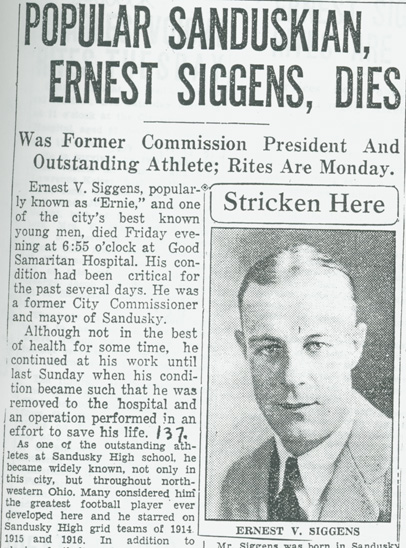
Ernest Siggens: Star Athlete, Mayor of Sandusky


Ernest V. Siggens, who was known as Ernie, was born in Sandusky on May 7, 1897 to George and Emily Siggens. He was a star of the Sandusky High School football teams of 1914, 1915, and 1916. From 1923 to 1925, Ernie played in the backfield for the Sandusky Maroons. (He is seen at the far right of the front row in the photo below, which was taken in 1923.)

Other teams which Ernie Siggens played for included the Parks Junior Basketball Team, who were the area champions in the 1913-1914 season, and the Sandusky Elks baseball team.
During World War One Ernie Siggens served in the United States Army from May to December, 1918. For several years, Ernie was the proprietor of the Siggens Electric Service store on Wayne Street in Sandusky. On January 1, 1932, Mr. Siggens was elected Mayor of Sandusky. He remained in that office January of 1934. On April 12, 1935, Ernest V. Siggens died at Good Samaritan Hospital following a brief illness. He was only age 37 at the time of his death. Mr. Siggens was survived by his wife, the former Mildred Atwood, a daughter, Mary Jane Siggens, and his mother, Mrs. Emily Siggens. Burial was in Oakland Cemetery. A touching tribute to Ernie Siggens appeared in the April 12, 1935 issue of the Sandusky Star Journal.

Monday, September 20, 2010

Judge James L. DeWitt

James Lloyd DeWitt was born on September 20, 1848 in Perkins Township of Erie County, Ohio to Mr. and Mrs. James DeWitt, pioneer settlers of the Firelands. (He was usually known as Lloyd DeWitt.) He attended Oberlin College, and studied law in Sandusky. In April of 1873, J.L. DeWitt was admitted to the bar. Mr. DeWitt practiced law in Sandusky, until he was elected Mayor of Sandusky and served as Mayor from 1883 to 1886. From 1887 until 1890, James L. DeWitt was the Common Pleas Judge for Erie County, Ohio.

On the afternoon of October 11, 1890, Judge J. L. DeWitt was killed while walking along the Lake Shore Railroad tracks just east of Sandusky. Some young boys saw the judge walking, and he stepped aside to avoid a freight train approaching from the west. He did not see the other train which was coming from the east. Judge DeWitt was struck by the east bound train, and died instantly. The judge’s faithful dog did not leave his side. His pocket watch was found to have stopped exactly at eight minutes to four o’clock, the accident having caused it to stop. A front page article about the tragic accident appeared on the front page of the October 12, 1890 issue of the Sandusky Register. The first paragraph read in part, “No man in the city was more generally known or better liked by people of all classes than Judge DeWitt, and the expressions of sorrow on all sides were most sincere and heartfelt.”

On the day of the funeral of Judge DeWitt, several members of the bar formed a procession and marched in a unit from the Erie County Courthouse to the DeWitt residence on Columbus Avenue, where the funeral was held. The courtroom of the Erie County Common Pleas Court was draped in mourning, as an expression of sympathy felt by the members of the bar and officials of the Courthouse. Newspaper accounts stated that funeral services were officiated by Rev. J. F. Brant of the Methodist Episcopal Church, and included several hymns. The red cedar casket was covered with broadcloth, and the plate on the casket bore his name. Burial was at Oakland Cemetery. In the proceedings of the Ohio Bar Association in 1891, E.B. King made these remarks:

Mr. DeWitt was at the time of his death a Common Pleas Judge in the first sub-division of this district, and had been holding that position for four years. He was a young man, in the prime of his life, and in the full vigor of his strength and manhood, and was regarded, both by the bar and a very large circle of acquaintances and friends, both as a citizen and as a judge, as a man of perfect, upright character, conscientious and faithful, to a fault, in the discharge of judicial duties, exceedingly careful in the decision of causes and the rendition of opinions, and popular with all classes of his fellow men. He was elected to the Bench at the age of thirty seven years, and in his forty-first year was accidentally and suddenly killed by a railroad train. No event that has happened in our community for a score of years cast the gloom over society and the public in general that the death of Judge DeWitt did, under the circumstances that it occurred.
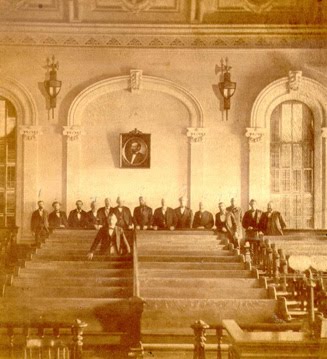
Judge J. L. DeWitt was survived by his wife and a son and daughter. Judge DeWitt is the first individual on the left in picture below. This stereographic image of the Erie County Common Pleas Courtroom was created by A.C. Platt in 1874.

Wednesday, April 28, 2010

John M. Brown, Mayor of Sandusky 1849-1850

On February 1, 1865, John Brough, the Governor of Ohio, appointed John M. Brown to the office of Notary Public for Erie County, Ohio. The document was recorded at the Court of Common Pleas of Erie County, Ohio by George O. Selkirk, Erie County Clerk of Courts.


John M. Brown was a pioneer citizen of Sandusky, Ohio, having settled there in 1847. He was admitted to the Erie County Bar in 1848, and served as the Mayor of Sandusky in 1849 and 1850. The 1937 Firelands Pioneer states that John M. Brown served as the Postmaster of Sandusky from 1853 through 1861.

An obituary for John M. Brown appeared in the June 8, 1891 issue of the Sandusky Register. The article points out that during President Buchanan’s administration, Mr. Brown was a Democrat, but later he became a Republican due to his views on the tariff question. The Register obituary reports that during the 1849 cholera epidemic, Mr. Brown’s “services were very efficient and devoted.” In his later years John M. Brown devoted himself to the business of real estate as well as farming. John M. Brown died on June 7, 1891 at the West House. He is buried in Oakland Cemetery, next to his wife Elizabeth.

Wednesday, January 13, 2010

John J. Molter, Civic Leader


John J. Molter was born in Sandusky on July 16, 1854 to Mr. and Mrs. John Molter, who were both natives of Baden, Germany. As a young man, Molter lived for ten years in Danville, Illinois, but he spent most of his life as a resident of Sandusky, Ohio. He was elected to the 69th and 70th General Assembly of Ohio. While serving as a legislator, he fostered a bill to make “physical education” a branch of the curriculum of the public schools of Ohio. In his youth, he had been active in the “Turners,” an athletic association whose members were primarily of German descent. In 1887, he earned the National Turn Verein swimming title during a competition in Covington, Kentucky. Walking was a favorite pastime of Mr. Molter, and he was known to hike daily, even in inclement weather.

Appointed by President Cleveland, John J. Molter served as Sandusky’s postmaster from 1894 through 1898. He was elected Mayor of Sandusky from April 1901 through January 1910. He was active in the Elks Lodge, and the Knights of Pythias, and for a time he was in the wholesale liquor business with August Guenther.

On December 19, 1934, John J. Molter passed away in Good Samaritan Hospital, after an illness of two months. His obituary, which is found in the 1934 OBITUARY NOTEBOOK at the Sandusky Library, reads in part, “No citizen was better known; none was more honored and respected….Molter was a man of unquestioned honesty and exemplary habits and enjoyed the confidence and friendship of citizens of all classes.” Mr. Molter was survived by a brother and a sister. His funeral was held at the Elks Lodge on East Adams Street, and was largely attended. Burial was at Oakland Cemetery, with the Knights of Pythias in charge of the gravesite services.


John J. Molter is pictured above in the Mayor’s Office on West Market Street in Sandusky, about 1908.

Thursday, March 19, 2009

Letters to George Anderson

Dr. George Anderson was Sandusky’s first physician and its second mayor, serving in the years 1829 and 1830. Dr. Anderson was active in the medical field as well as in local politics. He was active in the development of the Columbus and Sandusky Turnpike Company, as well as in the creation of the Mad River and Lake Erie Railroad. Dr. Marjorie Anderson, the great-granddaughter of Dr. George Anderson, donated several of Dr. Anderson’s letters, legal and educational documents to the Sandusky Library in 1937.

Senator Benjamin Ruggles wrote the following letter to Dr. George Anderson on February 9, 1827.
Transcription:

Washington Feb. 9, 1827

Dear Sir

Your letter dated January the 21st enclosing a petition praying that congress would grant a portion of the public lands to aid in making a turnpike road from Columbus to the city of Sandusky, has been read. The petition will be presented and laid before the Senate.

Some weeks since a bill was reported in the Senate agreeable to the prayer of a petition, which was forewarded last winter and signed by all the members of the Legislature. Gen. Harrison and myself will make use of every exertion to have the object of your wishes accomplished.

Very respectfully
Your obt. Sevt.
Benj. Ruggles


Benjamin Ruggles was elected to the U.S. Senate in 1815; was re-elected in 1821, and again in 1827. He was known as the “Wheel Horse of the Senate,” due to his deep work ethic.

Dr. Anderson received the following letter from Eleutheros Cooke, while Cooke was a member of Congress, on March 15, 1832. Eleutheros Cooke, father of Jay Cooke, was Sandusky’s first lawyer. House Rep. March 15, 1832

Dear Sir

I shall apply as soon as I can get an audience with our excellent friend Gov. Cass for a detachment of the U.S. Engineer corp. to make a survey and estimate on our Railroad. The increased hostility prevailing at head quarters on the subject of internal improvement is rather discouraging. Yet I not abandon the hope that Cass will act independently of this spirit and treat our road as a measure of national importance in a commercial military a& mail transportation point of view – I will give you the earliest information of the result of my application.

In great haste
very respectfully
your friend
E. Cooke

Both of Dr. Anderson’s transportation goals for Sandusky did become successful. A brief history of the Sandusky and Columbus Turnpike is found in an earlier blog post. Ground was broken for the Mad River and Lake Erie Railroad on September 17, 1835. Through Dr. Anderson’s letters, we can get a glimpse into Sandusky’s past. Dr. Anderson died in 1834, after treating patients in a cholera epidemic. He is buried at Sandusky’s Oakland Cemetery

Tuesday, February 24, 2009

George Daniel, Mayor of Sandusky 1871-1876

George Daniel was born to John and Eva Daniel in Germany in 1834. The family settled in Sandusky in 1847. George was in the grocery business with his father, and later was a manufacturer of grape wine. A biographical sketch about George Daniel in History of Erie County, Ohio, edited by Lewis Cass Aldrich, states that George Daniel was the oldest manufacturer of wines in Erie County.

In 1855, George Daniel married Agnes Iceman. They had ten children. Mrs. Agnes Daniel passed away on August 14, 1883. Mr. Daniel married Claudine Good in 1886. The first Mrs. George Daniel is pictured below:
George Daniel served his community in many different capacities. He was the Mayor of Sandusky from 1871 through 1876. He had been town treasurer in 1857; councilman for four terms; elected as a member of the Board of Equalization of Property in 1880; and was appointed commissioner of the fishery interest in 1884. In the Archives Research Center of the Sandusky Library is the document which lists the appointment of George Daniel as Postmaster of Sandusky in 1877, signed by President Grover Cleveland.

George Daniel died November 5, 1909 [corrected original post], and he is buried in St. Mary’s Cemetery in Sandusky. A descendant of the Daniel family donated the photographs of Mr. and Mrs. Daniel to the historical collections of the Sandusky Library. If you would like to share photographs of your ancestors with future generations, consider donating them to the Archives Research Center of the Sandusky Library.

Friday, May 30, 2008

Promising Young Men of Sandusky

The eight young men pictured below were photographed in 1861. While the exact reason for the photo is not known, the men may be members of a literary club or a church youth group.
Jay Smith, J. Edward Mathews, Harper Austin, and Charles B. Dennis all served in the 101st Ohio Volunteer Infantry during the Civil War. Frank Pierce worked Sandusky in the hardware business before moving to Cincinnati. C. M. Thorpe was engaged in the coal business in Sandusky and Detroit. Henry C. Huntington was a successful local businessman in several ventures, and was president of the Men’s Literary Society. Charles E. Bouton became Mayor of Sandusky in April 1895.
All of these young men served their country and community well. The photograph above captures them in the innocence of youth before they had to face the responsibilities of work, warfare, and civic duty.

If you have historical photos of Erie County residents, consider donating them to the Archives Research Center of the Sandusky Library.