Showing posts with label World War I. Show all posts

Monday, March 31, 2025

Dominick Cua, War Veteran and Businessman


Dominick Cua was the son of Salvatore and Maria Cua, born in Italy in 1890. He served in the Quartermaster’s Corps during World War I. In the 1920s, he operated a billiards hall in downtown Sandusky. Below is a page from his patent for a cue holder that he invented.


Later Mr. Cua ran a lunch room on Fulton Street, and from the 1930s to the 1950s, he was the operator of a concession stand at Battery Park.

As a Veteran of World War I, he was active in the American Legion. This is a medal he wore at an American Legion Convention held in Detroit, Michigan in 1931:

By 1959, Dominick Cua and his family moved to Florida. He died in Broward County, Florida in 1974. He and his wife June were buried at Lauderdale Memorial Park in Fort Lauderdale, Florida.

Friday, May 31, 2024

Morris Platte: Baseball Star, Soldier in War, Victim of Influenza


On the left of this photograph of the Shamrocks baseball team is Morris "Baldy" Platte, star pitcher for the 1914 Sandusky city champions. He accomplished much in his tragically short life.

Born in Sandusky in 1891, the son of Adolph and Mary, Morris Platte married Elsie Ramm when they were both teenagers. The couple had their first child in 1911, before he had turned twenty years old, and they had three more children in quick succession. (Sadly, their second child died at birth.) He supported his family in jobs that included delivering ice for the City Ice Company in town. But life wasn't all work; he had a passion for baseball, and played for teams including the Sandusky Tool Company team (below) and the Shamrocks, where he helped lead the team from the mound to the city championship.


But after the United States entered the Great War, Morris Platte chose to serve his country and joined the Army. He went to Camp Sherman in Chillicothe for training in July 1918, and quickly advanced up the ranks to Sergeant. Later, he was transferred to Fort Benjamin Harrison for continued training. It was there that he faced the enemy that would defeat him.


During the First World War, nearly as many servicemen died from influenza as from war wounds. Approximately 45,000 died from the flu; 53,400 died in combat. Sadly, Morris Platte was one of the 45,000; he died on base in Indianapolis on October 9, 1918, about one month before the end of the war.

Friday, March 31, 2023

Gertrude Schnaitter, American Red Cross Nurse in the Great War


Gertrude Schnaitter was born in Sandusky in 1884, to Frank and Christina Schnaitter. In the 1910 U.S. Census, Gertrude was listed as pupil studying nursing at the Lakeside Hospital in Cleveland. Below is a portion of Gertrude’s Passport Application, dated August 9, 1917.


Medical officials from Lakeside Hospital stated in a letter attached to the passport application, “This is to certify that Miss Gertrude E. Schnaitter has been duly appointed by the Officials in Washington as a Red Cross Nurse who is going to France as additional personnel to Base Hospital No. 4 now located there.” An article in the September 18, 1917 issue of the Sandusky Star Journal reported that she was the nurse in charge of the second contingent of nurses from Lakeside Hospital who were traveling to France to serve in military hospitals during the Great War. She cabled her parents that she had arrived “Safe.”


On November 1, 1917, an article in the Sandusky Star Journal indicated that Gertrude found joy in her work as a Red Cross Nurse. During her time in France, Gertrude served under the British, and cared for Australian soldiers who were injured during the war.


By the Spring of 1919, the medical team in Rouen, France returned to the United States. In April of 1921, Gertrude married Dr. Andrew Robert Warner in a ceremony officiated by the Rev. N.R.H. Moor. Dr. Warner had formerly been the superintendent at Lakeside Hospital in Cleveland.


Following Dr. Warner’s death, Gertrude Schnaitter Warner returned to Sandusky. She passed away on October 7, 1966, and was buried at Oakland Cemetery. 

To learn more about the Cleveland doctors and nurses who served at U.S. Army Base No. 4 during World War I, see the article about the Lakeside Unit in the Encyclopedia of Cleveland History.

Wednesday, November 09, 2022

Ira C. Krupp, Veteran of the First World War


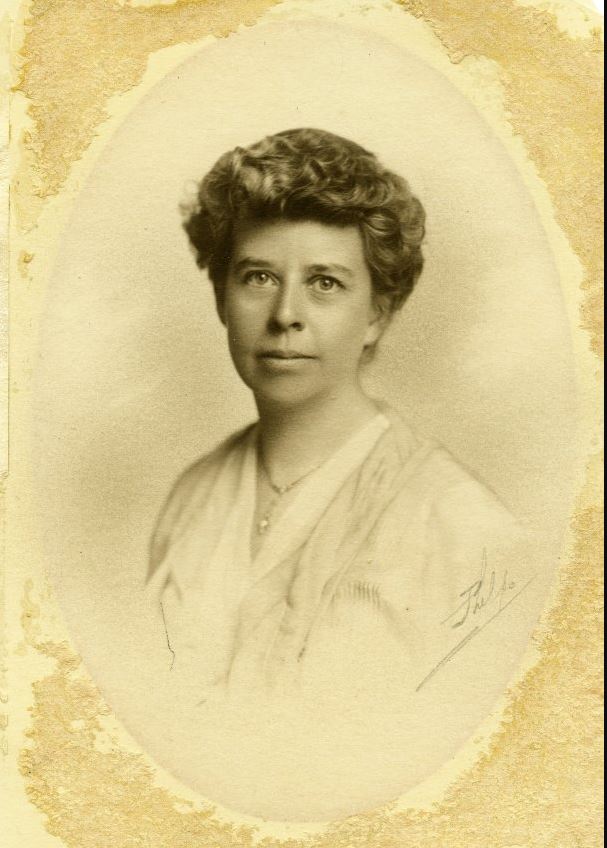
The image above of Captain Ira Charles Krupp appears in the Honor Roll of Ohio, 1917-1918, Erie County Edition. He served as a Captain in the Fourth Corps Artillery Park during World War I.

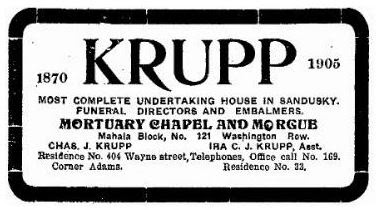
Ira C. Krupp was the son of funeral director Charles J. Krupp and the former Ida May Palmerton. At the turn of the twentieth century, the Krupp family resided at 404 Wayne Street, the former home of Oran Follett, which is now known as the Follett House Museum.

In 1901, Ira Krupp graduated from the Renouard training school for embalmers in New York City. By 1905, he was an assistant at the Krupp Mortuary Chapel. The Sandusky Star Journal of February 27, 1905 reported that he was seriously ill with blood poisoning that he had contracted through a small cut on his skin while embalming someone who had died from the same ailment. For a time, doctors thought they may have to amputate young Krupp’s arm. Fortunately, he recovered.


In 1906, he took a job as a sales representative with a large chemical manufacturing company, working in Boston, and traveling throughout New England. He married Emeline Moss in 1907; she was the daughter of Sandusky banker Charles H. Moss and the granddaughter of Judge William Griswold Lane.

The December 5, 1908 issue of the Sandusky Register featured an article that stated Mr. Krupp was now the proprietor of “Ye Oak Meadow” stock farm and dairy, on South Hayes Avenue. He had recently been at a large farm and dairy exhibit in Chicago, where he purchased a Guernsey bull, Messmate of Ingleside. He said about the animal, “It is one of the finest specimens I have ever seen in all of my experience and is bound to attract the attention of stockmen near and far.”

In 1917 and 1918, Ira C. Krupp achieved the rank of Captain with the Fourth Corps Artillery Park. While in military service in Germany during the war, Ira was the editor of the first American newspaper printed in Germany. The paper was called the “Fourth Corps Flare,” and was considered the official organ of the Fourth Corps Artillery Park. An article in the March 25, 1919 issue of the Sandusky Register featured an article about the publication.


After returning home from military service, Mr. and Mrs. Ira Krupp sold their land in Perkins Township, and moved to Black Hall, Connecticut, where they lived for several years. Ira Krupp died in 1935. His remains were returned to Sandusky. The final resting place of both Mrs. and Mrs. Ira Krupp is in the Lane family lot at Oakland Cemetery in Sandusky, Ohio.

Mrs. Ira Krupp, the former Emeline Moss, was once on the Board of Trustees of the Sandusky Library Association. Mrs. Krupp died in 1957 in Connecticut.


Though Ira and Emeline Krupp lived their final years in Connecticut, they had strong family ties to Sandusky and Erie County, Ohio. Visit the Sandusky Library Archives Research Center if you would like to research your own ancestors from Erie County, Ohio.

Thursday, November 25, 2021

Giving Thanks


This is the menu that Sgt. Wilford T. Schleicher was served at Camp Sherman, Chillicothe, Ohio, on Thanksgiving day, November 29, 1917. 


He was to leave for Europe in June 1918 as part of the American Expeditionary Forces. 

In February 1919, he and his family were able to be thankful for his safe return to the United States and a long life, happily married, and a successful career at the American Crayon Company.

There is always something to be thankful for. Happy Thanksgiving.

Saturday, October 23, 2021

Marriage of of Tella Axline and Claude B. DeWitt


In the spring of 1901, Mr. and Mrs. Henry Augustus Axline sent out a wedding invitation for their daughter Tella Maude Axline, who was to marry Claude Bennett DeWitt, a lawyer from Sandusky. The wedding took place on Thursday evening, April 25, 1901, at the Axline residence in Columbus, Ohio. Henry A. Axline was known as the “Father of the National Guard in Ohio.”

From about 1902 to 1922, Mr. and Mrs. Claude B. DeWitt lived in Sandusky, Ohio, where he served for several years as a bankruptcy referee. He was also associated with the local law firm of Dewitt & Savord for a time. During World War I, he served as an induction officer. The image below appeared in the Honor Roll of Ohio, a reference book which features biographies and photographs of Erie County Veterans of the First World War.


Unfortunately, the marriage did not last. By the 1930’s Claude DeWitt had moved to Howard County, Iowa, where he remarried. Mrs. Tella DeWitt passed away in Columbus, Ohio on October 31, 1959. The only child of Claude and Tella DeWitt, whose name was Axline Claude DeWitt, moved to Wheeling, West Virginia, where he became president of the Dunning Coal Company

Thursday, July 08, 2021

Jay Hoehlein, Great War Veteran and Photographer


Jay Lawrence Hoehlein, who served as a Sergeant during World War I, was born in Sandusky, Ohio on April 16, 1889 to Lawrence and Jessie Hoehlein. (The Social Security Death Index reported his birth year as 1888.)  During his military service, he worked in the photo laboratory for the Signal Corps in Washington D.C.

Here is a picture of Jay’s fourth grade class of the Ninth Ward School (later known as Monroe School) in 1897:

He is seated directly behind the young ladies who are labeled numbers 6 and 7:

After living in Kentucky for several years, Jay and his wife Katherine moved back to Sandusky, Ohio. From 1935 until his retirement in 1979, he operated a photographic studio in Sandusky, starting out at 234 West Market Street, and later moving to Central Avenue. In the 1960’s and 1970’s, his photography studio was at 502 West Monroe Street.

On June 11, 1935, he took this picture for the Third National Exchange Bank on West Market Street in downtown Sandusky.

In the summer of 1935, he took pictures of Miss Helen Koppenhafer and Paul Mayberry, both of Norwalk, as they got married aboard the steamer Chippewa. The beautiful bride pictured below, Lucille Holtz Moosbrugger, was photographed in 1938.

An article in the July 8, 1935 issue of the Sandusky Star Journal stated that Mr. Hoehlein had the largest and most modern studio in Sandusky, and was equipped to handle all kinds of photography. The article ended with: “Hoehlein’s ideal is to render the greatest possible service at a price which will be entirely satisfactory.”   

On September 18, 1984, Jay L. Hoehlein passed away at the age of 96. He had been a member of Grace Episcopal Church and the American Legion Post 83. He was buried next to his wife, the former Katherine Horne, at Sandusky’s Oakland Cemetery.

Sunday, February 07, 2021

August Wilhelm’s Invitation to The White House in 1914


In 1914 Lieutenant and Mrs. August Wilhelm received an invitation to a reception to be held at the White House on February 24, when Woodrow Wilson was the President of the United States. The Army Navy Reception held at the White House was a formal affair with the Navy and Army officers in dress uniforms, and the ladies in long gowns.

August C. Wilhelm was the son of John and Elizabeth Wilhelm. He graduated from the United States Naval Academy in 1906. He rose to the rank of Lieutenant Commander in the Navy, serving on the battleships Ohio, Baltimore, West Virginia, and Petrel. After serving in World War I, he entered the banking business. August C. Wilhelm was a charter member of the Commodore Denig Post 83, American Legion. Mr. Wilhelm passed away on May 28, 1970. He was preceded in death by his wife, the former Julia Zimmerman. He was survived by a son, daughter, and several other relatives. Burial was in Sandusky’s Oakland Cemetery.

Saturday, October 24, 2020

With the 308th Engineers From Ohio to the Rhine and Back


In the military section of the Genealogical and Local History books at the Sandusky Library is a book entitled With the 308th Engineers From Ohio to the Rhine and Back. The book was published in 1923 by the 308th Engineers Veterans Association. Pictured below are insignia and symbols associated with the 308th Engineers.

The major operations of the 308th Engineers in World War I were in France in 1918, and included the Aisne-Marne Offensive, the Oise-Aisne Offensive, and the Meuse-Argonne Offensive. The main tasks of the 308th Engineers were to repair and maintain roads and build bridges. The 308th Engineers were the first American troops to bridge the Rhine. The 308th also furnished Guards of Honor for General Pershing, the Prince of Wales, and Marshall Ferdinand Foch. Several men from Sandusky, Ohio served with the 308th Engineers during the war: Edwin Uhl, Reinhold Ahlers, Henry Baker, Ralph Carney, Vergil Grant, Fred Kranz, Victor J. Moore, John Riesterer, Emil Grahl, Paul Knupke, Robert Mees, Henry Cycoly, Walter J. Kleinfelder, Edward Klueg, Carl Mainzer, Lee Staffler, Guy Norton, Henry Bates, Norman Martin, Charles Hasbrook, Peter Scavio, Charles Voight, and Herbert Textor.

The third annual reunion of the 308th Engineers Veteran Association was held at Cedar Point on August 5 through August 7, 1923. The headquarters for the group during their stay at Cedar Point was at the Hotel Breakers. During the Reunion, business meetings were held, along with a banquet, athletic events, and several speeches. A dance was held at the Coliseum on August 5, 1923. Sandusky resident Herbert Textor served as Treasurer of the Association in 1923.

Visit the Sandusky Library to see the book With the 308th Engineers From Ohio to the Rhine and Back. Another outstanding World War I resource at the library is Erie County Edition, Honor Roll of Ohio, 1917-1918, which provides brief biographical sketches and photographs of Erie County residents who served in the Great War. Inquire at the Reference Services desk for more information.

Tuesday, March 24, 2020

Sandusky and the Great Influenza of 1918


As we are living through a world-wide pandemic today, so were the people living in 1918. What is often called the Great Influenza struck the nation, and the world, briefly in the Spring of 1918, and returned with a vengeance in the early Fall. In all, between 50 million and 100 million people died worldwide as a result of the flu, with both the old and the young as its victims. In fact, except for children under five years old, the death rates were highest for people between age 25 and 50. 


The people of Sandusky, and all over the United States, faced multiple challenges at that time: first, a world war that began in 1914, with Americans joining in 1917, and then, as that war was waning, a new war against a killer virus. Sanduskians fought both wars.


Many of the nation's earliest victims were soldiers sent to training camps for the war. (It is believed by some experts that Ground Zero for the 1918 outbreak was in Kansas, probably spreading to a military base there.) The high concentration of soldiers on bases and in transport to battle zones allowed the virus to travel at great speed. And soldiers returning home often unknowingly brought the influenza with them.

Sandusky and Erie County faced a large outbreak, responding in many ways that our similar to our response today. Many events were cancelled and businesses were ordered to close; some that could stay open were under strict rules regarding personal contact. A temporary emergency hospital was opened in the newly constructed Elks Lodge on Adams Street.


The exact number of Erie County residents who died from the flu in 1918-19 is uncertain, but it was at least in the hundreds. The influenza hospital operated for about two months, serving 95 patients with 19 deaths (a mortality rate of 20%). By the Summer of 1919, about 32,000 Ohioans died from influenza, about 25,000 more than would have been expected. Nationally, about 675,000 Americans died from the Great Influenza. 

Of course, we hope the current pandemic will not compare to 1918, but we will need to be vigilant. To keep abreast with the Coronavirus in Ohio, follow https://coronavirus.ohio.gov/wps/portal/gov/covid-19/.

Sunday, November 11, 2018

Honoring Those Who Served in World War I


As we commemorate the 100th anniversary of World War I, it is time to take a moment to remember the soldiers from Erie County who gave their lives for their country during the war.

Harold Blancke


Harold Blancke was born on January 10th, 1900 in Perkins Township. He enlisted long before the United States entered the war. He enlisted in the 6th Ohio, a National Guard unit, on July 7th, 1915. Once the war started the 6th Ohio was stationed around the state guarding railroad bridges and railroad yards. Harold was stationed outside of Port Clinton guarding the New York Central Bridge. On the night of April 15th, when Harold was relieving another soldier of guard duty, Harold was struck by a train and killed instantly. He was buried in Oakland Cemetery Sandusky, Ohio on April 17th. Harold Blancke was the first soldier from Erie County to die during World War I.

Elmer Reese

Elmer Reese was born in Niles, Ohio on August 12th, 1896. He eventually moved to Sandusky to work for the Baltimore and Ohio Railroad. He enlisted in the Marines on May 19th, 1917 and was assigned to the 6th Regiment, Company A. He was promoted to Corporal on November 30th, 1917. He was shipped to Europe with his units on February 20th, 1918. During the Battle of Belleau Wood Elmer was killed in action on June 8th, 1918. He became the first Erie County soldier killed in combat during the war. His family was notified of the death on September 20th, 1918. Corporal Reese was originally buried in France but in 1921 his body was returned to the United States to buried. His body arrived in Sandusky on September 12th, 1921 with funeral services and burial in Oakland Cemetery Sandusky, Ohio the next day.

John Risch


John Risch was born in Sandusky, Ohio on October 31st, 1891.  John enlisted in the Coastal Artillery on November 21st, 1913 long before the war even started. He was stationed at several forts on the west coast, but mainly in Washington state. On June 11th, 1918 he was discharged with a 100% disability due to an illness. After discharged he returned to Sandusky. In January of 1919 he was admitted to the Sandusky Soldiers' Home and was discharged on March 1919. John was the first soldier to be admitted to the Sandusky Soldiers' Home who served in World War I. He died May 12th, 1919 and was buried in Oakland Cemetery Sandusky, Ohio.

Edward Roth


Edward Roth was born in Sandusky, Ohio on May 24th, 1893. He enlisted in the regular army on October 5th, 1917. He was sent to Camp Sheridan in Alabama and stayed there until his discharge on June 19th, 1918. Edward was discharged with 100% disability due to a chronic illness. After discharge Edward returned to Sandusky and eventually died in Good Samaritan Hospital on June 24th, 1919. This marks the last soldier to die from Erie County whose cause of death was linked to his time in the service during the war. Edward’s funeral was June 27th, 1919 and was buried in Oakland Cemetery Sandusky, Ohio.

In total 56 soldiers died in the service of the country during the war from Erie County. Twenty-three soldiers died due to combat related injuries. The rest either died from illness (26), accident (3), or cause of death is unknown (4). Exactly half of these soldiers died during the month of October in 1918. There is no better way to honor these men than to remember them. Below is a list of the soldiers who died during their service.

First Name
Last Name
Date of Death
Cause of Death
Harold E.
Blancke
4/14/1917
Killed by Train
John
Knupke
5/31/1917
Scarlet Fever
Harry J.
Colvin
1/21/1918
Pneumonia
Elmer A.
Reese
6/8/1918
KIA
Lowell C.
Hein
7/20/1918
KIA
Millard M.
Moore
7/28/1918
KIA
Charles W.
Scott
7/29/1918
Died of Wounds
Charles A.
McCormick
8/11/1918
Illness
Joe
Horvath
8/14/1918
Died of Wounds
John
Leaver
8/14/1918
Died of Wounds
Herbert Le Roy
Stanton
8/16/1918
Unknown
Rufus R. D.
Smith
8/30/1918
Illness
Thomas C.
Curtis
8/31/1918
Died of Wounds
Charles J.
Reilly
9/6/1918
KIA
J. Ralph
Cookson
9/18/1918
KIA
Archie
Birch (Burch)
9/29/1918
Unknown
Archie F.
Burch
9/29/1918
KIA
Anthony
Dantonio
9/29/1918
KIA
Fred
Ritz
10/3/1918
Pneumonia
Lee P.
Magill
10/4/1918
Bronchopneumonia
James H.
White
10/4/1918
KIA
Nelson C.
Geise
10/5/1918
Pneumonia
James H. (Hall)
Friday
10/6/1918
Influenza
Walter T. (Walter Theodore)
Hall
10/6/1918
Labor Pneumonia
Russell E.
Miller
10/6/1918
KIA
Edward O.
Miller
10/6/1918
Typhoid Fever
Morris J.
Platte
10/9/1918
Spanish Flu
Carl A.
Salzman
10/9/1918
Bronchopneumonia
George H.
Feiszli
10/10/1918
Died of Wounds
Ralph B.
Quackenboss
10/10/1918
Pneumonia
Chester P. (J)
Herb
10/11/1918
Pneumonia
Joseph
Orcutt
10/11/1918
KIA
Clarence A.
Popke
10/11/1918
Tetanus
Ralph T.
Saunders
10/11/1918
Unknown
Joseph F.
Baier
10/12/1918
Pneumonia
Clarence P.
Howard
10/12/1918
Accident Overseas
August W.
Meyer
10/12/1918
Influenza
John
Sattler
10/13/1918
Influenza
Joseph
Dewhirst
10/14/1918
Pneumonia
Fred
Dale
10/18/1918
pneumonia
Lester C. (Lester Conrad)
Kautz
10/20/1918
Labor Pneumonia
Carl A.
Link
10/21/1918
KIA
Max
Schnittker
10/21/1918
KIA
August H.
Speer
10/23/1918
KIA
Robert
Adkerson
10/27/1918
Unknown
Austin J.
Atwood
10/31/1918
Accidental Drowning
Carl F.
Fedderson
11/4/1918
KIA
John A.
Michel
11/8/1918
KIA
Emil
Strickler
11/11/1918
Died of Wounds
Albert F.
Schlett
11/21/1918
Influenza
George A.
Scheid
12/10/1918
Unknown
Charles H.
Parker
12/20/1918
Pneumonia
Gaius (Gains)
McDowell
1/19/1919
Flu
Ernest H.
Wankey
3/2/1919
Died of Wounds
John A.
Risch
5/12/1919
Illness
Edward Frank (F.)
Roth
6/24/1919
Illness