Showing posts with label Boats. Show all posts

Friday, September 20, 2019

Bouncing Owl Club on a Boat in the Bay


Several men and women were on a small boat near Meigs Street in Sandusky on September 20, 1908. The picture was entitled “Bouncing Owl Club.” What this club was and who its members were is unknown. In the background, the city water works plant is visible. (It appears that the water works plant was having some work done to the roof.) At this time, Theodore Roosevelt was nearing the end of his term as President of the United States. Sandusky had almost 20,000 residents, while Perkins was home to about 3500 people. Looking at the microfilmed copy of the Sandusky Register for September 20, 1908, the weather was fair on this date. The new Herb and Myers store announced its grand opening, and both Jessie Meenan and Carrie Freyensee advertised that their stores had recently received shipments of their new fall hats. Baseball games were being played at League Park, and members of the Shamrocks Baseball Club were going on an excursion to Leamington, Canada.

But we don't know anything about the Bouncing Owl Club. Do you?

Thursday, March 28, 2019

Captain Otto J. Biemiller


Otto J. Biemiller was born in Sandusky, Ohio on March 28, 1865 to Christian and Margaret (Weber) Biemiller. He worked on Great Lakes fishing boats for over fifty years, having served as master of boats operated by the Post Fish Company and Lay Brothers Fisheries. Earning his first-class pilot papers in 1891, some of the boats that Captain Biemiller served on as Master were: the Anna Roberson, Erie, Silver Spray, Maythan, Markwell, the Driscoll, and the Canadian steamer Thistle.


On December 25, 1909, Captain Biemiller rescued the sons of Erie County Auditor, John Deist. William Deist, age 13, and Carl Deist, age 8, were ice skating on the Jackson Street slip when Carl fell through the ice, and William fell into the icy bay as he tried to rescue his brother. Though the ice was cracking, Captain Biemiller walked across the thin ice and grabbed Carl. William was then able to remain afloat while he waited for Biemiller to assist him. The April 23, 1911 issue of the Sandusky Register reported that Captain Biemiller had also rescued a party in distress on Lake Erie in Vermilion in June of 1902.

In January 1938, Captain Otto Biemiller retired as Master of the Shearwater, a vessel used by the Ohio Department of Conservation, in conjunction with the fish hatchery at Put in Bay. Otto Biemiller died on January 2, 1942, after having been in failing health for some time. Funeral services were conducted by Dr. Donald Wonders at the Keller Funeral Home, and burial was at Oakland Cemetery.  

The Biemiller family was well known in Sandusky. Otto’s uncle, Andrew Biemiller, was a prosperous fisherman, and was owner of the Biemiller Opera House which he had built in the 1870s.


Thursday, December 07, 2017

Vim Motors Were Made in Sandusky


The boat above, owned by Ed Hinkey and a Mr. Pfeil in 1911, was powered by a 35 horsepower motor manufactured by the Vim Motor Company. On the reverse side of this picture postcard is the owners' positive description of the Vim Motor and its performance.


An article in the April 12, 1907 issue of the Sandusky Register stated that the Vim Motor Manufacturing Company had recently been incorporated by C.P. Barber, W.L. Fiesinger, H.W. Parsons, Herman Kugel and E.C. Knopf. The business was established at the southeast corner of Hancock and Market Street, but by 1911 the company had re-located to the southwest corner of Water and Meigs Street, close to Battery Park. Eventually the company had a plant on the west end of Monroe Street, and a repair shop at 636 East Water Street. In 1911 the Vim Motor Company made nineteen different sizes of marine engines, ranging from 3 to 55 horsepower. “Put real Vim in your boat” was the slogan used in this 1916 advertisement which appeared in a Power Boating magazine in 1916:


By that time, the Vim Motor Company had branched out into farm engines as well as marine engines. This advertisement appeared in Popular Mechanics in January, 1916:


During World War I, the Vim Motor Company merged with the Sandusky Forge Company, and began manufacturing munitions for the war effort. After the war’s end, the company faltered, and went into receivership in 1920. In the 1950s, Ruby’s Fisheries was located at the site of the former Vim Motor Company, now the parking lot for the Erie County Senior Center.

Wednesday, August 23, 2017

The Steamer Eastland


The Eastland served as a passenger liner between Cleveland and the Cedar Point amusement park from 1907 to 1913. 

                                 
In its final season in 1913, it is estimated that the Eastland carried 200,000 people to and from Cedar Point. A steam calliope entertained passengers on the Eastland on their boat ride. Below is a postcard of the Eastland arriving at Cedar Point.

              
In 1911, S.J. Monck wrote words and music to a song titled On the Boat Eastland. It was considered the waltz hit of that summer season. The Sandusky Library Archives Research Center owns a photocopy of the sheet music.


By 1915, the Eastland had moved to Chicago as its primary port. It became infamous for the disaster of July 24, 1915. More than 800 people lost their lives when the boat rolled over into the Chicago River just at the edge of the wharf shortly after its departure. The Eastland Disaster Historical Society is devoted to the memory of those who lost their lives in this tragedy.

Friday, August 11, 2017

The Steamer Lakeside, Later Named the Olcott


Ernst Niebergall took this picture of the Steamer Lakeside as it was coming in through icy waters, around 1905. The Lakeside had been built in 1901 by the Craig Shipbuilding Company.  An advertisement from the Sandusky Register of August 10, 1908 provides us with the prices for round trips aboard the Lakeside from Sandusky to Cleveland and Sandusky to Detroit (about $13.50 and $20 in today's money).


In 1911, the name of the steamer Lakeside was changed to the Olcott. During the summer of 1911, the Olcott was chartered by the Buffalo, Lockport and Rochester Transit Company, to ferry passengers from Olcott, New York to Toronto, Canada. The Olcott returned to Sandusky in October, 1911. The Niebergall photo below shows the Olcott travelling through open waters.

     
The photograph below, by Ernst Niebergall, shows the Olcott as viewed from the rear.

          
In 1916, the Olcott was sold to the Government of France, and never returned to the Great Lakes region.  


Monday, August 22, 2016

Three Vessels Named Erie Isle


From 1930 to 1946 the Erie Isle, pictured above, ferried cars and passengers back and forth to the Lake Erie islands. This ship had originally been known as the Fredericka. In 1933 the Erie Isle docked at the foot of Hancock Street at the Schacht Fish Company dock. The boat left Sandusky at 2:30 in the afternoon, and left Put in Bay at 7:00 in the morning. From 1938 to 1941, a Canadian ship, also known as the Erie Isle, took passengers from Sandusky to Canada.  This vessel had originally been named the Waubic.

       
An advertisement in the August 19, 1939 issue of the Sandusky Star Journal invited people to a lake excursion to Kingsville aboard the Erie Isle, departing from Sandusky on August 21.     

                      
Yet another ship named Erie Isle was in operation for the Erie Isles Ferry Company from 1951 to 1973, taking passengers to Put in Bay. Below is a postcard which shows several crew and passengers about the boat.


An interesting article by Gordon Wendt about the long tradition of passenger boat service to Put in Bay is found in the Sandusky Register of March 8, 1992, now on microfilm.

Friday, July 29, 2016

Theodore Roosevelt Ferried Passengers to Cedar Point in 1945


Owned by the U.S. Navy from 1918-1919, the steamer Theodore Roosevelt was part of the Cleveland-Cedar Point Steamship Company in the mid 1940s. You can see passengers on three different levels in this closer view.


This vessel was particularly busy during the Cedar Point season of 1945. From June through Labor Day, the Theodore Roosevelt took passengers from Cleveland to Cedar Point. The July 9, 1945 issue of the Sandusky Register Star News reported that these excursionists were arriving at Cedar Point aboard the steamer: Denison, Brooklyn, Faith and Ellbrook chapters of the Eastern Star, Myrtle May Auxiliary of Euclid Temple, Bikur Cholin Relief Society, Women’s Alliance First Unitarian Church, and employees of the Monmouth Products Company. At the end of July, 1945, veterans from the Crile General Hospital boarded the Theodore Roosevelt for an outing at Cedar Point.  See the Great Lakes Vessels Online Index for more details about this and other Great Lakes vessels.

Friday, November 06, 2015

The Bustling Waterfront in Sandusky in the 1910s


This photograph of a busy day in downtown Sandusky’s waterfront district was taken in the 1910s. The steamer “R.B. Hayes” was docked at the Cedar Point pier, while the “Arrow” was out in Sandusky Bay, most likely heading towards Cedar Point.  A third vessel, the “Ottawa,”  is on the western side of the Cedar Point pier. Several people are located near the train, including some local policemen. In this closer view, you can see a Penny Arcade located near the pier, as vacationers head towards the boarding area. 


On the very right side of the full picture, you can see the steps on the side of the Post, Lewis & Radcliffe building, now 101 East Water Street. In the view below, you can read the words New York Central Lines on the U.S. mail car number 105.


In the close-up view below, the abbreviation CCC & STL appears on the locomotive. The Cleveland, Cincinnati, Chicago and St. Louis Railway, also known as the “BigFour” was an affiliate of the New York Central System for much of the first half of the twentieth century.


The foot of Columbus Avenue in Sandusky has long been the  hub of activity and transportation center, especially during the warm weather months. Visit the Sandusky Library Archives Research Center. to learn much more about the history of Sandusky and Erie County. 

Monday, July 13, 2015

Historic Views of the Former Railroad Bridge on Sandusky’s East Side


Oswald Zistel was aboard his sailboat in the picture above, taken in the early twentieth century. Behind him is the old railroad bridge. In the 1896 Erie County Atlas, a swing bridge is shown along the railroad tracks just past the cove on Sandusky’s northeast side, near present day Battery Park.


A late nineteenth century stereographic image shows the drawbridge of the Lake Shore and Michigan Southern Railroad, along with Ben Icsman’s lumber yard in the east cove area of Sandusky.

           
The bridge and tracks were in use by several different railroads from 1853 until the 1970s, including the Lake Shore and Michigan Southern Railroad, and the Baltimore and Ohio. In June of 1908, a train wrecked at the drawbridge, causing a large crowd to gather.


According to the New York Times of June 22, 1908, an engine carrying a heavy trainload of tourists from Indianapolis who had spent the day at Cedar Point, plunged through an open drawbridge in the east end of Sandusky. While none of the passengers was hurt, J. J. Perrish, the engineer, had both legs broken, and Fred Sullivan, fireman, had cuts on his head and shoulders. Both had internal injuries as well. The gatekeeper of the bridge says the train pulled out at 9 p.m., but had not been scheduled to leave until 9:30.

Sunday, June 07, 2015

Aerial View of Dutch Lane and Cove

Photographer and pilot Thomas Root took this aerial view of Dutch Lane and the surrounding area on June 7, 1959.  You can still see the railroad bridge in the upper right hand portion of the photo. The 1896 Erie County Atlas also shows the bridge on the map, as they lead to the B and O Railroad docks on Sandusky’s waterfront. The same tracks and bridge were in use by a number of different railways leading into downtown Sandusky since 1853, and remained in use until the late 1970s or early 1980s.


Click here to see this area as it appears on Google maps. The Sandusky Library Archives Research Center’s Tom Root Aerial Photograph Collection features several area photographs taken by Tom Root between 1949 and 2000.

Thursday, April 17, 2014

From Sandusky to Camp Vivian


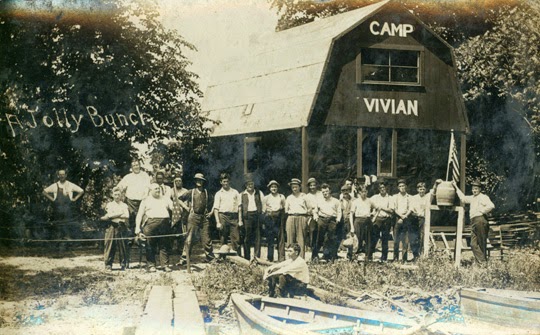
Between 1910 and 1913, Henry Klieger operated a saloon at 445 First Street in Sandusky. He and his wife Jeannette lived above the business. The men above are standing in front of the boat named the “Vivian” outside Mr. Klieger’s saloon. It looks as though one gentleman took his beverage with him onto the boat.

  
Camp Vivian was a camp where amateur boxers trained, possibly on the Cedar Point peninsula.  To date we do not know the exact location of Camp Vivian. If anyone is familiar with Camp Vivian, please leave us a message in the Comments section of this website.   


All the picture postcards featuring the Vivian and Camp Vivian were created by Sandusky photographer E.H. Schlessman.

Tuesday, May 07, 2013

Steamer Frank E. Kirby


Sandusky photographer Ernst Niebergall took this picture of the steamer Frank E. Kirby in the first quarter of the twentieth century.   The Frank E. Kirby was built in Wyandotte, Michigan by the Detroit Dry Dock Company in 1890. Notes in our historical files indicate that the Frank E. Kirby travelled between Detroit and Sandusky, with stops at Kelleys Island, Put-in-Bay, and Middle Bass Island, until the end of 1919. Pictured below are members of the Silver Bell Benefit Club aboard the Frank E. Kirby. On Sunday, June 14, 1908, the members of the club traveled on the Frank E. Kirby to Detroit, to see the baseball game between the Detroit Tigers and the Philadelphia Athletics.


Visit the Sandusky Library Archives Research Center to see hundreds of vintage photographs from Sandusky and Erie County.

Tuesday, June 12, 2012

The Steamer Put-in-Bay


From 1911 to 1949 the steamer Put-in-Bay transported passengers from Detroit to Sandusky, with stops at Put-in-Bay and Cedar Point. The ship was launched at Detroit, Michigan on March 25, 1911. An eight year old youngster named William McFall Heyser broke a bottle of champagne which had been made in Sandusky over the steamer. According to an article in the March 26, 1911 issue of the Sandusky Register, there were thousands of people gathered at the Wyandotte yards of the Detroit Shipbuilding Company for the special occasion. Built by the Detroit Shipbuilding Company, the Put-in-Bay was a part of the Ashley and Dustin steamer line. As she traveled down the Detroit River, the captain greeted area residents with three long and two short whistles. The Put-in-Bay featured four decks, and could hold over three thousand people. Passengers danced in the steamer’s ballroom to the music of orchestra leader George Finzel. In an advertisement from 1918 the round trip fare was seventy cents for week days, and $1.10 for Sunday excursions.


In 1949 the Put-in-Bay was transferred to a route that went from Detroit to Port Huron, and in 1953 she was sold for scrap. To read a history of the passenger boats that operated in the Sandusky area, see the Twin Anniversary Edition of the Sandusky Register-Star-News from November 24, 1947, which covers the history of passenger boats in our area up to that time. Ask at the Reference Services desk if you would like to view this historic edition.

Saturday, August 06, 2011

Annual Excursion of the Great Western Band

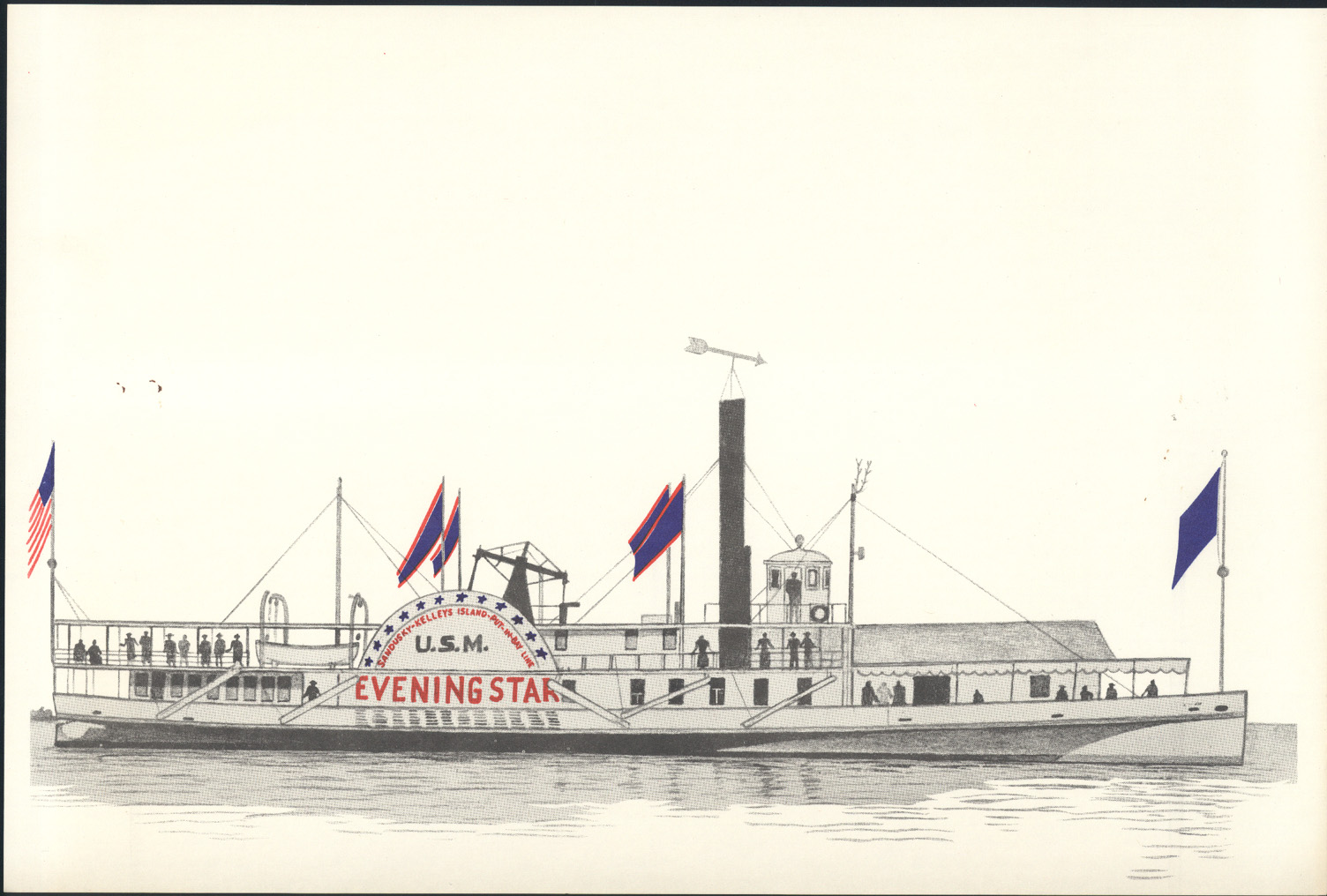
Sandusky area residents were invited to the annual excursion of The Great Western Silver Cornet Band on Thursday, August 6, 1868. The Great Western Band was formed in 1867 and was led for many years by Charles Baetz.

The steamer Evening Star was chartered for the excursion, which left at 10 a.m. from Fitzhugh’s Dock. The Evening Star carried passengers on the Great Lakes from the 1860’s through the 1890’s.

Monday, January 31, 2011

Davis Boat Works

 
The Davis Boat Works was in business in Sandusky from about 1901 to 1920 at the foot of Sycamore Street. The owner of the Davis Boat works was Adelbert B. Davis, the son of prominent local businessman Ira T. Davis. At six years of age Adelbert Davis became deaf. He graduated from the Ohio School for the Deaf in Columbus, Ohio, where he also met his future wife, Lucy Cook.  The Davis Boat Works built boats for customers all across the United States. At a yacht race in Put in Bay about 1909, forty percent of the boats there were made by the Davis Boat Works.

Charles E. Frohman wrote in Sandusky's Yesterdays, that the Davis Boat Works built the hulls for Weldon Cooke’s hydroplanes. One of Cooke’s flying boats, the Irene, was well known locally, but it was not successful in getting from the water up into the air for flight.
The Irene is pictured below.

An article in the October 8, 1937 issue of the Sandusky Star Journal reported that Adelbert Davis died in Columbus at the age of 80, after he had contracted pneumonia. He was survived by his wife, a son, Seth Davis, daughter, Mrs. A. J. Beckert, three sisters and a brother. Two sisters of Adelbert Davis, Caroline Davis and Mrs. Charles Stroud were residing in Sandusky at the time of his death. An article about Adelbert Davis, entitled “A Deaf Boat Builder,” by Mrs. E. F. Long, appeared in the January 1912 issue of the periodical The Silent Worker.