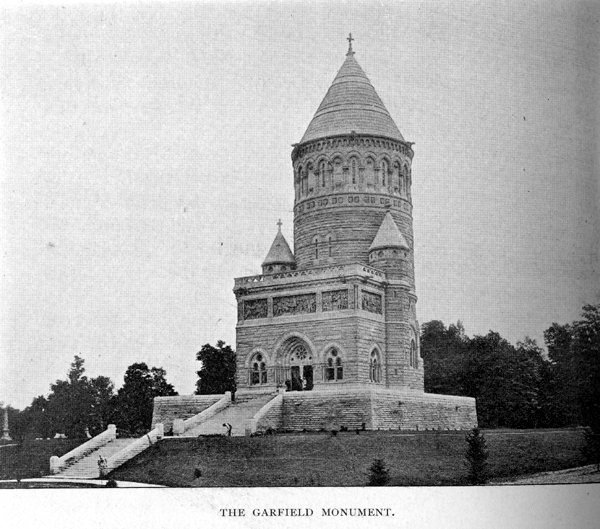
President James A. Garfield died on September 19, 1881, after having been shot on July 2, 1881. Born in Cuyahoga County, Ohio in 1831, he became president of the Western Reserve Eclectic Institute (now Hiram College) in 1857, and was elected to the Ohio Senate in 1859. Garfield served as a general in the Civil War, and after the War he was elected to the United States Congress. In 1880, at the Republican National Convention, James A. Garfield became the “dark horse” candidate for the presidency. He was elected President on November 4, 1880. Author James Baird McClure wrote in his book General Garfield: From the Log Cabin to the White House, that Sandusky Register editor I. F. Mack rode with James Garfield in the train to Cleveland, immediately after Garfield secured his presidential nomination in Chicago in 1880.
The Sandusky Register
carried several feature articles about the funeral of President Garfield from
September 20 through September 27, 1881. A detailed list of the groups
participating in the funeral procession appeared in the paper, as well as an
account of the hymns sung, scriptures read, and government officials in
attendance. A delegation from the Sandusky Masons, the Erie Commandery, marched in the procession. A number of tributes to
President Garfield also appeared in the Register.
On September 25, 1881, the First Presbyterian Sunday School held a commemorative service for the deceased president.

O. P. Cowdery spoke about Garfield’s boyhood; U.T. Curran’s address was about Garfield, the educator; while W. F. Converse spoke on Garfield as a statesman.

The back of the program from the Presbyterian service featured President Garfield’s favorite hymn, “Ho, Reapers of Life’s Harvest.”
At the dedication of the Garfield Memorial, on May 30, 1890, I.F. Mack commanded a group of Sandusky Civil War Veterans who were at the service in Cleveland. The Great Western Band
from Sandusky sent twenty five musicians to participate in
the procession. The full text of the dedication of the Garfield Memorial can be read at Google Books. On July 3, 1948, the Sandusky Register Star News featured a
syndicated column entitled “Let’s Explore Ohio: Mother of Presidents.” The column mentions the home of James A. Garfield and his tomb at Lakeview Cemetery.



 World War I interrupted commercial trade between many nations including the United States and Germany. Prang’s heavy reliance on German chemicals and products to manufacture its own items was impeded by decreased availability before and during World War I. These circumstances pushed Prang Educational Company and American Crayon Company into a merger in 1913. The combined companies organized their own small independent watercolor factory in Sandusky called Kroma Color Company. American Crayon Company’s complete take- over of the Prang Educational Company around 1915 gave them the rights to use the unmistakable “Prang” trademark of the “Old Faithful” geyser at Yellowstone National Park as their advertising logo symbolizing quality, value, and tradition. The American Crayon Company manufactured a long line of crayons, chalks, blackboards, erasers, watercolors, pencils, paste, cleaners, and other more industrial items, such as chalk for tailors, carpenters, textile mills, and railroad stockyards. The growing success and popularity of the American Crayon Company led to its prosperous operation at the original Sandusky plant through the 1920s to the 1950s.
 On the night of August 7, 1849, a meeting was held at the Congregational Church for the purpose of organizing a Temperance League. There were nineteen women who were active members, and five women who were supporting members. Later their group became a chapter of the W.C.T.U., the