Showing posts with label Civil War. Show all posts

Thursday, November 28, 2024

Happy Thanksgiving

This is a repost from 2006

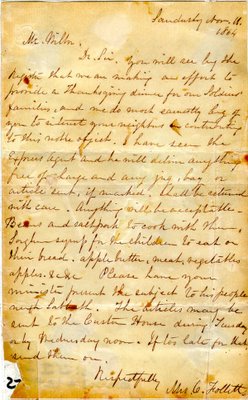
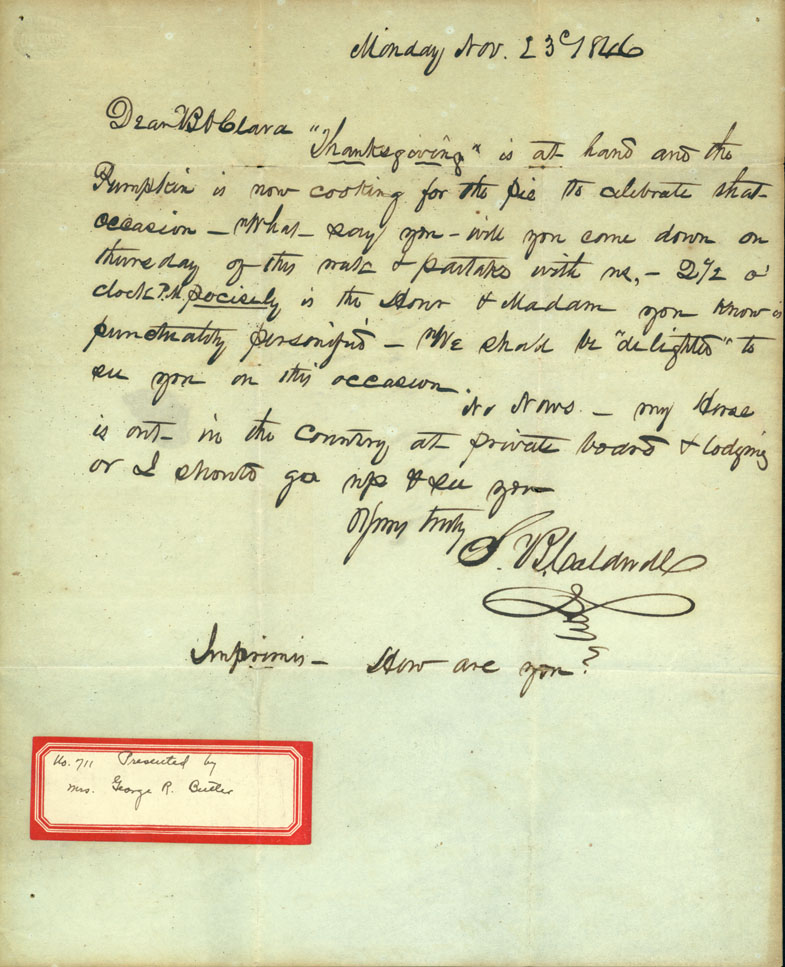
As many of you might remember learning in grade school, the first "official" Thanksgiving was proclaimed by President Abraham Lincoln during the height of the Civil War, in 1863, in honor of the first Thanksgiving held by the pilgrims in Plymouth during the 17th century. But even before President Lincoln made Thanksgiving a holiday, it was traditionally celebrated by many people. The first letter below is evidence of that:

In this letter, Judge Samuel Caldwell of Sandusky has invited Samuel Butler and his wife Clara to his home for Thanksgiving dinner. (We know pumpkin pie was on the menu!) The date of the letter is November 23, 1846, nearly twenty years before the national holiday was observed. (It is also interesting to note that even then Thanksgiving was celebrated on a Thursday in November -- nobody seems to know for sure why this day was chosen.)


The second letter is from Eliza Follett, the wife of Oran Follett, requesting contributions from local residents to provide Thanksgiving food to the wives and children of soldiers serving in the Civil War. Mrs. Follett was very active in community service and charitable work, as can be inferred from this letter.

Have a happy Thanksgiving. . .

Saturday, July 29, 2023

Benjamin E. Deeley, Civil War Veteran


Benjamin E. Deeley was born in Sandusky on August 31, 1841, to Edmond and Dora Kinney Deeley. Benjamin worked with his father in the local fishing industry, and he was also a carpenter by trade. In 1861, at the outbreak of the Civil War, he enlisted in Company E of the 8th Ohio Volunteer Infantry for three months' service. In 1862, he re-enlisted, this time in Company G of the 123rd Ohio Volunteer Infantry, ultimately earning the rank of Corporal during his service.


During his years as a soldier, he was held as a prisoner of war at least three times, in prison camps at Libby, Belle Isle, and Andersonville. After the war was over, he worked for the railroad in Sandusky, building railroad cars. He was also an active member of the McMeens Chapter of the Grand Army of the Republic; during Sandusky's Memorial Day services of 1911, he was chairman of the decorating committee.

Benjamin Deeley and his wife, the former Eliza Jane Steen, had six children. Two sons became physicians, one son became a dentist, and two daughters were teachers in Sandusky City Schools. At the time of her retirement, his daughter, Miss Mary Deeley, was serving as principal of Sycamore School, and had been in the field of education for forty-two years.

Benjamin E. Deeley died on November 26, 1925. His obituary appeared in the Sandusky Star Journal on the same day.


In light of the occupations of the children, it is clear that the Deeley family placed a great value on education and service. Surviving the horrors of war in military service and confinement at prison camps, Benjamin Deeley returned home to his family after the Civil War, and led an active life. Mr. Deeley was buried in the family lot at Oakland Cemetery in Sandusky, Ohio.

A Soldiers’ Memorial, honoring Co. G. of the Ohio 123rd Ohio Volunteer Infantry can be seen at the Follett House Museum.

Wednesday, July 19, 2023

The Cowell Family of Castalia


For many years Mr. and Mrs. Alvin T. Cowell resided in a home on South Washington Street in Castalia, approximately where the Castalia Branch of Civista Bank is now located. Mr. and Mrs. Cowell are in front of the house, and their daughter Frances Alberta Cowell, known as “Bertie” or “Fannie” is standing by a chair.

The book A Standard History of Erie County, Ohio, by Hewson L. Peeke provides biographical information about Alvin Cowell and his family:

Alvin T. Cowell was reared in Castalia, attended the public schools there, and was about seventeen years of age when the country was thrown into the confusion resulting from the outbreak of the Civil war. A few years later he responded to the call of his patriotism and enlisted on May 2, 1864, in Company I of the One Hundred and Forty-fifth Volunteer Infantry of Ohio. He was out about four months, and spent most of the time with his regiment in guard duty at Arlington Heights, just across the Potomac River from Washington. On receiving his honorable discharge he returned to Erie County, and subsequently .had the advantage of a brief attendance at the Notre Dame University in South Bend, Indiana. With this preparation for practical life he became a farmer, and for many years conducted a large farm of more. than 200 acres in the vicinity of Castalia. While a man who has been known for his strict attention to his business, he has at different times consented to serve in the public interest and for six years was a trustee of Margaretta Township. At the present time he is living in Castalia, and has all the conveniences and comforts he needs for the evening of life.

On February 28, 1910, Mr. Cowell was called upon to mourn tine loss of his faithful companion who had shared with him in the joys and sorrows of existence for nearly forty years. On December 26, 1871, he married Catherine Cooper, who was born in Mount Vernon,. Ohio, a daughter of Cyrus and Sarah (Mitchell) Cooper. Her father was for many years a resident of Knox County, Ohio, and came from there to Margaretta Township where he was a prosperous farmer, but finally sold his land and spent his declining years at Clyde, Ohio, but his body now rests in the cemetery at Castalia. Mr. and Mrs. Cowell became the parents of two children. Fannie A. is the wife of Rev. Charles J. Dole, who is pastor of the Congregational Church at Chelsea, Michigan. The only son, Philip C., is now deceased. Rev. Mr. Dole and wife have five children named Marie L. Catherine Irene, Alberta A., Edward C. and Charles R.

Frances Alberta Dole married a Congregational minister, Rev. Charles Joel Dole in 1891. In the late 1800s, Rev. Dole served as the minister of the Castalia Congregational Church. Two of the Dole daughters had long careers with the Sandusky Library. Miss Irene Dole was the librarian for the Castalia Branch Library from 1942 to 1968. During her time as librarian, the library was housed in the former Town Hall on Main Street in Castalia. The former town hall in Castalia is pictured at the left, in the post card below, about 1905.

Mrs. Alberta Dole Smith was the children’s librarian at Sandusky Library during the 1950s and early 1960s. Mrs. Smith’s picture appeared in the Sandusky Register during National Library Week, on March 19, 1958. The article stated in part: “Children’s librarians feel that none of their patrons will turn out to be a Johnny or Joan who “can’t read” as they are accustomed to having books around the home, and visiting a store house of wonderful and exciting book friends.”

Friday, June 24, 2022

John C. Zollinger, Civil War Veteran, Businessman, Humanitarian


According to the October 28, 1924 issue of the Sandusky Register, John C. Zollinger was one of the oldest native born Sandusky residents at the time of his death at age 82 in 1924. He was the son of Mr. and Mrs. Charles W. Zollinger, both natives of Germany. 

As a young man, he worked in the dry goods business, first for Everett Cooke and Company, and later for C.E. and G.A. Cooke. When the Civil War broke out, Mr. Zollinger enlisted in Company G of the 65th Ohio Volunteer Infantry. During the war, he took part in many engagements, including battles at Shiloh, Perryville, Stone River, Missionary Ridge, as well as the siege of Atlanta. After the war’s end, Mr. Zollinger was reenlisted and served as an officer with a regiment that was sent to Texas. Hewson Peeke’s A Standard History of Erie County, Ohio stated that he achieved his commission as captain; the 1890 Census of United States Union Veterans lists his highest rank as Full Quartermaster. 

After the war, in September 1866, he married Paulina Lerch. 

Throughout his lifetime, Mr. Zollinger had many different occupations and civic interests. In 1880, the U.S. Census listed him as a merchant. Later he was in a partnership with Frederick Ohlemacher in the lime business. In the late 1890s, he was in the fish business with Louis Adolph. 

Both Mr. and Mrs. Zollinger were very active in the Erie County Humane Society. A resolution from the Erie County Humane Society, which appeared in the Sandusky Star Journal of January 22, 1925, read in part, about Mr. Zollinger, “Nothing stirred him so deeply as cruelty to either to persons or animals, and he was ever ready to help protect the defenseless and helpless. Mr. and Mrs. Zollinger not only devoted much of their lives to the work of the society, but gave in addition thereto thousands of dollars for its support, although they were in very moderate circumstances.” 

For several years, Mr. Zollinger served as president of the Castalia Trout Club. In 1893, he presented 44 adult brook trout from the Castalia Trout Club to J.J. Stranahan, superintendent of the United States Fish Commission at the Put in Bay station, for the purpose of being placed in the Fish and Fisheries Exhibit at the World’s Columbian Exposition in Chicago. 

In 1875, he was the master of the Science Lodge, No. 50, F.and A.M. When the Science Lodge celebrated its centennial, John C. Zollinger was the oldest living past master, and he gave reminiscences at the celebration.

Sandusky Star Journal, October 18, 1919

On October 26, 1924, John C. Zollinger died after a lengthy illness. The Sandusky Register published a lengthy obituary in the October 28, 1924 issue. He was survived three sisters and two brothers. Mrs. Paulina (Lerch) Zollinger had passed away in 1904. Funeral services for Mr. Zollinger were held at the Masonic Temple in Sandusky, and burial was in Oakland Cemetery.

Friday, April 01, 2022

Henry Clay Strong, Soldier and Businessman


Henry Clay Strong was born on October 4, 1841 to Lyman and Calista (Nims) Strong. During the Civil War, he served for a three month term with Company B of the 88th Ohio Infantry. After that term was up, he joined Company D of Hoffman’s Battalion, later known as the 128th Ohio Volunteer Infantry, where he was appointed second sergeant. While serving in the 128th Infantry, he became commissary sergeant, and later served as first lieutenant and regimental quartermaster. For a time he was commander of Company G. 

He married Mary Harper, the daughter of Mr. and Mrs. Rice Harper, in 1865. Mr. and Mrs. Strong had a son named Harper Lyman Strong in 1880, but the child died in 1881. In 1909, Mr. and Mrs. Strong legally adopted William Henry Spencer, a son of Henry Strong’s sister; he went by the name William Henry Spencer-Strong after the adoption.

After the war ended, Mr. Strong was appointed paymaster for the Sandusky, Dayton & Cincinnati Railroad. In the late 1860s and 1870s, he was a salesman for a wholesale lumber house in Sandusky. By 1874, he had moved to Newark, Ohio, where he was in a partnership with John Fleck in the wholesale grocery business. 


In 1897, Mr. Strong moved back to Sandusky, where he was one of the organizers of the Ohio Motor Company, which did business at the southeast corner of East Water and Perry Streets. The company made small engines for stationary power purposes, from the end of the 1890s until 1920. 

On June 12, 1918, Henry Clay Strong passed away following complications from surgery. He was buried in the family lot in Oakland Cemetery. Both Henry and Mary Strong had family ties to pioneer residents of Erie and Huron Counties. Read more about the early residents of the Firelands area in books, historical journals and newspapers at the Sandusky Library Archives Research Center.

Saturday, November 13, 2021

Confederate P.O.W.’s: Soldiers & Sailors Who Died in Federal Prisons and Military Hospitals in the North


In 1984 Frances Ingmire and Carolyn Ericson compiled into a book the names, rank, regiment, death dates, and burial location of Confederate soldiers and sailors who died in federal prisons and military hospitals in the North, during the Civil War. The records were compiled from the Office of the Commissioner for Marker Graves of Confederate Dead. The main text is compiled by the names of each prison, but an index of servicemen is found in the back of this volume, listing the former Confederate sailors and soldiers alphabetically by surname.

Soldiers and sailors who died at Camp Chase, near Columbus, Ohio are listed on pages 50 through 93. The names of four soldiers who died while prisoners of war in Gallipolis, Ohio are found on page 175. Of particular interest is the section of the book with the names of several soldiers and Confederate officers who died during the Civil War at Johnson’s Island. Their names are provided on pages 178 through 182. You can view this book at the Sandusky Library, where it is shelved with the genealogical and local history books in the library’s lower level.

Many items relating to the Civil War can be found at the Sandusky Library Archives Research Center and the Follett House Museum. The original wooden tombstone of D.L. Scott, 2nd Lieutenant, Co. I, of the Third Missouri Cavalry, is on display at the Follett House. In the late 1880s, a group of Georgia businessmen raised funds to provide marble tombstones for those soldiers and officers interred at Johnson’s Island.


Over one thousand people witnessed the unveiling of the Confederate Cemetery Monument at Johnson’s Island on June 8, 1910, an event sponsored by the United Daughters of the Confederacy.

Wednesday, October 20, 2021

Research Resource: Record of Discharge of Civil War Soldiers


The Sandusky Library Archives Research Center has microfilmed copies of the discharge records of Erie County Civil War soldiers. These records were originally filed at the Erie County Recorder’s Office. An index which lists the soldiers’ names alphabetically by surname aids in locating each soldier’s information.

Thomas McFall, a private with Company B in the 145th Regiment of the Ohio National Guard was discharged on August 24, 1864 at Camp Chase, Ohio.

Alexander Hornig served as a private under Captain Harvey E. Proctor in Company D of the 41st Ohio Volunteer Infantry. He was discharged at Pulaski, Tennessee on December 2, 1864. Pvt. Hornig’s discharge record listed his place of birth as Germany. A physical description is also provided, stating that he was 20 years old and 5 feet 5 inches tall. He had a light complexion, blue eyes, and brown hair, and his occupation was marble cutter.

Christian Stubig was discharged at Johnson’s Island on February 28, 1865. He had served with the 128th Ohio Volunteer Infantry.  He was a native of Germany, and his occupation was shoemaker.


Elijah Brown was with Company I of the Massachusetts 55th Infantry, comprised of African Americans. (At that time, Ohio did not allow African American men into military service, although the policy changed shortly after, but only for the remainder of the war. It was not until 1870 that black men were allowed to serve in Ohio state militias.) He was discharged at Charleston, South Carolina on August 29, 1865. Mr. Brown was eighteen years old, having been born in Sandusky, Ohio. His occupation was farmer. Elijah Brown’s military unit was led by Captain George T. Garrison, brother of well known abolitionist William Lloyd Garrison.

By browsing through these government records, a great deal of personal information can be learned about the men who served in the Civil War. Visit the Sandusky Library Archives Research to view these military discharge records. Several book sources and online databases available at Sandusky Library can also aid in the research of Civil War soldiers.

Saturday, October 02, 2021

A Letter from William Edward Chapman to His Father in 1862


When he was still a high school student, William Edward Chapman, known as Ed, wrote to his father, William Pendleton Chapman. A transcription of the first page of the letter is below:

April 11, 1862

Dear Father,

I received your letter of the 17th yesterday noon. In the afternoon I saw W.T. Williams and he said he would ship the provisions at 40 cents per hundred 10 cents per hundred cheaper than he did the others. The Portsmouth arrived that same afternoon and this afternoon we loaded the provisions. I got the insurance on it just now, paid $5.04. I also got G.J. Anderson to insure the $3000 on the provisions in Keech’s building, paid $3.75 for insuring that. The Sandusky Gas Light Co. have declared a dividend & they gave me a check on Moss Brothers, so I went and got the money and paid for these things instead of taking it out of the drawer. The girl has left: she is going to be married next Monday. She found us another girl though.

Poor Henry Barney is dead! He died from the effects of his wound at Pittsburgh Landing. He died in the hospital at Louisville on last Friday night between 10 & 11 o’clock. His mother was with him. His remains were brought home last night & he was buried with military honors this afternoon.

It’s about as sorrowful a time here as I ever knew. He was buried from the Church. Dr. Bronson preached a funeral

[The second page of the letter continued:]

sermon. Henry fought all day Thursday & Friday, rested Saturday, & then fought Sunday & Monday till 2 o’clock in the afternoon. He was lying on his back loading, with his knee elevated, when a bullet struck him below the knee, hit the bone & shattered his knee all to pieces. It is thought, if it had been amputated on the field, his life could have been saved, but he kept sinking lower & lower & after it was dressed the last time he fell right away & died that night. He said before he died that he had seen enough of war. If anyone that passed through those days might well say so. It seems hard to be shot nearly the last thing. Olds had a narrow escape. A ball went through his cap & bruised his head without hurting him. Everybody feels as bad nearly as if they lost a brother. I can’t realize that it is so.

Yours affectionately,

Ed


William Edward Chapman worked as a clerk in the freight office of the Sandusky, Mansfield & Newark Railroad. Later he worked for the Erie Railway at Dunkirk, New York. He moved back to Sandusky for a time, and in the 1890s he and his wife and children moved to Cuyahoga County, Ohio, where he worked successfully in the lake transportation business.

William Edward Chapman died in 1925 in Cleveland, Ohio. He was buried at Sandusky’s Oakland Cemetery next to his wife, the former Julia Mills. The Sandusky Library Archives Research Center is fortunate to have a series of nineteenth century letters written to and from members of the Chapman and Pendleton families. These letters help us to more clearly understand the daily lives of early settlers of Erie County, Ohio. William Edward Chapman’s letter poignantly shows the sadness that is experienced when someone loses a loved one to war injuries.

Sunday, July 11, 2021

Jennie Lincoln in the Civil War


Photo credit: Jennie Lincoln at about age 12; from Pierson Family Papers, 1821-1996
Bentley Historical Library, University of Michigan

The name of Miss Jennie E. Lincoln appeared several times in the Sandusky Register in 1863 and 1864. She served as the Secretary and Treasurer of the Relief Society. The Relief Society gathered donations of food and money, to provide aid to Civil War soldiers, as well as to the families on the home front.


An article which appeared in the December 1, 1863 issue of the Sandusky Register reported on donations of food and money which were collected from the residents of Sandusky, Perkins Township, Castalia, Oxford Township, Kelleys Island and Put in Bay. One hundred six families, including three families of color, were provided food from the generous donations of local residents. All the families to whom food was given had either a son or husband who was in military service for the Union.  A portion of the article appears below:

In January of 1864, several soldiers from the 122nd New York Volunteer Infantry arrived in Ohio, where they would become guards at the Confederate Prison at Johnson’s Island.

Some of the citizens of Sandusky housed the soldiers from New York. The Relief Society prepared a banquet for the soldiers. Captain Lucius Abel Dillingham, of Company I of the New York 122nd Volunteers, fell in love with the secretary of the Relief Society, Jennie Lincoln.

Capt. Lucius Abel Dillingham
Photo Credit: Archives of Michigan 

 Lucius A. Dillingham and Jennie E. Lincoln were wed in Sandusky, Ohio, in November, 1865, after the close of the Civil War. By 1880, Mr. and Mrs. Dillingham resided in Coldwater Michigan with their daughter Clara. Clara Dillingham, later Mrs. John Pierson, became well known as the author of several children’s books.

Capt. Lucius Abel Dillingham died in Stanton, Michigan in 1911, and his wife Jennie passed away in 1916. Both are buried at the Forest Hill Cemetery in Stanton, Michigan.

Wednesday, February 24, 2021

Civil War Letter -- Black and White Fighting for Freedom


In the Sandusky Library's collections is a letter from a United States soldier during the Civil War to an acquaintance in his hometown of Huron, Ohio. The author, George Haskin (sometimes identified as Haskins), was at the time a sergeant in the 63rd Regiment, Ohio Volunteer Infantry, serving in the recently captured city of Corinth, Mississippi. He wrote with a passion for the cause of the Union and in support of the African American soldier.

Early in his letter, Sergeant Haskin expresses his contempt for those in the North who fail to support the war: "How, I want to ask, can you men of the North, how, in the name of God and Justice can you tolerate the traitors who are seeking to pollute the minds of the people in your midst?" He was especially angry that newspapers and correspondence sent to his fellow soldiers often encouraged "aid and comfort to traitors in arms," including encouraging desertion. His disgust even extended to some of the Army officers he served with: "We do not want them to have a chance to show their Plantation Breeding to us, and can easily spare such a traitorous few."  


Instead of these "plantation-bred" officers, Sergeant Haskin instead placed his trust in the African American soldier, and praises the service and bravery of African American men: "And only give us the privilege of putting Arms in their hands and you men at home keep the traitors in check there, we can soon finish the Rebs here."  As he noted in his letter, African American men served ably in the Revolution and the War of 1812, and were once again serving bravely in his war.


Sergeant Haskin's hope for the creation of "Negro Regiments" was fulfilled shortly after he wrote this letter. On May 18, 1863, he was promoted to Lieutenant in the First Regiment of the Alabama Colored Troops. 


Image in Public Domain

Thursday, February 11, 2021

Poem by Confederate Lieutenant S. Boyer Davis, imprisoned at Johnson's Island


According to the book Rebels on Lake Erie, by Charles E. Frohman, Samuel Boyer Davis was sentenced, as a spy, to be executed by hanging on February 17, 1865, at Johnson’s Island Prison. According to a note written on the back page, the poem was given to "Pri. M. Hebblethwaite, USA" (possibly a guard at the prison?) on February 11, 1865, "on condition . . . that they are never made public." After 156 years, we think Lt. Davis would not mind the recognition we give him. 

Fate was kind to Lt. Davis, however, as President Abraham Lincoln commuted his sentence from execution to imprisonment for the duration of the war, with the prisoner only learning of his fate on the very day that the execution was to be carried out. He was transferred to a prison at Fort Delaware, on the Delaware River. 

Transcribed, the poem reads:


A Soldier boy from “Dixie” lay dreaming in his cell

He was far from home & kindred & those that he loved well

His feet were sore & weary & bound by iron chains

He dreamt of Far off Richmond lovely Richmond on the James.


No Sister sat beside him to sooth his troubled brow

No comrade now bent o’er him to whisper words of cheer

But his Soldier heart was fearless, Twas got him there had chained

And he dreamt of one in Richmond dear Richmond on the James.


He walked or thought he walked the old familiar path

He talked or thought he talked with friends of days gone past

But at each & every moment the clanging of his chains

Told he was far from Richmond old Richmond on the James.


He thought of those who loved him what pain they would endure

When they heard that he was missing from the old Potomac Shore

And Oh! it will be deeper when they hear he’s bound by chains

The sorrow at old Richmond at Richmond on the James.


He wakes! The light is growing dim darkness is falling fast

Another night of sorrow & anguish must be past.

How many many moments must he spend thus bound by chains

E’re again he goes to Richmond, to Richmond on the James.


After the war, Samuel Boyer Davis was released. He married Anna Mason, and died on September 14, 1914. They are buried at Ivy Hill Cemetery in Alexandria, Virginia.

Saturday, December 05, 2020

Samuel Magill, Civil War Veteran

Samuel Magill in his G.A.R. uniform


Samuel Magill was born near Bloomingville, Ohio on September 22, 1815. His parents, Mr. and Mrs. Samuel Magill, Sr., were early pioneers of Erie County. In 1810 they traveled from Pennsylvania to Bloomingville, Ohio in a covered wagon along with several of their youngsters.  The elder Mr. Magill farmed the land located about two miles south of the Seven Mile House, along the Columbus Pike. Samuel Magill, Jr. married Celia Ann Sampson in 1835. They had a total of eleven children. One son, Alfred A. Magill, was the Erie County Sheriff from 1894 through 1898.


During the Civil 
War, Samuel Magill, Jr. enlisted as First Sergeant in Company G of the 145th Ohio Volunteer Infantry. He served in the military for 100 days, and received a Certificate of Honorable Service from President Abraham Lincoln on December 15, 1864. An article about the family that appeared in the April 16, 1922 issue of the Sandusky Register stated that eight of the Magills served in the Union ranks during the Civil War, with four reaching the rank of officers. 


Samuel Magill, Sr. died in 1858, and Samuel Magill, Jr. died in 1897. Both are buried in Sand Hill Cemetery, along with several other Magill family members. 


An interesting historical story passed down through the Magill family was recounted in the March 29, 1916 issue of the Sandusky Register by A. A. Magill. On September 10, 1813, Samuel Magill, Sr. and some of his sons and a hired man were working in the fields of the family farm. The boys sat down on a boulder which stood near the roadside. They could hear a cracking noise when they placed their ears next to the large stone. Later they learned that the noise they heard was the booming of a cannon during the Battle of Lake Erie when Commodore Perry met and defeated Commodore Barclay. 

Sunday, May 31, 2020

Hector Jennings, a Man of Service


Hector Jennings was born in Elmira, New York, in 1804, and died in Sandusky, Ohio on January 27, 1900. He was married to Delina Cummings in 1825. The family settled in Sandusky about 1838.


The January 29, 1900 Sandusky Register stated, “His early steps in learning's paths were taken under the guidance of his mother, who at the same time instilled a profound love for God and fellow men which gave rise to qualities of uprightness and honesty in his character which he retained through life. They were also productive of a strong love of liberty, which made him ever the champion of the oppressed and down trodden. During the days before the war his home was very often the refuge of the fugitive bondsmen.”

Mr. Jennings was an ardent foe of slavery, and he was pleased that several of his sons enlisted for service for the Union during the Civil War. He tried to enter the conflict as well, but he was barred due to his advanced age.

Through military records accessible via Ancestry Library Edition, we learned that James Jennings was a Colonel in the 4th Ohio Volunteer Infantry. H. C. Jennings was a Corporal in the 65th Ohio Volunteer Infantry. William and Wesley B. Jennings both served in the 123rd Ohio Volunteer Infantry; William as a musician, and Wesley as a First Sergeant. The daughter of Hector Jennings, Mrs. Caroline Cady, was reported to have ministered to prisoners, and residents of the hospitals and the soldiers’ home.

Though many of his children moved away from this area, Hector Jennings, his wife Delina, son Wesley B. Jennings, and daughter Mrs. Caroline Cady are all interred in Block Two of Sandusky’s Oakland Cemetery.

Monday, May 25, 2020

Leo Long, Grand Army of the Republic


Oscar Long donated his father’s badge from the Grand Army of the Republic to the Sandusky Library Archives Research Center. Leo Long was a veteran of Company E of the 186th Ohio Volunteer Infantry during the Civil War. In a Sandusky Register article from May 29, 1932, Leo Long recalled a battle from the Cumberland Gap in which the Union band played “Yankee Doodle” after running down the Confederate flag and replacing it with the Stars and Stripes. Mr. Long fondly recalled the Union victory on that foggy Kentucky morning during the war.

For many years Leo Long served as Commander for the McMeens Post No. 19, Grand Army of the Republic, an organization made up of Civil War Veterans. When Leo Long died on March 26, 1934, G.A.R. services were conducted for him at Oakland Cemetery. Two Civil War veterans of advanced age, Charles Cooper and Abraham Eddy, attended the funeral. Officers of the Santa Clara Camp, United Spanish War Veterans also paid tribute to Leo Long. A squad from the Ohio Soldiers’ and Sailors’ Home sounded taps at the gravesite of Mr. Long.

Memorial Day of 1934 was the last time the McMeens Post of the G.A.R. was active in Erie County, Ohio. An article in the May 31, 1934 issue of the Sandusky Register stated that the three remaining members of the local G.A.R. would keep the post alive inactively as long as possible, but the organization passed out of active existence at that time.

Saturday, May 23, 2020

A Military History of the Eighth Ohio Volunteer Infantry by Franklin Sawyer

During the Civil War, Franklin Sawyer was the commanding officer of the Eighth Ohio Volunteer Infantry from May of 1862 until the unit was mustered out. A prominent lawyer from Norwalk, he achieved the rank of Brevet Brigadier General. Mr. Sawyer wrote a book about his unit, called A Military History of the Eighth Regiment Ohio Volunteer Infantry. It was published in 1881 by Fairbanks and Company of Cleveland, Ohio.


A copy of this military history, donated by Hattie Bretz, is housed in the Sandusky Library Archives Research Center. The book originally belonged to Hattie’s father, William Bretz, who served in Co. E of the Ohio Eighth Infantry. A reprint of this book, with additional photographs, was published by the Blue Acorn Press in 1994. This edition of Franklin Sawyer’s books is found in the Local History and Genealogy collection in Reference Services.

General Sawyer tells about the Eighth Ohio’s participation in many battles, including Antietam, Fredericksburg, Gettysburg, Spotsylvania, and Cold Harbor. During the Battle of Antietam, a barn on a nearby farm was used as an operating room. Wounded and dying men covered the ground around the barn. Sandusky native Horace Harper Bill, who was then with Company K, died at Antietam. In the author’s preface, Franklin Sawyer stated, “There were many individual acts of bravery and fortitude, on the part of both officers and men.”

Many men from Sandusky and Erie County were in Company E of the Ohio Eighth Volunteer Infantry. Sawyer’s book lists the names of all the officers and soldiers in each company. The unit’s chaplain, Rev. Lyman N. Freeman, had served as rector of Grace Church in Sandusky from 1845 to 1850. Zenas W. Barker, Jr., the son of the former Mayor of Sandusky, died at Oakland, Virginia on August 28, 1861. Wells W. Miller, who was a Captain in the Ohio Eighth Infantry, went on to serve as Ohio’s Secretary of Agriculture. To read many more details about the Eighth Ohio, visit the Sandusky Library to view this historic accounting of the unit.

After the war Franklin Sawyer was elected to the Ohio legislature. He died in Norwalk, Ohio on August 22, 1892. Reunions of the Veterans of the Ohio Eighth Infantry were held for several years. A reunion was held at the Dixie restaurant in Sandusky on September 18, 1922. According to the Sandusky Star Journal of August 7, 1922, four of the former soldiers of Company E of the Ohio Eighth Infantry were living in Sandusky. Their names were E.E. Warren, William Braby, Charles Chapman and Romeo Foster.


Wednesday, March 18, 2020

Emily Skillman and Her Brother Alva Halt


Emily Johanna Halt was born in 1889 to Frederick and Louisa Frey Halt. Sadly, Emily’s father was killed in a railroad accident when she was just a child.  Emily marred Harry Hickman Skillman on October 16, 1907. They were married for over 50 years, until Mr. Skillman died in 1965. She lived to be 94 years of age,  passing away in Milan on March 10, 1983. Mrs. Skillman was survived by a daughter, Lois Skillman. She had outlived her husband and two sons and grandson.

Emily Skillman’s brother Alva Halt, often  known as Al or Alvie, was a well known professional baseball player. Alvie played for the Brooklyn Tip Tops, of the Federal League, in 1914 and 1915, and with the Cleveland Indians during the 1918 season.  He is pictured below with Sandusky’s BPOE Elks Baseball Team in 1910. (Unfortunately, we are not sure which one he is in the picture.)


After the death of Harry and Emily Skillman, family members donated a microfilmed copy of the papers of Harry’s uncle, Isaac Skillman, to the Sandusky Library Archives Research Center. Isaac Skillman served as a Sergeant and later as a Second Lieutenant with the Third Ohio Cavalry during the Civil War. His papers include diary entries and personal recollections of his war experiences. Isaac Skillman died in 1925, and he is buried in Oakland Cemetery.

Sunday, September 29, 2019

Letter to Private Lehnhard Winkler in 1864


On her fifty-third birthday, September 26, 1864, Mrs. Justina Winkler of Sandusky, Ohio wrote a letter to her son, who was serving in Company I of the Third Ohio Cavalry. Mrs. Winkler told her son Lehnhard (sometimes spelled Lenhart; later he was called Leonard) about a recent plot to free some prisoner’s at the Johnson’s Island prison. She told her son how the Winkler home was saddened without Lehnhard’s presence, and that she and the family wished him well. John Schwab, another Civil War soldier who had recently returned home from war, also sent greetings to Lehnhard.  The Winklers’ neighbor’s son was unable to adapt to the rigors of life in military service. Mrs. Winkler assures Lehnhard that the family back home was well, and she was most anxious to be re-united with her son.

Dr. Norbert A. Lange translated Justina Winkler’s letter to her son from the German:


Private Winkler did return safely from the Civil War. He was discharged from the service on August 4, 1865. He brought home with him a photograph album which contained several tintypes of soldiers that he had met.


In 1871 Leonard Winkler married Theresa Weber.


Mrs. Justina Winkler passed away in 1877. She was buried at St. Mary’s Catholic Cemetery. Her son Leonard died on May 29, 1893, and the G.A.R. conducted burial services for him at Oakland Cemetery. Theresa Weber Winkler lived well into her 80’s; she died on January 5, 1935 and was buried in the Winkler family lot in Block 76 of Oakland Cemetery. Leonard and Theresa (Weber) Winkler named one of their daughters Justina, in honor of Leonard’s mother.