Showing posts with label Lehrer. Show all posts

Saturday, May 20, 2023

George T. Lehrer, Mayor of Sandusky


George T. Lehrer is seen at the far right above, in an undated photograph which shows a group of men at the back of a train car. He was born in 1863 to Rev. J.G. Lehrer, one of the earliest pastors of Zion Lutheran Church, and the former Susanna Kneb. 

For forty years, Mr. Lehrer was the owner of a drug store on Washington Street in Sandusky.

Besides being well known as a Sandusky businessman, Mr. Lehrer was prominent in Republican political circles. He was director of the Erie County Infirmary for several terms. In the fall of 1909, he was elected Mayor of Sandusky, defeating J.J. Molter, who had been mayor for four terms.


When Theodore Roosevelt was campaigning in Sandusky in 1912, as a member of the Bull Moose Party, Mayor Lehrer was seated on the platform, not far from the American flag.

During his first term as Mayor, Lehrer authorized the purchase of the first motorized fire equipment for the city of Sandusky. When Sandusky went to the Charter form of government, Mr. Lehrer was appointed City Manager. In 1918, he resigned his position, and was succeeded by George M. Zimmerman. 

On March 6, 1938, George T. Lehrer died at the age of 74, just weeks after he celebrated his Golden Anniversary with his wife, the former Elisa Schmidt. The final resting place of Mr. and Mrs. George T. Lehrer is Sandusky’s Oakland Cemetery.

Wednesday, August 04, 2021

The Sandusky High School Orchestra in 1904


Mr. George Johnston donated this photograph of the 1904 Sandusky High School Orchestra to the Sandusky Library Archives Research Center.  Pictured are: Bottom row: Verna Murphy and Edna Becker; Middle row: George Lehrer, Bess Lawrence, Theresa Winkler, and Mr. Cornelius Schnaitter, director; Top row: Maude Claus, Ralph Scherz, and Marguerite Andrews.

Edna Becker and Bess Lawrence went on to become longtime teachers with the Sandusky Public School system. Dr. Ralph Scherz was a leading physician on Cleveland’s west side for over fifty years. George J. Lehrer, who was son of a Mayor of Sandusky with the same name, was a charter member of the Actors Equity Association, and was nationally known as an actor and director.  Locally, Mr. Lehrer was associated with the Lloyd-George Studios for the production of stage scenery and costumes. A biographical sketch of Cornelius Schnaitter is found in volume two of Hewson L. Peeke’s A Standard History of Erie County; Mr. Schnaitter was a prosperous merchant tailor in Sandusky for many years, in addition to being a noted musician. Theresa Winkler, who later became Mrs. Norman Jessen, donated several historical items from the Winkler family to the Follett House Museum and the Sandusky Library Archives Research Center.

Wednesday, October 21, 2020

The Former Lehrer Clinic on West Washington Street


In 1916 Dr.  Henry William Lehrer opened his medical practice at 1015 West Washington Street in Sandusky, Ohio. He practiced medicine at that location until his retirement in 1977. During his long career, Dr. Lehrer served as chief of medical staff at both the former Providence and Good Samaritan Hospitals. He also served on the Advisory Board of BGSU Firelands College. The article below appeared in the February 4, 1974 issue of the Sandusky Register, when Dr. Lehrer was honored, along with several other area physicians.


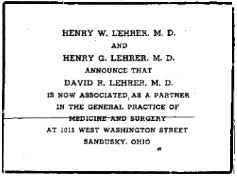
Dr. Henry G. Lehrer joined his father’s medical practice in 1946, and another son, Dr. David R. Lehrer, came on board in 1948.


The senior Dr. Lehrer died in 1980. Eventually, Dr. David R. Lehrer left the Sandusky area. When Dr. Henry George Lehrer retired in 1983, it was the first time in sixty-seven years that there was not a Dr. Lehrer in the medical office at 1015 West Washington Street.

According to the Ohio Historic Inventory for Erie County, the man who was constructing the original building became sick with cholera and died in 1849. Later the building was a boarding house, a millinery shop, and a doctor’s office. In 1906. Dr. G.H. Boehmer had his medical office at 1215 Washington Street, the former address of the Lehrer Clinic. In 1901, this ad appeared in the January 15, 1901 issue of the Sandusky Star.


In the 1990s, Doctors Jay and Jerri Nielsen (known for her experience as a cancer patient in Antarctica) had their offices at 1015 West Washington Street, followed by an After-Hours Medical Center. Though this location no longer serves as a medical office, hundreds of Sandusky area patients were treated at the former Lehrer Clinic throughout many decades of the twentieth century.

Thursday, May 14, 2020

Theodore Roosevelt on the Campaign Trail in Sandusky in 1912


On May 15, 1912, Theodore Roosevelt spoke in Sandusky, Ohio while he was campaigning for president on the Progressive (Bull Moose) Party ticket. Roosevelt had already served as United States President for two terms, from 1901 to 1909, following the assassination of President William McKinley.

In this closer view, you can see TR addressing the crowd from a platform at the foot of Columbus Avenue:


According to the May 16, 1912 issue of the Sandusky Register, about 2,500 people were in the crowd. Roosevelt arrived by train in Sandusky on Wednesday morning, May 15, 1912. Ackley’s Band entertained the crowd until his arrival. The train, consisting of two Pullmans and a day coach, was due at 8:45, but did not get to town until 9 a.m. Roy H. Williams introduced Mr. Roosevelt. When Roosevelt saw veterans from the Ohio Soldiers’ and Sailors’ Home, he addressed them as “boys” and “comrades.”

In the picture below, Theodore Roosevelt can be seen raising his hat with his typical enthusiasm:


Sandusky Mayor George T. Lehrer is seated on the left of the platform. According to the Oyster Bay Historical Society, Mr. Roosevelt’s speech in Sandusky was one of fourteen speeches he gave in Ohio in May 15.

President William Howard Taft also visited Sandusky, Ohio on May 15, 1912. President Taft spoke from 8:30 to 10:30 p.m. to an enthusiastic audience at the Sandusky Theatre. The theater held 1,500 people, but it was estimated that several thousand people cheered and applauded Taft as they waited outside the theater for a glimpse of President Taft.

Though Theodore Roosevelt and President William Howard Taft campaigned vigorously in 1912, in November of 1912, Woodrow Wilson became the 28th United States President. On May 12, 2012, Gib Young portrayed Theodore Roosevelt at the foot of Columbus Avenue, re-enacting the visit of TR one hundred years after his original visit

Thursday, April 20, 2017

“You Never Can Tell” in Sandusky, 1922


On April 20, 1922  the play You Never Can Tell, by George Bernard Shaw, was presented by Sandusky Federation of Women’s Clubs at the Sandusky Theater.


Charlotte Atwater DeVine directed the performance, which was put on for the benefit of a free dental clinic for school age children in Sandusky. The play was about a dentist falling in love. A subplot in the play was about three children who accidentally meet their father for the first time. Mrs. Lilly Johnson wrote a review of the local production in the April 21, 1922 issue of the Sandusky Register, declaring that a large and distinctive audience saw the play, which featured many professional touches. Two actors who played their roles very well were George Lehrer as the semi-villainous father, and Charles Selkirk, who portrayed the suave attorney. The article concluded, “In this group of people Sandusky possesses dramatic talent of a high order and it is to be hoped that lovers of the drama have an opportunity of seeing them at frequent intervals. A total of $300 was raised for the future dental clinic.”

Along the edges of the play’s program were advertisements for local businesses, which were written in rhyme. These two ads are from Gassen and Werner’s and  W.A. Bishop, photographer.


Wednesday, February 22, 2017

Historical Items from Sandusky Pharmacies

                       
This cabinet file once used for storing medicine labels is now housed in the attic level of the Follett House Museum. It had been used at the Sloane House Pharmacy, which was on the street level of the Sloane House hotel in Sandusky, beginning about 1890. Several different pharmacists worked in the Sloane House over the years, including H.K. Henkelman, Henkelman & Bechberger; Bechberger & Brown; Bechberger & Kubach, and Kubach and Buderer. Some of remedies on the labels are for Epsom salts, cod liver oil, boric acid and liniment. The label below from a container of pine tar capsules was purchased when Bechberger & Brown were partners in the Sloane House Pharmacy.


This apothecary bottle came from the pharmacy of Charles A. Lehrer, who had his business at the corner of Central Avenue and Decatur Street for several years in the first quarter of the twentieth century. He was the son of former Zion Lutheran Church pastor Rev. J. George Lehrer.
  
    
The compound of licorice powder is from the pharmacy of J.H. Emrich, an early Sandusky pharmacist.

    
This bottle of medicinal oil came from the E. J. Windisch Quality Pharmacy, which was in business in the 800 block of Hayes Avenue from about 1908 to 1925.

  
From 1898 until about 1930 Daniel Schaffer manufactured liniment. Advertisements claimed it to be the “greatest pain killer on earth.”  This advertisement for Schaffer’s Wonderful Liniment appeared in the Sandusky Star Journal on November 17, 1920:


Mihalovitch’s Hungarian Blackberry Juice was manufactured by a liquor dealer in Cincinnati, but was sold locally by nine different pharmacies in Sandusky in 1887. The juice was said to be a remedy for diarrhea, dysentery, cholera morbus (gastroenteritis), and all disorders of the bowels.


Tuesday, April 21, 2015

“You Never Can Tell” Performance in 1922


On April 20, 1922, the play “You Never Can Tell” was presented by the Sandusky Federation of Women’s Clubs at the Sandusky Theater on Jackson and Water Streets.


Charlotte Atwater DeVine directed the play, which was put on for the benefit of a free dental clinic for school age children in Sandusky. George Bernard Shaw wrote the play, which was about a dentist falling in love. A subplot in the play was about three children who accidentally meet their father for the first time. Below is the list of characters, and the local actors who portrayed them.


Mrs. Lilly Johnson wrote a review of the local production in the April 21, 1922 issue of the Sandusky Register. Mrs. Johnson stated that a large and distinctive audience saw the play, which featured many professional touches. Two actors who played their roles very well were George Lehrer as the semi-villainous father, and Charles Selkirk, who portrayed the suave attorney. The article concluded:

In this group of people Sandusky possesses dramatic talent of a high order and it is to be hoped that lovers of the drama have an opportunity of seeing them at frequent intervals. A total of $300 was raised for the future dental clinic.


Along the edges of the play’s program were advertisements for local businesses, which were written in rhyme. These two ads are from W.A. Bishop, photographer, and Denzer’s office supply store.


Tuesday, February 17, 2015

Double Stone House on West Market Street


According to the book, At Home in Early Sandusky, by Helen Hansen, this double stone house, which no longer stands, was built at what is now the 400 block of West Market Street by Leonard B. Johnson (of Johnson's Island) in 1846. William A. Simpson bought the property in 1848. In 1866, Rev. J. George Lehrer owned the west half of the house, and Julius Robrahn owned the right side. Until 1960, this property had several different residents. In the 1920 U.S. Census, sisters Mary and Amelia Maul lived in one half of the house, where they both worked as dressmakers. 

In 1960 the double stone house was razed, for use as a parking lot. This link to Google Maps shows what the space looked like in the fall of 2013. See At Home in Early Sandusky to learn more about houses in Sandusky, some still standing. This book is available at the Sandusky Library in the Reference Services area of the Sandusky Library, or you may buy it for $1.00 at the check-out desk at the library. 

Monday, February 17, 2014

Advertising Card from Henry Eichler and Company


The 1882 Sandusky City Directory lists Henry Eichler and Charles A. Lehrer as manufacturers and dealers of German roots and herb bitters. (Unfortunately, we do not know which man is Mr. Eichler and which is Mr. Lehrer.) Their business, Henry Eichler and Co.,  was located at 420 Decatur Street in Sandusky, Ohio. Sandusky photographer C.A. Cross created this advertising card, now housed in the Sandusky Library Archives Research Center.


German root and herb bitters were a digestive aid, and it was felt that they helped “impurities of the blood” and many other health problems. Both Henry Eichler and Charles A. Lehrer were of German descent. Mr. Eichler eventually moved to Cleveland, Ohio, where he was a dealer in patent medicines. Both Charles A. Lehrer and his brother George Lehrer operated drugstores in Sandusky for several years. In his later years, Charles A. Lehrer moved to North Carolina, where he was engaged in vineyard culture.

Tuesday, February 12, 2013

George J. Lehrer as Abraham Lincoln


From the 1940s through the 1960s, Sandusky resident George J. Lehrer toured the United States portraying former President Abraham Lincoln. Mr. Lehrer’s tall, thin frame, and his excellent voice made him an ideal Lincoln impersonator. Besides his portrayal of Lincoln, George J. Lehrer also gave other educational, patriotic, and inspirational presentations. When George J. Lehrer presented the Gettysburg Address at Cedar Point on Memorial Day of 1962, all the amusement parks rides were stopped during his performance, in honor of Lehrer’s portrayal of Abraham Lincoln.


In 1906 George J. Lehrer produced a Sandusky High School play entitled “Every Man,” which was performed at the Sandusky Library’s Carnegie Hall. Mr. Lehrer was a charter member of the Actors Equity Association, and a member of the Association of Directors of the Actors Guild. He acted on Broadway, and for a time he was associated with the Lloyd-George Studios, which created stage scenery and costumes. On August 25, 1966, George J. Lehrer passed away at the age of 77. At his death, he was survived by his wife, three sons, a daughter, and nine grandchildren. George J. Lehrer’s father, George T. Lehrer was a former Mayor of Sandusky.

Friday, October 05, 2012

Sandusky High School Orchestra in 1904


The group of students with Mr. Cornelius Schnaitter made up an early orchestra at Sandusky High School in 1904. Pictured are: Front row, Verna Murphy and Edna Becker; middle row, George Lehrer, Bess Lawrence, Theresa Winkler, Mr. Schnaitter; top row, Maude Claus, Ralph Scherz, and Margeruite Andrews. Edna Becker went on to teach at Sandusky City Schools for twenty five years. George Lehrer became involved in theatrical productions, and was known nationally for his Lincoln impersonation. Ralph Scherz got his medical degree and practiced medicine in Cleveland for over fifty years.

Visit the Sandusky Library Archives Research Center to view this and hundreds of other vintage photographs from Erie County and Sandusky.

Monday, September 03, 2012

Sandusky High School Victory Song


In 1914 Sandusky High School senior Lloyd F. Weninger wrote both the words and music to the Sandusky High School Victory Song, published by the Alvord Peters Company.


For a time, Lloyd Weninger co-owned the Lloyd-George Studios with George J. Lehrer. Lloyd F. Weninger was a graduate of the School of Drama, Carnegie Institute of Technology, now known as Carnegie Mellon University. Mr. Weninger was professor of Dramatic Arts at Carnegie Tech for thirty one years, retiring in 1961. While at Carnegie Tech, Weninger designed more than five hundred stage sets. Frank Smith stated, in an article in the March 29, 1973 issue of the Sandusky Register, that Lloyd Weninger was ahead of his time. He used black light technology before anyone else. He wrote a Harlequins play in 1949, entitled “619 Portrait of the Polish Family,” based on his experiences of living with a Polish family. During the summer months, and after his retirement, he resided in Sandusky. For several holiday seasons Mr. Weninger played Santa Claus at the Hill’s Department Store in Sandusky. After contracting pneumonia, Lloyd Weninger died on December 23, 1971. He was buried at Sandusky’s Oakland Cemetery.

The Lloyd Weninger Award for Stage Design is awarded to a Junior or Senior at the Carnegie Mellon School of Drama.

Sunday, August 28, 2011

The 100th Anniversary of the Incorporation of the City of Sandusky

From August 24 through 29, 1924, Sandusky celebrated the one hundredth anniversary of the Incorporation of the City of Sandusky. An open air religious service kicked off the festivities. The service was held at the Courthouse Square, and everyone was invited, regardless of religious affiliation. A mass choir, accompanied by Ackley’s Band, sang sacred music. At midnight a cannon was fired in Washington Park. Local residents and visitors were asked to sign the registration book in a log cabin in Washington Park.


The Sandusky Register published lists of the names of out of town visitors to the celebration throughout the week. On Monday, August 25, the Sandusky High School athletic grounds hosted a historic pageant produced by Lew J. Griffith and George J. Lehrer. Noted theatrical manager Daniel Frohman attended the pageant, and stated that “The pageant was a remarkable, gorgeous and edifying achievement. I enjoyed every moment of my stay and the centennial of my home town will always be a cherished memory.”

On Wednesday, August 27, a large parade was held at 2:30 p.m. as a major feature of the Centennial. Civic, fraternal, patriotic, and businesses all participated. Public buildings were closed at 1 p.m., and most retail merchants closed early. Various segments of the parade met at several different formation points, and then traveled down Jackson Street and on to downtown Sandusky.

Here is a view of the parade traveling south on Columbus Avenue. Holzaepfel’s Sporting Goods and the Interurban Station can be seen on the west side of Columbus Avenue.

Many women’s organizations participated in the parade.

Several Sandusky policemen, city officials, Dan Frohman, Ackley’s Band, and a host of uniformed groups participated in the parade. There were over 170 vehicle entries.

On Friday afternoon a “Kiddies Karnival” was held for children between the ages of 2 and 12. Over 1,000 ice cream cones were distributed at the carnival, and prized awarded in a variety of categories, including decorated bicycles, costumes, and dolls. Out of town guests were invited on an automobile tour of the city with automobiles provided by the Erie County Automobile Club. The tour visited places of historical, civic, and industrial interest throughout the city of Sandusky.

To read more about the 100th Anniversary of the Incorporation of the City of Sandusky, see the historical sketch and official souvenir program, located with the genealogical books in the Reference Services area of the Sandusky Library.

Monday, November 15, 2010

The Acquittal, presented by the Singara Grotto

On October 22 and 23, 1923 the Singara Grotto presented The Acquittal at the Sandusky Theatre. The George M. Cohan Mystery Drama, written by Rita Weiman, was produced, staged and directed locally by George J. Lehrer. An article in the October 16, 1923 issue of the Sandusky Register reported that in the original Broadway production of The Acquittal George J. Lane was in the cast, under the stage name of Norman Lane.

The character of Madeline Winthrop was played by Maybelle Hinkey. The newspaper article stated that Miss Hinkey was “fully capable of playing this part”….which called for “wonderful repression of the emotions and great power to sustain dramatic situations.” In the play the character of Mr. Winthrop, played by Sam Cunningham was just acquitted of murder. Beryl Starr played the role of Mr. Winthrop’s secretary. Due to popular demand the performance played again on Thursday evening, so more area residents could see this popular play.
Some of the advertisements in the play’s program were interesting. The Sandusky Butter & Egg Company recommended that you could protect your health by drinking Budweiser. The C.S. Garretson Lumber Company featured an ad that said “We would like to C-U-B-A customer of ours.” The letters C-U-B-A represented the phrase see you be a. Hoffman Motor Sales sold Hupmobile vehicles at 801 Hancock Street.

Saturday, July 25, 2009

City Officials' Picnic on Johnson's Island, 1910

In 1910, representatives from several different Sandusky city departments had a picnic at Johnson’s Island.

Seated in the boat are: Mr. Hornig, Mr. Gremelsbacher, Mayor George Lehrer, chief of police, C. A. Weingates; Lee Mears (with banjo), unidentified, Health Inspector, Jacob Bickel, and Water Works employee Frank Schoefflin.

Standing are: Fred Thompson, Patrick Regan, Jack Weltlin, City Engineer Smith, John Bing, unidentified, unidentified Dan Loveland, Health officer Dr. Reader, City Treasurer, Al Wiesler, unidentified, City Auditor Joseph Loth, Water Works Superintendent Nathaniel Cronenmet, and City Solicitor, George Steinemann.

Standing in last row are: George J. Lehrer, Lawrence Holtz, Park Superintendent Jacob Roth, unidentified, Hayes Loth, and Charles Gremelsbacher.

An article by Karl Kurtz from the October 28, 1978 Sandusky Register also features this photograph from the Archives Research Center of the Sandusky Library.

Wednesday, September 03, 2008

Beatty Church on Washington Square

John Beatty, the Mayor of Sandusky from 1833 to 1836, founded a church in Sandusky in 1835, after the Methodist Church voted against hosting an antislavery speaker. He withdrew his membership from the existing Methodist Church and formed a new Methodist church, commonly known as the “Beatty Church.” It was located at the west end of Washington Square, along Jackson Street, facing Washington Street. After Beatty’s death, most of the membership of the Beatty Church returned to the parent church.

During the Cholera Epidemic of 1849, the building formerly known as the Beatty Church housed a cholera hospital. Hewson Peeke wrote in The History of Erie County that the city of Sandusky had seized the building for use as a hospital. Charles E. Frohman devoted an entire chapter of his book, Sandusky's Yesterdays, to the “Cholera Days” of Sandusky.

In 1855 the Baptist Church purchased this building. Rev. Justin D. Fulton was the minister of the Baptist Church in Sandusky from 1855 to 1859. Former Sandusky dentist Frank Sage wrote in the January 19, 1923 Sandusky Register that Rev. Fulton was “fearless in attacking with fiery zeal, public wrong, abuse of all descriptions.” Rev. Fulton later pastored churches in Boston and New York. He wrote several books, many of them expressing his anti-Catholic sentiment. Justin D. Fulton married a Sandusky girl named Sarah Norcross after he had moved to Boston.

The German Lutherans of Sandusky purchased the building in 1862. (The Lutherans actually traded buildings with the Baptists, paying an additional $2,000 in cash.) Rev. J. G. Lehrer was the Lutheran minister in 1862. The History of Zions Lutheran Church tells of Rev. Lehrer’s direction of the congregation toward order and progress. Members who failed to live up to their calling were disciplined, and sometimes excluded from the congregation. The Lutheran church held services here until November 12, 1899, moving to the building they still use today, at Columbus Avenue and Jefferson Street. Eventually the building on the courthouse square was demolished.

The old stone church in the Courthouse Square hosted many different groups of Sanduskians, with some very strong-willed men in leadership positions. Several church histories, historical files, and microfilmed church records are available at the Archives Research Center of the Sandusky Library for further research.
View of the Beatty Church and Erie County Courthouse from Washington Row, circa 1890.

Monday, August 13, 2007

Lloyd-George Studios


In the 1927 City Directory the “Lloyd-George Studios” advertised studio props and scenery as well as production of pageants, plays, minstrels and reviews with amateurs. The proprietors of the business were Sandusky High School graduates Lloyd F. Weninger and George J. Lehrer. The Lloyd-George Studios continued in business until the late 1930’s, though it was managed by Mr. Lehrer alone for many years.


Lloyd F. Weninger (pictured above) was an artist and musician. He wrote a song entitled “Victory” for Sandusky High School in 1914, and he illustrated the booklet “Our City Sandusky” for the centennial celebration of the city of Sandusky. He went on to graduate from Carnegie Tech, where he taught for 31 years.

George J. Lehrer was a nationally known actor and director. He performed in Broadway, Vaudeville, and Hollywood productions but is best known for his one man show in which he portrayed Abraham Lincoln. The front page of the February 11, 1961 Sandusky Register has a feature article about George Lehrer’s Lincoln performances.

The Lehrer family has a long history of community involvement in Sandusky and Erie County. George J. Lehrer’s grandfather, Rev. J. G. Lehrer was an early pastor of Zion Lutheran Church, and his father, George T. Lehrer ran a local drugstore and was elected mayor of Sandusky in 1910, later serving as city manager.

Here is a view of the Lehrer Drug Store in 1904, at 1211 Washington Street.

Visit the Archives Research Center of the Sandusky Library to learn more about the early residents and businesses of Sandusky and Erie County.