Showing posts with label Brown. Show all posts

Thursday, May 19, 2022

“A Hero in Rags” Presented by the Social Footlight Club


In May of 1909 the Social Footlight Club presented a play entitled “A Hero in Rags” at the Sidley Memorial Hall in Saints Peter and Paul school. Victor W. Brown was the leading man in the play. Other cast members were: William A. Brune, Carl Swigert, Archie Blainey, Norma Heir, Pearl Roesch, and Ethel Herman. Charles C. Corell served as the musical director for the performance. Special acts were also performed by “The Elmores” and Byer and Moos, an acrobatic team. 


The Social Footlight Club was a theatrical club begun by a group of young men in Sandusky in 1906, with Chester Weis as its first president. Victor W. Brown was connected with a variety of amateur theatrical events in the 1900s to the 1920s

Wednesday, October 20, 2021

Research Resource: Record of Discharge of Civil War Soldiers


The Sandusky Library Archives Research Center has microfilmed copies of the discharge records of Erie County Civil War soldiers. These records were originally filed at the Erie County Recorder’s Office. An index which lists the soldiers’ names alphabetically by surname aids in locating each soldier’s information.

Thomas McFall, a private with Company B in the 145th Regiment of the Ohio National Guard was discharged on August 24, 1864 at Camp Chase, Ohio.

Alexander Hornig served as a private under Captain Harvey E. Proctor in Company D of the 41st Ohio Volunteer Infantry. He was discharged at Pulaski, Tennessee on December 2, 1864. Pvt. Hornig’s discharge record listed his place of birth as Germany. A physical description is also provided, stating that he was 20 years old and 5 feet 5 inches tall. He had a light complexion, blue eyes, and brown hair, and his occupation was marble cutter.

Christian Stubig was discharged at Johnson’s Island on February 28, 1865. He had served with the 128th Ohio Volunteer Infantry.  He was a native of Germany, and his occupation was shoemaker.


Elijah Brown was with Company I of the Massachusetts 55th Infantry, comprised of African Americans. (At that time, Ohio did not allow African American men into military service, although the policy changed shortly after, but only for the remainder of the war. It was not until 1870 that black men were allowed to serve in Ohio state militias.) He was discharged at Charleston, South Carolina on August 29, 1865. Mr. Brown was eighteen years old, having been born in Sandusky, Ohio. His occupation was farmer. Elijah Brown’s military unit was led by Captain George T. Garrison, brother of well known abolitionist William Lloyd Garrison.

By browsing through these government records, a great deal of personal information can be learned about the men who served in the Civil War. Visit the Sandusky Library Archives Research to view these military discharge records. Several book sources and online databases available at Sandusky Library can also aid in the research of Civil War soldiers.

Thursday, June 17, 2021

Did Fannie Mills Really Live in Erie County, Ohio? A Brief Adventure in Genealogy Research

In the 1880s Fannie Mills appeared in museums and sideshows as the “Ohio Big Foot Girl.” It seems that a medical condition caused Fannie’s feet to grow large, though the rest of her body was of a normal size. An article in the July 26, 1885 New York Times reported that Fannie wore size 29 shoes.


Did Fannie Mills really live in Erie County, Ohio at one time? By accessing Ancestry Library Edition, we learned that Fannie was eight and one half months old in the 1861 Census of England. She had been born in the registration district of Thakeham in Sussex, England. In 1861, Fannie resided in Sussex with her father George Mills, her mother Sarah Mills, and two older brothers. By the time of the 1880 U.S. Census, her name was listed as Fanny. On June 5, 1880, the census taker recorded the family of George and Sarah Mills as residing in Perkins Township of Erie County, Ohio. Fanny, her parents, and her brother Albert and sister Frances, all were born in England.

The census enumerator made a note next to the listing for Fanny Mills, age 14, that read  “deformed feet.”  A “Forty Years Ago Today” column in the Sandusky Register of April 9, 1929, reported that on April 9, 1886, Fannie Mills of Sandusky, who was noted as the girl with big feet, was appearing in New York. Newspaper accounts stated that she was offering $5,000 and a “well stocked farm” to the man who would marry her.  That may have been just a publicity item, rather than a fact, as Fannie/Fanny Mills married William Brown. To date, no marriage record has been located, but the Oakland Cemetery interment cards for Fannie Mills Brown list her burial date as May 4, 1899.  She was buried in Lot 6 of Block 76 at Oakland Cemetery.


Mr. William Brown, who died of cancer in 1904, was also buried in Lot 6 of Block 76 at Oakland Cemetery.


Census and cemetery records indicate that Fannie/Fanny Mills did indeed reside in Erie County, Ohio, and her death notice in the May 4, 1899 issue of the Sandusky Star helps to confirm it. 


The Follett House Museum in Sandusky has the lasts that were used to make shoes for Fannie Mills.

Monday, May 11, 2020

“The Belle of Sandusky”


This advertisement for the silent film “The Belle of Sandusky” ran in the Sandusky Register on May 31, 1925. Walter Steiner directed the film, which was shot in Sandusky on May 17 and 18, 1925. The movie was shown for a week at the Star Theatre, beginning May 31, 1925. According to the Internet Movie Database, Walter Steiner also directed “The Belle of Kenosha” in 1923 and “A Romance of Seattle” in 1919.


Local residents who appeared in the film were: James A. Ryan, Mrs. Leroy Beutel, William A. Hart, Mathilda Botson, Frank Brown, Nora Richey, Walter Thorin, Evelyn Danke, Vivian Close, Paul Auxter, Fred Richey, Walter Brown, Francis LaDuke, Norman Borman, Edith Jeffrey, and Mrs. Clara Brooks. James Esposito played a “hootch hound.” At the last minute, Sergeant Al Tremper and Patrolman Henry Scherer of the Sandusky police force were added to the cast. They played policemen who were trying to catch the villains as they tried to make a getaway on the New York Central train. The Sandusky Register reported that crowds of Sandusky residents followed the crew making the film, and commented on “the seeming excellence of the cast.”


While we are not certain if the photos below are from the filming of “The Belle of Sandusky,” these pictures of three men in a 1925 Ford appear to be staged, as if for a movie.


Thursday, January 02, 2020

Bobbed Hair

Members of the Sandusky High School Class of 1928

The bob cut hairstyle was popular in the United States in the 1920’s. It was a hairstyle for women with the hair cut to neck or chin length, all around the head. The public reaction to bobbed hairstyles varied widely. An Associated Press article featured in the September 6, 1921 issue of the Sandusky Register was entitled “Bobbed Hair Argument Gets Serious.” Some employers banned the new shorter hair styles. The AP article reprinted editorials which represented opposing points of view on bobbed hair. One editorial stated, “Bobbed haired girls may not be vapid and silly, we don’t say they are, but you can’t get around the fact that they look that way. And, naturally, a girl that appears frivolous is not wanted in business, even though she may be serious minded.”


Another editorial thought bobbed hair was sensible. “Bobbed hair is not a foolish fad. It is the most sensible way for business girls to wear it. They don’t keep looking at the mirror all the time, and it gives them a chance to type a letter all the way from the ‘replying to you favor’ to the ‘we beg to remain’ without having to fidget around trying to keep stands from trickling the ears or blowing in the eyes.”

In the picture below, three young ladies are getting bob haircuts at the McMahon Barber Shop, inside the Hotel Rieger, in 1925.


Visit the Sandusky Library Archives Research Center to view historical photographs and high school yearbooks, to see the fashions and hairstyles of past generations in Sandusky and Erie County.

Wednesday, November 13, 2019

The Sandusky Automobile Company


In 1902, the Sandusky Automobile Company was incorporated with James J. Hinde as President; Edward J. Cable, Secretary; F.P. Zollinger, Treasurer; and J. S. Bennett, Vice President. The factory was located on the west side of Sandusky, on Camp Street, and  manufactured an automobile called the Sandusky.


The Sandusky Automobile Company re-organized in 1904, and a new line of automobile called the Courier was manufactured. The Brown family is pictured below in a “Courier” automobile in 1904.


Within a year of its reorganization the Sandusky Automobile Company went bankrupt. The building was later used by the Brown Clutch Company for several years.

J. J. Hinde was associated with other successful businesses. He was the senior partner in the Hinde and Dauch Paper Company until 1910.  He is said to have been the man who introduced the tractor to Henry Ford. His obituary in 1931 stated that he was a “farmer, industrialist, and globe trotter.” He was long considered a booster of the Sandusky community.

The Fall 1980 issue of the Northwest Ohio Quarterly, available at the Archives Research Center of the Sandusky Library, features the Sandusky Automobile Company in its lead article by John L. Butler. The second volume of From the Widow's Walk by Helen Hansen and Virginia Steinemann also contains an article about Sandusky’s early automobiles.

Friday, May 03, 2019

The Capsizing of the Sandsucker Kelley Island


On Saturday morning, May 2, 1925, a crew of sixteen men left from Sandusky in the sandsucker Kelley Island, owned by the Kelley Island Lime & Transport Company. Early in the afternoon the vessel met with rough waters just off Point Pelee.  The adverse weather conditions, combined with shifting cargo, caused the vessel to capsize. Several men were trapped below decks. 

A total of nine men perished in the lake disaster. The dead were: Captain William G. Slackford, Oley Kriss, William Mayer, Rolland Will, Alvey Martin, William A. Slackford, all of Sandusky. Frederick Holder and Paul Everett, both of Oak Harbor, and Thomas Moran, of Castalia also drowned in the accident.


Deckhand Curtis Brown was hailed a hero because of his successful efforts in rescuing three crew members. The Sandusky Register reported that several other crew members also heroically tried to save the ship from the water that was rushing into the ship. Alvey Martin and Frederick Holder failed in their efforts. Captain Slackford remained in the deckhouse as the ship sank. The Canadian fishing boat, the Flossie B., came to the aid of the crew of the capsized sandsucker. Members of the crew who survived the disaster were: Curtis Brown, Andrew Krause, William Loveridge, and Scott Pethbridge, all of Sandusky; Clarence Bloomstrom and Nicholas Rennard, both of Toledo; and Morton Everett of Oak Harbor. The surviving crew members of the ill fated voyage are pictured below:


The picture below shows three men from the Lakeside viewing the overturned hull of the Kelley Island.


The Slackford family suffered a double loss, as Captain William G. Slackford and his son William A. Slackford both died in the lake tragedy. Captain Slackford was a well respected shipmaster; his biography is online. A shipmaster’s pennant which once belonged to Captain Slackford is in the collections of the Follett House Museum.


To read more about the capsizing of the Kelley Island, visit the Sandusky Library Archives Research Center. Sandusky newspapers, now on microfilm, carried numerous articles about the tragedy.

Friday, September 22, 2017

When Brown’s Boats Was at the Foot of Columbus Avenue


Worthy R. Brown was born in Port Clinton, Ohio on March 17, 1884. He was the first person to operate charter boats for reel fishing on Lake Erie. He founded Channel Grove Marina in East Harbor, and for many years operated "Sandy Beach," now known as East Harbor State Park. In 1904, Mr. Brown started Worthy Brown & Sons, Inc., which was later known as Brown's Marina. In 1928, he purchased the boats and the route of the Maley Transportation Company. By 1929 Mr. Brown leased space in the G.A. Boeckling building for office use. He changed the company name to Brown’s Boats, Inc. about that time.

The G.A. Boeckling building and dock, originally used for ferries to Cedar Point
 By 1931, Worthy Brown had purchased all the buildings between the Lay Brothers fishery and the east pier, and used the area as a boat docking facility. If you look closely, you can read the words Brown’s Boats, Inc. in the building in the center of the picture below.


For several years, Brown Boats was the local representative for Lyman Boats Works of Sandusky.  A Lyman boat catalog was included in the 1953 WLEC Time Capsule, which was opened in 2003, and is now housed at the Follett House Museum.


Worthy Brown died suddenly on March 31, 1959, and William Brown took over management of the company. A listing in the 1962 Sandusky City Directory states that at that time William R. Brown was the president and manager of Brown’s Boats, Inc. The company was then the distributor in the Lake Erie Islands District for Chris-Craft boats, Johnson Motors, Thompson and Henry outboard motors, marine supplies, and marine sales and service. Brown’s Boats, Inc. ceased operations in 1973. For several years in the 1970s and 1980s, Erie Bay Graphics was located on the site of the former Brown’s Boats. The legal firm of Murray and Murray Co. L.P.A. and Dock of the Bay Marina are now located on the property. For an interesting and detailed history of Brown’s Boats, Inc. see the December 19, 1993 issue of the Sandusky Register, now available on microfilm. The article is on the second front page, in a feature known as “By the Bay.”

Wednesday, February 22, 2017

Historical Items from Sandusky Pharmacies

                       
This cabinet file once used for storing medicine labels is now housed in the attic level of the Follett House Museum. It had been used at the Sloane House Pharmacy, which was on the street level of the Sloane House hotel in Sandusky, beginning about 1890. Several different pharmacists worked in the Sloane House over the years, including H.K. Henkelman, Henkelman & Bechberger; Bechberger & Brown; Bechberger & Kubach, and Kubach and Buderer. Some of remedies on the labels are for Epsom salts, cod liver oil, boric acid and liniment. The label below from a container of pine tar capsules was purchased when Bechberger & Brown were partners in the Sloane House Pharmacy.


This apothecary bottle came from the pharmacy of Charles A. Lehrer, who had his business at the corner of Central Avenue and Decatur Street for several years in the first quarter of the twentieth century. He was the son of former Zion Lutheran Church pastor Rev. J. George Lehrer.
  
    
The compound of licorice powder is from the pharmacy of J.H. Emrich, an early Sandusky pharmacist.

    
This bottle of medicinal oil came from the E. J. Windisch Quality Pharmacy, which was in business in the 800 block of Hayes Avenue from about 1908 to 1925.

  
From 1898 until about 1930 Daniel Schaffer manufactured liniment. Advertisements claimed it to be the “greatest pain killer on earth.”  This advertisement for Schaffer’s Wonderful Liniment appeared in the Sandusky Star Journal on November 17, 1920:


Mihalovitch’s Hungarian Blackberry Juice was manufactured by a liquor dealer in Cincinnati, but was sold locally by nine different pharmacies in Sandusky in 1887. The juice was said to be a remedy for diarrhea, dysentery, cholera morbus (gastroenteritis), and all disorders of the bowels.


Thursday, February 20, 2014

"It's Kleenex Time in America" -- Including Sandusky


In 1938 the window of the Bechberger and Kubach drugstore in the Sloane House in downtown Sandusky featured a display entitled “It’s Kleenex Time in America.” The display showed the Seven Dwarfs explaining why they liked Kleenex. Snow White and the Seven Dwarfs, an animated movie produced by Walt Disney in 1937, was still very popular in the U.S. at that time. In the display Doc said “Don’t  put a cold in your purse – use Kleenex.” Happy was happy about the price of Kleenex, which in 1938 was 13 cents for a package of 200, or 28 cents for a package of 500. Dopey said “I’m dopey because I was the last one to get the Kleenex habit.” The sign by Grumpy read, “Grumpy is so pleased with Kleenex  that he intends to smile soon.”


John H. Bechberger retired in 1945, after sixty years in the pharmacy business. Rol Kubach had joined the business in 1921. Prior to Bechberger & Kubach’s partership, John H. Bechberger had been in business with Henry Henkelman, and later with Nicholas Brown. Below is a picture from 1909 of the pharmacy at the Sloane House when it was operated by Mr. Henkelman & Mr. Bechberger. 

Tuesday, May 01, 2012

Views of the Steamer Arrow

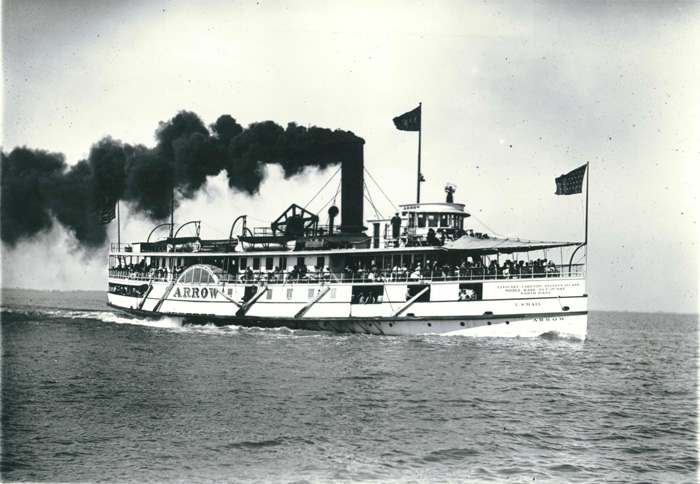
The steamer Arrow was built by the Detroit Dry Dock Company in Wyandotte, Michigan in 1895. Her first captain was George A. Brown. The Arrow was 165 feet in length, and 28 feet wide, with a net tonnage of 182. From 1895 until 1922, the Arrow sailed on Lake Erie taking passengers from Sandusky to Kelleys Island, Middle Bass, North Bass, and Put-in-Bay. Her cabin was furnished in light mahogany, and a grand piano was featured in her salon. Round trip fares in 1912 cost fifty cents. There were several steamers on the Island route in the early twentieth century.

Visitors to Cedar Point and the Lake Erie islands often arrived at the docks in Sandusky by passenger train.

The photograph below by Ernst Niebergall captures the Arrow vividly as it travels across Lake Erie.

Tuesday, December 06, 2011

Captain George A. Brown

George Arthur Brown was born in Canada on December 6, 1841 to Joseph and Ann (Arbor) Brown. He began his long career with Great Lakes vessels as a deck hand when he was age sixteen. At age twenty one, he was made mate on a ship that operated out of Detroit. In the early 1860’s, Mr. Brown was appointed captain of the J.O. Moss, a ship owned and operated by the Gilcher & Shuck Lumber Company. Captain Brown was connected with several ships throughout his lengthy career. For a time he owned and operated the Champion, a ship that carried lumber. For thirty two years, Captain Brown was on the route between Sandusky and the Lake Erie Islands. He was captain of the steamers Jay Cooke, the City of Sandusky, and the Arrow.


An article in the December 22, 1910 issue of the Sandusky Register stated that Captain Brown “was known by practically every islander and many people from different parts of the United States, who acquaintance he made during the summer seasons…He was a personal friend of Grover Cleveland and many other notables. During all his experience as a lake captain he never met with a serious mishap.” After a lengthy illness, Capt. George A. Brown passed away at Providence Hospital, on December 21, 1910. He was survived by his wife, a son, daughter, and several siblings. The funeral for Captain George A. Brown was held on the day after Christmas in 1910 at the Masonic Temple. Burial was at Oakland Cemetery. Captain Brown was involved in many aspects of life on the Great Lakes. He transported mail, goods, as well as hundreds of individuals to a variety of locations in the Lake Erie Islands.

Sunday, July 17, 2011

Major George P. Barker

George Putnam Barker was the son of Jacob A. and Mary (Paterson) Barker, and grandson of former Mayor of Sandusky, Zenas W. Barker. He was born in Sandusky in May of 1852, and was associated with the United States Express Company in Sandusky for over forty years. From 1915 to 1929 Mr. Barker was storekeeper at the Ohio Soldiers’ and Sailors’ Home.

During the Spanish American War, George P. Barker rose to the rank of Major. He began with Company B of the Sixteenth Infantry, and mustered out with the Sixth Infantry. For four months Major Barker held the position of military governor of the district of Santa Clara in Cuba.

On January 24, 1930 George P. Barker died as a result of heart disease. His wife, the former Alice Lyman, had predeceased him in 1925. Funeral services for Major Barker were held on January 27 at Grace Episcopal Church, and burial was at Oakland Cemetery. A military salute was fired at the grave, and taps were played. The honorary pallbearers for Major Barker were Gen. Perry Null, Dr. J.T. Haynes, Edward McCune, A.V. Brown, Roy T. Rogers, and Alva S. Humiston. Active pallbearers were members of the Spanish American War Veterans, including John Bamberl, George Schiller, A.C. Schultz, John Wunder, Thomas Schwank, and Ralph Stockdale. Obituaries for George P. Barker are found in the 1930 Obituary Notebook at Sandusky Library.

Saturday, February 26, 2011

The Public Life of Captain John Brown, by James Redpath

In 1928, Harry Dane,  chief clerk in the Erie County Probate Court, donated the book The Public Life of Captain John Brown to the Sandusky Library.

The preface states that the title was the 41st edition of James Redpath’s biography of John Brown. An association of African American residents in Sandusky was responsible for securing the reprinting of this edition, which was published locally by the Kinney Brothers in 1872. (John C. Kinney and Addison D. Kinney were also the publishers of the Sandusky Journal.) Profits from the sale of the book were to be devoted to the erection of a monument to John Brown, the radical abolitionist. Despite their efforts, the monument was never built.

James Redpath was born in Scotland. After coming to America as a young man, he became an author, editor, and social reformer. He ran the Boston Lyceum Bureau which was an agency that booked popular lecturers, such as Mark Twain and Susan B. Anthony. Redpath became a friend of John Brown, and shared his abolitionist sentiments. During the Civil War, James Redpath traveled throughout the Southern states interviewing slaves. He published the book The Roving Editor in 1859, based on his travels. He grew to despise slavery as a result of his experiences in the South.

No documents have survived which would have provided us with the names of the Sandusky residents who were responsible for the 1872 reprinting of The Public Life of Captain John Brown. By doing an advanced search in Ancestry Library Edition, over 100 names of African American residents are listed in Sandusky,  residing primarily in Wards 2, 3, and 4 of the city. Many Erie County residents throughout the years were active in antislavery activities, including helping fugitive slaves make their way to freedom in Canada via the Underground Railroad. A sculpture honoring Sandusky’s efforts in the Underground Railroad was dedicated in November, 2007.