Showing posts with label Lane. Show all posts

Sunday, June 20, 2021

The Ebenezer Lane House


The building at 318 Huron Avenue, now known as the Firelands Apartments, was constructed in 1853 from limestone. Built in the Italianate style, this structure was considered a mansion at the time, and served as a spacious home for Dr. Ebenezer Shaw Lane’s family.


Dr. Ebenezer S. Lane, 1819-1893

Dr. Lane’s wife was Pallas Anderson, whose father Dr. George Anderson was the first physician to settle in Sandusky. During the cholera epidemic of 1849, Dr. Lane worked long hours to aid the many people who were sick with the dreaded illness that took many lives. 

Prior to 1915, the address of this home had been 114 Huron Avenue, as seen on this nineteenth century Sanborn map. The creators of the Sanborn map made an accurate depiction of the curved double steps that lead up to the main entrance of the home.


After Dr. and Mrs. Lane moved to Chicago in 1870, John H. and Elizabeth Hudson purchased the home and property.

John H. Hudson, 1827-1893

John H. Hudson was superintendent of the Mad River and Lake Erie Railroad prior to the Civil War. After the war, he had a grain, salt and lime business at the foot of Columbus Avenue. His second wife was Elizabeth Orton Hudson. After her husband died in 1893, Mrs. Hudson supported herself by painting and giving art lessons. She also rented out some of the upper rooms. In the late 1890s, a female doctor, Dr. Emily Blakeslee, had her medical office and residence in the building, perhaps renting from Mrs. Hudson. Dr. Blakeslee went on to practice medicine in Sandusky for over fifty years.

This straight razor, once used in Dr. Blakeslee’s office, is now a part of the historical collections of the Follett House Museum.


From about 1908 to the early 1910s, Dr. W.A. Crecelius had his medical practice in the building. Dr. Clarence Schimanksy practiced here from 1916 through the 1930s. Dr. Emil Meckstroth had his office here in the 1940s and 1950s. Now the Firelands Apartment building is a multi-family rental unit. There have been additions to the original structure on the eastern and southern sides of the building. To learn more about the many historic buildings in Sandusky, see Ellie Damm’s book Treasure by the Bay, and Helen Hansen’s book, At Home in Early Sandusky.

Sunday, October 15, 2017

Ione Klenk Wiechel’s Book Plate Collection

Bookplates (aka Ex Libris) have been a popular method throughout history for book owners to create a personalized method of showing ownership of their books. The creative quality and informational value of many bookplates has inspired collectors and artists. 


Mrs. Ione Klenk Wiechel, a longtime member of the American Society of Bookplate Collectors and Designers, shared her hobby of collecting bookplates, calligraphy, and miniature books with the community through an exhibit at the Sandusky Area Cultural Center from November through December of 1979.


After her death Mrs. Wiechel’s bookplate collection was donated to the Sandusky Library. The collection features bookplates owned by individuals and businesses of Sandusky and Erie County. 

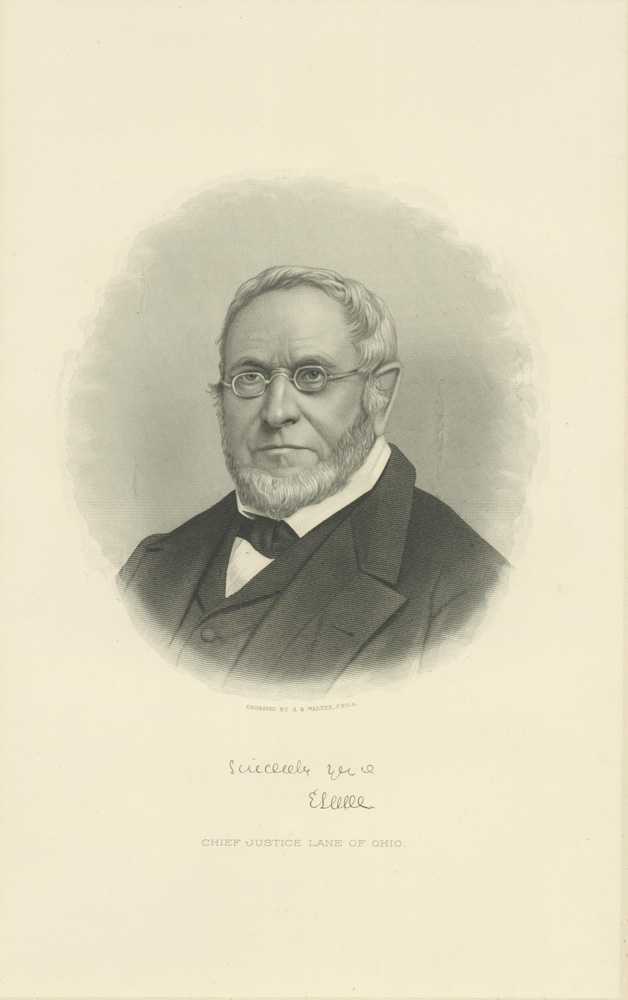
This bookplate once belonged to Judge Ebenezer Lane, former Common Pleas Judge and Judge of Supreme Court of Ohio:


Esther Sloane Curtis was the granddaughter of abolitionist and former Sandusky Mayor Rush Sloane:


Author and local historian, Charles E. Frohman, was a past president of the Ohio Historical Society. His bookplate reflects his many interests, including nautical history, the theater, and the history of Sandusky industry. Mr. Frohman’s bookplate was designed by Norman Lonz and Harold Zeitsheim.


Daisy A. Kugel was graduated from Sandusky High School in 1896. She earned a Bachelor of Arts from the University of Michigan in 1900, and graduated from Columbia University in 1909. From 1911 to 1927, Miss Kugel served as Director of Household Arts at University of Wisconsin-Stout.


There are several more bookplates in the holdings of the Sandusky Library Archives Research Center. Ask for assistance at the Reference Services desk if you are interested in viewing Ione Klenk Wiechel’s bookplate collection.

Monday, March 06, 2017

Women in the Western Reserve Before 1850


Often overlooked, the microfilmed copy of  Women in the Western Reserve Before 1840-1850 is an invaluable resource to consult if you have female ancestors who settled in the Western Reserve before 1850.  Mrs. Emily (Coan) Anderson (pictured above) was one of these women. Emily L. Coan, later Mrs. George J. Anderson, came to Sandusky in 1849. She moved to Sandusky from North Ridgeville, Ohio. You can see the name of Mrs. George J. Anderson at the top of the list of the page below, providing information about early women who resided in Erie County, Ohio before 1850.


This resource is housed in the microfilm cabinets of the Sandusky Library Archives Research Center. Arranged alphabetically by county, the microfilm roll contains genealogical data about early women residents of the Western Reserve.  Within each county, the names are not in alphabetical order, so a thorough search must be made of several pages in order to locate a particular name. The columns provide: Married Name, Maiden Name, Year Came to Township, Where From or Where Born, and Last Residence. The Sandusky Library Archives Research Center is fortunate enough to have some photographs of some of these pioneer female residents. A sister-in-law of Emily (Coan) Anderson was Pallas Lane, whose name was also listed in the Women in the Western Reserve Before 1840-1850. Pallas Lane was born Pallas Anderson. She was the daughter of the first physician in Sandusky, and she became of the wife of Dr. Ebenezer Shaw Lane, also an early physician in the Firelands.

Pallas (Anderson) Lane was born in Sandusky in 1825, but later moved to Chicago, Illinois.
  

 Visit the Sandusky Library Archives Research Center to view the microfilmed copy of Women in the Western Reserve Before 1840-1850. See a previous blog post from Sandusky History for even more resources helpful in locating that elusive female ancestor!

Monday, October 06, 2014

I.F. Mack’s Address on “The Four Pioneers”

On June 8, 1881, I.F. Mack, the well-known publisher of the Sandusky Register, gave an address at the twenty fifth annual meeting of the Firelands Historical Society in Norwalk, Ohio.


His address, entitled “The Four Pioneers,” featured sketches of four well known pioneer attorneys in the Firelands area.


In the eight years prior to the 1881 meeting, four respected judges from Erie County had passed away. They were: Walter F. Stone, William G. Lane, Joseph M. Root, and Cooper K. Watson. Mr. Mack had known each of these men personally. He gave a brief biography of each of the deceased attorneys, and then he examined the character of each of the men. According to Mack, Walter F. Stone was very gentle in nature, and was a man of peace. “He was a gentleman always, in the practice of his profession as well as social life.”  

William G. Lane was described as having the combination of diffidence, mental strength, fidelity to the highest duty, patience and courage. Mr. Mack also said that Judge Lane had “sincerity, coupled with unquestioned purity of thought and feeling,” and claimed that he was the “wisest counsellor we ever had at our bar.” 


About Joseph M. Root, I.F. Mack said that he was sincere, honest, and brave, but “his prejudices were too intense to make him an agreeable social companion.” When someone disagreed with Joseph M. Root, his wrath was often excited and he was known to “draw forth a torrent of abuse.” Mr. Mack said simply that Root “was not a great lawyer.”

According to Mack, Cooper K. Watson “possessed legal ability of the highest order.” He had a consummate knowledge of the laws, and a thorough understanding of the intricate rules and modes of practice, and was known to be severe in the sentencing of criminals. Mack wrote that Judge Watson “read books, law, theology, poetry, history, romance, and science greedily, remembered what he read, and made it useful, in the practice of his profession and in his intercourse with friends.”

Mr. Mack concluded by stating that all four of the pioneer lawyers were regarded as honest men, in a profession popularly believed to contain its full share of dishonest men. He stressed the importance of honesty and integrity as the chief cornerstone of character, to be regarded as more important than owning lands, stocks and bonds. 

To read I.F. Mack’s address “The Four Pioneers,” see the Firelands Pioneer of June 1882. His address is found on pages 62 to 70. You can see a framed picture of each of the four attorneys discussed in Mack’s speech on the third floor of the Erie County Courthouse.


Friday, March 14, 2014

Annual Examinations in the Sandusky Public Schools in 1860

Don't put stickers on your historic documents!
On March 14, 1860, at 9 a.m., several students from the First Grammar School of Sandusky City Schools had a program in connection with the students’ Annual Examinations. In 1860 the First Grammar School was located in Sandusky’s Public Square. Mr. John G. Chandler was the principal. Miss Eliza Moore was Mr. Chandler’s assistant and she taught elementary school classes as well. Essays and declamations were presented by students from geography, arithmetic and grammar classes. Musical selections were presented throughout the exercises. At 1:30 in the afternoon another set of students participated in the Order of Exercises for Annual Examinations.


Many of the students who attended the First Grammar School in downtown Sandusky were the children of individuals who played key roles in the city’s history. Ezra Gregg’s father, Philander Gregg, served as Sandusky’s Mayor from 1869 to 1870. Master Ebenezer Lane and Master William Cheesebrough were both the grandsons of Judge Ebenezer Lane. John G. Chandler married Miss Emeline Barber in 1864. By 1870 the Chandlers were living in St. Louis, Missouri, where John G. Chandler was an attorney. Eliza Moore and her sister Sarah Moore were teachers with the Sandusky City Schools for over fifty years. In 1891 Sandusky children collected pennies to help pay for a monument to be erected at Oakland Cemetery in honor of their teachers, the Moore sisters.


Tuesday, February 26, 2013

Martha Pitkin and the Sandusky Chapter, D.A.R.

Mrs. E. Lea Marsh, nee Elizabeth Diodate Griswold Marsh, is pictured below. She is one of the many descendants of Martha Pitkin, whose name is associated with the Sandusky chapter of the Daughters of the American Revolution.

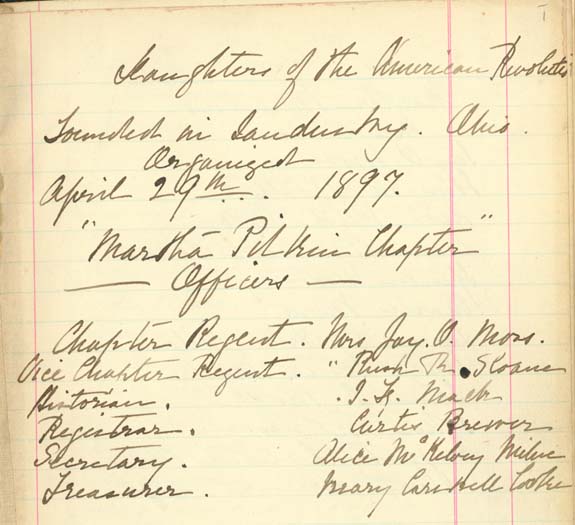
The founder, organizer, and first regent of the Martha Pitkin Chapter of the D.A.R. was Mrs. Jay Osborne Moss, who was born Frances Griswold Boalt. The local chapter was organized on April 27, 1897, with fourteen charter members. Mrs. Moss was a direct descendant of Martha Pitkin. Judges Ebenezer Lane and William G. Lane were also directly descended from Martha Pitkin and her husband Simon Wolcott.

A history of the Martha Pitkin chapter of the D.A.R. was reported in the May 1, 1927 Sandusky Register, on the thirtieth anniversary of the organization’s founding. Mrs. Curtis Schaufelberger, historian, wrote about Martha Pitkin: “Martha, a young woman of religious character, was possessed of a natural brilliancy of intellect, which was later on developed by an education in London. In addition to these attributes she was endowed with great beauty.” Charles Knowles Bolton wrote a “versified narrative” which describes the courtship of Martha Pitkin and Simon Wolcott. The title is On the Wooing of Martha Pitkin. Martha Pitkin was born in England. She came to the United States in 1661. Her first husband was Simon Wolcott. Among their descendants were five Connecticut governors. Martha’s grandson Governor Oliver Wolcott was a member of the Continental Congress and a signer of the Declaration of Independence. After the death of Simon Wolcott, Martha married Daniel Clark. Martha Pitkin Wolcott Clark died in 1719, and is buried in East Windsor, Connecticut.

The records of the Martha Pitkin Chapter of the Daughters of the American Revolution are located in the Archives Research Center of the Sandusky Library. Included in the collection are financial records, historian’s records, and several scrapbooks.

Reminder: Those interested in learning more about genealogy and the D.A.R. are invited to the Genealogy workshop sponsored by the Martha Pitkin Chapter, at the Sandusky Library, beginning at 10:30AM Saturday, March 2.

Tuesday, May 04, 2010

Edward Lea Marsh and Elizabeth D.G. Moss

When Edward Lea Marsh married Elizabeth D. G. Moss, the society page of the Sandusky Daily Star reported that the bride and groom represented two of Sandusky’s largest and best known families.

Edward Lea Marsh was the son of Edward H. Marsh and Caroline Mackey Lea. Edward’s grandfather, Edward Lockwood Marsh, was a pioneer manufacturer of plaster of Paris in Ohio.

Edward Lea Marsh’s father, Edward H. Marsh, also in the plaster business, was a personal friend of President William Howard Taft. Elizabeth D. G. Moss was the daughter of banker Charles H. Moss and his wife, the former Elizabeth Griswold Lane. Elizabeth D. G. Moss’s grandfather William Griswold Lane and her great-grandfather Ebenezer Lane were both well respected judges in Erie County, Ohio.

The couple was married at the home of Mr. and Mrs. Charles H .Moss on Wayne Street in Sandusky. The Moss drawing room was decorated with palms and ferns. The two ministers who officiated at the wedding were Rev. Winfield Baer, rector of Grace Episcopal Church, and Rev. Dr. Gilbert of Southport, an uncle of the bride. The bridal party was made up of the best man, Vaughn McFall; ushers, Mr. Goodwin, Mr. Perkins, Mr. McKinley, and Mr. Hargrave; maid of honor, Miss Emeline Moss; and bridesmaids, Miss Ethel Mack, Miss Adah Kunz, Miss Knapp, and Miss Carrie Marsh.

While not all the individuals in the wedding party have been identified, the bridal party is pictured below, in a photograph taken by W.A. Bishop. Edward Lea Marsh is the young man seated in front. His bride, Elizabeth D. G. Moss Marsh, is the third person in the second row.

Emeline Moss (later Mrs. Ira Krupp) is the second person in the third row. Caroline Lea Marsh, sister of the groom, is the fourth person in the third row.
The wedding guests were served dinner in the Moss dining room, and each guest received a box of wedding cake, decorated with the monogram M M. After the wedding dinner, the couple left for their cottage at Plaster Bed in Ottawa County. Later they were to take a wedding trip to Black Hall, Connecticut. Pictured below are the newly married Mr. and Mrs. Edward Lea Marsh in Plaster Bed in Portage Township of Ottawa County.
When future President William Howard Taft visited Sandusky on September 8, 1908, Edward Lea Marsh was standing next to Mr. Taft in a photograph taken that day. (to Mr. Taft’s left.)
Edward Lea and Elizabeth Marsh had two daughters. One of them is pictured with her first grade class in Sandusky about 1910. Elizabeth Griswold Marsh is third individual from the right in the second row.
Helen Hanson wrote in At Home in Early Sandusky that Edward Lea and Elizabeth Marsh moved to Lyme, Connecticut in the 1920’s. Edward Lea Marsh died on November 21, 1937 in Old Lyme, Connecticut. An obituary for Mr. Marsh appeared in the November 22, 1937 issue of the Sandusky Daily News. He was survived by his wife , son, and two daughters, and a sister. Edward Lea Marsh had just been to Sandusky earlier that month, while on a business trip with the United States Gypsum Company. He had visited with many of his old friends at that time, and appeared to be in excellent health. Mrs. Marsh died in Connecticut in 1960. While many members of the Moss, Marsh, and Lane families are buried at Oakland Cemetery in Sandusky, Mr. and Mrs. Edward Lea Marsh were buried in Old Lyme, Connecticut.

Edward Lea Marsh, Jr., who died in 1996, was an attorney in Connecticut for sixty years, and was elected as State Representative from Old Lyme in 1937. He was Speaker of the House of the Connecticut General Assembly from 1945 to 1946. Edward Lea Marsh, Jr. lived on a pioneer farm in Old Lyme, and one of his cows was “Elsie the Borden Cow,” who was once exhibited at the New York World’s Fair.

Monday, January 04, 2010

Dr. Ebenezer S. Lane


Ebenezer Shaw Lane was born in August, 1819, the oldest child of Judge Ebenezer Lane and his wife Frances Griswold Lane. He graduated from Kenyon College, and studied medicine at the Ohio Medical School and also in Paris. Ebenezer S. Lane married Pallas Anderson, the daughter of Sandusky’s fist physician, Dr. George Anderson. During Sandusky’s cholera epidemic in 1849, Dr. Ebenezer S. Lane helped care for the sick, but he too became ill. Luckily, Dr. Lane survived his illness.

Dr. Lane and his family moved to Chicago. He eventually left the medical field and worked in real estate and finance, and had some interests in the railroad. Dr. Lane continued in his father’s hobby of collecting books and autographs. His collection totaled 9,000 volumes, and contained books about history, art, and literature. Eventually, Dr. Lane’s children, a son also named Ebenezer Lane, and a daughter, Fannie G. Lane, donated the Lane Collection to the University of Chicago. The collection now has been dispersed throughout the Special Collections of the University of Chicago Library. In 1983 Dorothy C. Drucker’s Masters’ Thesis was entitled: The Ebenezer S. Lane Library: A Study in Nineteenth-Century Reading Taste.

Dr. Ebenezer S. Lane died in Chicago on January 3, 1893. He is buried in Block 11 of Sandusky’s Oakland Cemetery. Dr. Lane’s tombstone lists his name as Dr. Eben S. Lane. He probably was known as Eben to avoid confusion with his father, Judge Ebenezer Lane.

Several members of the Lane family are buried in Block 11 of Oakland Cemetery. The Lane family made significant contributions to Sandusky in its early years. Helen Hansen wrote in her book At Home in Early Sandusky that Dr. Ebenezer Shaw Lane was “a true pioneer of this locality.”

Wednesday, October 29, 2008

William Griswold Lane

William Griswold Lane was born in Norwalk, Ohio in 1824 to Ebenezer Lane and Frances Griswold. When William was twelve years old he became acquainted with fellow student Rutherford B. Hayes, at the Maple Grove Academy, in Middletown, Connecticut. They became lifelong friends. William Lane attended college at Yale and Harvard, and spent a year studying law in Berlin, Germany.

After returning to the United States, William practiced law with his father. In 1850, William married Elizabeth Diodate Griswold. In February 1873 William G. Lane was appointed Judge of Common Pleas for the Fourth Judicial District.

William G. Lane died in October 1877, at the age of 52. Resolutions from the Court and Bar of Erie County appeared in the Sandusky Register. One resolution stated “In this death, the bench and bar have lost an able, impartial and upright Judge – one of the most esteemed, high minded and scholarly members of the profession – and this community a citizen of great mental and moral worth – a man just, honorable and honest in all his dealings with his fellow men and conscientious and faithful in the discharge of all the public and private duties that devolved upon him. While we mourn his loss we delight to honor his memory.”

The Lane family monument at Oakland Cemetery is a beautiful sculpture in honor of William Griswold Lane and his family. I.F. Mack wrote in an article in the June 1882 Firelands Pioneer, that Judge William G. Lane was “without doubt, the wisest counsellor we ever had at our bar.” A memorial tribute to Judge William G. Lane is on file at the library at the Rutherford B. Hayes Presidential Center in Fremont, Ohio.

A view below of the Lane Family monument at Oakland Cemetery in Sandusky, Ohio. Several family members’ names are inscribed on the stone.

Thursday, February 15, 2007

Judge Ebenezer Lane: the “Walking Library”


Early Ohio lawyer Ebenezer Lane was a Harvard University graduate who moved to Ohio in 1817. Born in Massachusetts in 1793, he received his degree from Harvard in 1811. After briefly practicing law in New England, he migrated westward and settled in Ohio, where he established his legal practice (around 1817). He was appointed Judge of Common Pleas of the Second Circuit in 1824, and became a Judge of the Supreme Court of Ohio in 1830. After he retired from the court, he had interests in the Junction Railroad, the Mad River and Lake Erie Railroad, and the Illinois Central Railroad.

While Judge Lane lived simply, he was an avid book collector. He read every one of the four thousand books he owned. Rev. Alfred Newton said in his memoirs of Ebenezer Lane that he could so accurately retain the knowledge of what he had read that he was a “walking library.”

After Judge Lane’s death in 1866, his book collection was passed down to his son Dr. Ebenezer S. Lane, in Chicago. The Ebenezer Lane library was the only library collection within the city limits of Chicago to survive the Great Chicago Fire of 1871. In 1922 the Ebenezer Lane book collection was donated to the University of Chicago by his grandchildren, the third Ebenezer Lane and Fanny Griswold Lane.

Judge Lane’s granddaughter, Mrs. Charles H. Moss, served on the first Board of Trustees of the “Library Association of Sandusky” which was incorporated in 1895.

A sketch of the life of Judge Ebenezer Lane can be found in the June 1867 Firelands Pioneer. The Ohio Supreme Court's Cases of Judge Ebenezer Lane are available in the Archives Research Center in the Sandusky Library.